U.S. Pork Market and Regulations: The Complete Guide for Producers, Processors & Exporters (2026)
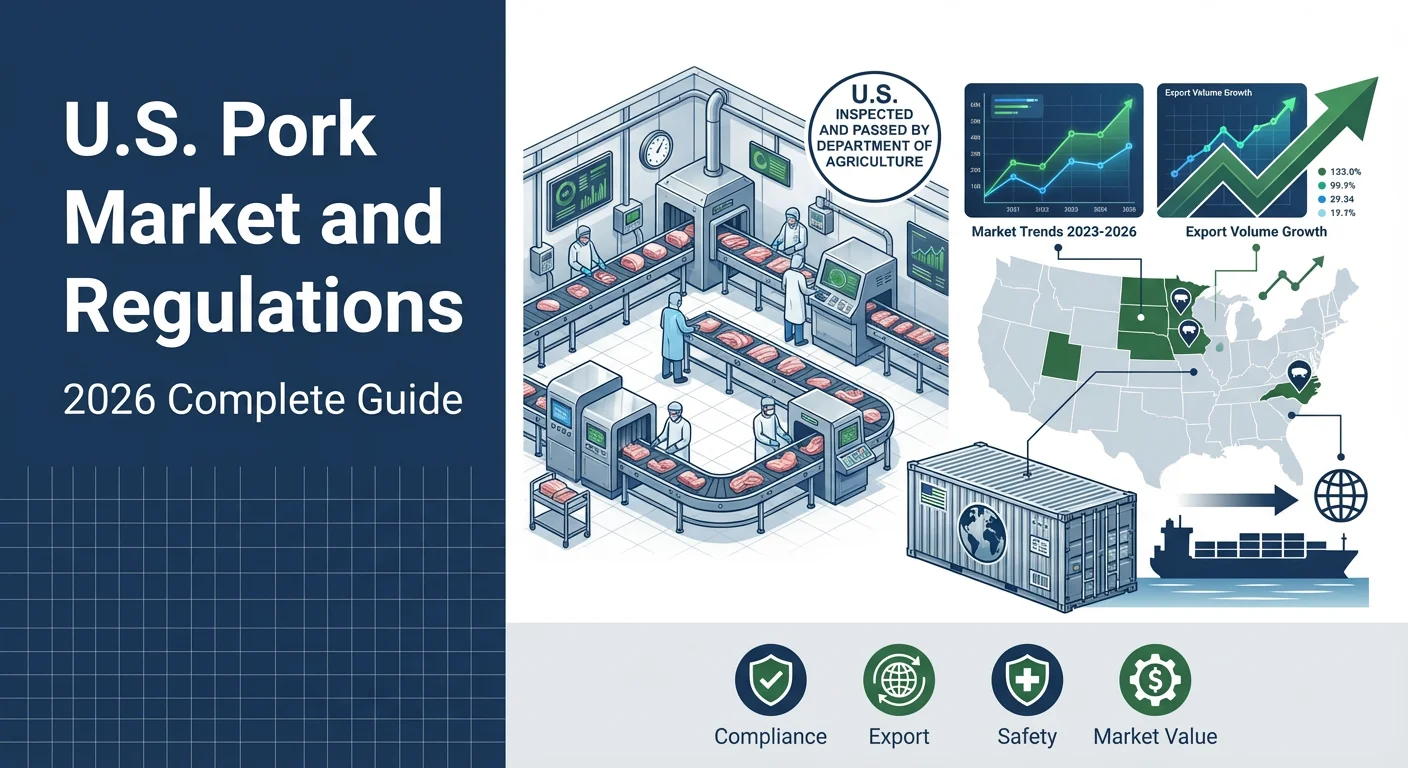
This is your comprehensive guide to the U.S. Pork Market and Regulations. Whether you’re a producer trying to understand compliance requirements, a processor navigating food safety rules, or an exporter exploring international opportunities—this pillar guide covers everything you need to know in 2026.
The U.S. pork industry is a $28 billion sector at the farm level, with over $57 billion in total economic impact. But success in this industry isn’t just about production—it’s about understanding the complex web of U.S. Pork Market and Regulations that govern every step from farm to fork.
This guide is structured to answer your real questions. Use it as a reference, and dive deeper into specific topics through our detailed guides linked throughout.
What This Guide Covers
1. U.S. Pork Industry Overview — Size, statistics, and economic impact
2. Production Landscape — Leading states, statistics, and modern systems
3. Market Dynamics — Prices, consumption trends, and forecasts
4. Export Markets — International buyers, trade policies, and certification
5. Regulatory Framework — USDA, FDA, FSIS, and compliance requirements
6. Food Safety & Processing — HACCP, inspections, and processing rules
7. Labeling & Consumer Transparency — Requirements and marketing claims
8. Environmental & Welfare Regulations — EPA compliance and animal welfare
9. Technology & Innovation — Advancements shaping the industry
10. Challenges, Risks & Future Trends — What’s ahead for U.S. pork
1. U.S. Pork Market and Regulations: Industry Overview
The United States ranks as the world’s third-largest pork producer and second-largest exporter. Understanding the scale and economic significance of the U.S. Pork Market and Regulations is the first step for any industry participant.
Key Industry Statistics (2026)
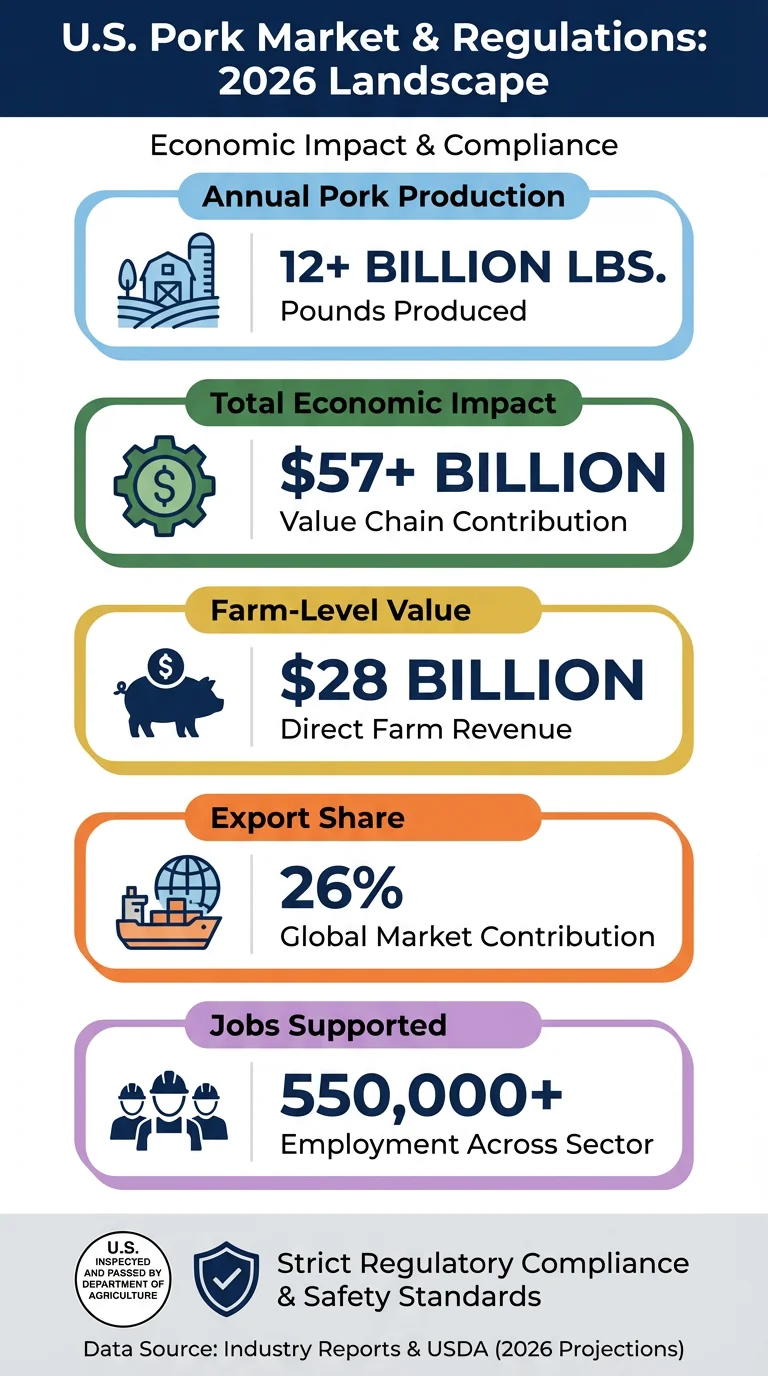
| Metric | Value | Significance |
| Annual Production | 12+ billion lbs | Third globally behind China and EU |
| Hogs Marketed Annually | ~75 million | Consistent growth trajectory |
| Farm-Level Value | $28 billion | Core agricultural sector |
| Total Economic Impact | $57+ billion | Including processing and retail |
| Jobs Supported | 550,000+ | Farm, processing, transport, services |
| Export Share | 26% | One in four hogs depends on exports |
The industry’s economic contribution extends far beyond farm gates. Pork production supports rural communities, drives demand for corn and soybean feed, and generates substantial export revenue that improves the U.S. trade balance.
⟶ What This Means for You:
• Know your industry’s scale—it affects pricing power and policy attention.
• Track USDA quarterly reports for production trends that impact your margins.
• Understand that 26% export dependence means trade news affects everyone.
2. Production Landscape: Where and How U.S. Pork Is Raised
Within the U.S. Pork Market and Regulations framework, production is highly concentrated geographically. This concentration creates both efficiencies and regional regulatory variations you need to understand.
Major Pork-Producing States
| State | Hog Inventory | % of U.S. Total | Key Advantage |
| Iowa | 24.2 million | 33% | Feed cost proximity |
| Minnesota | 9.2 million | 13% | Integrated supply chain |
| North Carolina | 8.8 million | 12% | Export port access |
| Illinois | 5.4 million | 7% | Processing infrastructure |
| Indiana | 4.3 million | 6% | Central logistics |
https://www.pork.org/These five states produce over 70% of American pork. If you’re operating outside these regions, you’re competing against operations with structural cost advantages—primarily cheaper feed and established processing infrastructure.
Modern Production Systems
Contemporary pork production has evolved into a technology-driven industry. Commercial operations use specialized facilities for each phase: breeding/gestation, farrowing, nursery, and finishing. This segmentation optimizes environments and enables disease control through all-in-all-out flows.
Top operations now wean over 30 pigs per sow annually. If you’re below 25, identifying and fixing your productivity bottleneck should be priority one.
The Pork Supply Chain
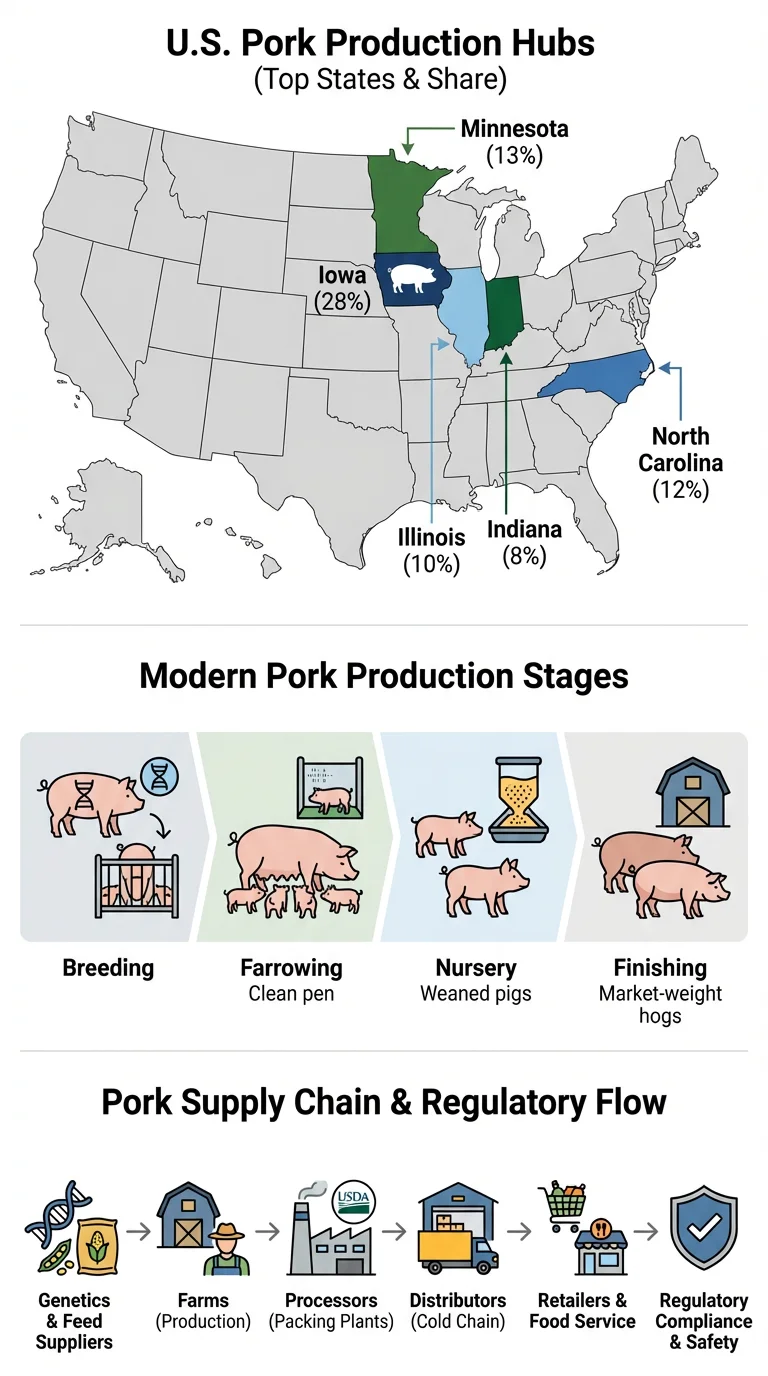
Understanding how pork moves from farm to retailer is essential for identifying where you fit and where opportunities exist. The supply chain includes genetics suppliers, feed manufacturers, farm operations, processors, distributors, and retailers—each with distinct regulatory requirements.
⟶ What This Means for You:
• Benchmark your location’s cost structure against Midwest competitors.
• Evaluate technology investments that close the productivity gap.
• Map your supply chain position to identify value-add opportunities.
3. U.S. Pork Market and Regulations: Prices and Consumption
Price volatility is a constant reality in the U.S. Pork Market and Regulations environment. Understanding what drives prices—and how to manage risk—separates profitable operations from those struggling to survive.
What Drives Pork Prices?
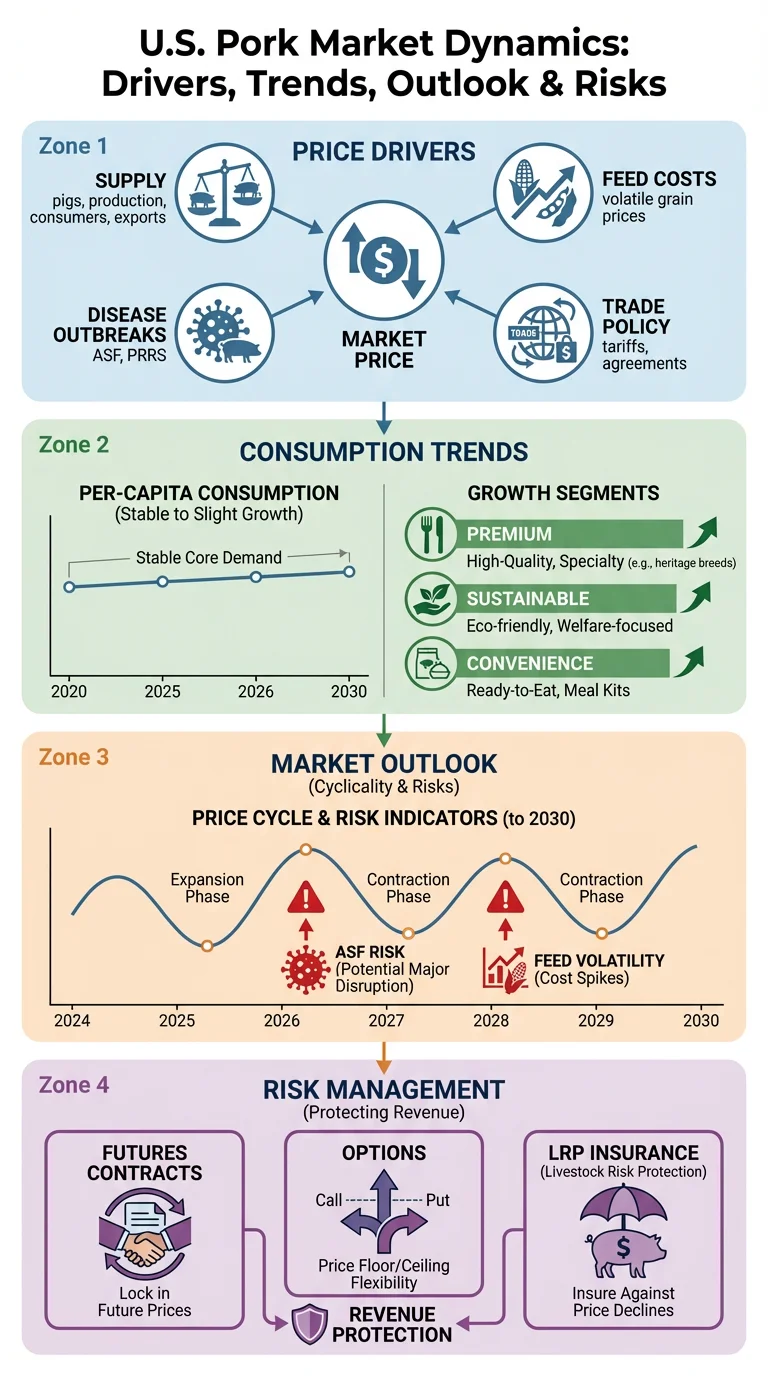
Pork prices are determined by the interplay of supply (production levels, imports), demand (domestic consumption, exports), and external factors (feed costs, disease outbreaks, trade policies). The futures market provides price discovery, but spot prices can diverge significantly based on local conditions.
Consumption Trends
American consumers eat approximately 50 pounds of pork per capita annually. But consumption patterns are shifting: demand for premium cuts, sustainably-raised pork, and convenient prepared products is growing, while commodity pork faces price pressure. Health-conscious consumers are also comparing pork to alternatives, including plant-based products.
Market Forecast
Industry analysts project moderate production growth through 2030, with prices remaining cyclical. The key variables to watch: African Swine Fever status globally, trade policy developments, and feed cost trends. Operations that can flex production and manage risk will outperform those locked into fixed strategies.
Risk Management Strategies
Hedging through futures contracts, options, and Livestock Risk Protection (LRP) insurance are essential tools. Many producers leave money on the table by not actively managing price risk—or lose catastrophically in downturns.
⟶ What This Means for You:
• Monitor CME lean hog futures weekly—not just when selling.
• Identify which premium markets (organic, heritage, local) fit your operation.
• Implement at least basic hedging; consult a commodity broker if unfamiliar.
4. U.S. Pork Market and Regulations: Export Opportunities
Exports represent 26% of U.S. pork production—over $7 billion annually. The U.S. Pork Market and Regulations governing international trade directly impact domestic prices, even for producers selling entirely within the U.S.
Major Export Destinations
| Country | % of Exports | What They Buy | Key Consideration |
| Mexico | 30% | Variety meats, commodity cuts | USMCA terms; most stable |
| Japan | 13% | Premium cuts | Strict traceability; highest premiums |
| China/HK | 12% | Variable | Politically volatile; high-volume potential |
| South Korea | 10% | Mixed cuts | Steady demand; quality focus |
| Canada | 9% | Processing inputs | Two-way trade relationship |
Trade Policies and Agreements
USMCA governs trade with Mexico and Canada—our largest partners. Bilateral agreements with Japan, South Korea, and others establish tariff rates and market access terms. Trade policy is made by governments, not markets—which means political developments can override supply/demand fundamentals overnight.
Export Certification Requirements
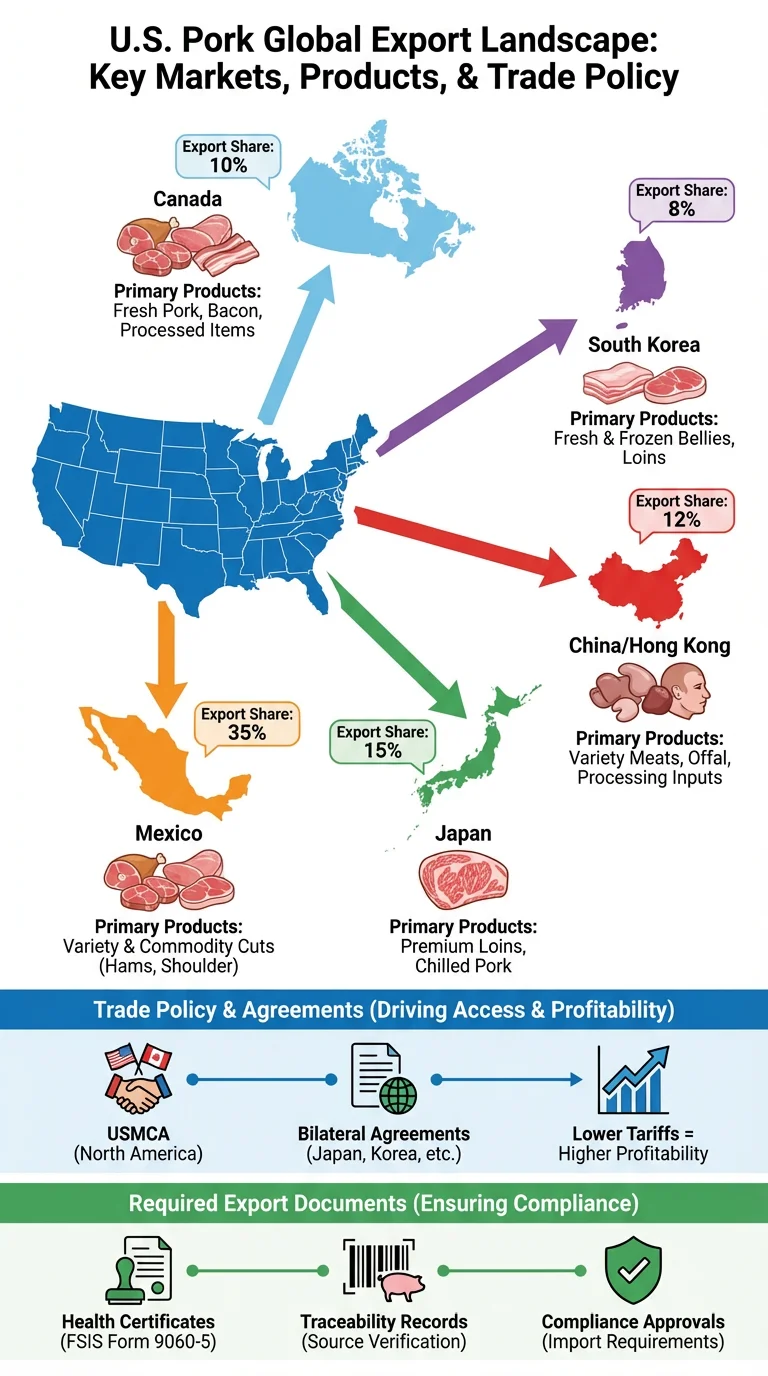
Selling internationally requires specific documentation: health certificates, establishment eligibility, and compliance with importing country requirements. Japan and South Korea have particularly stringent traceability requirements. If your operation can’t document animal history from birth to slaughter, you’re locked out of premium export markets.
⟶ What This Means for You:
• Know whether your packer exports—and to where. That’s your exposure.
• If targeting export premiums, invest in traceability systems now.
• Monitor trade policy news; a tariff change can move markets 10% in days.
5. Understanding U.S. Pork Market and Regulations: The Regulatory Framework
Multiple federal and state agencies oversee different aspects of the U.S. Pork Market and Regulations. Knowing which agency governs what—and what they require—is fundamental to compliant operations.
Key Federal Regulatory Bodies
| Agency | Jurisdiction | What They Regulate |
| USDA-FSIS | Meat safety | Slaughter inspection, processing, labeling |
| USDA-APHIS | Animal health | Disease surveillance, export certification |
| USDA-AMS | Marketing | Grading, organic certification, market reports |
| FDA | Feed safety | Animal feed ingredients, medicated feeds |
| EPA | Environment | Waste management, air/water quality |
USDA Grading Standards
Pork grading is voluntary but affects market value. Understanding how carcass quality is assessed—and what premiums different grades command—helps you make informed genetic and management decisions.
State vs. Federal Regulations
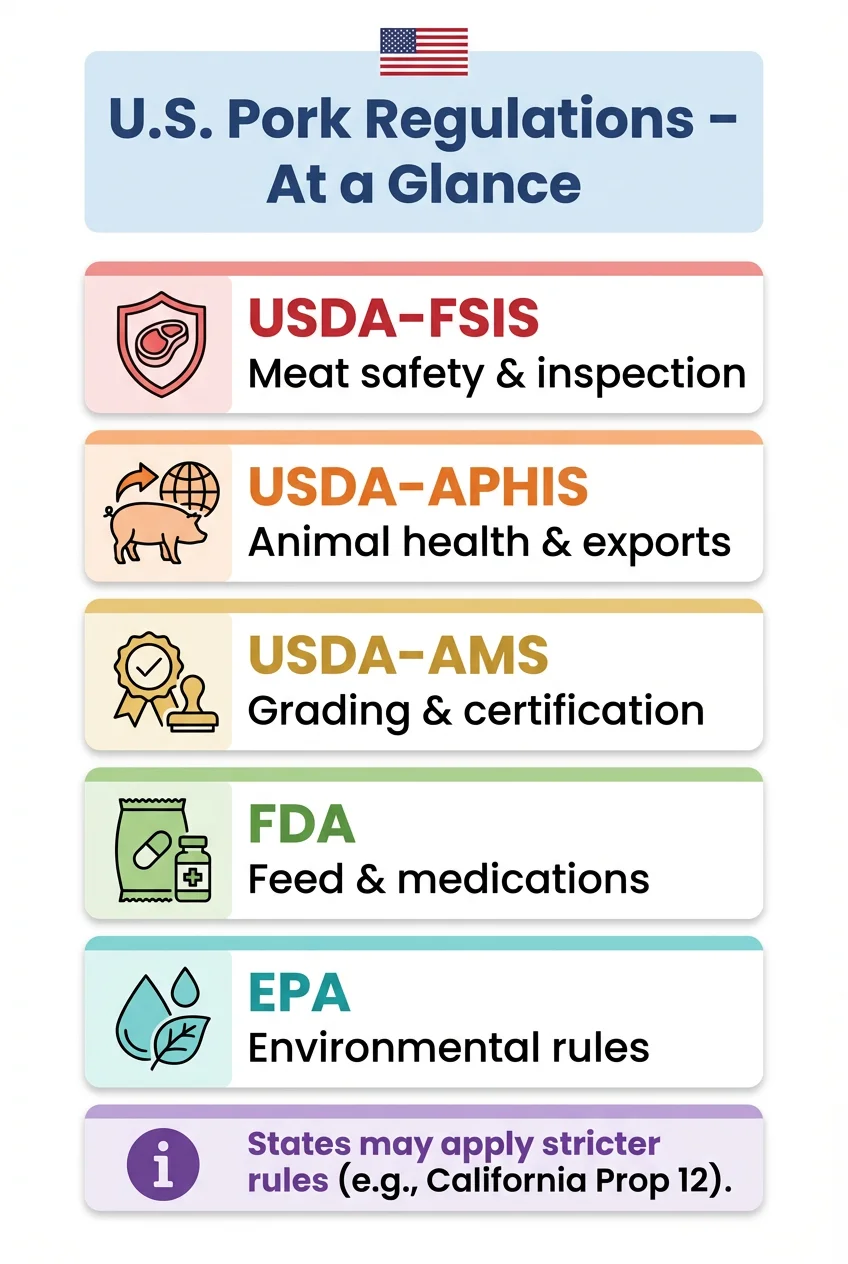
State laws can exceed federal minimums. California’s Proposition 12 (housing requirements) is the most prominent example, but states also vary on environmental permits, transportation rules, and processing requirements. Multi-state operations must navigate a patchwork of requirements.
⟶ What This Means for You:
• Know your primary regulators—FSIS for processing, APHIS for health/exports.
• If selling across state lines, map which state rules apply to your operation.
• Grading affects pricing; understand what buyers in your market prioritize.
6. U.S. Pork Market and Regulations: Food Safety and Processing
Food safety is non-negotiable in the U.S. Pork Market and Regulations framework. FSIS inspection is mandatory for interstate commerce, and the requirements are detailed and strictly enforced.
Slaughter and Processing Regulations
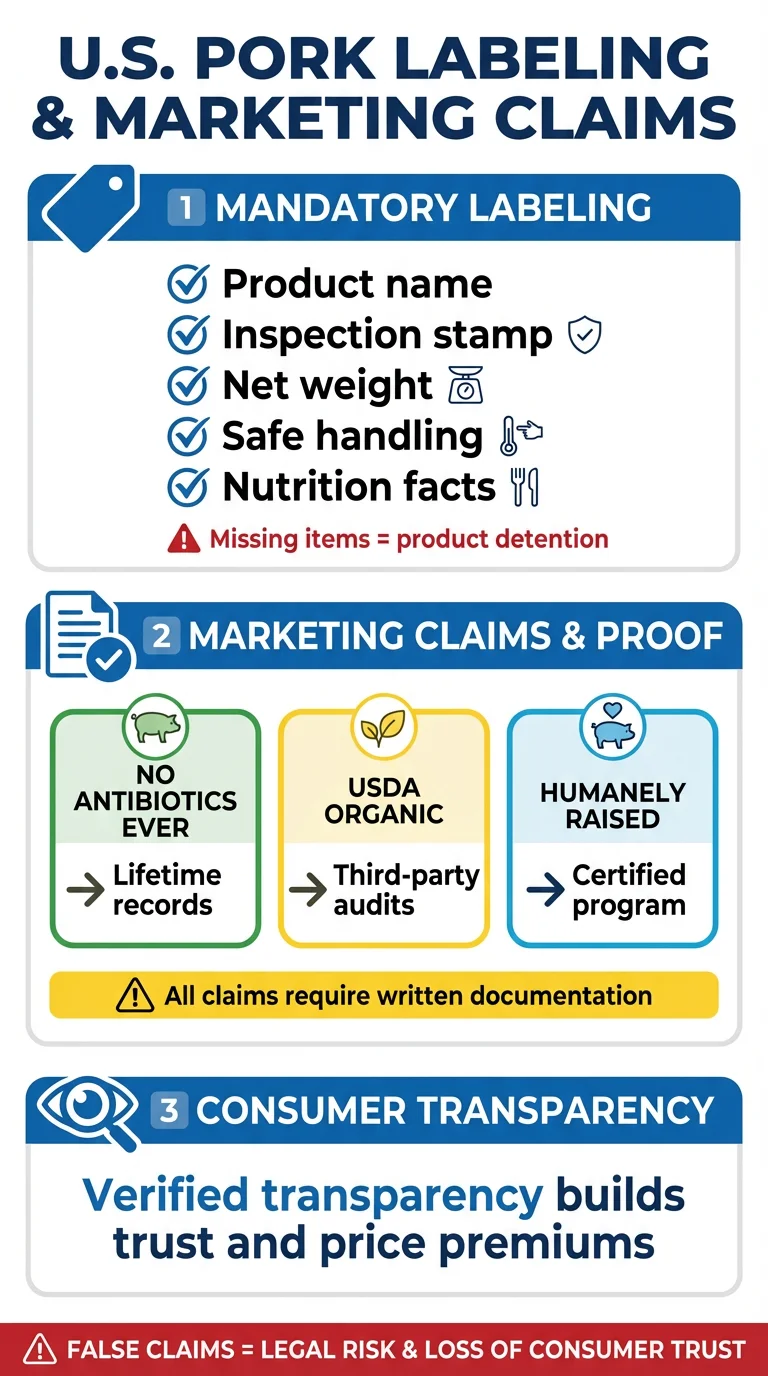
Federal inspection requires ante-mortem (live animal) and post-mortem (carcass) examination of every animal. Plants must maintain sanitary conditions, implement HACCP plans, and retain detailed records. Inspectors are present during all slaughter operations.
HACCP Requirements
Hazard Analysis Critical Control Points (HACCP) is the foundation of meat safety. Every federally inspected establishment must have a written HACCP plan identifying biological, chemical, and physical hazards—and the critical control points where those hazards are prevented or eliminated. Plans must be validated, monitored, and verified continuously.
Antibiotic Use Regulations
Antibiotic use in pork production is heavily regulated. The FDA’s Veterinary Feed Directive requires veterinary oversight for medically important antibiotics. Withdrawal periods before slaughter must be observed, and residue testing can result in condemnation and penalties. “No antibiotics ever” claims require complete documentation.
Disease Management
Biosecurity isn’t just good practice—it’s increasingly required for export market access and some buyer programs. African Swine Fever (ASF) hasn’t reached North America, but the consequences if it does would be catastrophic: immediate export market closure and price collapse. Your biosecurity protocols are your first line of defense.
⟶ What This Means for You:
• Review your HACCP plan annually—outdated plans cause inspection failures.
• If using antibiotics, document everything; withdrawal periods are strictly enforced.
• Strengthen biosecurity now, before ASF arrives. Focus on vehicles and visitors.
7. U.S. Pork Market and Regulations: Labeling and Marketing Claims
Labeling rules within the U.S. Pork Market and Regulations protect consumers and create opportunities for differentiation—if you understand what claims require what proof.
Mandatory Labeling Requirements
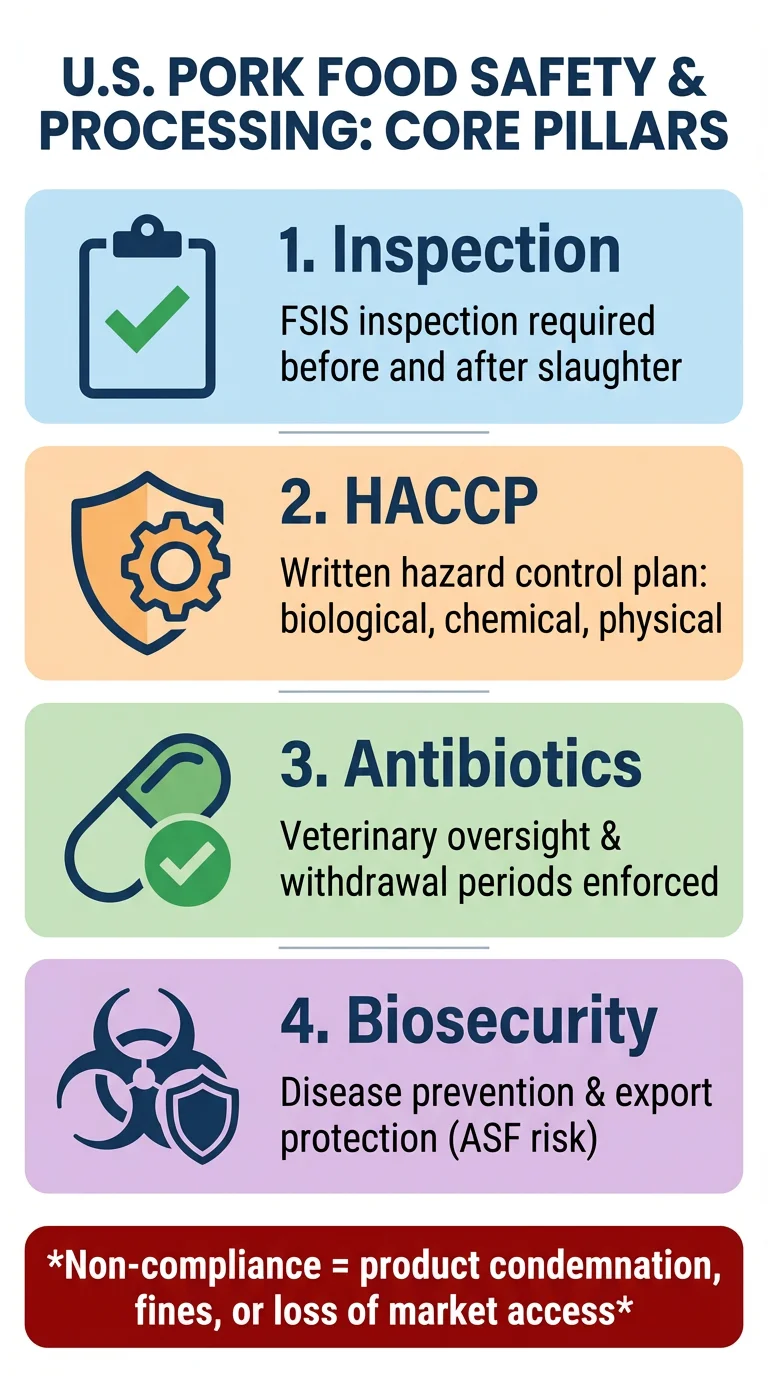
All retail pork must display: product name, inspection legend, establishment number, net weight, safe handling instructions, and nutrition facts. Ground pork must show fat/lean percentage. These aren’t optional—missing elements result in product detention.
Marketing Claims and Documentation
| Claim | Requirement | Documentation Needed |
| No Antibiotics Ever | FSIS approval | Complete lifetime records |
| USDA Organic | Third-party certification | Annual audits, organic feed receipts |
| Humanely Raised | Third-party certification | Program-specific audit |
| Free Range | Continuous outdoor access | Facility documentation |
| Natural | Minimal processing | Ingredient documentation |
| No Hormones Added | Disclaimer required | Note: hormones already prohibited |
Consumer Transparency Trends
Consumers increasingly want to know how their food was produced. Transparency about sourcing, production practices, and animal welfare can command premiums—but only if claims are substantiated. Unverified claims create legal liability and consumer backlash.
⟶ What This Means for You:
• Every marketing claim requires documentation—no exceptions.
• “Natural” is nearly meaningless; focus on substantive differentiators.
• If pursuing premium claims, budget for certification and annual audits.
8. Environmental and Animal Welfare Regulations
Environmental and animal welfare regulations are expanding—driven by both government mandates and market requirements. Operations that ignore these trends face both regulatory penalties and market access loss.
Environmental Compliance
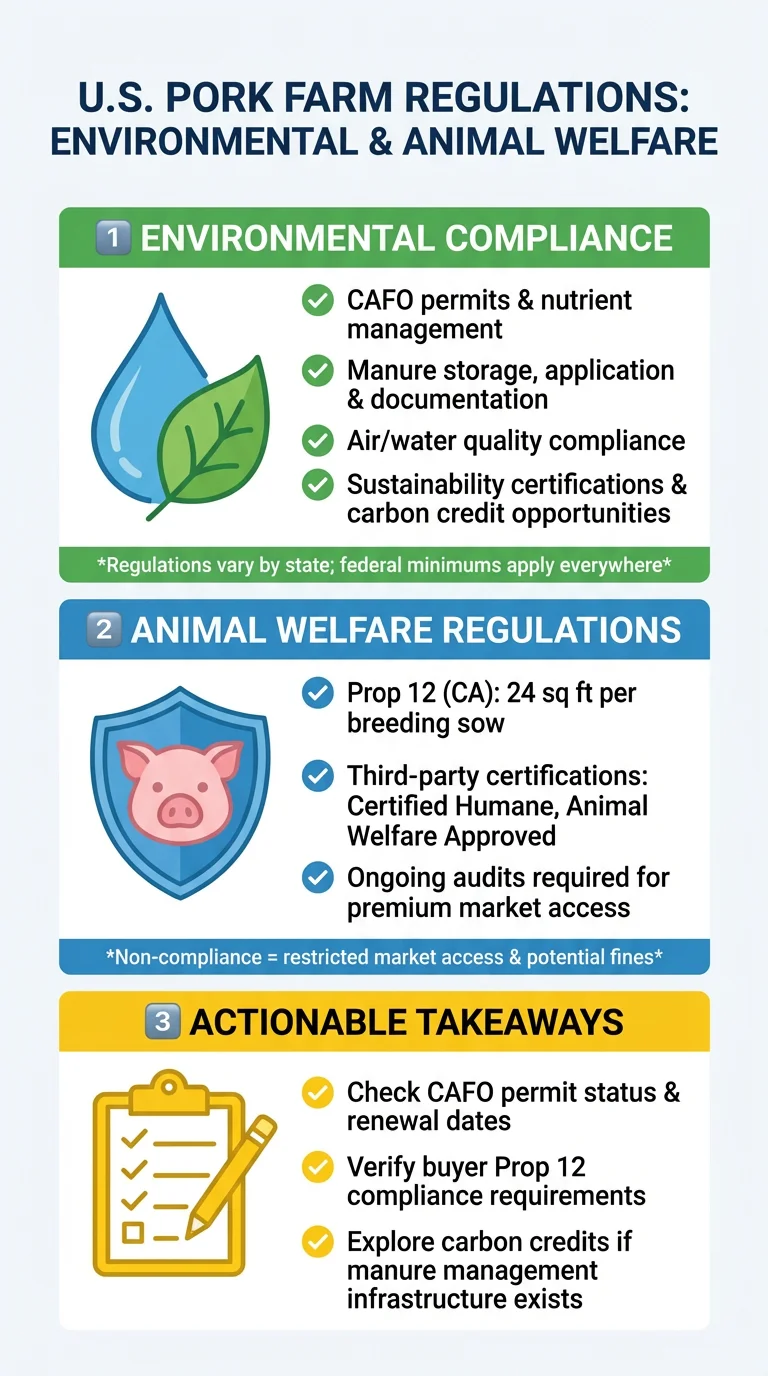
Concentrated Animal Feeding Operations (CAFOs) face Clean Water Act permitting, nutrient management plans, and potentially Clean Air Act requirements. State regulations often exceed federal minimums. Manure management—storage, application, and documentation—is the primary compliance challenge.
Carbon markets and sustainability certifications are creating new opportunities. Operations with anaerobic digesters or verified emissions reductions are generating revenue from carbon credits. Major buyers increasingly require sustainability documentation.
Animal Welfare Regulations
Federal animal welfare law (Animal Welfare Act) excludes farm animals, but state laws increasingly fill this gap. California’s Proposition 12 requires 24 square feet for breeding sows—affecting not just California producers but anyone selling into that market. Massachusetts and other states are considering similar requirements.
Third-party welfare certifications (Certified Humane, Animal Welfare Approved) can command premiums in certain markets but require significant operational changes and ongoing audits.
⟶ What This Means for You:
• Know your CAFO permit status and renewal timeline.
• Ask buyers whether they require Prop 12 compliance—many do regardless of destination.
• Evaluate carbon credit opportunities if you have manure management infrastructure.
9. Technology and Innovation Shaping the Industry
Technology is widening the gap between industry leaders and laggards. Operations that invest strategically in technology outperform those relying on traditional methods—in productivity, compliance, and market access.
Production Technology
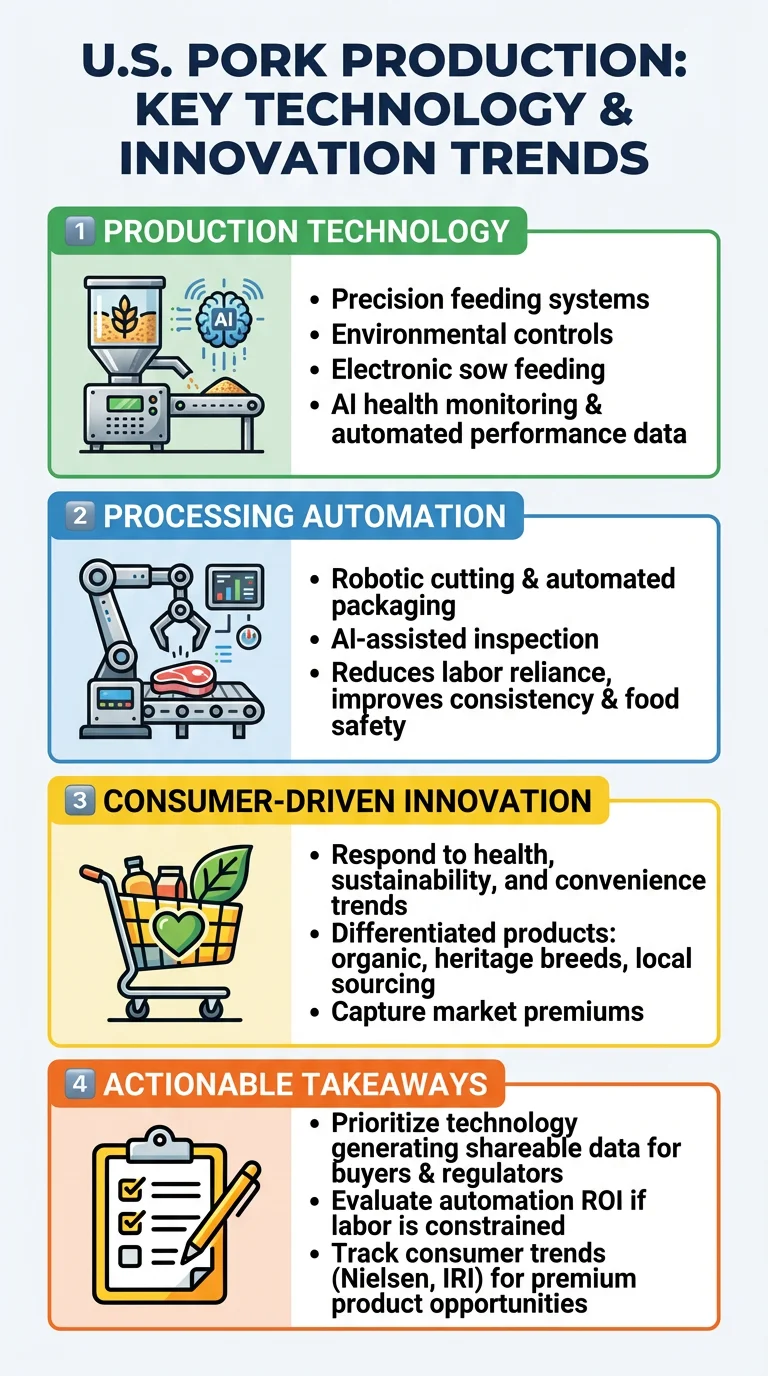
Precision feeding systems, environmental controls, and electronic sow feeding are now standard in competitive operations. AI-powered health monitoring can detect illness before clinical signs appear. Automated data collection enables real-time performance benchmarking and continuous improvement.
Processing Automation
Labor shortages are driving automation in processing. Robotic cutting, automated packaging, and AI-assisted inspection are reducing reliance on hard-to-find workers while improving consistency and food safety.
Consumer-Driven Innovation
Consumer trends—health, sustainability, convenience—are driving product innovation. Operations that can respond to these trends with differentiated products (organic, heritage breeds, local sourcing) capture premiums that commodity producers cannot.
⟶ What This Means for You:
• Prioritize technology that generates shareable data for buyers and regulators.
• If labor is your constraint, evaluate automation ROI carefully.
• Track consumer trend data—Nielsen, IRI—to identify premium opportunities.
10. Future of U.S. Pork Market and Regulations: What’s Coming
The U.S. Pork Market and Regulations landscape is evolving. Operations that anticipate change and adapt early will outperform those that react after the fact.
Regulatory Trends
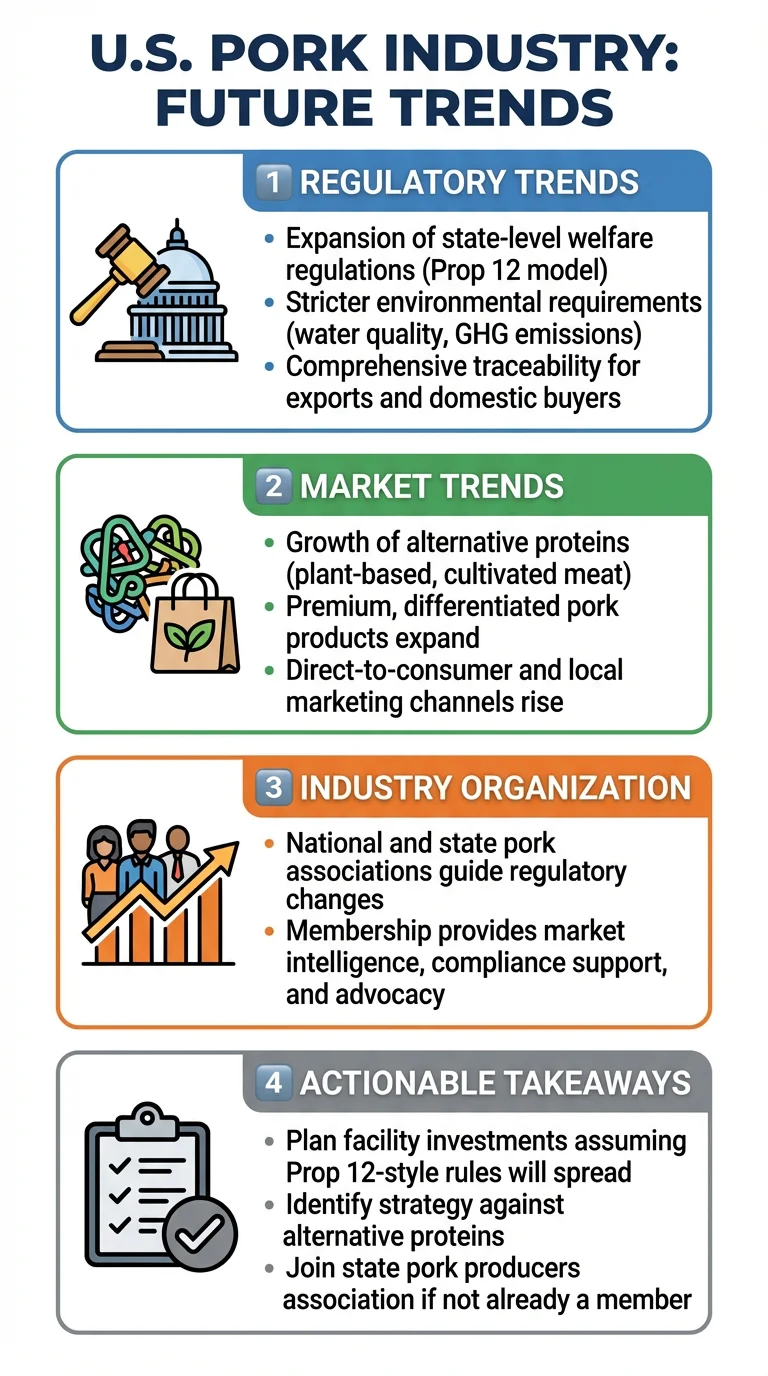
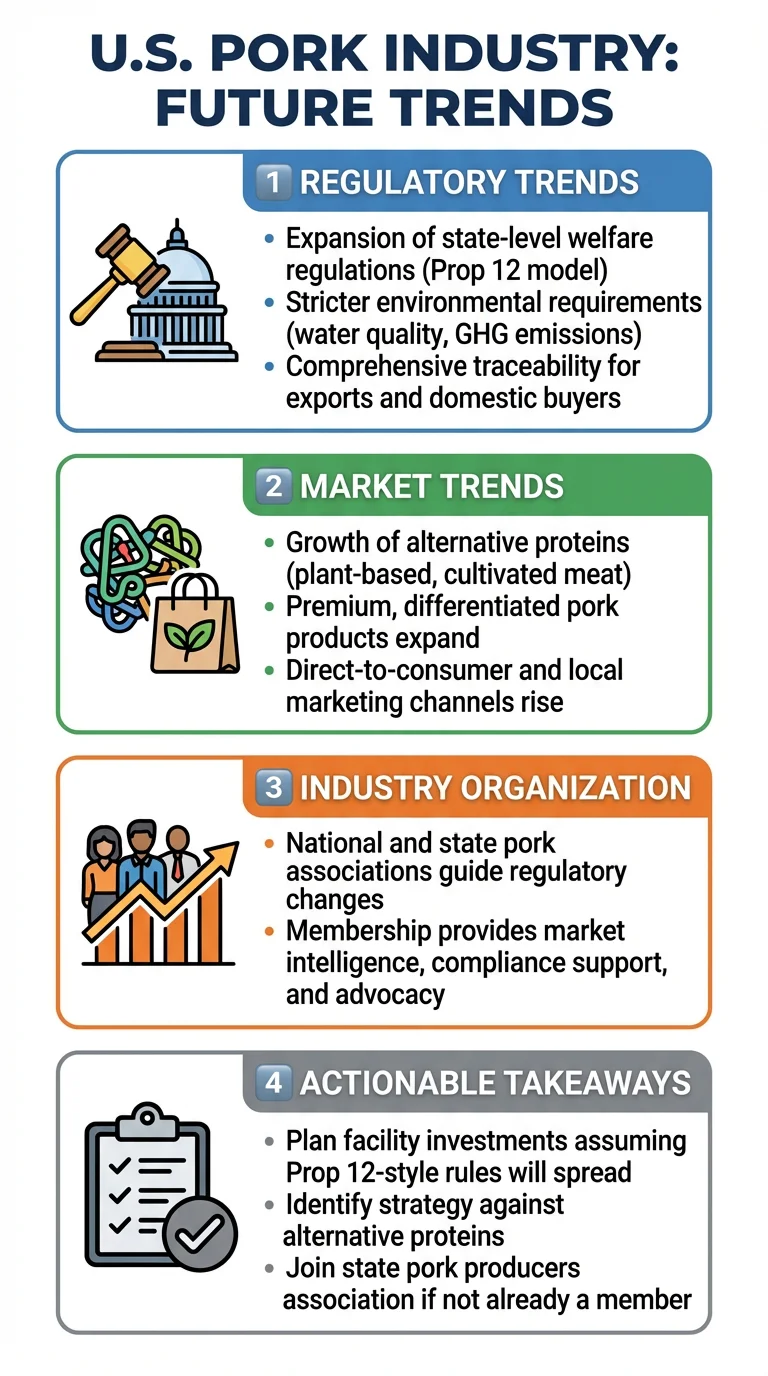
Expect continued expansion of state-level welfare regulations following the Prop 12 model. Environmental requirements—particularly around water quality and greenhouse gas emissions—will intensify. Traceability requirements will become more comprehensive as export markets and domestic buyers demand greater transparency.
Market Trends
Alternative proteins (plant-based, cultivated meat) will continue capturing market share, particularly among younger consumers. Premium differentiated products will grow while commodity margins compress. Direct-to-consumer and local marketing channels will expand as technology reduces barriers.
Industry Organization
Industry associations—National Pork Producers Council, state organizations—will remain critical for navigating regulatory change and representing producer interests. Membership provides access to market intelligence, compliance resources, and collective advocacy.
⟶ What This Means for You:
• Plan facility investments assuming Prop 12-style rules will spread.
• Identify your competitive response to alternative proteins.
• Join your state pork producers association if not already a member.
U.S. Pork Market and Regulations: Frequently Asked Questions
Q: What’s the biggest regulatory risk I’m probably not preparing for?
African Swine Fever reaching North America. It hasn’t happened, but if it does, exports close immediately, prices collapse, and recovery takes years. Your biosecurity protocols and financial reserves are probably inadequate for this scenario.
Q: How do I know which state regulations apply to my operation?
If you sell product into a state, that state’s rules apply—regardless of where you’re located. California Prop 12 affects Iowa producers selling pork that ends up in California. Map your supply chain to understand your exposure.
Q: What’s the minimum compliance I need for a small operation?
If selling meat interstate: federal inspection (FSIS), HACCP plan, proper labeling. If selling intrastate only, state inspection may suffice. Either way: biosecurity basics, proper record-keeping, and accurate labeling are non-negotiable.
Q: Are premium certifications (organic, humane) worth the cost?
Depends on your market. Premium programs require significant investment in facilities, documentation, and audits. They only pay off if you have buyers willing to pay the premium. Research your specific market before committing.
Q: How should I stay current on regulatory changes?
Subscribe to USDA FSIS and APHIS updates. Join your state pork producers association. Monitor Pork Checkoff resources. Regulatory changes rarely happen overnight—there’s usually comment periods and implementation timelines if you’re paying attention.
Navigating U.S. Pork Market and Regulations: Your Action Plan
What You Now Understand
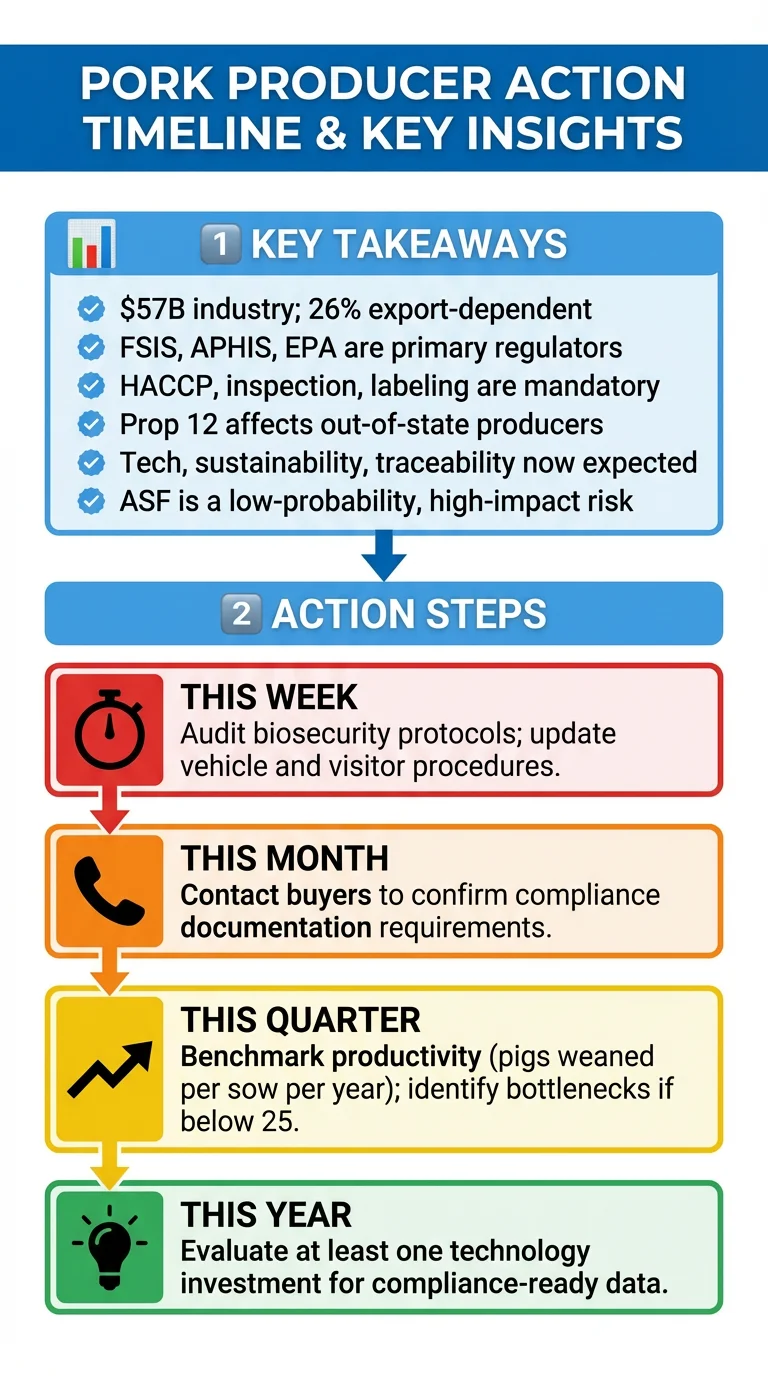
→ The U.S. pork industry is a $57 billion sector where 26% of production depends on export markets.
→ Multiple federal and state agencies regulate different aspects; FSIS, APHIS, and EPA are the primary players.
→ Food safety compliance (HACCP, inspection, labeling) is mandatory and non-negotiable.
→ State regulations like Prop 12 can affect you even if you’re in a different state.
→ Technology, sustainability, and traceability are shifting from optional to expected.
→ African Swine Fever is the low-probability, catastrophic-impact risk the industry faces.
Your Next Steps
This week: Audit your biosecurity protocols. When did you last update vehicle and visitor procedures?
This month: Contact your primary buyers: “What compliance documentation will you require in 2026-2027?”
This quarter: Benchmark your productivity (pigs weaned/sow/year) against industry averages. Below 25? Find the bottleneck.
This year: Evaluate one technology investment that generates compliance-ready data.
The U.S. Pork Market and Regulations environment rewards those who stay informed and adapt proactively. Use this guide as your reference point, explore the detailed articles linked throughout, and revisit your compliance and market strategy at least annually. Success in this industry belongs to operators who pay attention—and act on what they learn.