
Pig Farm Biosecurity Measures: Practical Protocols for Disease Prevention
Introduction
Disease outbreaks cost the U.S. swine industry an estimated $3 billion annually in lost production, treatment expenses, and mortality.
In my 15 years of swine practice across Iowa and the Midwest, I have witnessed devastating Porcine Reproductive and Respiratory Syndrome (PRRS) outbreaks that spread within days to neighbouring farms through inadequate biosecurity protocols.
Effective biosecurity measures for pig farms form the foundation of any successful hog operation, whether you manage 50 sows or 5,000 head. Preventing disease introduction costs far less than treating active infections—every dollar spent on biosecurity infrastructure saves $10 to $20 in potential treatment and production losses.
The connection between farm infrastructure and disease prevention is critical; proper pig barn design that incorporates traffic flow patterns and shower facilities significantly reduces contamination risk.
This guide covers the practical biosecurity protocols every pig farmer must implement.
Understanding Biosecurity Risk Zones
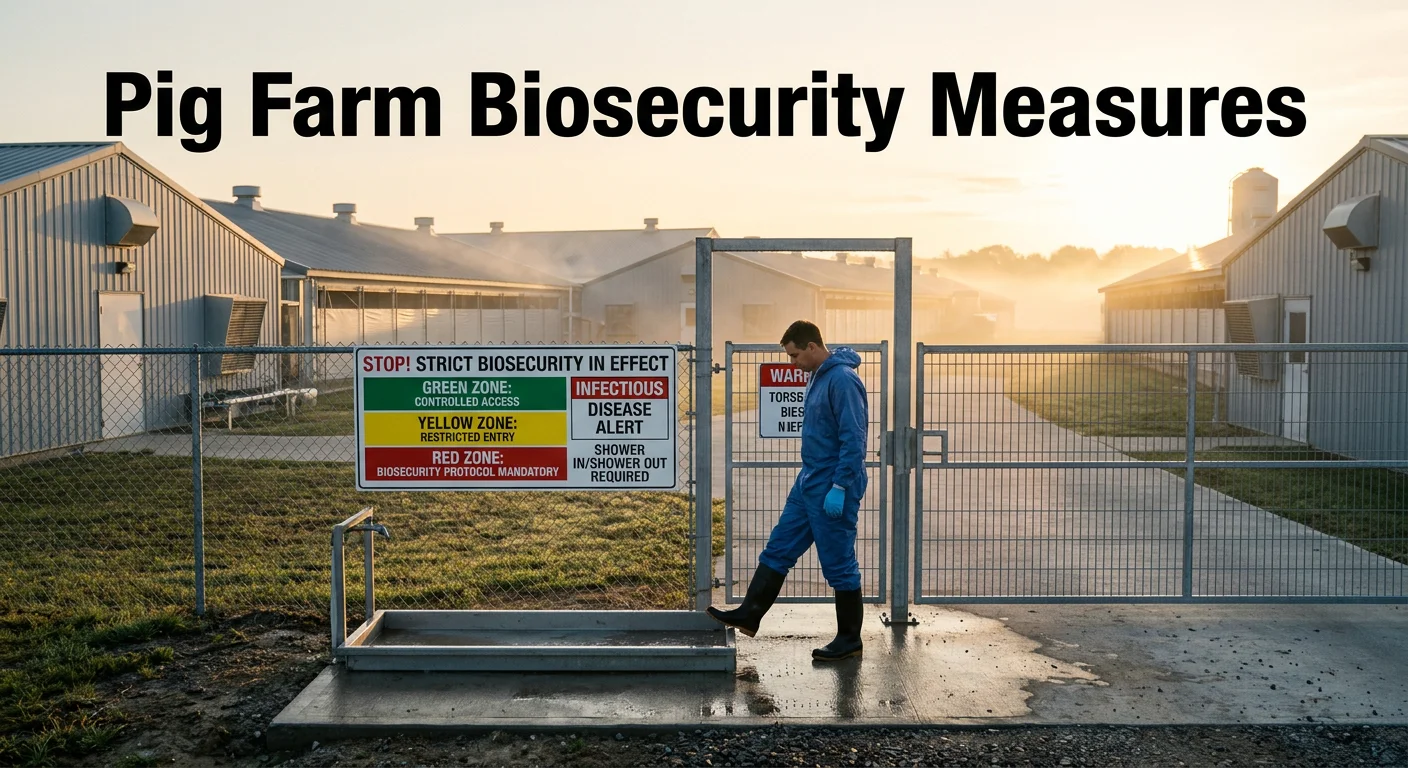
Effective biosecurity requires dividing your farm into distinct zones based on disease risk.
The USDA Swine Health Protection Act identifies three primary zones that require different protocols.
The outermost zone (brown zone) includes areas outside your farm perimeter where exposure to contaminated materials is possible.
Delivery trucks, feed deliveries, and visitors first enter here. Keep a log of all vehicle and personnel entries, including date, time, and purpose.
The middle zone (yellow zone) represents transition areas where decontamination occurs before entering production areas.
This includes loading docks, supply storage areas, and shower facilities.
All personnel must change into farm-provided clothing here.
The inner zone (green zone) contains your pig housing and production facilities.
Only showered personnel wearing disinfected clothing and boots may enter.
Maintain a clear boundary between zones using physical barriers, signage, and colour-coded areas.
Pro Tip: Install visible perimeter fencing at least 100 feet from pig buildings.
This buffer zone prevents direct contact with stray animals and reduces dust-borne pathogen transmission between wild boar populations and your herd.
Entry Control and Traffic Management
Controlling who and what enters your pig farm ranks among the most critical biosecurity measures. Research from the University of Minnesota (2024) shows that 67% of disease introductions on commercial farms occur through personnel and equipment movement.
Shower-in, Shower-out Systems: Every individual entering pig production areas must shower completely and change into farm-provided clothing and boots.
This practice eliminates 90% of potential pathogen carriers. Provide clean towels and prohibit personal items in the inner zone.
Visitor Log and Training: Maintain a log of all farm visitors, including their names, contact information, purpose of visit, and the farm they last visited. Require visitors to watch a brief biosecurity orientation video explaining protocols.
Never allow visitors who have been on another pig farm within 48 hours.
Dedicated Farm Footwear: Provide rubber boots in multiple sizes at each building entrance. Never allow personal shoes inside pig housing.
Implement boot colour-coding: specific colours for specific buildings.
Key Data Point: A 2025 USDA study found farms with mandatory shower facilities reduced PRRS incidence by 73% compared to farms using only boot baths.
Farm Hygiene and Sanitation Protocols
Regular cleaning and disinfection form the backbone of swine biosecurity. Pathogens can survive in the environment for weeks, making systematic sanitation essential for disease prevention.
All-In, All-Out Management: Move entire groups of pigs together through the production system. Empty, clean, and disinfect each room or barn completely between groups.
This prevents disease transmission between age groups and allows for complete sanitation cycles.
Pressure Washing Protocol: Remove all organic matter (manure, feed, bedding) before applying disinfectants. Organic matter neutralises most disinfectants and provides a protective barrier against pathogens.
Use hot water (180°F minimum) and high-pressure equipment for thorough cleaning.
Disinfectant Selection: Choose EPA-registered disinfectants effective against your target pathogens.
Rotate between two or three different disinfectant classes to prevent pathogen resistance. Common effective options include:
- Quaternary ammonium compounds (daily barn cleaning)
- Accelerated hydrogen peroxide (facility sanitation)
- Phenolic compounds (equipment disinfection)
- Virkon S (foot baths and equipment)
Tip: Allow all surfaces to dry completely after applying disinfectant. Many products require 10–20 minutes of contact time to achieve maximum efficacy against viruses and bacteria.
Equipment and Vehicle Biosecurity
Farm equipment and vehicles represent significant vectors for disease transmission. Contaminated trucks, borrowed tools, and shared equipment can introduce pathogens from infected premises.
Dedicated Farm Equipment: Assign specific tools, loaders, and equipment to your farm. Never borrow equipment from neighbouring operations.
If borrowing is unavoidable, complete thorough cleaning and disinfection before bringing equipment onto your property.
Loading Dock Management: Designate one loading area for pig shipments. Never load pigs directly from transportation vehicles into your main barns. Use separate alleys and handling equipment for outgoing animals.
Clean and disinfect loading areas after each use.
Feed Delivery Protocols: Require feed trucks to remain outside your perimeter fence when possible. If trucks must enter, enforce wheel-wash stations at the entrance.
Consider installing feed bins at the property edge to eliminate truck entry entirely.
Deadstock Disposal: Remove dead animals from pig housing immediately. Use covered containers for temporary storage before disposal through rendering, composting, or incineration.
Never drag carcasses across the ground where healthy pigs have access.
Rodent, Pest, and Wildlife Control
Mice, rats, birds, and wild animals carry numerous swine pathogens, including Salmonella, Leptospira, and Brachyspira hyodysenteriae.
Rodent control programmes are essential for maintaining biosecurity on any pig operation.
Exclusion Methods: Seal all building openings larger than ¼ inch.
Install rodent barriers around feed storage areas. Use bird netting in ventilation intakes. Repair gaps in walls, floors, and foundations that provide wildlife access.
Bait Station Programmes: Establish permanent bait stations around the farm perimeter and inside feedstorage areas.
Check and replenish bait weekly. Use rodenticide bait blocks in tamper-resistant stations to prevent accidental pig exposure.
Wildlife Habitat Reduction: Eliminate vegetation within 10 feet of pig buildings. Remove woodpiles, debris, and equipment near barns.
Store trash and organic waste in rodent-proof containers. Eliminate standing water that attracts wildlife.
Pro Tip from Dr Sarah Mitchell: Conduct monthly rodent population assessments by counting droppings at standardised locations.
A sudden increase in rodent activity often signals a breeding population nearby—act immediately before an infestation develops.
Monitoring and Auditing Your Biosecurity Program
Biosecurity requires ongoing attention and regular assessment. Even well-designed protocols break down over time without monitoring and enforcement.
Daily Biosecurity Checklist: Post checklists at entry points reminding staff of required procedures. Include items like boot disinfection, clothing change, and equipment sanitation. Review protocols at weekly staff meetings.
Monthly Audit: Walk your entire farm monthly with fresh eyes. Look for broken fences, unlocked gates, accumulated debris, and any signs of biosecurity lapses.
Document findings and assign corrective actions with deadlines.
Annual External Review: Invite your veterinarian to conduct an annual biosecurity audit.
An external perspective often identifies blind spots that farm staff overlook. The American Association of Swine Veterinarians (AASV) provides biosecurity audit templates.
Outbreak Investigation Protocol: When disease occurs, conduct a biosecurity review to identify potential entry points.
Review personnel movement logs, equipment sharing records, and feed delivery procedures. Please address any weak points before restocking the affected areas.
Comparison: Core Biosecurity Components
| Component | Basic Farm (10-50 head) | Commercial Farm (100+ head) | Best For |
|---|---|---|---|
| Entry Control | Boot bath + dedicated boots | Shower-in facility + changing room | All farm sizes prevent personnel contamination |
| Traffic Management | Single entrance with log | Segregated entry/exit zones | Large operations with multiple buildings |
| Cleaning Protocol | Weekly manual cleaning | All-in/all-out + pressure washing | All sizes reduce pathogen load |
| Disinfectant Program | Single product rotation | Multi-product rotation schedule | All sizes prevent resistance |
| Pest Control | Bait stations along perimeter | Integrated pest management system | All sizes eliminate wildlife vectors |
| Audit Frequency | Quarterly self-audit | Monthly internal + annual external | All sizes—ensures protocol adherence |
Frequently Asked Questions
How much does implementing farm biosecurity cost?
Basic biosecurity measures cost $500–$2,000 for small farms, including boot baths, signage, and disinfectant supplies.
Commercial operations typically invest $10,000–$50,000 for shower facilities, perimeter fencing, and vehicle wash stations.
However, these costs represent a fraction of disease outbreak expenses, which can exceed $100 per sow in lost production.
What is the most important biosecurity practice?
Shower-in, shower-out protocols provide the single most effective biosecurity measure for commercial farms.
This practice removes pathogens carried on skin, hair, clothing, and personal items.
For small farms without shower facilities, thorough hand washing combined with boot changes provides adequate protection.
How often should foot baths be changed?
Change footbath solutions at minimum daily, or more frequently if heavily soiled with organic matter.
Organic material rapidly neutralises disinfectant effectiveness.
Position foot baths on concrete pads for easy cleaning and ensure boots are free of mud before stepping in.
Can wild boar transmit diseases to farm pigs?
Yes, wild boar carry PRRS, Seneca Valley virus, and classical swine fever.
Maintain double fencing at least 100 feet from production buildings if wild boar inhabit your area. Never feed wild pigs or allow them access to farm feed or water sources.
How long should new pigs be quarantined?
Isolate new additions for a minimum of 30 days, ideally 60 days.
Use separate facilities with dedicated equipment and personnel.
Monitor for clinical signs and test for key diseases before introducing animals to the main herd. This prevents introducing latent infections to your established population.
Conclusion
Biosecurity represents your farm’s first line of defence against devastating disease outbreaks. Every protocol—from shower facilities to pest control—contributes to protecting your herd’s health and your operation’s profitability.
Three key takeaways:
Effective biosecurity requires daily attention, but the investment prevents losses that can devastate your operation.
Start with your farm’s highest-risk entry points and build comprehensive protocols over time.
For detailed guidance on herd health management, explore our complete pig health and disease management resource hub.

Our Fact Checking Process
We prioritize accuracy and integrity in our content. Here's how we maintain high standards:
- Expert Review: All articles are reviewed by subject matter experts.
- Source Validation: Information is backed by credible, up-to-date sources.
- Transparency: We clearly cite references and disclose potential conflicts.
Our Review Board
Our content is carefully reviewed by experienced professionals to ensure accuracy and relevance.
- Qualified Experts: Each article is assessed by specialists with field-specific knowledge.
- Up-to-date Insights: We incorporate the latest research, trends, and standards.
- Commitment to Quality: Reviewers ensure clarity, correctness, and completeness.
Look for the expert-reviewed label to read content you can trust.