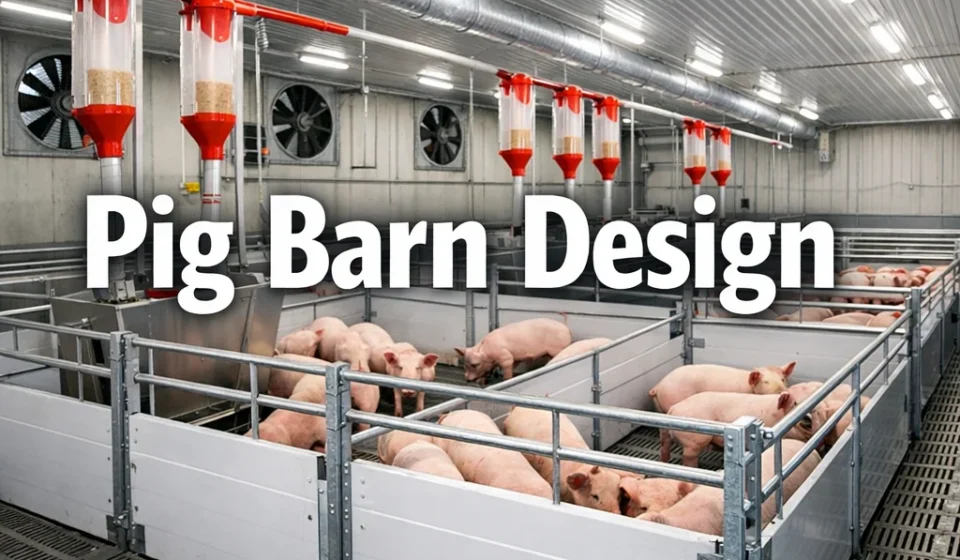
Pig barn design is the single most consequential infrastructure decision a producer makes. A well-designed barn improves feed conversion by 3–5%, reduces labour by 20–30%, lowers mortality by 1–2 percentage points, and maintains these advantages every day for 20–30 years. A poorly designed barn does the opposite — and unlike a bad feed formula that can be changed next week, a bad barn design is permanent.
The challenge is that pig barn design involves dozens of interconnected decisions—pen dimensions, ceiling height, ventilation type, flooring, alley configuration, manure system, feed delivery, and water placement—that must all work together as a system. Getting seven out of eight right and one wrong can undermine the entire building’s performance.
This article covers the seven critical design features that distinguish high-performing pig barns from mediocre ones, with specific dimensions, materials, and layout recommendations for each production stage. For how these barns fit into the overall farm plan, see designing a pig farm layout. For how space per pig within these designs affects performance, see ideal pigpen size and space requirements.
TL;DR — Quick Takeaways
- Pig barn design determines feed efficiency, health, labour costs, and animal welfare for the 20–30-year life of the building.
- Seven critical design elements: pen layout, ceiling height, alley width, ventilation integration, flooring type, manure system, and feed/water delivery.
- Rectangular pens (2:1 ratio) outperform square pens at the same space per pig — natural dunging separation is the reason.
- Minimum ceiling height: 8 ft clear above slats for adequate air volume; 9–10 ft is preferred for tunnel ventilation.
- Center-alley barns (double-loaded) provide the most space-efficient and labor-efficient layout for growing finishes.
- Design for the heaviest pig you’ll house — not the lightest. A barn designed for 250-lb pigs fails at 300-lb market weights.
- Every design shortcut costs more to fix later than it would have cost to do right the first time.
Feature 1: Pen Layout and Dimensions
Pen layout is the foundation of barn design. Everything else—ventilation, feeding, and manure flow—adapts to the pen arrangement.
Pen Shape: Why Rectangles Beat Squares
Pigs naturally separate their living space into functional zones: a lying area (near the feeder, warm side), an eating/drinking area (middle), and a dunging area (far end, cooler side near ventilation inlets). Rectangular pens with a 2:1 to 2.5:1 length-to-width ratio facilitate this separation naturally. Square pens or very short, wide pens fail to establish clear zones—resulting in pigs dunging in the lying area, which increases ammonia, foot problems, and skin lesions.
Recommended pen dimensions by stage:
| Stage | Pen Width | Pen Depth | Pigs per Pen | sq ft/Pig |
|---|---|---|---|---|
| Nursery | 8 ft | 8–10 ft | 20–25 | 3.0–4.0 |
| Grower (50–130 lbs) | 10 ft | 16–18 ft | 25–30 | 6.0–7.0 |
| Finisher (130–280 lbs) | 10–12 ft | 20–24 ft | 25–30 | 8.0–10.0 |
| Heavy finisher (280–320 lbs) | 12 ft | 24–26 ft | 25–28 | 10.0–12.0 |
The industry standard for grow-finish pens is 25–30 pigs per pen. Smaller pens (10–15 pigs) are less space-efficient (more partition material per pig, more wasted alley space). Larger pens (40–60 pigs) increase competition and within-pen weight variation. The 25–30 range balances space efficiency, social dynamics, and manageable group size for observation.
Pen Partitions
Pen partitions separate adjacent groups while allowing airflow. The best design uses:
- Solid lower section (18–24 inches): Prevents pig-to-pig fighting through the partition, provides a comfortable surface for pigs to lie against, and reduces cross-pen draught at pig level.
- Open upper section (bars or rods at 3-inch spacing): Allows airflow between pens, provides visibility for daily observation, and reduces material cost versus full-solid panels.
- Material: Galvanised steel or concrete panels for durability. PVC panels are lighter but less durable. Wood rots in the high-moisture barn environment and is difficult to sanitise.
- Height: 32–36 inches for finishers, 24–28 inches for nursery, and 42–48 inches for boar pens.
Feature 2: Barn Layout — Center Alley vs. Outside Alley
Center Alley (Double-Loaded)
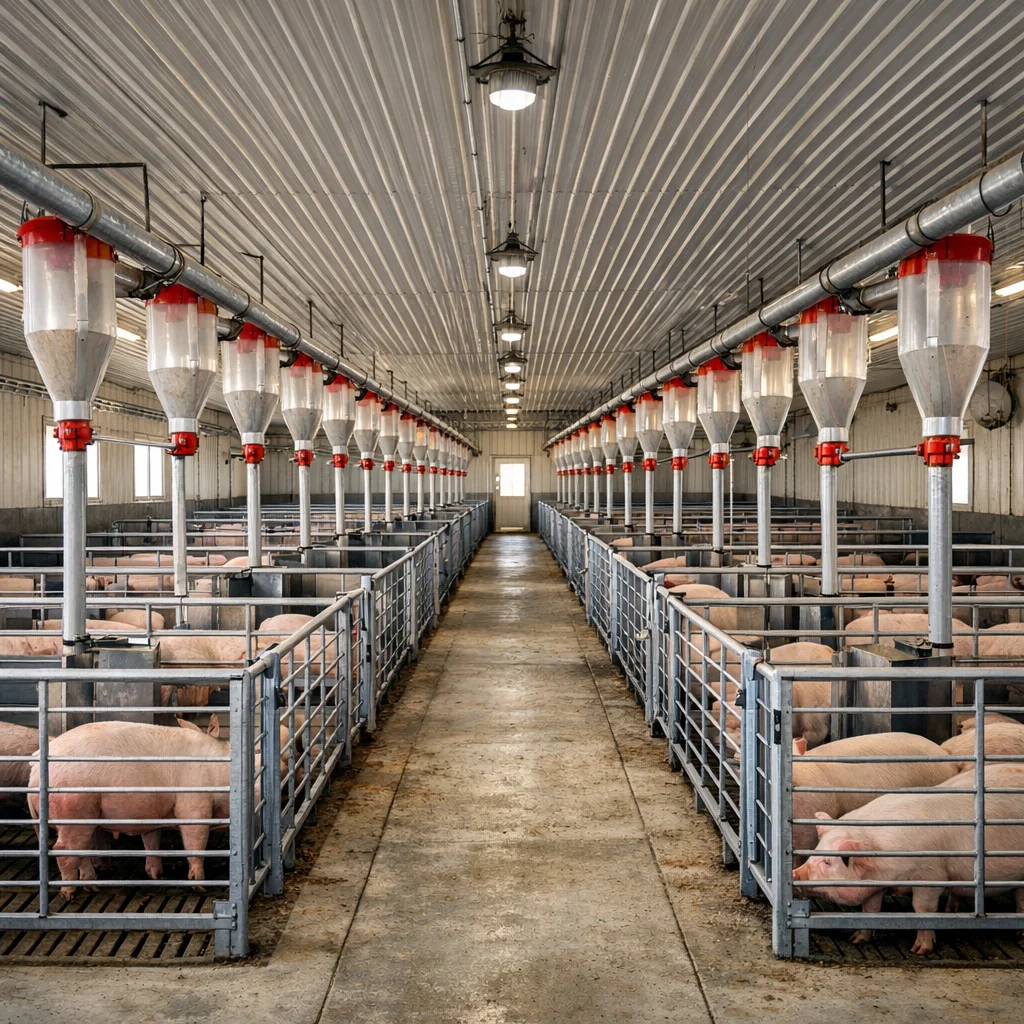
The most common and efficient layout for grow-finish: a single centre alley with pens on both sides. The alley runs the full length of the barn and serves as the primary pig movement path, observation walkway, and service corridor.
Advantages:
- The alley maximises space efficiency by providing more pen area per square foot of the building footprint.
- A single observation path covers all pens in one walk.
- Feed delivery (overhead auger or chain disc) runs down the centre, serving both sides.
- Pigs moved between pens or to loadout travel through one alley.
Recommended center alley width: 30–36 inches for growth finishes (wide enough for a person to walk comfortably plus a pig to pass). 24–28 inches for nursery. Some designs use 42–48 inch alleys for sort-to-market operations where small groups of heavy pigs must pass each other.
Outside Alley (Single-Loaded)
Pens are located exclusively on one side, with the alley running along the outside wall. While it may not be as space-efficient, it offers improved access to each pen and permits natural ventilation from one side. These pens are predominantly found in older barns, nurseries, and some breeding/gestation barns.
Double-Wide Center Alley
Some modern barns feature a 6–8-foot-wide central alley that also serves as a pig sorting and weighing area. Heavy pigs can be sorted from pens into the wide alley, weighed or evaluated, and sent either back to the pen or to the loadout. The arrangement eliminates the need for a separate sorting facility—saving construction costs and improving marketing efficiency.
Feature 3: Ceiling Height and Air Volume
Ceiling height is one of the most underappreciated design decisions. Too low, and ventilation performance suffers — trapped heat, ammonia buildup, and uneven air distribution. Too high, and heating costs increase in winter.
Why Height Matters
Ventilation systems move air through the barn in predictable patterns. In mechanically ventilated barns, fresh air enters through sidewall or ceiling inlets, mixes with barn air above pig level, and exits through exhaust fans. This mixing zone requires adequate vertical space above the pigs. If the ceiling is too low, incoming cold air drops directly onto pigs (causing draughts) instead of mixing with warm barn air first.
Recommended Heights
| Barn Type | Minimum Clear Height | Preferred Height | Notes |
|---|---|---|---|
| Tunnel ventilated (grow-finish) | 8 ft above slats | 9–10 ft | Higher ceilings improve air velocity uniformity |
| Cross-ventilated | 8 ft | 9–10 ft | Need adequate volume for mixing |
| Naturally ventilated (curtain sidewall) | 10 ft at eave | 12–14 ft at peak | Need stack effect for natural draught |
| Nursery | 7.5–8 ft | 8 ft | Lower volume reduces heating cost |
| Farrowing | 7.5–8 ft | 8 ft | Climate-controlled rooms; minimize volume |
| Hoop barn | 12–15 ft at peak | 15 ft | Fixed by structure geometry |
The ammonia connection: Ammonia is lighter than air and rises. In barns with adequate ceiling height (9+ ft), ammonia naturally stratifies above pig level—reducing pig exposure. In low-ceiling barns (7 feet), ammonia concentrates at the pig’s breathing level, increasing respiratory disease risk.
For how ventilation systems interact with ceiling design, see ventilation systems in pig housing. For cooling system integration, see cooling systems for pig barns.
Feature 4: Flooring Type and Design
Flooring affects pig comfort, manure management, foot health, and hygiene. The three primary options in confinement:
Fully Slatted Floors
The entire pen floor consists of slats (concrete, metal, or plastic) with gaps that allow manure to fall into the pit below.
Advantages: cleanest pen surface, lowest labour (no scraping), minimal ammonia at floor level (manure falls through immediately). Disadvantages: hardest surface for pig comfort, highest foot lesion risk, no lying comfort without mats.
Partially Slatted Floors
A solid concrete section typically occupies 40–60% of the pen area and serves as the front/lying area, while a slatted section at the back serves as the dunging area.
Advantages include better lying comfort on the solid section, natural dunging zone separation, and lower foot lesion rates compared to full slats. Disadvantages: It necessitates a pen design that incentivises pigs to excrete on the slatted section, which can be achieved through temperature differential and the placement of ventilation inlets. If pigs dung on the solid section, the advantage is lost.
Solid Floors with Scraping
The entire floor is solid concrete. Manure is removed by mechanical scrapers, manual scraping, or flush systems.
Advantages: Most comfortable for pigs, lowest foot lesion rates, compatible with deep bedding. Disadvantages include the highest labour costs, the most ammonia at the pig level (as manure sits on the surface until removed), and the requirement for daily or twice-daily scraping.
Slat Specifications
| Material | Slat Width | Gap Width | Best For | Lifespan |
|---|---|---|---|---|
| Concrete | 5–6 inches | 0.75–1.0 inches | Finishers | 20–30 years |
| Concrete (tribar) | 3 inches | 0.75 inches | Nursery, growers | 20–30 years |
| Cast iron/steel | 3–4 inches | 0.375–0.50 inches | Farrowing (sow area) | 15–25 years |
| Plastic/fiberglass | 4–5 inches | 0.375–0.50 inches | Nursery, farrowing creep | 10–15 years |
| Woven wire | N/A | 0.50 inches | Nursery, farrowing creep | 8–12 years |
Critical detail: Gap width must be sized for the smallest pig that will use the floor. Nursery slats with 1-inch gaps designed for finishers will trap and injure piglet feet. Always ensure that slat specifications match the production stage.
For detailed flooring comparisons, see flooring options for pig pens. For hygiene management across flooring types, see flooring hygiene and bedding management.
Feature 5: Manure System Integration
The manure system is literally the foundation of a confinement barn — the pit is poured before the building goes up, and changing it after construction is essentially impossible without demolishing the barn.
Deep Pit (Most Common)
A concrete pit 8–12 feet deep beneath the slatted floor stores 6–12 months of manure. Pit is pumped out 1–2 times per year, and contents are land-applied to crop ground.
Design requirements:
- Pit walls: 6–8 inch reinforced concrete, designed for lateral soil pressure plus liquid manure pressure.
- Pit floor: 4–6 inch reinforced concrete on compacted fill.
- Agitation access: 18–24 inch ports in the barn wall or floor at each pit section for pump/agitation equipment access during pumpout.
- Ventilation: Deep pits produce hydrogen sulphide (H₂S) — a lethal gas. Pit fans that run during agitation and pumpout are essential safety equipment. Multiple farm deaths occur annually from H₂S exposure during pit agitation.
Shallow Pit with Pull-Plug
The pit is 2–4 feet shallow and has a drain plug at one end. When the plug is pulled, liquid manure drains by gravity to an outside storage (lagoon or holding tank). Remaining solids are flushed or scraped out.
Advantages: Lower construction cost than a deep pit; more frequent manure removal reduces gas buildup. Disadvantages include the need for outside storage (lagoon), more frequent management, and that gravity drainage requires a precise floor slope (1–2% toward the drain).
Flush System
Fresh or recycled water flushes manure from shallow gutters under the slats into an outside lagoon. This system is prevalent in southern states where water is readily available and standard lagoon systems are in place.
For complete manure system design and regulatory requirements, see waste management infrastructure for pig farms. For drainage specifics, see flooring drainage and wastewater systems.
Feature 6: Feed and Water Delivery Systems
Feed and water equipment placement must be integrated into the barn design from the beginning—not retrofitted after construction.
Feed Delivery
- An overhead auger, or chain-disc system, runs from external bulk bins through the barn center, dropping feed into individual feeders at each pen. This is the standard for confinement barns with 200+ pig spaces.
- Drop tubes from the overhead line to individual feeders. Each tube has a shut-off valve for pen-level feed control.
- Feeder placement: the center of the pen’s eating zone—typically along the central alley partition, accessible from the alley for adjustment.
Water Delivery
- The water supply line runs the length of the barn, typically along the pen partition opposite the feeder, which encourages pigs to use the far end for drinking and dunging.
- Nipple or cup drinkers mounted at pig shoulder height—adjustable as pigs grow—or installed at two heights (nursery pigs use the lower; growers use the higher).
- Water pressure: 20–30 PSI at the drinker. Flow rate: minimum 1 cup/minute for nursery, 2+ cups/minute for finishers.
For equipment selection, installation details, and maintenance, see watering and feeding equipment setup. For how automated systems integrate with barn designs, see automation and smart infrastructure.
Feature 7: Insulation and Envelope
The barn envelope (walls, ceiling, and foundation) determines how much energy you spend maintaining the target temperature—and how much control you actually have over the pig’s environment.
Insulation R-Values
| Component | Minimum R-Value | Preferred R-Value | Notes |
|---|---|---|---|
| Ceiling/roof | R-19 | R-25 to R-30 | Most critical — heat rises |
| Sidewalls | R-13 | R-19 | Exposed to wind; higher R in cold climates |
| Foundation/curtain wall | R-5 to R-10 | R-10 to R-13 | Below-grade portion, first 2–4 ft |
| End walls | R-13 | R-19 | Often tunnel-ventilated; endwall is fan end |
Material choices: Spray foam insulation (closed-cell polyurethane) provides the best R-value per inch and doubles as an air/vapour barrier. Fibreglass batts are cheaper, but they require a separate vapour barrier and are less effective in a humid, corrosive barn environment. Rigid foam board (EPS or XPS) works well for foundation insulation.
Vapour barrier: Essential on the warm side (interior) of the insulation to prevent condensation within the wall/ceiling assembly. Moisture condensation inside insulation destroys R-value and rots wood framing.
Why Insulation Determines Energy Cost
According to Midwest Plan Service engineering standards, a well-insulated pig barn (R-25 ceiling, R-19 walls) uses 40–60% less heating energy in winter than a poorly insulated barn (R-13 ceiling, R-11 walls). On a nursery barn that burns 2,500 gallons of propane per year, that’s 1,000–1,500 gallons saved—$2,000–4,500/year at current propane prices.
For heating system selection that works with barn insulation, see heating systems for pig housing. For temperature management strategies, see temperature control in pig farms.
Stage-Specific Barn Design Highlights
Farrowing Barn
- The barn design features individual farrowing crates or pens, with a crate area of approximately 7 feet and a creep area of 2 to 5 feet on each side, totalling approximately 50 square feet per sow unit.
- Heated creep areas (heat lamp or heat mat) maintain 85–90°F for piglets while the sow area stays at 60–65°F.
- There are all-in/all-out rooms that accommodate 12–24 crates each, ensuring thorough washing and disinfection between groups.
- The rooms are kept separate from other production stages to ensure biosecurity.
See farrowing house design and management for complete specifications.
Nursery Barn
- The nursery barn features small pens, each housing 20–25 piglets and measuring 3–4 sq ft.
- The nursery barn maintains excellent temperature control, starting at 82°F at placement and decreasing by 2°F per week to 70°F.
- Woven wire or plastic flooring for small feet.
- The ceiling is kept low, at 8 feet, to reduce air volume and heating costs.
- We utilise all-in/all-out rooms to effectively manage disease.
See nursery design for weaned piglets.
Grow-Finish Barn
- Centre alley, double-loaded layout.
- 25–30 pigs per pen at 8–10 sq ft each.
- The pigs are housed on either fully or partially slatted concrete slats.
- Tunnel or cross ventilation with evaporative cooling.
- Deep-pit manure is stored for 6–12 months.
- Most barns: 40 ft wide × 200–300 ft long (1,000–1,200 pig spaces per barn).
See grower and finisher barn management.
Common Design Mistakes
- It is important to design for the pigs of today, not those of tomorrow. If market weights are trending from 270 to 300 lbs, design pen space and slat strength for 300+ lb pigs. Retrofitting pens for larger pigs is impossible without demolition.
- Skimping on ceiling height. Saving $5,000 on a lower ceiling costs $50,000+ in ventilation problems, ammonia issues, and lost performance over the barn’s life.
- Inadequate pit access. Insufficient agitation ports, or poorly located ports, cause manure solids to accumulate, reducing storage capacity and creating H₂S hotspots.
- It is recommended to place feeders and drinkers on the same side of the pen. This concentrates traffic in one area and eliminates the natural lying-eating-dunging zone separation.
- No sort/loadout alley. Designing a barn without a way to sort and remove individual pigs without moving the entire pen makes marketing heavy pigs and removing sick pigs extremely difficult.
- Forgetting maintenance access. Ventilation equipment, feed lines, water lines, and electrical panels need accessible service points. Burying these behind pens or above ceilings without access panels creates maintenance nightmares.
- Not consulting a designer. A barn is a 20–30 year investment of $150,000–500,000+. Spending $5,000–15,000 on professional design prevents mistakes that cost 10x more to fix.
Frequently Asked Questions
What is the standard size for a pig finishing barn?
The most common U.S. grow-finish barn is 40 ft wide × 200–300 ft long, housing 1,000–1,200 pigs. This size optimises construction costs per pig space, ventilation performance, and labour efficiency. Smaller barns (500–600 head) work for mid-scale; larger barns (1,500–2,400 head) are built at 43–54 ft width.
Should I use fully slatted or partially slatted floors?
For grow finishes, fully slatted is the industry standard in the U.S. because it requires the least labour and provides the cleanest pen surface. Partially slatted works well when properly designed (solid section at the warm/feeder end, slats at the cool/inlet end) and provides better pig comfort. European regulations are pushing toward partially slatted or solid floors for welfare reasons — a trend that may eventually reach the U.S.
How important is barn orientation?
Very. East-west long-axis orientation reduces solar heat gain by 15–25% versus north-south orientation. For tunnel-ventilated barns, align the long axis with prevailing summer wind. Getting orientation wrong wastes cooling energy every summer for the barn’s entire life.
Can I design a barn that works for both growers and finishers?
Yes — many barns house pigs from 50 lbs to market. Design pen space for the heaviest pig (8–10 sq ft per finisher), slats for the smallest pig (gap width appropriate for 50-lb pigs), and ventilation for both minimum and maximum ventilation needs. The key constraint is that nursery-age pigs (< 50 lbs) should NOT be housed in finisher barns — the temperature requirements are too different.
How much does professional barn design cost?
For a standard 1,000-head grow-finish barn: $5,000–15,000 for design and engineering, including structural plans, ventilation layout, plumbing, and electrical. This is 1–3% of total construction cost—and prevents design errors that can cost 10–50% of construction cost to fix after the building is up.
Conclusion
Pig barn design is a system — seven critical features that must work together. The design should incorporate rectangular pens that provide ample space for pigs. The ceiling height should be sufficient to ensure proper ventilation. A center-alley layout maximises labour efficiency. The flooring matches the production stage. The manure pit is designed and built correctly only once. Feed and water delivery integrated from the start. Insulation plays a crucial role in controlling your energy bill for decades.
Every shortcut in design becomes a permanent penalty in performance. A barn that saves $10,000 on lower ceilings, narrower alleys, or thinner insulation costs multiples of that in lost feed efficiency, higher energy bills, increased labour, and more health treatments—every year for 20–30 years. Design for the heaviest pig, the worst weather day, the busiest marketing week, and the maintenance access you’ll need at 2 AM when something breaks. That barn is the one that generates a significant return on investment.
Related Guides
- Introduction to Pig Housing Systems
- Designing a Pig Farm Layout
- Ideal Pig Pen Size and Space Requirements
- Flooring Options for Pig Pens
- Ventilation Systems in Pig Housing
- Cooling Systems for Pig Barns
- Heating Systems for Pig Housing
- Temperature Control in Pig Farms
- Waste Management Infrastructure
- Watering and Feeding Equipment Setup
- Automation and Smart Infrastructure
- Farrowing House Design
- Nursery Design for Weaned Piglets
- Grower and Finisher Barn Management
Author