Pig Nutrition & Feeding Guide (USA 2026): Stages, FCR & Cost-Saving Tips
TL;DR – Quick Guide to Pig Nutrition and Feeding
- Pigs need different diets at each life stage. Starter, grower, and finisher feeds aren’t interchangeable—each serves a purpose.
- Protein requirements decrease as pigs grow. Piglets need 22-24% protein; finishers only need 13-15%.
- Feed conversion ratio (FCR) determines profitability. Expect 2.8-4.0 for market hogs; heritage breeds and small-scale systems may see higher.
- Commercial feed is usually best for beginners. Homemade pig rations require nutritional knowledge most new farmers lack.
- Pigs should eat 3-5% of their body weight daily. Adjust based on age, condition, and production goals.
- Clean water matters as much as feed. A water-to-feed ratio of 2:1 to 3:1 is standard; outdoor systems need more.
- Breeding stock and pregnant sows have special needs. Don’t feed market hog diets to your breeding herd.
- The cheapest pig feed isn’t always the most economical. Poor feed conversion wastes money regardless of per-bag cost.
Introduction: Understanding Pig Nutrition and Feeding for Small Farms
Pig nutrition and feeding form the foundation of profitable, healthy pig production—whether you’re raising three pigs for the freezer or managing a small breeding operation. What you feed, when you feed it, and how much you offer directly impact growth rates, feed costs, meat quality, and animal health.
This complete pig feed guide targets small-scale and backyard pig farmers across the USA. We’re not writing for 5,000-head confinement operations with nutritionists on staff. We’re writing for folks raising pigs on pasture, in backyards, or in small barn setups who need practical pig ration guidance without agricultural degrees. If you’re just getting started, our complete guide to small-scale pig farming in the USA covers the fundamentals of setting up your operation.
Here’s the reality: feed typically represents 65-75% of total pig production costs. Get your pig feed chart wrong, and you’ll either spend too much on feed that doesn’t perform or produce pigs that grow slowly with poor carcass quality. Neither outcome works. Understanding how feed costs fit into your overall operation is essential—our guide to pig farming economics breaks down the full financial picture.
The good news? Pig nutrition isn’t mysterious. Modern commercial feeds handle most of the complexity, and understanding the basics helps you make smart decisions for your operation.
This guide covers everything from piglet starter rations through finishing diets, plus special considerations for breeding stock and pregnant sows. We’ll provide practical pig feed schedules, feeding charts you can reference daily, and actionable strategies that work for small-scale production in 2026.
What Pigs Actually Need: Core Nutritional Requirements
Pig nutrition requirements change dramatically from birth through market weight. Understanding these shifting needs helps you select appropriate feeds and avoid costly mistakes.
The Six Essential Nutrient Categories
Every pig diet must provide sufficient amounts of the following nutrients:
1. Energy (Calories): Pigs need energy for maintenance, growth, and activity. Corn provides most energy in typical U.S. pig diets. Energy deficiency slows growth; excess energy creates overly fat carcasses.
2. Protein and Amino Acids: Protein builds muscle. More importantly, pigs need specific amino acids—lysine being the most critical. Modern nutrition focuses on standardised ileal digestible (SID) lysine rather than the crude protein percentage alone. Soybean meal is the primary protein source in commercial feeds.
Key Point: While we list protein percentages throughout this guide for simplicity, what truly matters is amino acid balance—particularly lysine, methionine, and threonine. Commercial feeds are formulated with this in mind; homemade rations often aren’t.
3. Vitamins Both fat-soluble (A, D, E, K) and water-soluble (B-complex) vitamins are essential. Most commercial feeds include complete vitamin premixes.
4. Minerals Calcium, phosphorus, salt, and trace minerals support bone development, enzyme function, and overall health. Mineral balance matters—an excess of one can interfere with the absorption of others.
5. Water. Often overlooked, water is the most critical nutrient. Pigs deprived of water stop eating within hours. Always provide clean, fresh water.
6. Fibre pigs don’t digest fibre efficiently, but some fibre aids gut health. Too much fibre reduces energy density and slows growth.
Pig Nutrition Requirements by Life Stage (Reference Table)
This is crucial: protein requirements decrease as pigs grow, while energy needs increase relative to protein.
| Life Stage | Weight Range | Crude Protein % | SID Lysine % | Notes |
|---|---|---|---|---|
| Starter (Phase 1) | 10-25 lbs | 22-24% | 1.45-1.50% | Highly digestible ingredients |
| Starter (Phase 2) | 25-50 lbs | 20-22% | 1.30-1.35% | Transition diet |
| Grower | 50-125 lbs | 18-20% | 1.10-1.15% | Rapid lean growth phase |
| Finisher | 125-280 lbs | 13-16% | 0.80-0.90% | Emphasizes efficient gain |
Feeding high-protein starter feed to finishing pigs wastes money—they excrete excess protein as nitrogen in manure. Feeding low-protein finisher feed to young pigs stunts growth.
Pig Feeding Stages Explained: Starter, Grower, Finisher
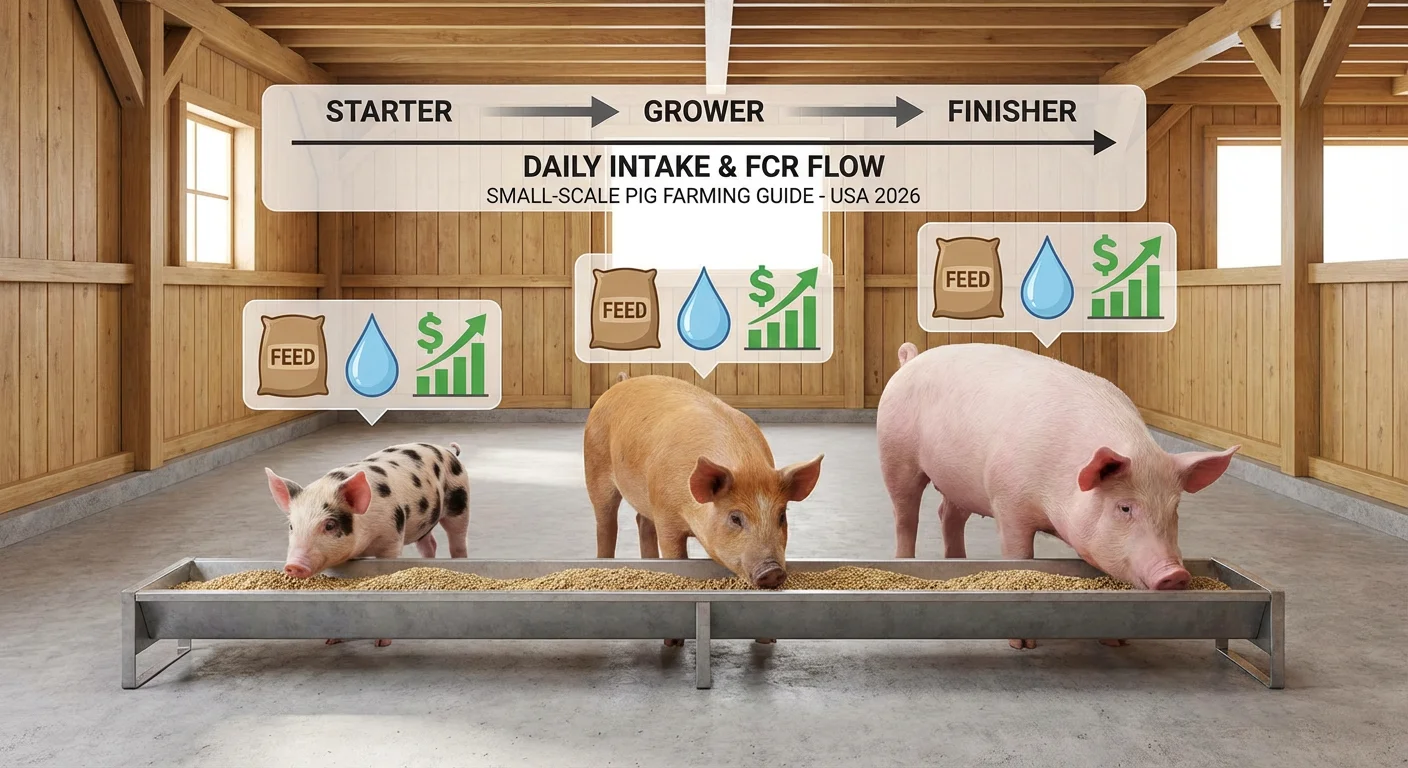
One of the most common questions new pig farmers ask is about pig feeding stages—what to feed when, and why it matters. Here’s the breakdown.
Stage 1: Pre-Starter and Starter Feeds (10-50 lbs)
Young pigs fresh off the sow have immature digestive systems. Young pigs’ guts cannot handle the same ingredients that adult pigs can process easily.
Pre-starter feeds (10-15 lbs):
- Highly digestible protein sources (milk products, blood plasma, fish meal)
- Often medicated or containing zinc oxide for gut health
- Most expensive feed you’ll buy—but pigs eat very little
- Typically fed for 1-2 weeks post-weaning
Starter feeds (15-50 lbs):
- Transitional diet moving toward corn-soy base
- Still relatively high protein (20-22%)
- Smaller pellet size for easier consumption
- Critical period—poor nutrition here affects lifetime performance
Feeding approach:
- Offer feed free-choice (available constantly)
- Use shallow pans or troughs that piglets can access easily
- Keep feed fresh—discard wet or stale feed
- Monitor consumption; healthy piglets should eat aggressively
Stage 2: Grower Feeds (50-125 lbs)
The grower phase is when pigs really start putting on weight. Feed consumption increases dramatically.
Grower feed characteristics:
- 18-20% protein
- Corn-soybean meal-based (cheaper than starter)
- Can use larger pellets or meal form
- May include growth-promoting additives where legal
Feeding approach:
- Continue free-choice feeding for maximum growth
- Alternatively, feed 2-3 times daily at slightly restricted levels for leaner carcasses
- Expect consumption of 4-6 pounds daily by the end of the grower phase
- Monitor body condition—ribs should be felt but not visible
Stage 3: Finisher Feeds (125 lbs to Market)
The finishing phase represents the longest feeding period and the highest total feed consumption.
Finisher feed characteristics:
- 13-16% protein (lower than grower)
- Maximum energy density
- Least expensive per-pound formulation
- Focus on efficient conversion to market weight
Feeding approach:
- Free-choice for fastest growth
- Restricted feeding (85-90% of free-choice) produces leaner carcasses
- Expect 6-10 pounds daily consumption, depending on genetics and management
- Target market weight of 250-280 pounds
Complete Pig Feeding Stages Timeline (Chart)
Here’s what a typical market pig feeding timeline looks like:
| Age | Weight | Feed Type | Daily Intake | Duration |
|---|---|---|---|---|
| Weaning (3-4 weeks) | 12-15 lbs | Pre-starter | 0.5-1 lb | 1-2 weeks |
| 5-8 weeks | 15-50 lbs | Starter | 1-2.5 lbs | 3-4 weeks |
| 8-14 weeks | 50-125 lbs | Grower | 3-6 lbs | 6 weeks |
| 14-24 weeks | 125-280 lbs | Finisher | 6-10 lbs | 10 weeks |
Total time from weaning to market: approximately 20-24 weeks.
What’s the Best Feed for Pigs? Evaluating Your Options
“What’s the best feed for pigs?” might be the most common question at feed stores. The honest answer: it depends on your situation, goals, and budget.
Commercial Complete Feeds
For most small-scale producers, complete commercial feeds are the best choice, especially for beginners.
Advantages:
- Nutritionally balanced by professional nutritionists
- Consistent quality batch to batch
- Convenient—just pour and feed
- Includes vitamins, minerals, and any additives
- Formulated for specific life stages
Disadvantages:
- More expensive per pound than mixing your own
- Less control over ingredients
- Must store properly to maintain quality
What to look for:
- Protein percentage appropriate for life stage
- Reputable manufacturer (Purina, Nutrena, local mills)
- Fresh manufacture date
- Appropriate form (pellets vs. meal vs. crumbles)
Homemade Pig Feed vs. Commercial Feed
Many small farmers wonder about mixing their feed. Here’s the reality.
Homemade feed advantages:
- Potentially lower cost if you have cheap grain access
- Control over all ingredients
- Can incorporate farm-produced feeds or food waste
- Satisfaction with self-sufficiency
Homemade feed disadvantages:
- Requires nutritional knowledge that most farmers lack
- Easy to create amino acid deficiencies or imbalances
- Need for vitamin/mineral premixes anyway
- Inconsistent quality without testing
- Time and equipment for mixing
The verdict: Unless you have agricultural training, access to feed testing, and reliable ingredient sources, commercial feed typically delivers better results. The money you “save” on homemade feed often disappears in slower growth and worse feed conversion.
📋 Example Ration: 100 lb Grower Pig (Corn-Soy Base)
This is an approximate example only—not a prescription. Always verify with extension resources or a swine nutritionist before mixing your feed.
Ingredient Pounds per 100 lbs Feed Ground corn 76-78 lbs Soybean meal (48%) 18-20 lbs Vitamin-mineral premix 2-3 lbs Salt 0.5 lb Limestone 0.5-1 lb Approximate analysis: 16-17% crude protein, 0.85% lysine
Warning: This basic formula lacks many micronutrients. Commercial premixes are essential. Consult your local extension service for complete, tested formulations specific to your region.
Alternative and Supplemental Feeds
Small farms often have access to feeds beyond standard commercial options.
Garden and kitchen scraps:
- Vegetables, fruits, bread, and dairy products can supplement diets
- Never feed meat or food containing meat (disease risk)
- Limit to 10-20% of total diet to avoid imbalances
- Cook beans, potatoes, and other problematic foods before feeding
Pasture and forage:
- Pigs utilize pasture poorly compared to ruminants
- Provides enrichment and some nutrition (5-15% of needs)
- Not a substitute for balanced feed
- Best viewed as supplemental, not primary nutrition
- For pasture-based systems, our sustainable and organic pig farming guide covers integration strategies
Brewery/bakery waste:
- Can be excellent feed sources when available
- Highly variable in nutrition—test if using regularly
- Storage and spoilage are concerns
- Price accordingly; “free” feed that’s 80% water isn’t free
How Much Should Pigs Eat Per Day? Daily Feeding Guidelines
Determining how much pigs should eat daily matters both for budgeting and animal performance. Here’s how to approach it.
The Body Weight Rule
A practical starting point: pigs eat approximately 3–5% of their body weight daily in feed.
This varies by:
- Age (young pigs eat more relative to body weight)
- Genetics (lean genetics often eat less)
- Environment (cold weather increases intake)
- Feed quality (pigs eat more low-energy feeds)
Daily Pig Feed Chart by Weight
| Pig Weight | Approx. Daily Intake | Notes |
|---|---|---|
| 25 lbs | 1-1.5 lbs | High relative intake |
| 50 lbs | 2-3 lbs | Transitioning to grower |
| 100 lbs | 4-5 lbs | Rapid growth phase |
| 150 lbs | 5-7 lbs | Approaching market weight |
| 200 lbs | 6-8 lbs | Feed efficiency declining |
| 250 lbs | 7-9 lbs | Near market weight |
Free-Choice vs. Limit Feeding
Free-choice feeding:
- Feed available constantly
- Maximizes growth rate
- Simplest management approach
- May produce fatter carcasses
- Higher total feed consumption
Limit feeding:
- Controlled amounts offered 2-3 times daily
- Typically, 85-95% of free-choice amounts
- Produces leaner carcasses
- Requires more labor
- Better feed efficiency (less waste)
For most small-scale producers raising a few pigs for home use, free-choice feeding works fine. If you are selling pigs and want to ensure carcass leanness, consider implementing limit feeding during the finishing phase.
Water Requirements for Pigs (Table)
Don’t forget water. The standard rule is a water-to-feed ratio of 2:1 to 3:1—meaning pigs drink 2-3 pounds of water for every pound of feed consumed.
As a practical guideline: 2-3 gallons per 100 pounds of body weight daily.
| Pig Weight | Daily Water (Gallons) | Notes |
|---|---|---|
| 50 lbs | 1-1.5 gal | Growing pigs |
| 100 lbs | 2-3 gal | Active growth |
| 200 lbs | 4-6 gal | Near market weight |
| 250 lbs | 5-7 gal | Market hogs |
| Lactating sow | 6-10 gal | Highest demand |
Important: These figures apply to moderate climates and indoor/shaded systems. Outdoor and pasture systems in hot weather may require 20%–30% more water. Always ensure unlimited access to clean, fresh water.
Water quality matters:
- Clean, fresh, temperature-appropriate
- Check waterers daily for function
- Test well water annually for nitrates and bacteria
- Dirty or restricted water immediately reduces feed intake
Pig Feed Conversion Ratio (FCR): The Profitability Number
Pig feed conversion ratio (FCR) measures how efficiently pigs convert feed into body weight. It’s arguably the most important number in pig production economics.
Understanding FCR
FCR = Pounds of Feed ÷ Pounds of Gain
An FCR of 3.5 means the pig ate 3.5 pounds of feed for every pound of weight gained.
Lower is better. An FCR of 3.0 beats an FCR of 4.0—same gain with less feed.
Typical FCR Values (Reference Table)
| Life Stage | Typical FCR | Notes |
|---|---|---|
| Nursery (15-50 lbs) | 1.5-2.0 | Best efficiency of entire growth period |
| Grower (50-125 lbs) | 2.2-2.8 | Still relatively efficient |
| Finisher (125-280 lbs) | 3.2-4.0 | Efficiency declines as pigs mature |
| Overall (weaning to market) | 2.8-3.5 | Commercial genetics, optimal management |
Reality Check for Small Farms: The FCR values above reflect commercial genetics under optimal conditions. Small-scale operations using heritage breeds, outdoor systems, or less-improved genetics may see an FCR of 4.0–5.0 or higher. Such an outcome isn’t necessarily a problem—heritage breeds often command premium prices that offset lower efficiency.
Factors Affecting Feed Conversion
Genetics —modern lean genetics converts more efficiently than heritage breeds. Trade-off: heritage breeds often have superior meat quality and hardiness.
Health status —sick pigs eat poorly and convert terribly. Disease prevention pays through better FCR. Our pig health and disease management guide covers prevention strategies that protect your feed investment.
Feed quality —balanced nutrition with appropriate energy and amino acids converts better than cheap, imbalanced feeds.
Environment – Temperature extremes hurt efficiency. Cold pigs use feed for warmth; hot pigs eat less.
Water availability —restricted water immediately hurts feed intake and conversion.
Feeder design – Poor feeders waste feed. When pigs root feed on the floor, it results in a loss of money.
Why FCR Matters More Than Feed Price
Here’s a scenario that illustrates the point:
Feed A: $15 per 50-lb bag, FCR of 4.0 Feed B: $18 per 50-lb bag, FCR of 3.2
To gain 200 pounds:
- Feed A: 800 lbs feed needed = $240
- Feed B: 640 lbs feed needed = $230
The “expensive” feed actually costs less per pound of pork produced. This is why the cheapest bag on the shelf often isn’t the most economical choice.
Feeding Pigs for Weight Gain: Maximizing Growth Efficiency
When your goal is efficient feeding for weight gain, several strategies help pigs reach market weight faster and more economically.
Optimize the Nursery Phase
Performance in the first weeks after weaning sets the trajectory for the entire growing period. Pigs that struggle early never fully catch up.
Key nursery practices:
- Provide highly digestible starter feeds without penny-pinching
- Maintain a warm, dry, draft-free environment (75-85°F for young piglets)
- Ensure adequate feeder and waterer space
- Minimize stress from mixing, moving, and handling
- Address health problems immediately
Match Feed to Growth Phase
Don’t keep pigs on grower feed too long, and don’t switch to finisher too early.
General guidelines:
- Switch from starter to grower at 50 lbs
- Switch from grower to finisher at 125 lbs
- Consider a late-finisher formula for the last 3-4 weeks if available
Additives and Growth Promotants (2026 Regulations)
The regulatory landscape around feed additives continues evolving. As of 2026:
FDA Veterinary Feed Directive (VFD) rules require veterinary oversight for antibiotics used in feed for growth promotion or disease prevention. You cannot simply buy medicated feed over the counter for growth promotion purposes. For details on current regulations affecting pig production, see our U.S. pork market and regulations guide.
Non-antibiotic options include:
- Organic acids (gut health support)
- Probiotics and prebiotics
- Essential oils
- Enzyme supplements
Whether these alternatives deliver meaningful performance improvements in small-scale settings remains debatable. Many work best under commercial conditions with measurable stress factors.
🚨 Red Flags Your Pig Feed Program Is Failing
Watch for these warning signs that indicate nutritional problems:
- Slow or stalled growth – Pigs not gaining 1.5-2 lbs daily during grower phase
- Rough, dull hair coat – Often indicates protein or mineral deficiency
- Loose or watery manure – May signal poor feed quality or digestive issues
- Excessive fat deposition – Too much energy, not enough protein
- Pigs chewing on wood, fences, or each other – Possible mineral deficiency or boredom
- Uneven growth within a group – Check feeder access and health status
- Poor appetite despite adequate water – Investigate feed freshness and health issues
If you see multiple red flags, review your feed programme and consult our pig health and disease management guide to rule out underlying health problems.
Sow Nutrition: Breeding, Gestation, and Lactation Feeding
Breeding animals have nutritional needs distinct from market hogs. Feeding breeding stock like finisher pigs creates problems. For complete breeding management information, our breeding and reproduction in pigs guide covers the full reproductive cycle.
Boar Nutrition
Boars need to stay in working condition—fit, not fat.
Key considerations:
- Lower energy than market hog diets
- Adequate protein (14-16%)
- Avoid excess weight that causes breeding problems
- Feed 4-6 pounds daily, depending on size and activity
- The condition score should be 3-3.5 (ribs felt with light pressure)
Gilt Development Feeding
Replacement gilts require careful nutrition to reach breeding weight without becoming fat.
Guidelines:
- Feed a gilt developer or moderate-energy grower diet
- Target 280-320 lbs at first breeding
- Avoid high-energy finisher diets that create fat gilts
- Provide adequate calcium and phosphorus for skeletal development
Gestation Feeding Schedule
Pregnant sows need enough nutrition to support fetal development while maintaining body condition—but not so much that they become obese.
First 75 days:
- Moderate feeding: 4-5 pounds daily
- Avoid overfeeding—embryo loss can result
- Body condition score should remain stable
Days 75-114:
- Increase to 6-7 pounds daily
- Fetal growth accelerates dramatically
- Additional protein may benefit large litters
Common mistakes:
- Overfeeding early gestation (creates fat sows)
- Underfeeding late gestation (reduces birth weights)
- Feeding market hog diets lacking reproductive nutrients
Lactation Feeding Requirements
Lactating sows have the highest nutritional demands of any production stage. Milk production requires an enormous nutrient intake.
Key practices:
- Build up to full feed gradually over 5-7 days post-farrowing
- Target 12-18 pounds daily, depending on litter size
- Rule of thumb: 4 lbs base + 1 lb per nursing piglet
- Higher protein than gestation (16-18%)
- Unlimited fresh water (sows drink 6-10 gallons daily)
Signs of inadequate lactation nutrition:
- Rapid condition loss (more than one body score)
- Reduced milk production (thin, vocal piglets)
- Prolonged return to heat after weaning
- Poor subsequent breeding performance
Many small farms feed the same diet year-round to breeding stock. If you do this, choose a formula designed for lactation—it’s better to slightly overfeed gestating sows than starve lactating ones.
Pig Feed Charts and Feeding Schedules (Printable Reference)
Many farmers want a simple pig feed chart they can reference daily. Here’s a practical feeding schedule for market hogs and breeding stock.
Market Hog Feeding Schedule (PDF-Ready Table)
| Week | Age | Approx. Weight | Feed Type | Daily Amount | Cumulative Feed |
|---|---|---|---|---|---|
| 1 | Weaning | 12-15 lbs | Pre-starter | 0.5-0.75 lb | 4 lbs |
| 2-3 | 4-5 wks | 15-25 lbs | Starter | 1-1.5 lbs | 20 lbs |
| 4-6 | 6-8 wks | 25-50 lbs | Starter | 1.5-2.5 lbs | 55 lbs |
| 7-10 | 9-12 wks | 50-100 lbs | Grower | 3-5 lbs | 170 lbs |
| 11-14 | 13-16 wks | 100-150 lbs | Grower/Finisher | 5-7 lbs | 340 lbs |
| 15-20 | 17-22 wks | 150-230 lbs | Finisher | 6-8 lbs | 630 lbs |
| 21-24 | 23-26 wks | 230-280 lbs | Finisher | 7-9 lbs | 850 lbs |
Total feed weaning to market: approximately 700-900 pounds, depending on genetics, management, and target weight.
Breeding Stock Feeding Schedule (Table)
| Production Stage | Daily Feed Amount | Protein % | Duration | Notes |
|---|---|---|---|---|
| Gilt development | 5-6 lbs | 16% | Until breeding | Prevent over-conditioning |
| Breeding/Early gestation | 4-5 lbs | 14% | Days 1-75 | Maintain condition |
| Late gestation | 6-7 lbs | 14-16% | Days 75-114 | Support fetal growth |
| Lactation | 12-18 lbs | 16-18% | 3-8 weeks | Maximize milk production |
| Post-weaning | 6-8 lbs | 16% | Until breeding | Rebuild condition |
| Boars (maintenance) | 4-6 lbs | 14-16% | Ongoing | Prevent obesity |
Creating Your Own Feed Budget
To estimate feed needs for your operation:
- Market hogs: Plan 800 pounds per pig from weaning to market
- Breeding sows: Plan 1,800-2,200 pounds per sow per year
- Boars: Plan 1,400-1,600 pounds per year
Add 5–10% to waste, spillage, and the inevitable adjustments.
For those wanting detailed printable resources, search extension service websites for “pig feed chart”—most state universities offer free downloadable feeding guides updated for current recommendations.
Common Pig Feeding Mistakes and How to Avoid Them
Years of working with small-scale pig farmers reveal consistent patterns of feeding mistakes. Here’s what to avoid.
Mistake #1: Feeding One Diet to All Ages
Using a single “pig feed” from weaning to market ignores changing nutritional needs. Young pigs fed low-protein finisher diets grow poorly. Finishing pigs fed high-protein starters waste expensive proteins as nitrogen in manure.
Fix: Use stage-appropriate feeds. At minimum, use a starter diet through 50 lbs and a grower/finisher from there on.
Mistake #2: Buying the Cheapest Feed Available
The $2 difference between bags matters less than the feed conversion those bags deliver. Cheap feed with poor conversion costs more per pound of pork produced.
Fix: Calculate feed cost per pound of gain, not just per bag. Track FCR to identify truly economical feeds.
Mistake #3: Inadequate Water Supply
Water restriction immediately reduces feed intake. Pigs won’t eat if they can’t drink.
Fix: Ensure waterers function properly and deliver adequate flow. Check daily. Provide at least one waterer per 10 pigs, positioned where all pigs can access it easily.
Mistake #4: Overfeeding Gestating Sows
Well-meaning farmers keep pregnant sows on full feed, creating obese animals that have difficult farrowings and poor milk production.
Fix: Limit gestating sows to 4-5 pounds daily during early gestation. Increase only in the last 5–6 weeks. Use body condition scoring rather than guessing.
Mistake #5: Ignoring Feeder Adjustment
Improperly adjusted feeders waste feed—either restricting intake or allowing pigs to root feed onto the floor.
Fix: Adjust feeders so approximately 50% of the pan bottom is covered when feed flows. Check and adjust at least weekly as pigs grow.
Mistake #6: Abrupt Feed Changes
Sudden diet switches upset gut function and reduce performance. Pigs need time to adjust to new feeds.
Fix: Transition between feeds over 5-7 days, gradually increasing the proportion of new feed while decreasing old.
Mistake #7: Storing Feed Improperly
Foods stored in damp conditions mould quickly. Rodents contaminate and waste stored feed. Old feed loses nutritional value.
Fix: Store feed in dry, rodent-proof containers. Use the oldest feed first. Don’t buy more than a 2–3 week supply in warm weather.
Mistake #8: Ignoring Body Condition
Some farmers feed by calendar rather than observation. A pig that needs more feed doesn’t care what the schedule says.
Fix: Learn to assess body condition. Ribs should be felt with light pressure but not visible. Adjust feeding based on condition, not just routine.
Cost-Efficient Pig Feeding Strategies for Small Farms
Feed costs have a significant impact on profitability. Here’s how to optimise without sacrificing performance:
Buy Smarter
Volume discounts: If you can store it properly, buying feed in bulk (tonne quantities) often costs 10–15% less per pound than bags.
Local mills: Regional feed mills sometimes offer better prices than national brands with comparable quality.
Timing purchases: Some feeds cost less at certain times of year. Ask your supplier about seasonal pricing.
Group purchasing: coordinate with neighbouring farms to achieve volume pricing breaks.
Reduce Waste
Feeder management: Properly adjusted feeders can reduce waste by 5-10%—significant over a growing period.
Rodent control: Mice and rats consume and contaminate substantial feed in poorly managed storage.
Fresh feed: Pigs eat stale feed poorly. Keep feeders clean and don’t overfill.
Strategic Supplementation
Pasture and forage: Pigs on well-managed pasture may eat 10-15% less purchased feed while gaining comparable weights. For detailed pasture integration strategies, see our sustainable and organic pig farming guide.
Food byproducts: Bakery waste, brewer’s grains, or vegetable culls can reduce feed costs when consistently available. Factor in labour and storage costs.
Garden produce: Excess vegetables, damaged fruit, and kitchen scraps provide supplemental nutrition and reduce feed bills modestly.
Know When to Market
There is a threshold beyond which the benefits diminish. Taking pigs beyond 280–300 pounds increasingly converts feed to fat rather than saleable meat. Unless you have specific reasons (breeding stock size, customer preference), market pigs before efficiency deteriorates further.
2026 Best Practices: Modern Pig Feeding for Small Farms
Pig nutrition continues evolving. Here’s what matters for small-scale producers in 2026.
FDA Medicated Feed Regulations
The Veterinary Feed Directive (VFD) rules now firmly apply across the industry:
- Antibiotics used in feeds for growth promotion or disease prevention require veterinary approval.
- Over-the-counter medicated feeds are limited to non-antibiotic products
- Proper documentation must accompany VFD feeds
- Withdrawal periods must be observed before slaughter
For small farms: Establish a relationship with a veterinarian who can authorise medicated feeds when they are genuinely needed. Focus on management and nutrition that reduces the need for antibiotics.
Feed Efficiency and Environmental Considerations
There is ongoing pressure to reduce nutrient excretion, particularly nitrogen and phosphorus, in manure.
Practical implications:
- Don’t overfeed protein; excess becomes nitrogen pollution
- Phase feeding (multiple diets matching needs) reduces waste
- Proper body condition feeding prevents over-consumption
- Pasture systems that utilize manure nutrients directly
Precision Feeding Tools for Small Farms
While industrial-scale precision feeding systems remain impractical for most small farms, some accessible tools exist:
Digital scales: Affordable livestock scales allow regular weighing and FCR calculation.
Feed management apps: Smartphone apps help track consumption, calculate conversions, and project feed needs.
Automated feeders: Small-scale automated feeders exist for operations seeking labour savings, though their costs remain significant.
Sustainable and Ethical Feeding Considerations
Consumer interest in production practices influences marketing opportunities.
Practices to consider:
- Non-GMO or organic feeds (premium markets)
- Pasture-raised production models
- Avoiding sub-therapeutic antibiotics
- Local and regional feed sourcing
- Heritage breed production with appropriate nutrition
These approaches often cost more but can return premiums through direct marketing channels. Understanding your target market helps—our guide on pig farming economics discusses pricing strategies for different market segments.
Frequently Asked Questions (FAQ)
What is the best feed for pigs in the USA?
For most small-scale producers, commercial complete feeds from reputable manufacturers (Purina, Nutrena, or quality regional mills) deliver the best results. Choose feeds formulated for your pigs’ life stage—starter for young pigs, grower for 50-125 lb pigs, and finisher for market-weight animals. While homemade rations can work, they require nutritional expertise that most beginners lack.
How much feed does a pig need per day?
Pigs typically eat 3–5% of their body weight per day. A 100-lb pig eats about 4-5 lbs per day; a 200-lb pig eats 6-8 lbs. Total feed from weaning to market weight (280 lbs) runs approximately 700-900 pounds, depending on genetics and management. Lactating sows have the highest intake, 12–18 lbs daily.
What is a good FCR for pigs?
Under commercial conditions, the favourable overall feed conversion ratio (FCR) is 2.8–3.5, from weaning to market weight. Nursery pigs achieve 1.5-2.0; finishers typically run 3.2-4.0 as efficiency naturally declines with age. Small-scale operations using heritage breeds or outdoor systems may see an FCR of 4.0-5.0, which is acceptable if premium pricing offsets lower efficiency.
How often should I feed pigs?
Most small farms use free-choice feeding (feeds that are always available), which is the simplest and maximises growth. Alternatively, restricted feeding (2–3 meals per day in controlled quantities) produces leaner carcasses but requires more labour. Whichever method you choose, ensure all pigs can eat simultaneously and always provide unlimited fresh water.
Can pigs eat kitchen scraps and garden waste?
Yes, but with limits. Vegetables, fruits, bread, and dairy can supplement pig diets but should constitute no more than 10–20% of total intake. Never feed meat or food containing meat products (disease risk). Cook beans and potatoes before feeding. Scraps supplement but cannot replace a balanced commercial feed.
Where can I find a pig feed chart PDF?
Most state university extension services offer free downloadable pig feeding guides and charts. Search “[your state] extension swine feeding guide” or check websites like Iowa State, Purdue, Penn State, or NC State. The Pork Checkoff (pork.org) also provides producer resources. These PDFs are updated regularly to reflect current nutritional recommendations.
Conclusion: Feeding for Success
Sound pig nutrition and feeding don’t require advanced degrees or expensive equipment. It requires understanding basic principles, selecting appropriate feeds, monitoring results, and adjusting based on what you observe.
The fundamentals haven’t changed much over the decades:
- Match feed to life stage
- Provide constant access to clean water
- Adjust based on body condition
- Track performance to catch problems early
- Don’t sacrifice quality for cheap price tags
What has changed: feed formulations continue improving, regulations around medicated feeds have tightened, and consumer expectations around production practices have risen.
For small-scale producers, the path forward remains straightforward. Start with quality commercial feeds appropriate for your pigs’ life stages. Keep excellent records. Pay attention to your animals. Learn from each group you raise.
The pigs will tell you whether your feeding programme works. Growing, healthy pigs with excellent appetites and proper condition are receiving adequate nutrition. Slow growth, poor condition, and health problems signal something’s wrong.
Feed represents your highest cost. Getting it right—not just cheap, but right—determines whether your pig operation makes money or loses it.
Good luck with your pigs.
Quick Reference: Key Numbers to Remember
| Metric | Target Range |
|---|---|
| Feed intake (% (body weight) | 3-5% daily |
| Water-to-feed ratio | 2:1 to 3:1 |
| Starter protein | 20-24% |
| Grower protein | 18-20% |
| Finisher protein | 13-16% |
| Lactation protein | 16-18% |
| Overall FCR (commercial) | 2.8-3.5 |
| Overall FCR (small-scale/heritage) | 3.5-5.0 |
| Total feed (weaning to 280 lbs) | 700-900 lbs |
| Market weight target | 250-280 lbs |
| Gestation feeding | 4-7 lbs/day |
| Lactation feeding | 12-18 lbs/day |