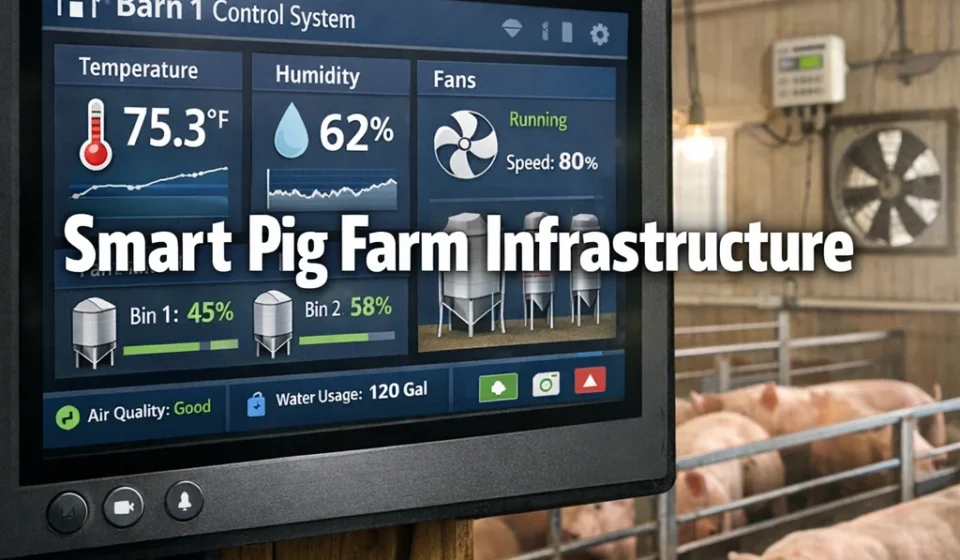
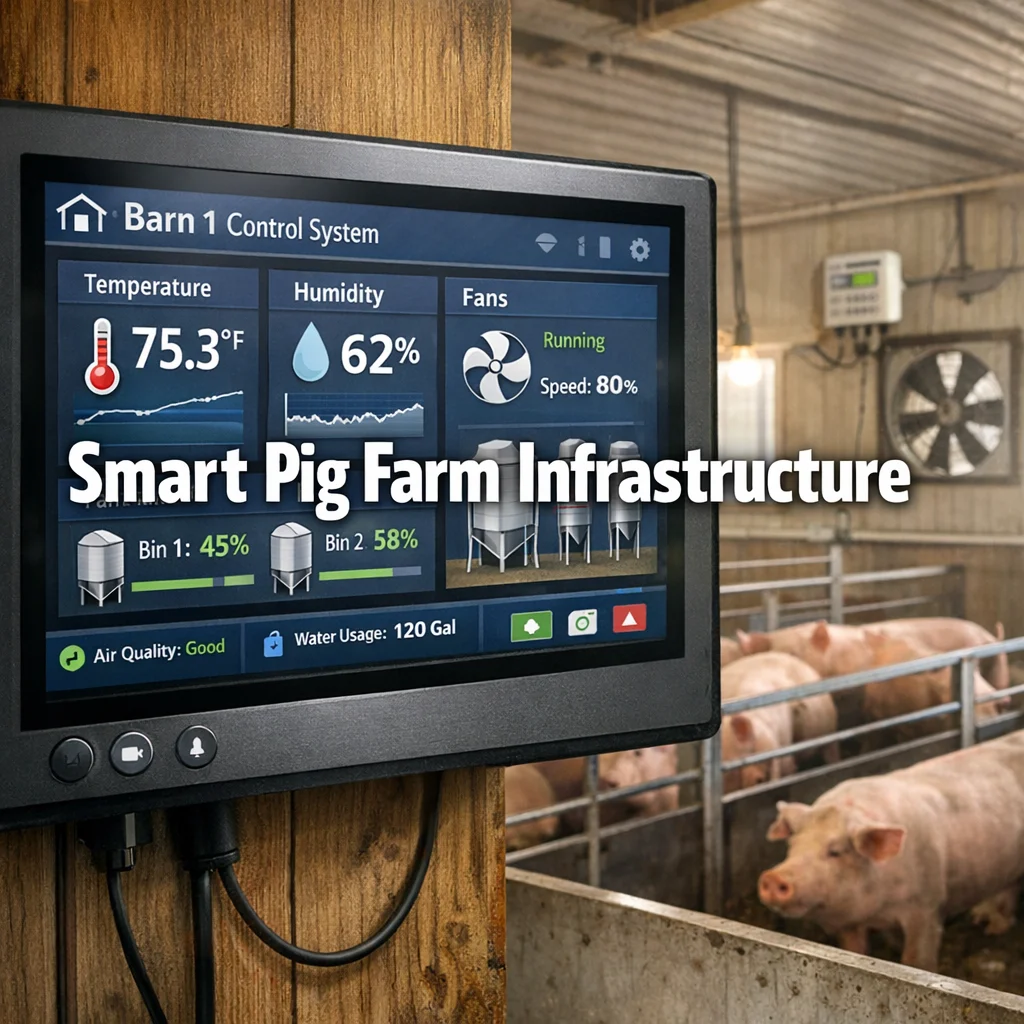
Smart pig farm infrastructure replaces manual observation, intuition-based decisions, and delayed responses with continuous automated monitoring, data-driven decision-making, and real-time intervention. The core value proposition is consistency — automated systems don’t forget to check the temperature at 3 AM, don’t estimate feed amounts by eye, don’t skip ventilation adjustments during busy days, and don’t wait until morning to respond to overnight water system failures.
The technology ranges from basic (environmental controllers that have been standard on commercial farms for 30+ years) to advanced (camera-based AI systems that detect individual sick pigs by gait analysis). The ROI follows the same gradient: basic automation pays for itself in months through labour savings and loss prevention; advanced systems require larger herds and higher per-pig margins to justify their investment. The key is matching technology level to operation scale, management capability, and the specific production bottleneck each system addresses.
This article covers seven automation systems ranked by ROI, installation costs, operation requirements, and the practical integration challenges that determine whether technology delivers its promised returns. For how automation integrates with overall barn design, see pig barn design: key features and layouts. For how environmental control prevents production losses, see temperature control in pig farms.
TL;DR — Quick Takeaways
- Environmental controllers take care of heating, cooling, and ventilation automatically. They keep the temperature within ±1°F of the setpoint, while manual management can let it go up to ±5–10°F.
- Automated feeding systems (overhead augers + electronic dispensers) save 1–2 hours of daily labour per 1,000-head barn and reduce feed waste by 3–5% through precise delivery.
- Electronic Sow Feeding (ESF) stations serve 40–60 sows each at $1,500–3,000 per station, enabling individual feed allocation in group housing.
- Monitoring water flow detects consumption drops of 10–15% within 12 hours—the earliest indicator of disease onset, 24–48 hours before clinical signs appear.
- Camera-based monitoring systems ($2,000–5,000 per barn) enable remote observation, reducing daily barn visits while improving problem detection.
- Environmental sensors (temperature, humidity, ammonia, CO₂) at $50–200 each provide real-time data that prevents the environmental extremes responsible for 15–25% of production losses.
- Total automation investment for a 1,000-head finishing barn: $15,000–35,000 above the manual baseline — generating a $5,000–15,000 annual return through labour savings, reduced feed waste, and improved environmental control.
System 1: Environmental Controllers (Essential)
Environmental controllers are not optional technology — they are the baseline automation that every enclosed pig barn requires. A controller monitors temperature (and optionally humidity, static pressure, and ammonia) and automatically adjusts fan speeds, inlet openings, heater output, and cooling pad pumps to maintain the target environment.
What Controllers Do
| Function | Manual Management | Controller Management | Performance Difference |
|---|---|---|---|
| Temperature maintenance | ±5–10°F of target | ±1–2°F of target | 3–8% better FCR at consistent temp |
| Fan staging | 2–3 adjustments/day (if remembered) | Continuous, every 30–60 seconds | Prevents temperature spikes and valleys |
| Minimum ventilation | Often over- or under-ventilated | Precise timer cycles (60 sec on/off) | Ammonia and moisture at target levels |
| Heat/cool coordination | Often conflicting (heat and cool simultaneously) | Interlocked — prevents simultaneous operation | 10–20% energy savings |
| Alarm function | None (problems found next morning) | Immediate alert (phone, text, siren) | Prevents catastrophic losses |
Controller Specifications
| Feature | Basic Controller | Mid-Range | Premium |
|---|---|---|---|
| Temperature zones | 1 | 2–4 | 8+ |
| Fan stages | 4–6 | 8–12 | 16+ with variable speed |
| Alarm capability | Local siren only | Phone dialer (1–4 numbers) | Cloud alert, smartphone app |
| Data logging | None | 7–30 days | Unlimited cloud storage |
| Remote access | None | Phone dial-in | Web/app dashboard |
| Cost per barn | $500–1,500 | $1,500–4,000 | $4,000–10,000 |
The alarm function alone justifies the investment. A ventilation failure in a sealed 1,000-head finishing barn on a 95°F day causes mass heat death within 30–60 minutes. A controller with a phone dialler alarm alerts the manager immediately—the $500–1,500 controller prevents a $200,000+ catastrophic loss.
ROI: A basic controller ($1,000) saves 3% FCR on a 1,000-head barn = $5,000–7,000 in annual feed savings + catastrophic loss prevention. Payback: 2–3 months.
System 2: Automated Feed Delivery
Automated feeding systems transport feed from bulk bins to individual barn feeders via overhead auger lines, eliminating manual feed delivery labour and providing precise feed scheduling.
Components
- Bulk feed bins (10–25 tonne capacity): $3,000–8,000 each. Typically, phase-feeding programmes require 2–4 bins per barn.
- Auger delivery system (4–6 inch diameter flex auger): $12,000–20,000 installed for a 1,000-head barn. The system transports feed from the bins through overhead lines to designated drop points at each feeder.
- Feed sensing (bin level indicators): $200–500 per bin. The system sends out alerts when the feed level is low, thereby preventing the occurrence of empty-feeder events.
- Programmable controllers (optional): $500–2,000. Schedule feed delivery times, rotate between feed phases, and track consumption.
Labor and Waste Savings
| Metric | Manual Feeding | Automated Delivery | Savings |
|---|---|---|---|
| Daily labor (1,000 head) | 1.5–2.5 hours | 0.25–0.5 hours | 1–2 hours/day |
| Feed waste (spillage) | 3–5% | 1–2% | 2–3% of total feed |
| Empty feeder events | 2–5 per month | 0–1 per month | Prevents growth gaps |
| Annual labor savings | 365–730 hours | — | $5,500–11,000 at $15/hr |
| Annual feed waste savings | $4,500–7,500 | — | At 2.5% of $180,000 feed cost |
Total annual savings: $10,000–18,500 for a 1,000-head barn. System cost: $15,000–28,000. Payback: 1.0–2.5 years.
System 3: Water Flow Monitoring
Water consumption is the earliest and most reliable indicator of pig health status. Healthy pigs drink predictably, consuming 1.5–2.5 gallons per 100 lbs of body weight daily and maintaining consistent daily patterns. A 10–15% consumption drop signals disease onset 24–48 hours before clinical signs (lethargy, coughing, fever) become visible.
How It Works
A water flow meter ($100–300) installed on the barn’s main water line measures total daily consumption. Advanced systems ($500–1,500) measure per-room or per-pen consumption with multiple meters and data logging.
| Alert Level | Consumption Change | Likely Cause | Response |
|---|---|---|---|
| Normal | ±5% of baseline | Normal variation | None |
| Early warning | –10–15% from baseline | Early disease, mild environmental stress | Increase observation; check water system |
| Action | –15–25% from baseline | Disease outbreak, water system partial failure | Walk barn immediately; check for clinical signs |
| Emergency | –25%+ from baseline | Water system failure, severe disease event | Immediate barn check; verify water delivery |
Cost: $100–300 per meter (basic flow measurement) or $500–1,500 for a monitored system with data logging and alerts. ROI: Detecting a disease outbreak 24–48 hours earlier allows treatment before clinical severity—reducing mortality by 0.5–1.5 percentage points per event. On a 1,000-head barn with 2–3 health events per year, this procedure prevents 10–45 pig deaths worth $1,700–7,650.
For how water delivery integrates with drinker design, see watering and feeding equipment setup.
System 4: Electronic Sow Feeding (ESF)
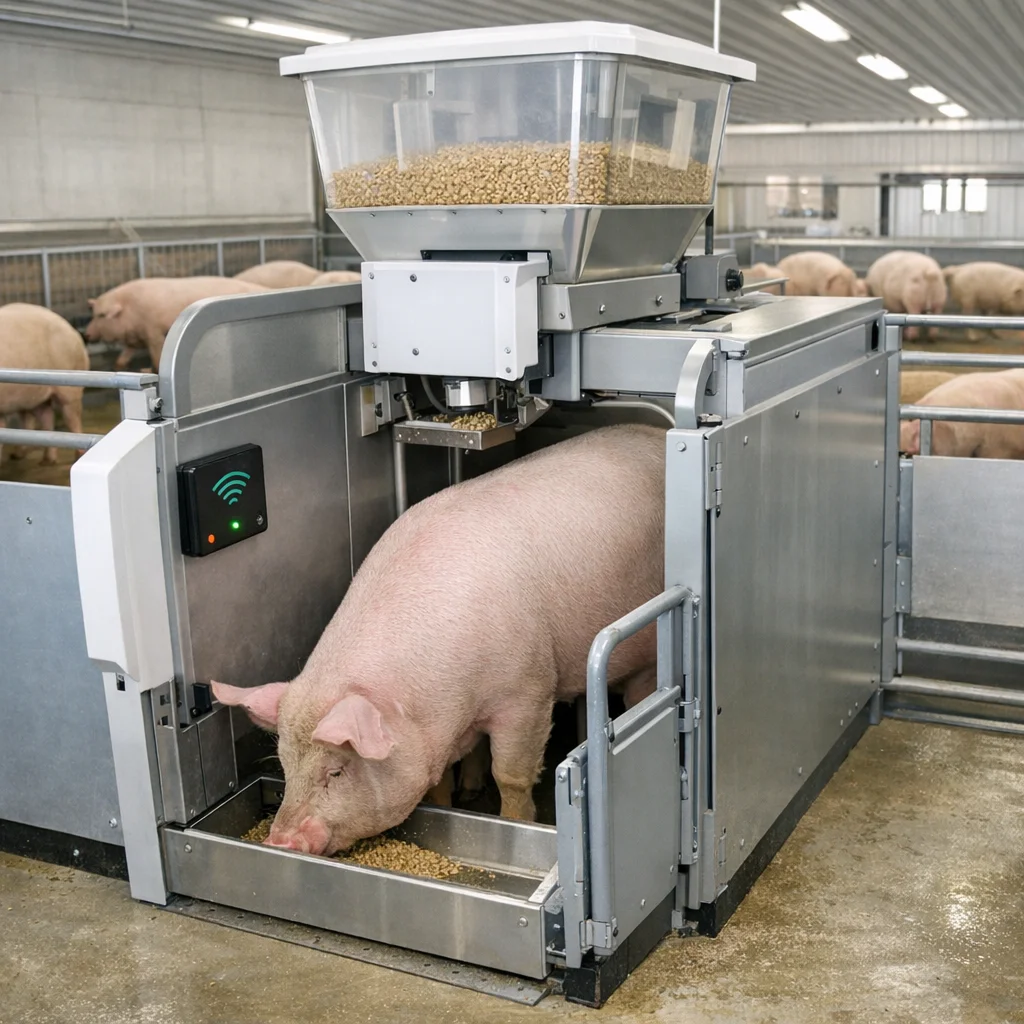
ESF stations individually identify sows (via RFID ear tags) and dispense a customised feeding ration specific to each animal’s body condition, gestation stage, and parity. This enables precise individual nutrition in group-housed sow systems—solving the fundamental challenge of group housing, where aggressive sows overconsume and timid sows are underfed.
How ESF works: A sow enters the feeding station, the RFID reader identifies her tag, the controller looks up her daily ration (3–8 lbs depending on gestation stage and body condition), and the dispenser delivers that exact amount while an entry gate prevents other sows from entering. Feeding takes 8–15 minutes per sow. Stations operate 20–22 hours per day to accommodate 40–60 sows per station.
Cost: $1,500–3,000 per station installed. A 200-sow gestation barn requires 4–5 stations: $6,000–15,000 total.
Benefits:
- Individual feed allocation reduces feed waste 5–10% versus floor feeding in groups.
- Body condition uniformity improves — fewer under-conditioned and over-conditioned sows at farrowing.
- Each sow’s daily feed intake is recorded, enabling individual health monitoring (sows that skip meals are flagged for observation).
- This system facilitates adherence to group housing mandates (Prop 12, retailer requirements) and ensures individual nutrition management.
System 5: Camera and Visual Monitoring
Camera systems provide remote barn observation—reducing the number of physical barn entries (which improves biosecurity) while improving the frequency and quality of monitoring.
System Types
| Type | Cost per Barn | Features | Best For |
|---|---|---|---|
| Basic IP cameras | $500–1,500 | Live view, manual review | Remote observation, security |
| Recorded surveillance | $2,000–5,000 | 24/7 recording, 7–30 day storage | Event review, mortality investigation |
| AI-enhanced monitoring | $5,000–15,000 | Automated behavior analysis, alerts | Large operations, early disease detection |
Basic cameras ($100–300 each, 2–4 per barn) provide live smartphone access to barn conditions. A manager can check barn status from home at midnight without driving to the farm — verifying that fans are running, pigs are distributed normally, and no equipment failures are visible.
AI-enhanced systems (emerging technologies) analyse camera feeds for abnormal pig behaviour—reduced activity, isolation from the group, abnormal postures, or coughing patterns. Early-generation systems detect illness events 12–24 hours before human observation. Current limitations: high false-positive rates (10–20%) and significant cost.
System 6: Automated Sorting and Weighing
Automated sorting scales weigh pigs as they pass through a single-file chute and sort them into destination pens based on weight—replacing manual visual estimation with objective measurement.
How it works: Pigs walk voluntarily through a scale chute (attracted by a water or feed reward on the exit side). The scale records weight, and a pneumatic gate directs each pig to the appropriate pen: light pigs return to the main group, and market-weight pigs are directed to the marketing pen.
Cost: $8,000–20,000 per scale unit. The scale unit can accommodate 500–2,000 pigs, depending on the layout of the barn.
Benefits:
- Sort marketing precision: pigs are marketed within ±5 lbs of target weight versus ±15–20 lbs with visual estimation.
- Improved packer premiums: $2–5 per pig from more consistent carcass weights within the packer’s preferred grid.
- Growth monitoring: daily weight data identifies pens or barns with declining growth rates before closeout.
ROI: On a 1,000-head barn, $3/pig improvement in marketing precision = $3,000/turn × 2.5 turns = $7,500/year. System cost: $10,000–15. Payback: 1.5–2.0 years.
System 7: Integrated Farm Management Software
Farm management software centralises data from environmental controllers, feed systems, water meters, scales, and health records in a single dashboard. This enables whole-farm performance tracking, trend analysis, and benchmark comparison.
Available platforms: PigCHAMP, MetaFarms, Agrovision, and proprietary integrator systems. Cloud-based platforms cost $500–3,000/year in subscription fees plus setup costs.
What the software tracks:
- The software tracks closeout performance (ADG, FCR, mortality, feed cost/lb gain) by barn, group, and genetics.
- The software correlates environmental data such as temperature, ventilation, and energy consumption with performance.
- We analyse health events, including treatments, the cause of mortality, and diagnostic results, by barn and time.
- We compare the actual feed consumption with the projected levels to identify instances of over- or underfeeding.
- The data also includes financial performance metrics such as cost per pig, revenue per pig, and margin per pig, broken down by production group.
Operations that use integrated management software do 3–5% better in Feed Conversion Ratio (FCR) and 0.5–1.0% better in mortality compared to those that don’t, because the software helps spot and fix issues quickly that might otherwise go
For how performance data drives finishing barn management, see grower and finisher barn management.
Total Automation Investment by Farm Scale
| Operation Size | Essential Automation | Recommended Add-ons | Total Investment | Annual Return |
|---|---|---|---|---|
| 50–200 head (small/backyard) | Basic controller + water meter | Camera system | $1,500–4,000 | $1,000–3,000 |
| 500–1,000 head (mid-scale) | Controller + auto feed + water monitoring | Cameras and management software | $15,000–35,000 | $5,000–15,000 |
| 2,500+ sows (commercial) | All systems, including ESF and sort scales | AI monitoring + integrated software | $100,000–300,000 | $50,000–150,000 |
Common Mistakes
- The environmental controller does not have an alarm system. A $200 phone dialler add-on prevents $200,000+ in catastrophic heat or cold death losses. The environmental controller is the single highest-value automation component on any pig farm.
- Installing technology without training staff to use it is a common mistake. A $10,000 ESF system managed by untrained staff underperforms a $500 manual feeding system managed by competent stockpersons. The budget should allocate training time on par with the installation time.
- Over-automating small operations. A 50-head farm doesn’t need AI camera monitoring or sort scales. Match technology to scale — basic controllers, water monitoring, and camera systems provide 80% of the automation value at 20% of the cost.
- The automated systems’ data should not be ignored. Water flow monitoring that generates alarms nobody responds to is a wasted investment. Please ensure that clear responsibility is assigned for alarm response and data review.
- Automated systems lack backup power. Environmental controllers, feed augers, and water pumps all require electricity. A generator ($8,000–15,000 for a 1,000-head barn) keeps automated systems running during power outages — without it, automation fails at the moment pigs need it most.
- Skipping water flow monitoring. At $100–300 per meter, water monitoring is the cheapest and earliest disease detection system available. The 24–48 hour early warning saves more pigs per dollar than any other monitoring technology.
Frequently Asked Questions
What is the most important automation for a pig farm?
The most important automation for a pig farm is the environmental controller, which also serves as an alarm system. It maintains optimal temperature (±1–2°F), coordinates ventilation and heating, and alerts the manager to equipment failures that would otherwise kill pigs. Every enclosed pig barn needs a controller regardless of operation size.
How much does pig farm automation cost?
Basic automation (controller, auto feed, water meter): $15,000–35,000 for a 1,000-head finishing barn. Full automation, including ESF, sort scales, and integrated software for a 2,500-sow commercial operation: $100,000–300,000. ROI on basic automation: 1–2 year payback; full automation: 2–4 year payback.
Can I monitor my pig barn remotely?
Yes. Modern environmental controllers with internet connectivity provide real-time temperature, fan status, and alarm monitoring via smartphone apps. Camera systems ($500–5,000 per barn) add visual monitoring. Cloud-based management software provides performance dashboards accessible from any device.
Does automation replace stockmanship?
No. Automation handles repetitive, time-sensitive tasks (temperature control, feed delivery, alarm monitoring) more consistently than humans.
But automated systems cannot assess individual pigs’ health, adjust management to subtle behavioural changes, or make the judgemental calls that experienced stockmen make every day. Automation frees stockpersons from mechanical tasks so they can spend more time on observation and decision-making.
What happens during a power outage?
Without backup power, all automated systems fail — ventilation stops, temperature rises, feed delivery halts, and water pumps shut down.
A standby generator with an automatic transfer switch ($8,000–15,000 for a 1,000-head barn) restores power within 10–30 seconds. Without a generator, a sealed finishing barn reaches lethal temperature in 30–60 minutes on a hot day.
Conclusion
Smart pig farm infrastructure automates the consistent, time-critical management tasks that determine whether housing investments deliver their designed performance. Environmental controllers maintain optimal conditions 24/7 at ±1°F precision. Automated feeding saves 1–2 hours daily while reducing waste 2–3%. Water flow monitoring can identify disease 24–48 hours before clinical signs appear. ESF enables individual sow nutrition in group housing.
Camera systems provide remote monitoring without biosecurity compromise. Sort scales capture $2–5/pig in marketing precision. And integrated software turns data into actionable insights. The total investment for mid-scale automation ($15,000–35,000 per 1,000-head barn) returns $5,000–15,000 annually — a 1–2 year payback that continues generating returns for the 15–25 year life of the building.
Start with the essentials: a controller with an alarm, automated feed delivery, and water flow monitoring. Add camera systems and management software as operation scale and management capability grow. Technology doesn’t replace stockmanship — it gives stockmanship the tools to operate at its full potential.
Related Guides
- Introduction to Pig Housing Systems
- Pig Barn Design: Key Features and Layouts
- Temperature Control in Pig Farms
- Watering and Feeding Equipment Setup
- Grower and Finisher Barn Management
- Future Trends in Pig Farm Infrastructure
Author