Feeding Pigs Kitchen Scraps: What U.S. Law Actually Says
Feeding pigs kitchen scraps is not simply legal or illegal in the United States — it depends on one specific question about the food, and then on which state you farm in. The federal line is not drawn around whether something is leftover. It is drawn around whether the food contains meat or has touched meat. Get that distinction right and most of the confusion disappears. If you are just setting up, our small-scale pig farming in the USA guide covers the wider picture.

Quick Answer
Under federal rules, human food that contains meat or has come into contact with meat during preparation is classified as “garbage,” and feeding it to pigs requires a license plus heat treatment — boiling at 212°F for at least 30 minutes. Scraps that never contained or came into contact with meat, poultry, or fish fall outside that federal garbage category. But the Swine Health Protection Act lets each state decide whether garbage feeding is permitted at all, and some states prohibit it outright.
Key Takeaways
- The legal test is meat contact, not leftovers. Food that contains or has come into contact with meat, poultry, or fish is “garbage” under federal rules.
- Cross-contamination reclassifies food. Vegetable trimmings from a board that held raw chicken are no longer plain vegetable trimmings.
- Garbage feeding requires a license and heat treatment — 212°F for a minimum of 30 minutes, with stirring.
- Your state decides. Federal law sets the framework; states may permit garbage feeding under license or ban it entirely.
- The rule exists to keep foot-and-mouth disease, African swine fever, and classical swine fever out of the U.S. herd.
What Kitchen Scraps Can Pigs Eat?
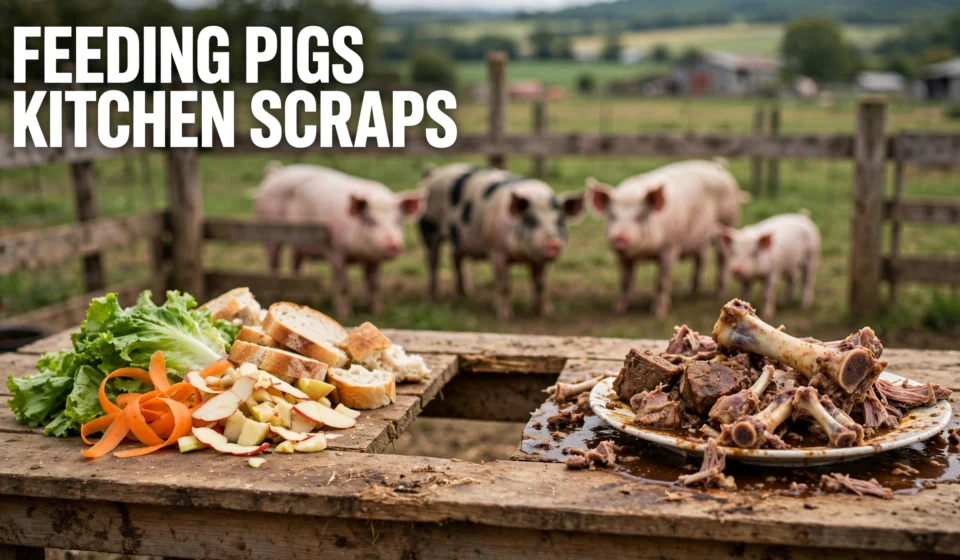
Scraps that have never contained or contacted meat, poultry, or fish are the category that sits outside the garbage rules — and in practice that covers most of what a household kitchen produces.
The Uncontaminated List
This is Vermont’s list, not a nationwide federal feeding list. Vermont’s agriculture department publishes it for its own producers: uncontaminated fruits, vegetables, bread, grains, dairy, eggs, and vegetable oils. The word doing the work in that sentence is uncontaminated.
Because that list reflects Vermont law, another state may draw its line differently. Treat it as an illustration of how a state frames the question, not as a rule that follows you across a state border.
The One Test That Decides Everything
Before you hand anything over the fence, ask a single question: has this food contained meat, poultry, or fish, or touched anything that did?
If the answer is no, you are dealing with ordinary food scraps. If the answer is yes — or if you are not certain — you are dealing with a regulated category, and the rest of this article applies.
That test is more restrictive than it first sounds, and the next section explains why.

What Counts as “Garbage” Under U.S. Law
Federal rules define garbage as human food that contains meat or has come into contact with meat during the food preparation process. Penn State Extension puts it in the same terms: when food waste contains or has come into contact with animal tissue products, that food waste is defined as garbage.
Note what the definition does not turn on. It does not ask whether the food is spoiled, whether it came from a restaurant or a household, or whether you consider it waste. A batch of vegetable scraps can fall into the garbage category if the vegetables were prepared on a surface that had meat on it during food preparation.
Swill feeding is a common term for feeding food waste to pigs, and it still appears in regulatory language. If you see it in a state document, read the definition that document gives rather than assuming it matches the federal wording exactly.
How Cross-Contamination Reclassifies Food
Cross-contamination — the transfer of material from one food to another through shared surfaces, utensils, or containers — is where most well-intentioned producers go wrong.
Carrot peelings are not garbage. Carrot peelings scraped off a cutting board that just held raw pork are. The carrots did not change; their legal classification did. The same applies to a scrap bucket that receives both vegetable trimmings and meat trimmings through the week — the whole bucket takes on the classification of what went into it.

This is why separation at the source matters more than sorting later. Once the categories mix, you cannot unmix them, and you cannot tell by looking.
Feeding Pigs Kitchen Scraps Under Federal Rules
Feeding pigs kitchen scraps that fall into the garbage category is permitted federally only under license and only after heat treatment — it is a regulated activity rather than a prohibited one.
The License Requirement
APHIS states that owners must be licensed in order to feed their pigs human food waste that contains or has had contact with meat, poultry, or fish. APHIS is the USDA’s Animal and Plant Health Inspection Service, the agency that administers the Swine Health Protection Act.
Licensing is not a formality you can skip because your operation is small. The framework applies to the practice, not to the scale — though what your state requires of you specifically is a question for your state, covered below.
Heat Treatment: 212°F for 30 Minutes
Where garbage feeding is permitted, the material must be cooked before it reaches the pigs. APHIS specifies boiling at 212° Fahrenheit for a minimum of 30 minutes, stirring throughout so all of it reaches temperature, then cooling before feeding.
Two details in that sentence are easy to miss. Stirring is part of the requirement, not a suggestion. And the requirement is not simply to bring the material to a boil; APHIS specifies boiling it for at least 30 minutes while stirring.
This is also the point where “free feed” stops being free — the fuel, the equipment, and the labor to boil food waste properly are real costs, and they arrive every week.

Two States, Two Different Answers
Federal law does not settle the question. APHIS is explicit that the Swine Health Protection Act allows each state to determine whether garbage feeding is allowed within their state — and states have reached genuinely different conclusions.
Pennsylvania Licenses It
Penn State Extension describes the state’s position: in Pennsylvania, feeding pigs food waste products that do not originate from a household on the same premises where the pigs reside requires a license.
Read that carefully, because the line is drawn around origin as well as content. It distinguishes waste generated by the household living with the pigs from waste brought in from elsewhere.
Vermont Prohibits It
Vermont takes a different approach entirely. Its agriculture department states that pigs must not be fed meat or fish, or their bones, oils, or juices, or any food that has touched these substances — and that doing so is illegal under Vermont law.
There is no licensing pathway offered there. The same practice that Pennsylvania regulates, Vermont forbids.
Who to Ask Before You Start
Neither of those answers is yours unless you farm in that state, and neither can be generalized. A state may be more restrictive than the federal framework, and a rule may change without any national announcement.
Contact your state department of agriculture before you feed anything in the garbage category. That is the authority to contact for the rules that apply to your operation, and the call takes less time than a single week of boiling scraps. Broader regulatory context for U.S. producers is covered in our guide to the U.S. pork market and regulations.
Why the Rule Exists
The rule is designed to reduce the risk of introducing three foreign animal diseases into the U.S. pig herd through food waste fed to pigs: foot-and-mouth disease, African swine fever, and classical swine fever.
That is why it is written around meat contact rather than around food quality — the concern is what the material may carry, not whether it looks fit to eat.
Penn State Extension also notes a more ordinary risk alongside those three: spoiled food waste can cause intestinal infections requiring treatment.
The disease logic here is the same logic behind the rest of your farm’s defenses, and it belongs in the same conversation as your biosecurity measures. It is also connected to containment — a pig that escapes after being fed prohibited material is a far worse problem than one that simply escapes, as covered in our guide to pig fencing.
Why “Free Feed” Rarely Is
Scraps look like free feed and rarely behave like it, which is the practical argument that sits underneath the legal one.
Penn State Extension warns that garbage feeding produces inconsistent nutrition. That inconsistency is the core problem: a pig’s requirements shift by growth stage, and a scrap stream that changes composition every week cannot be matched to them. What arrives is whatever the kitchen produced, not what the pig needed.
Scraps also carry hazards that are not nutritional — packaging fragments, bones, mold, and cleaning residues all end up in bins that were never assembled with an animal in mind.
None of that makes uncontaminated scraps useless. It makes them a supplement rather than a ration. The balanced portion of the diet still has to do its job, and what that portion needs to contain is set out in our pig nutrition and feeding guide, which also covers the feeds pigs should never receive at all.
Frequently Asked Questions
What food scraps can you feed pigs?
Scraps that have never contained or touched meat, poultry, or fish sit outside the federal garbage category. Vermont’s agriculture department gives one state’s version of the list: uncontaminated fruits, vegetables, bread, grains, dairy, eggs, and vegetable oils. Other states may define the boundary differently, so confirm with your own state department of agriculture rather than applying another state’s list.
What scraps should not be fed to pigs?
Anything containing meat, poultry, or fish, and anything that has touched them — including plates, boards, pans, and shared scrap buckets. Under federal rules this material is classified as garbage, and feeding it requires a license and heat treatment where a state permits it at all. Spoiled or moldy material should be kept out regardless of category.
Is it legal to feed food scraps to pigs in the U.S.?
It depends on the food and the state. Scraps with no meat contact are not classified as garbage federally. Garbage feeding is a licensed, heat-treated activity under the Swine Health Protection Act, and APHIS states that each state decides whether to allow it. Some states permit it under license; others prohibit it. Your state department of agriculture is the authority.
Can pigs eat meat scraps?
Not without meeting the garbage feeding requirements, and not at all in states that prohibit the practice. Meat scraps are the exact material the federal rules were written around, and the stated purpose is reducing the risk of introducing foot-and-mouth disease, African swine fever, and classical swine fever. Where permitted, the material must be licensed and boiled at 212°F for at least 30 minutes.
Can pigs eat moldy food?
Keep moldy material out. Penn State Extension notes that spoiled food waste can cause intestinal infections requiring treatment, and molds on feedstuffs can produce toxic compounds. Mold is a separate issue from the garbage classification — moldy vegetable scraps are not garbage in the legal sense, but they are still not something to feed.
Conclusion
Feeding pigs kitchen scraps comes down to three things. Apply the meat-contact test before anything crosses the fence, because that single question decides which set of rules you are under. Separate at the source rather than sorting later, since cross-contamination reclassifies food and cannot be undone. And call your state department of agriculture before feeding anything in the garbage category, because Pennsylvania and Vermont reached opposite conclusions on the same practice and neither answer travels.
The scraps that pass the test are a useful supplement to a balanced ration. The ones that fail it are a regulated material with a licensing pathway in some states and none in others — and the reason for that is a set of diseases the U.S. herd has so far kept out.
Explore More: Browse every article in Small-Scale and Backyard Pig Farming.