Contract Pig Farming in the USA: How Grower Contracts Actually Work
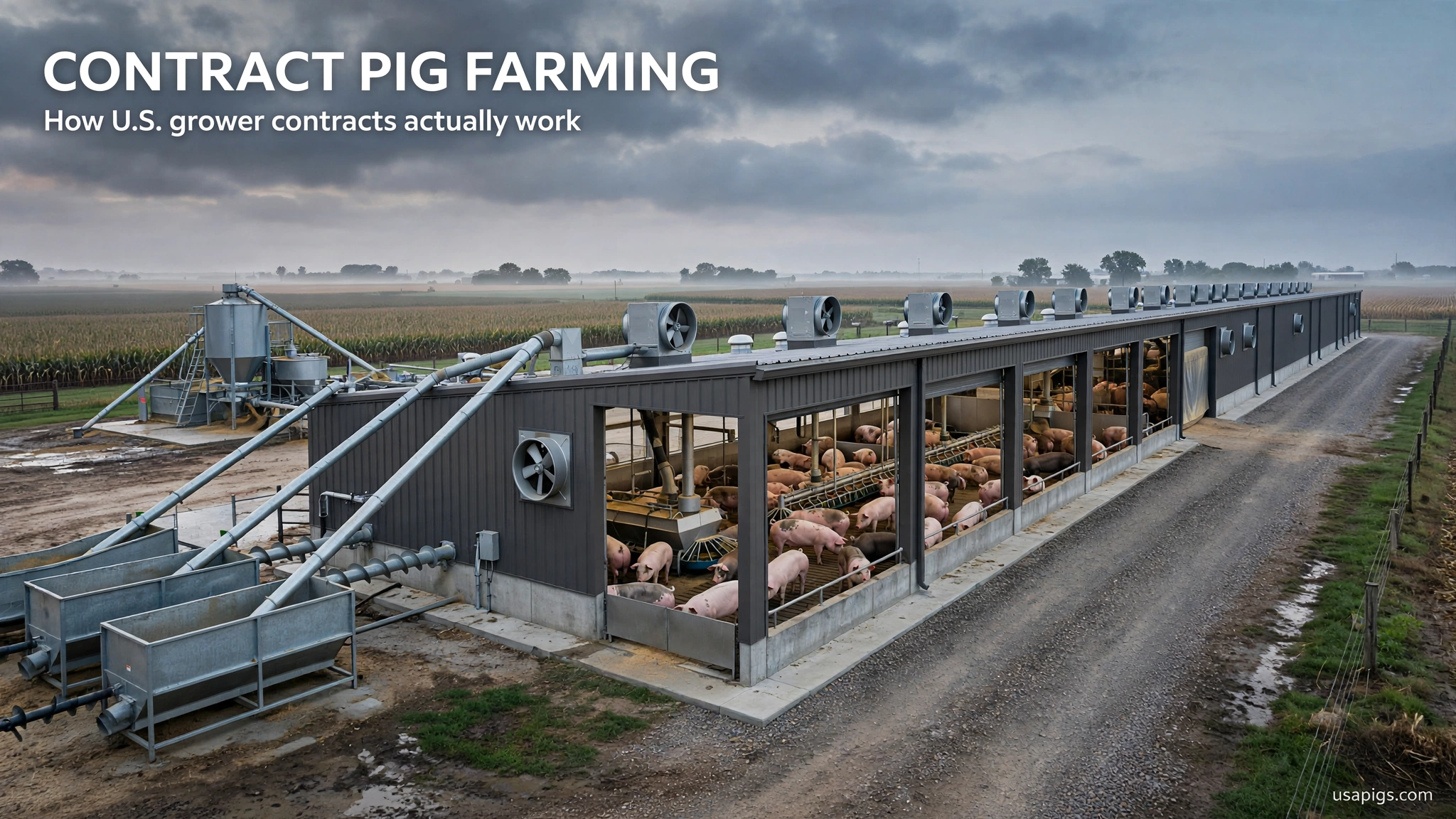
Contract pig farming is the arrangement behind most of the hogs raised in the United States today, and it works differently from the independent production model many new producers still picture. Understanding it matters before you borrow against a barn. If you are still mapping the wider industry, start with our guide to commercial pig farming in the USA, then come back here for the contract layer.
Quick Answer
Under contract pig farming, an integrator owns the pigs and supplies feed, veterinary care, and transport, while the grower provides the barn, land, labour, utilities, and manure handling. The grower is paid a negotiated fee for space and care rather than a share of the pork. This removes hog and feed price risk but transfers the full capital risk of the building onto the grower.
Key Takeaways
- Only about 1.85% of U.S. barrows and gilts moved through the negotiated cash market in the week ending April 5, 2025, according to the USDA Agricultural Marketing Service—the rest moved under contracts, formulas, or packer ownership.
- The integrator owns the pigs. The grower owns the debt.
- Payment is set by contract, not by a published market rate. No public source lists a standard per-pig-space figure.
- Manure carries real value — Missouri Extension’s 2026 budget puts it at roughly $4.20 per hog finished.
- Barn loans commonly run 15 years; contracts often run far shorter. That gap is the central risk.
What Contract Pig Farming Is and Why It Exists
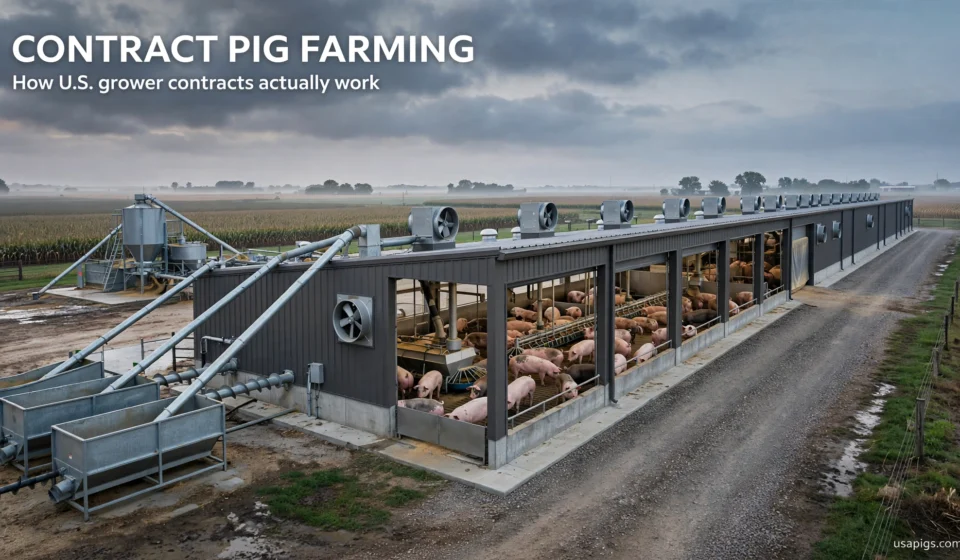
Contract pig farming is a production agreement in which a grower raises pigs owned by another party—an integrator—in the grower’s own facilities, for a fee. The grower never takes ownership of the pigs and never sells pork.
An integrator is a large pork company that controls pigs across several stages of production, from genetics through processing, and places those pigs with independent growers rather than owning every barn itself. The model spread because it splits risk: the integrator absorbs hog price and feed price volatility, while the grower absorbs facility and labour costs.
The scale of the shift is visible in federal market data. In the week ending April 5, 2025, USDA’s Weekly National Direct Swine Report recorded negotiated purchases at 1.85% of barrows and gilts, packer-owned hogs at 40.73%, and swine or pork market formula purchases at 26.83%. A producer planning to sell hogs on the open cash market is planning around a channel that now handles a small fraction of national volume.
Two contract families exist, and they are frequently confused:
- Production contracts — the grower provides service and space; the integrator owns the animals. This is what “contract growing” means in practice.
- Marketing contracts — the producer owns the hogs and commits to deliver them to a buyer on an agreed pricing formula. Ownership, and therefore market risk, stays with the producer.
This article covers production contracts. For the ownership-side economics, see our complete guide to pig farming economics.
Geography still shapes availability. Contract networks are densest where processing capacity sits, which is why the top pig-producing states and the states with the deepest contract markets are largely the same list.
The Contract Types U.S. Growers Are Offered
Four production contract types dominate, each with a different barn specification, turn length, and labour load.
| Contract type | Pigs in | Pigs out | Typical turn | Turns per year |
|---|---|---|---|---|
| Wean-to-finish | ~12–15 lbs | ~280 lbs | ~22–24 weeks | ~2 |
| Feeder-to-finish | ~50 lbs | ~280 lbs | ~16–18 weeks | ~2.5 |
| Nursery | ~12–15 lbs | ~50 lbs | ~6–8 weeks | ~5–6 |
| Breed-to-wean (sow) | Bred gilts/sows | Weaned pigs | Continuous | n/a |
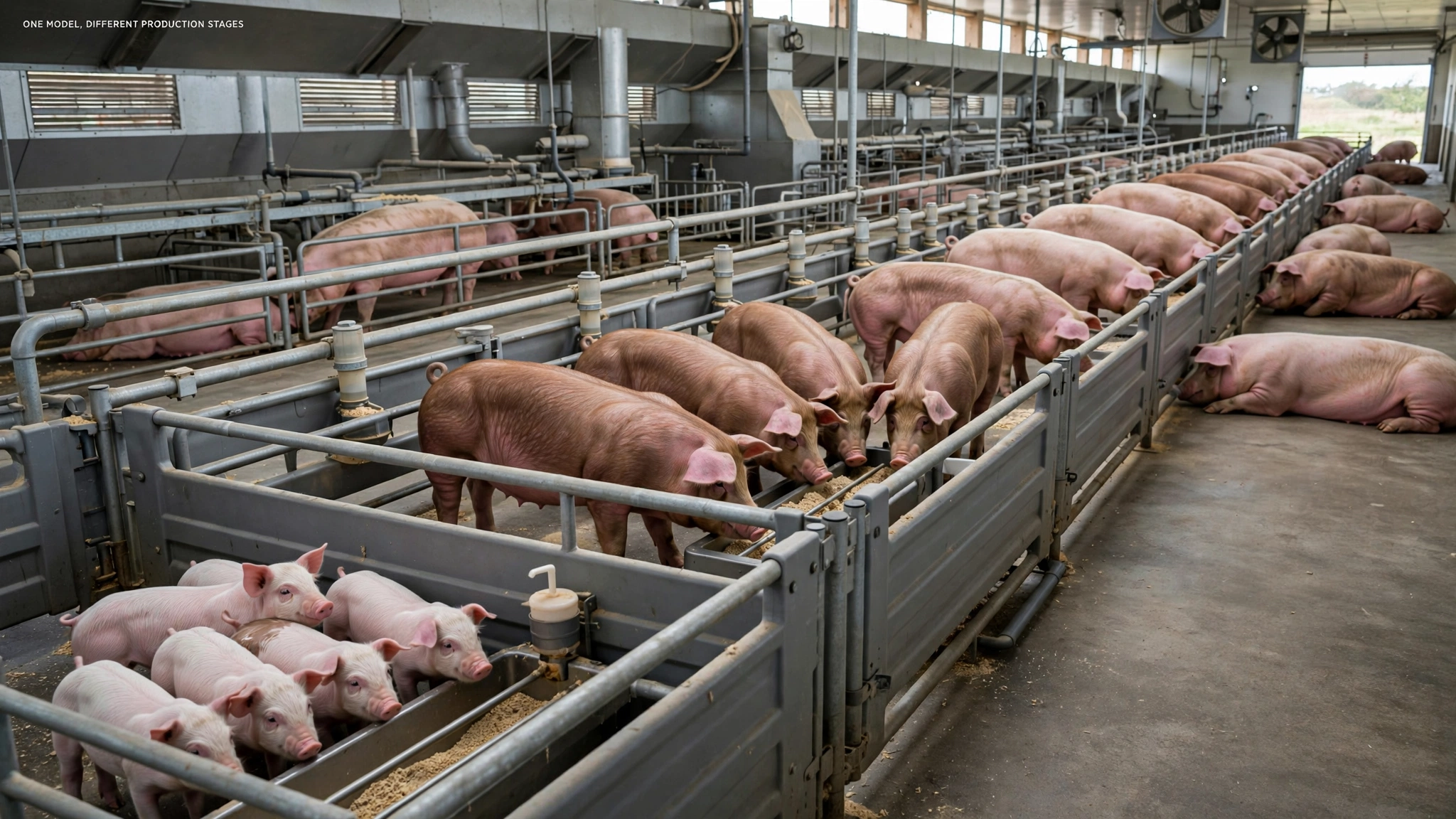
Wean-to-finish has become the common entry point because a single barn handles the pig from weaning to market weight, avoiding one transport event and one facility. Nursery contracts turn faster but demand tighter environmental control, since a 15-lb pig needs a starting room temperature near 85°F while a finishing pig is comfortable closer to 65°F.
Sow contracts are a different business entirely—continuous farrowing, breeding technicians on site, and much higher labour intensity. If you are weighing the underlying production systems rather than the contract wrapper, our comparison of farrow-to-finish and wean-to-finish systems covers the biology and flow.
Who Supplies What: The Responsibility Split
The integrator supplies the pigs, feed, veterinary care, technical support, and transport; the grower supplies the facility, daily care, utilities, and manure management. Michigan State University Extension’s 2025 bulletin on models for raising pigs for pork, developed under a National Pork Board grant, sets out this division in detail for contract finishers.
| Line item | Integrator | Grower |
|---|---|---|
| Pigs (ownership) | ✔ | |
| Feed and nutrition services | ✔ | |
| Veterinary care and medication | ✔ | |
| Transport of pigs in and out | ✔ | |
| Technical and logistics support | ✔ | |
| Barn, land, and pig space | ✔ | |
| Daily care and husbandry labor | ✔ | |
| Feeders, waterers, penning, handling equipment | ✔ | |
| Electricity, propane, water | ✔ | |
| Repairs, maintenance, insurance, property tax | ✔ | |
| Manure storage and land application | ✔ |
Supplied Is Not the Same as Owned
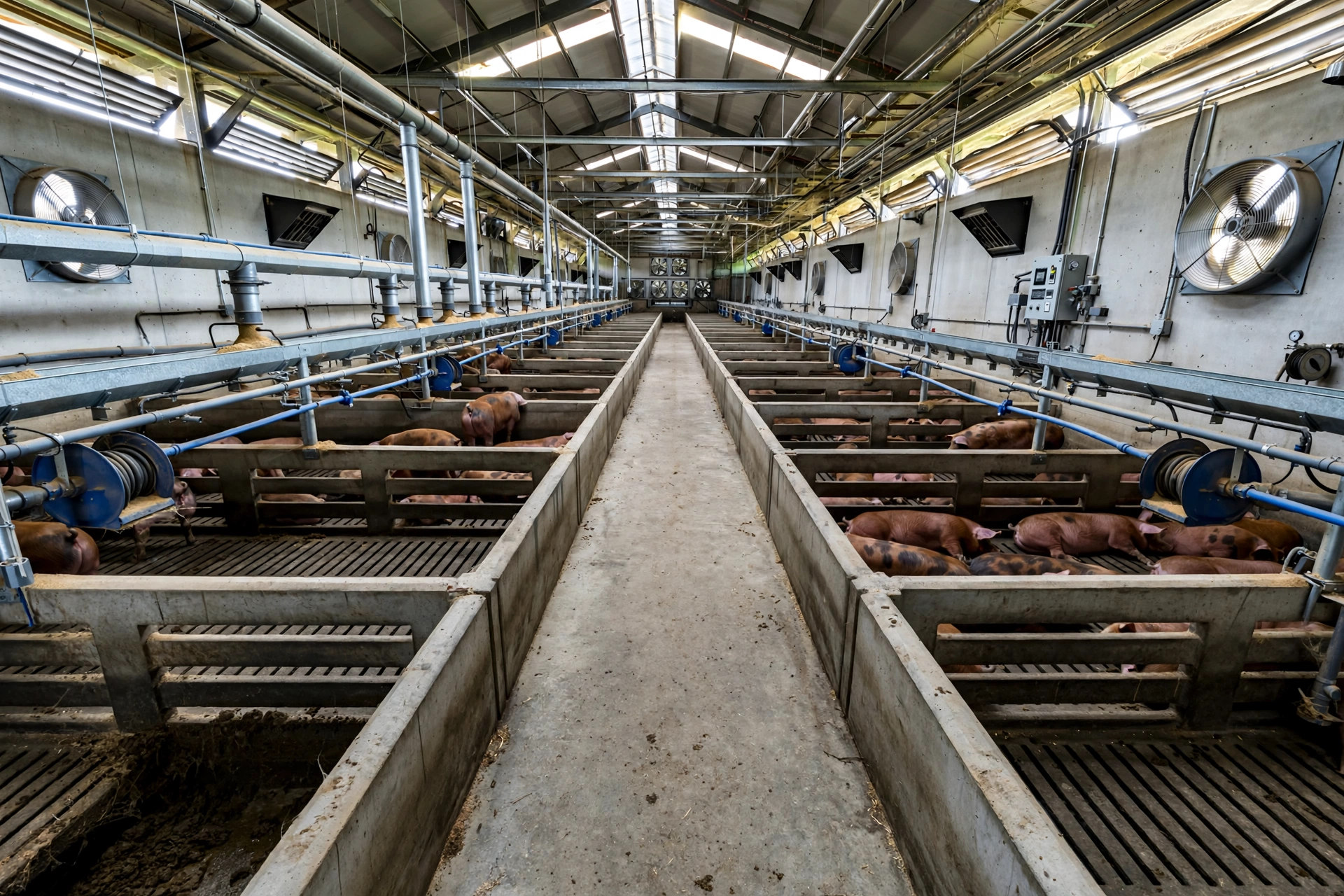
Nothing the integrator supplies belongs to the grower, and nothing the grower owns is covered by the integrator. That distinction decides who pays when something breaks. A ventilation failure that kills pigs is an integrator asset loss, but the fan, the controller, the backup alarm, and the repair invoice are all grower costs—and a mortality clause may still reduce the grower’s payment for the same event. Grower-side equipment reliability is therefore an economic decision, not a maintenance preference. What that equipment looks like in practice is covered in our walkthrough of a modern commercial pig farm.
How Contract Growers Get Paid
Contract growers are paid a negotiated fee for space, care, and time—never a share of the pork. Three structures are common, and most real contracts blend them:
- Per pig space, per turn or per month. The grower is paid on barn capacity whether or not the barn is full. This is the most stable structure and the one lenders prefer, because payment does not depend on the integrator’s placement schedule.
- Per head marketed. Payment follows pigs actually delivered. Cash flow tracks placement decisions the grower does not control.
- Incentive and bonus clauses. Additional payment tied to mortality below a stated threshold, feed conversion ratio (FCR — pounds of feed required per pound of gain), or barn condition scores.
Why Swine Contracts Are Not the Poultry Tournament System
Swine finishing contracts are predominantly fixed-rate agreements with bonus clauses, not competitive ranking systems. This is the single most repeated error in online coverage of the topic.
In broiler production, the tournament system ranks each grower’s cost of production against other growers delivering in the same period, then adjusts their pay above or below a base rate accordingly. Two growers with identical results can be paid differently depending on their neighbours. Swine finishing contracts generally do not work this way: the base rate is set in the agreement, and performance clauses add to it rather than rank it. Coverage that describes swine contracts using poultry tournament language is describing a different industry—verify the payment mechanism in the document in front of you rather than in an article about chickens.
How Much Do Contract Hog Farmers Make?
There is no published standard rate for contract hog growing, and any single figure presented as one should be treated as an estimate rather than a benchmark. Payment terms are private commercial agreements that vary by integrator, region, barn age, contract length, and negotiated performance clauses.
What can be examined is the cost structure the payment has to cover. Missouri Extension’s 2026 hog finishing budget, revised in October 2025, models a 100-hog lot of 50-lb feeder pigs finished to 280 lbs. Its non-feed, non-pig cost lines are the ones a contract grower still carries: labour at $374, utilities and fuel at $460, facility and equipment repair and maintenance at $722.20, and taxes and insurance at $271.40 per 100-hog lot. That budget also assumes 0.17 hours of labour per pig.
A contract payment must clear those recurring costs and the barn’s debt service before anything reaches the grower. That is the calculation to run — not a per-space number copied from a search result.
What It Costs to Get In
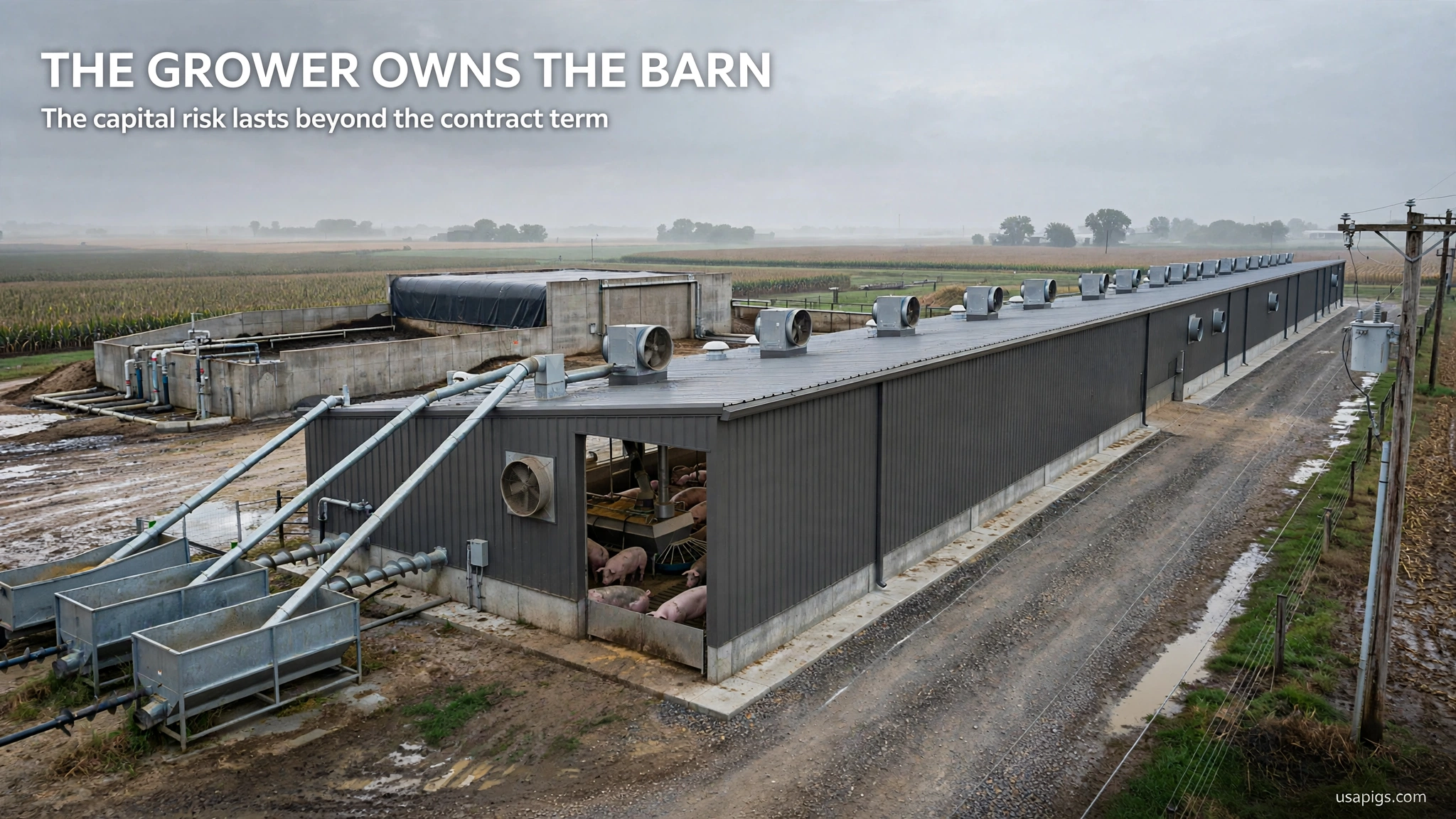
Barn construction is the dominant entry cost, and it is carried entirely by the grower. A new finishing or wean-to-finish barn is a six- to seven-figure investment financed over a long term, and construction costs per pig space have risen substantially over the past two decades along with interest rates.
The structure of the deal matters more than any single cost figure:
| Cost line | Who carries it | Notes |
|---|---|---|
| Barn shell, penning, flooring, | Grower | Financed, typically 10–15 year term |
| Ventilation, feeding, watering systems | Grower | The integrator often specifies the standard |
| Manure storage structure | Grower | Sized to state nutrient rules |
| Land and site work | Grower | Setback and siting rules vary by state |
| Working capital for utilities and repairs | Grower | Ongoing, not financed |
| Pigs, feed, medication | Integrator | Zero grower capital |
The Contract-Length Mismatch
Barn financing routinely outlasts the contract that justifies it. A 15-year loan secured against a 5-year agreement leaves a decade of debt with no contracted income behind it.
Lenders manage this risk by underwriting the integrator as much as the grower—asking who the counterparty is, how long the agreement runs, and what the renewal history looks like. A grower should ask the same questions before signing. A contract that renews on the integrator’s option is not a 15-year income stream; it is a series of short ones.
Manure: The Income Line Most Guides Skip
Manure is a genuine revenue line, not a disposal problem. In Missouri Extension’s 2026 finishing budget, manure is valued at $420.25 per 100-hog lot from 10,230 gallons—roughly $4.20 per finished hog, or about $102 per 1,000 gallons applied.
For a grower who also farms row crops, that value is realized as reduced fertilizer purchases rather than as a check, which is why it disappears from most contract discussions. In many contracts, the grower retains the manure specifically because it is the part of the arrangement where the grower’s own crop enterprise creates value that the integrator cannot capture. Confirm ownership in writing—a contract that assigns manure rights to the integrator removes a material part of the return.
The Risks Before You Sign
The core risk in contract growing is not price volatility; it is counterparty dependence on a single buyer for an asset with no alternative use.
Termination and Non-Renewal
Most agreements permit termination on notice, and some permit it without cause. A finishing barn has almost no alternative use, and its resale value depends heavily on whether a contract can be attached to it.
Mortality and Disease Breaks
A disease break can push mortality well above the contract’s incentive threshold through no management failure. PRRS (porcine reproductive and respiratory syndrome, a costly viral disease affecting reproduction and growth) can move a barn from bonus territory to penalty territory in a single turn. Read how mortality is defined, measured, and disputed.
Required Capital Upgrades
Integrators update facility standards. A clause obliging the grower to fund specified upgrades during the contract term converts a fixed cost structure into a variable one on the integrator’s timetable.
Single-Buyer Dependence
Most growers sit within economic reach of one or two integrators. That concentration limits renegotiation leverage in a way that has no equivalent in crop farming.
Contract Clauses Worth Reading Twice
Have an agricultural attorney review the document before signing. At minimum, confirm the contract states each of the following in writing:
- Duration and renewal — fixed term, automatic renewal, or integrator option
- Notice period for termination by either party, and whether cause is required
- Payment amount, method, and timing — including what happens during an empty barn between placements
- Placement commitment — how many pigs, how often, and whether volume is guaranteed
- Mortality definitions and how disputed losses are resolved
- Capital upgrade obligations during the term, and who funds them
- Manure ownership and nutrient management responsibility
- Lien position on the pigs, and whether a lien subordination is available
- Arbitration clause and governing jurisdiction
The Packers and Stockyards Act gives federal oversight of unfair and deceptive practices in livestock contracting, but it does not set your pay rate. Statutory protection is not a substitute for reading the agreement.
Is the contract growing right for your operation?
Contract growing fits producers who have land, labour, and crop acres to absorb manure and who want production income without market exposure. It fits poorly where the barn is the entire business.
It tends to work when you already farm row crops that can use the manure · you have equity to withstand a renewal gap · you or family members supply the labour. · You value predictable monthly income over upside.
Independent production tends to fit better when you have the working capital to own pigs and feed them. · you can access processing or direct-to-consumer markets · You are willing to carry hog price risk in exchange for the full margin.
Frequently Asked Questions
What are the requirements to become a contract swine grower?
Integrators generally require a suitable site that meets state setback and environmental rules, a barn built to their facility specifications, adequate manure storage and a nutrient management plan, financing already arranged or approved, and a demonstrated ability to provide consistent daily labour. Most large integrators run a formal application process through regional offices. Site approval usually comes before contract approval, so permitting is the first hurdle, not the last.
How long do hog contracts usually last?
Contract lengths vary widely, commonly ranging from short multi-year terms to a decade or more, with many agreements including renewal provisions. Shorter contracts preserve flexibility for the grower but weaken the financing case, since lenders underwrite against contracted income. Longer contracts improve loan terms but lock in a rate that may lag inflation in utilities, insurance, and repairs. The renewal clause matters as much as the stated term.
Who pays if the pigs die?
The integrator absorbs the asset loss because the integrator owns the pigs, but the grower may still be affected financially if the contract ties payment to mortality thresholds. Normal death loss is expected and built into most agreements. Losses attributed to grower negligence—a failed ventilation alarm, an empty feed bin—are treated differently from disease breaks. How the contract distinguishes the two is worth negotiating before signing.
Can small producers get pig farming contracts?
Integrators generally contract at barn scale rather than herd scale, which effectively sets a minimum entry point well above small-farm production. The binding constraint is the facility specification, not the applicant. Producers operating below that scale usually find better returns in independent production serving local, direct-to-consumer, or niche markets, where the margin per pig is higher and no facility standard is imposed from outside.
Do I still own the manure?
In most contract finishing arrangements, the grower retains the manure and is fully responsible for storage, nutrient management planning, and land application. That responsibility is regulated at the state level and carries real compliance costs. Because manure ownership is a negotiated term rather than a legal default, confirm it explicitly in the contract—Missouri Extension’s 2026 budget values it at roughly $4.20 per hog finished, which is not a line to leave ambiguous.
Is contract growing better than independent hog production?
Neither is better in the abstract; they distribute risk differently. Contract growing removes hog and feed price volatility but concentrates capital risk in a single-purpose building tied to one buyer. Independent production carries full market exposure but leaves the producer free to sell anywhere and to capture the whole margin. The right answer depends on your equity position, your access to markets, and how much price risk your operation can survive.
Conclusion
Contract pig farming is best understood as a trade: the integrator takes the market risk, and the grower takes the capital risk. Three things should carry forward from this guide.
First, read the payment mechanism yourself rather than trusting general descriptions—swine contracts are not poultry tournaments, and no published standard rate exists. Second, compare the contract term against the loan term before you sign anything; the gap between them is where growers get hurt. Third, treat manure as income, confirm you own it, and value it at a real figure rather than an afterthought.
Tom Bradley
Explore More
Browse all of our commercial pig farming guides for more on U.S. production systems, facilities, and farm management.