Selecting Pig Breeding Stock for Your Farm: A Complete 2026 Guide
TL;DR – Quick Takeaways
- Quality breeding stock is the foundation of profitable pig farming. Poor selection leads to lower productivity, higher health costs, and reduced market value.
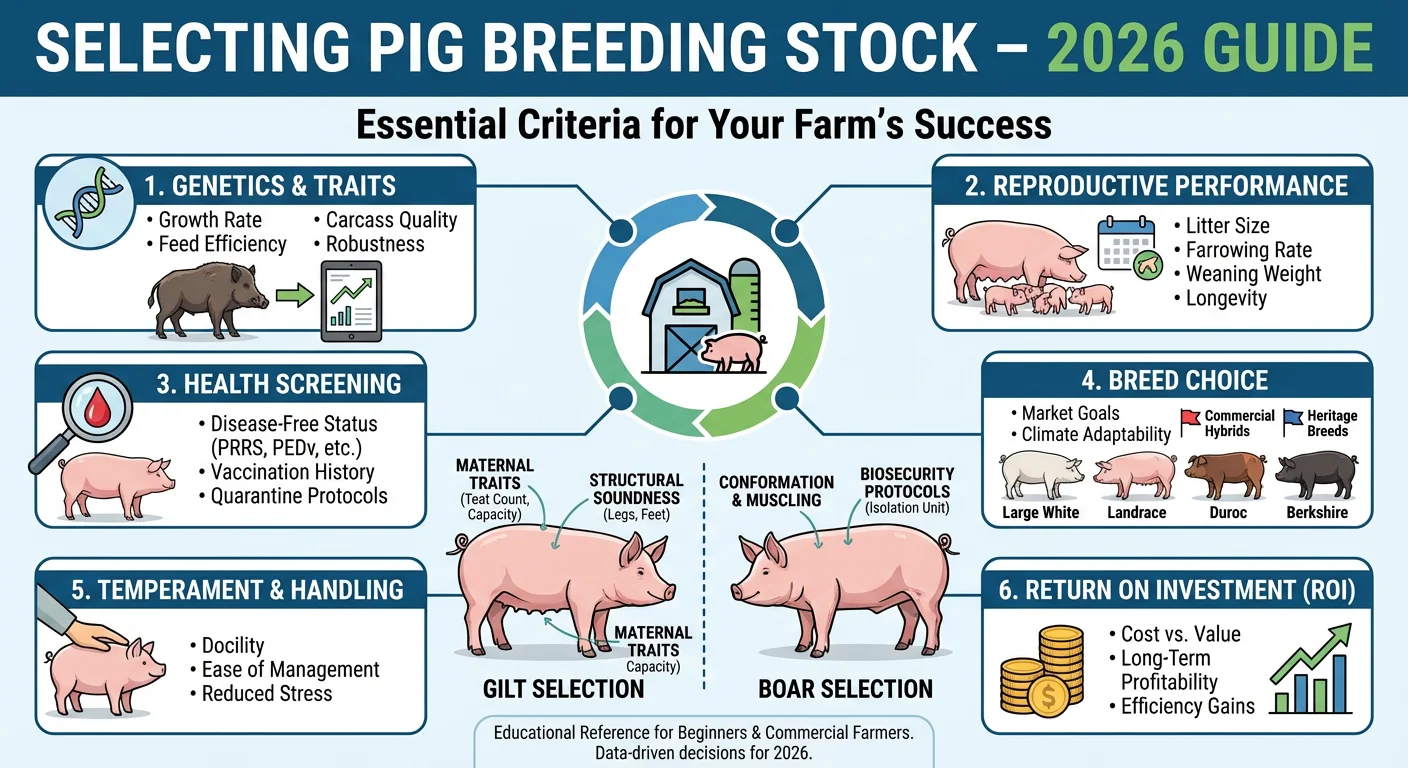
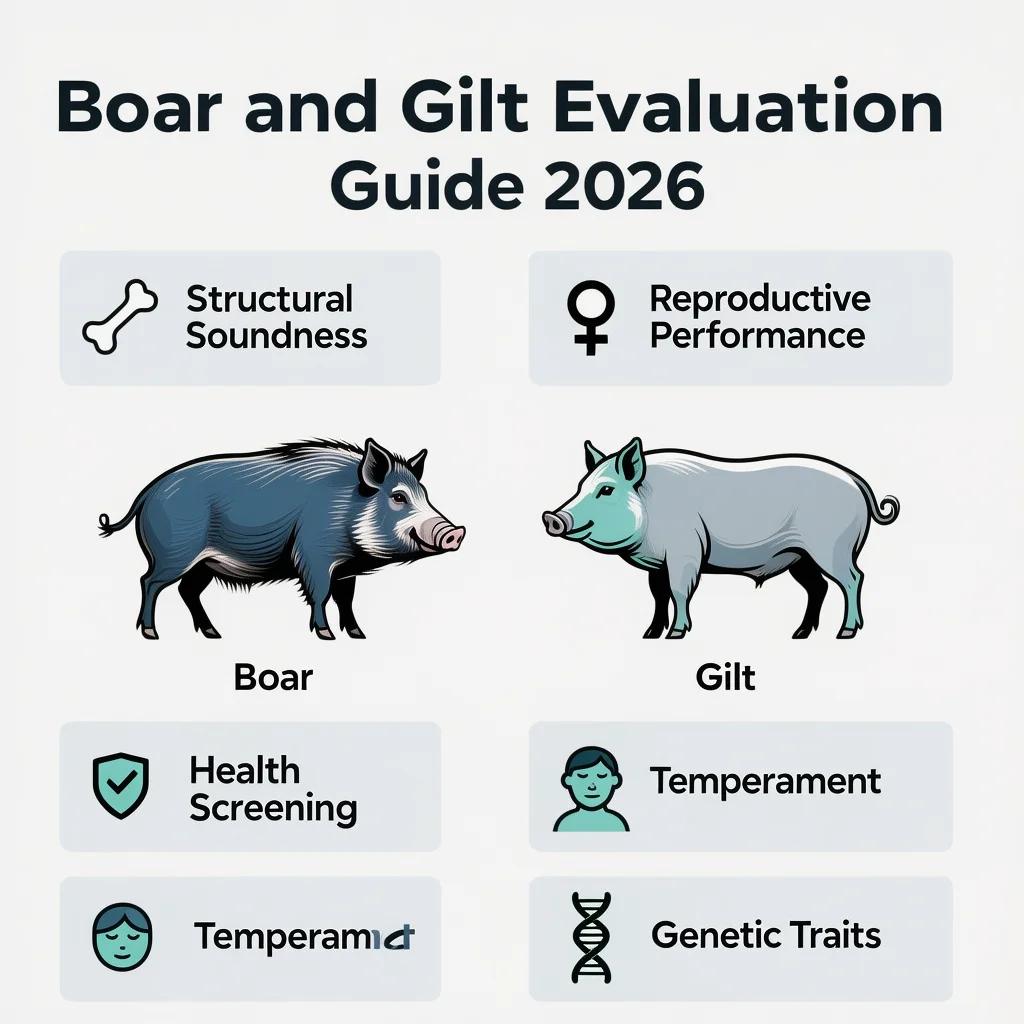
- Key selection criteria include structural soundness, reproductive performance, genetic background, health status, and temperament.
- Breed choice matters. Match your breeding stock to your production goals—commercial pork, heritage meat, or show animals.
- Source verification is critical in 2026. Work with reputable breeders, request health records, and understand genetic lineage.
- Initial investment in superior breeding stock pays dividends through improved litter size, growth rates, and herd longevity.
- Biosecurity protocols must be followed when introducing new breeding animals to your farm.
Introduction: Why Breeding Stock Selection Determines Your Farm’s Success
Selecting breeding stock for your pig farm is arguably the most critical decision you’ll make as a pork producer. Whether you’re managing a small-scale backyard operation or scaling up to commercial pig farming, the quality of your foundation breeding animals directly impacts every aspect of your operation.
Feed efficiency, piglet vitality, growth rates, and market value all trace back to your breeding stock decisions.
Unlike purchasing feeder pigs or market hogs, breeding stock represents a long-term genetic investment. A well-selected gilt or boar can produce hundreds of offspring during their breeding career. That multiplies either excellence or deficiencies throughout your operation for years to come.
In 2026, American pig farmers have access to unprecedented genetic resources. Comprehensive health testing is standard. Detailed performance records are readily available. However, this abundance of information can overwhelm beginners.
This guide breaks down the breeding stock selection process into actionable steps that apply whether you’re purchasing your first breeding pair or expanding an established herd.
This article complements our comprehensive Pig Breeding and Reproduction Guide and works hand-in-hand with our Pig Breeds in the USA resource to help you make informed decisions.
Understanding Your Production Goals Before Selecting Breeding Stock
Defining Your Farm’s Purpose
Before evaluating individual animals, clarify your production objectives. Your breeding stock selection criteria will vary significantly based on your goals.
Commercial Pork Production
- Focus on breeds with high feed efficiency and fast growth rates
- Prioritize maternal traits (litter size, milk production, mothering ability)
- Terminal sire characteristics (lean meat percentage, carcass quality)
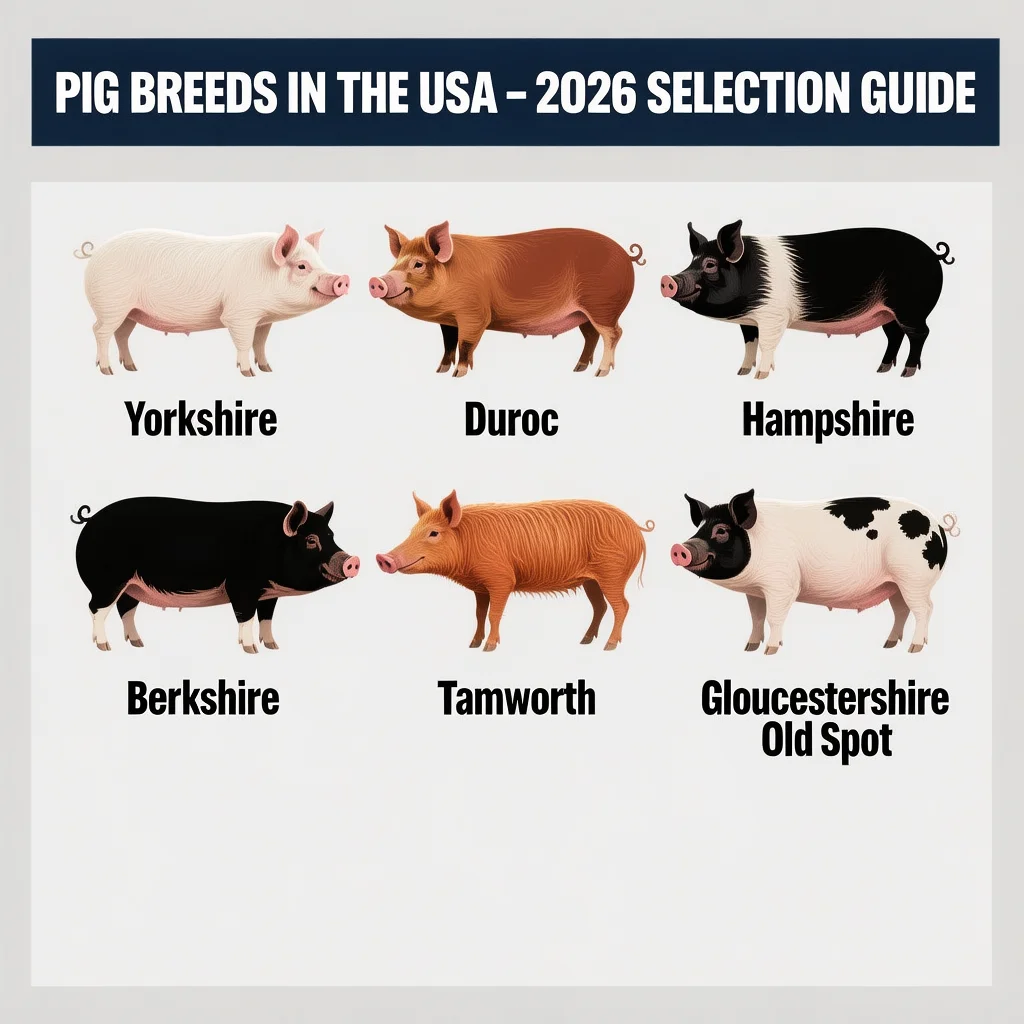
- Examples: Yorkshire, Landrace, Duroc, Hampshire crosses
Heritage and Niche Markets
- Select breeds recognized for flavor, marbling, and pasture-raising ability
- Consider market premiums for heritage pork certification
- Breed preservation may be a secondary objective
- Examples: Berkshire, Red Wattle, Gloucestershire Old Spots, Tamworth
Small-Scale and Homestead Operations
- Emphasize docile temperament and ease of handling
- Moderate size for easier management
- Dual-purpose breeds for both meat and breeding
- Consider browsing our Small-Scale Pig Farming Guide for specific recommendations
Show and Exhibition
- Prioritize breed standard conformity
- Pedigree documentation essential
- Structural correctness and appearance
Essential Selection Criteria for Breeding Pigs
Physical Structural Soundness
Structural integrity is non-negotiable in breeding stock. Animals with structural defects will pass these problems to offspring. They also tend to have shortened productive lives.
Leg and Foot Conformation
Examine breeding candidates from all angles:
- Front view: Legs should be straight, evenly spaced, and squarely set under the body
- Side view: Pasterns should have moderate slope (not too straight or too weak)
- Rear view: Hind legs should be wide-set with a slight outward turn at the hocks.
- Feet: Look for even toes, strong dewclaws, and no evidence of cracks or overgrowth
Red flags to avoid:
- Buck-kneed (forward bend at knees)
- Sickle-hocked (excessive angle at hock joint)
- Post-legged (too straight, lacking flexibility)
- Weak pasterns (excessive slope indicating structural weakness)
- Uneven toe length or splayed feet
Body Structure and Capacity
Quality breeding stock should exhibit:
- Long, level topline from shoulder to hip
- Deep, wide body cavity indicating room for internal organs and reproductive capacity
- Well-sprung ribs providing heart and lung space
- Wide, level rump (especially critical in females for farrowing ease)
- Adequate muscling without excessive fat cover
For gilts specifically, evaluate underline quality:
- Minimum 12-14 evenly spaced, well-developed teats
- No inverted, damaged, or blind nipples
- Teats should be prominent and functional
- Spacing should be consistent from front to rear
Reproductive Performance and Genetic Background
Evaluating Maternal Lines (Gilts and Sows)
When selecting female breeding stocks, prioritise proven maternal genes.
Request performance data on:
- Dam’s litter size (born alive average should be 10-12+ for commercial breeds)
- Weaning weights of previous litters
- Rebreeding intervals and conception rates
- Longevity and number of successful parities
Genetic markers to investigate:
- Litter size EPDs (Expected Progeny Differences), if available
- Days to 250 pounds (growth efficiency)
- Backfat measurements at standardized weight
- Feed conversion ratios from siblings or dam
Many reputable breeders now provide genetic testing results. These screen for known genetic defects and production traits. Request this documentation as part of your selection process.
Evaluating Terminal Sire Lines (Boars)
Boar selection requires equal rigour. One boar can influence dozens of litters, so his genetic impact is massive.
Key boar selection criteria:
- Lean gain and muscling (especially for market hog production)
- Feed efficiency of sire line
- Carcass quality data from siblings or progeny
- Libido and breeding soundness evaluation
- Temperament for safe handling and natural breeding or AI collection
Physical requirements:
- Both testicles descended, equal size, and have a firm texture
- No evidence of hernias or ruptures
- Sound locomotion (will be breeding multiple females)
- Appropriate size for the females he’ll breed (avoid extreme size mismatches)
Health Status and Biosecurity Considerations
Disease Screening and Health Records
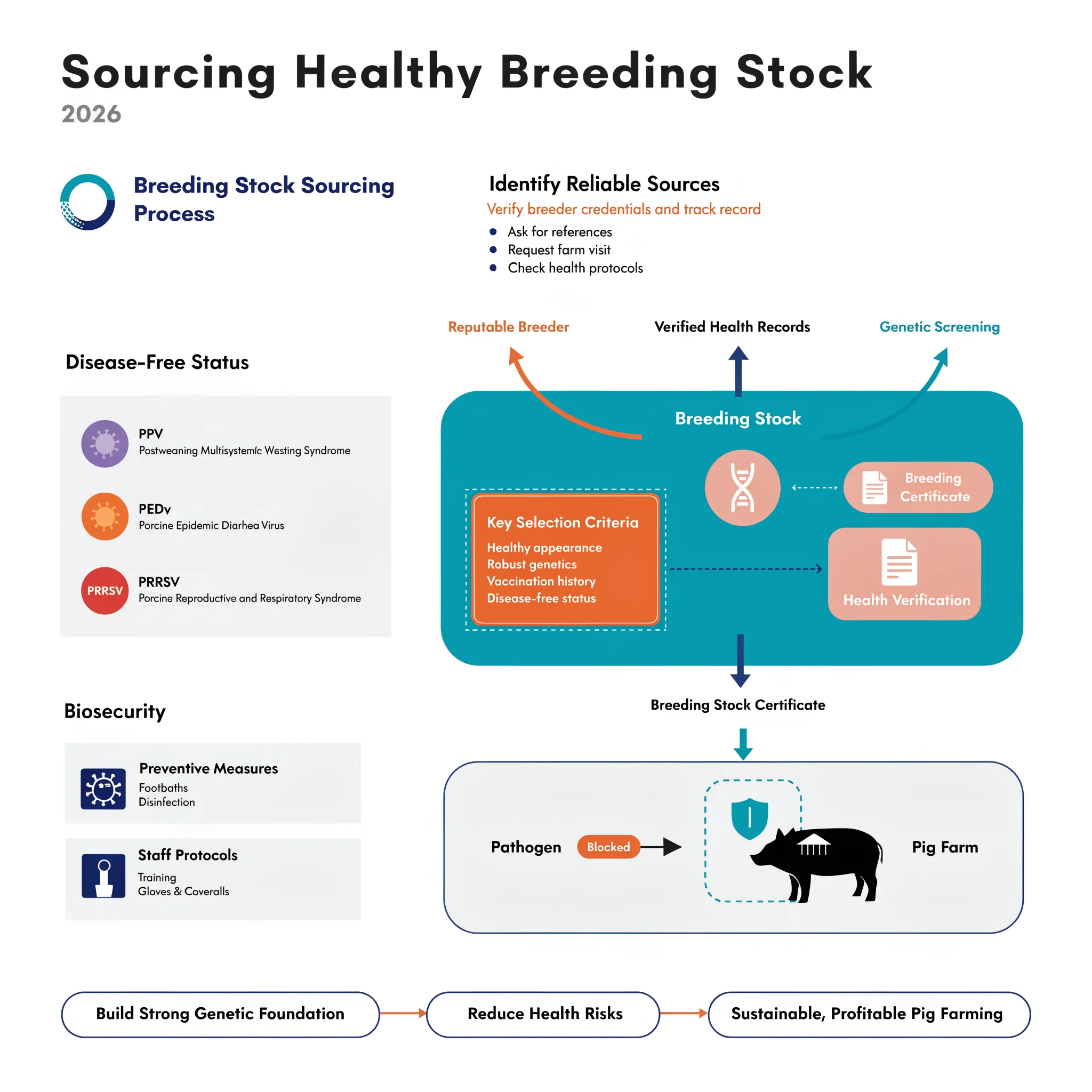
In 2026, comprehensive health testing is standard practice when purchasing breeding stock. Introducing diseased animals can devastate your herd. It can also violate USDA biosecurity protocols.
Essential Health Documentation
Request the following before purchasing:
Herd health status:
- PRRS (Porcine Reproductive and Respiratory Syndrome) negative certification
- Pseudorabies accreditation
- Brucellosis testing results
- Swine influenza screening
- Mange and lice treatment records
Individual animal records:
- Vaccination history (minimum: erysipelas, parvovirus, leptospirosis)
- Deworming protocol and dates
- Any antibiotic treatments administered
- Genetic defect screening results
State-specific requirements:
- Certificate of Veterinary Inspection (CVI) for interstate transport
- Official ear tags or identification
- Movement permits as required by state regulations
Consult our Pig Health and Disease Management resource for comprehensive biosecurity protocols.
Quarantine Protocols
Never introduce new breeding stock directly into your existing herd. Industry best practices in 2026 are recommended:
- 30-60 day quarantine period in complete isolation
- Separate air space from existing pigs (minimum 200 feet)
- Dedicated equipment and clothing for quarantine area
- Observation for clinical signs of disease
- Booster vaccinations during quarantine
- Fecal testing and follow-up health screening
Breed Selection and Crossbreeding Strategies
Matching Breeds to Production Systems
Different pig breeds in the USA excel in different production environments. Your breed selection should align with your farm’s infrastructure, climate, and market goals.
Commercial Production Breed Recommendations
| Breed | Primary Role | Key Strengths | Best Use |
|---|---|---|---|
| Yorkshire | Maternal line | Large litters, excellent mothering, good milk production | Foundation females in crossbreeding programs |
| Landrace | Maternal line | Long body, high litter size, docile temperament | Crossbreeding with Yorkshire for F1 females |
| Duroc | Terminal sire | Fast growth, feed efficiency, meat quality | Market hog production, adding growth to maternal lines |
| Hampshire | Terminal sire | Lean muscle, strong carcass, good structure | Producing lean market hogs from F1 females |
| Pietrain | Terminal sire | Extreme leanness, heavy muscling | Specialized lean pork markets, premium programs |
Heritage and Small-Scale Breed Options
For operations focused on sustainable and organic pig farming or speciality markets:
Berkshire: Premium marbling, excellent meat quality, calm temperament, 10-12 piglets per litter
Red Wattle: Heat tolerance, foraging ability, good mothering, 8-10 piglets per litter
Tamworth: Exceptional bacon quality, outdoor hardiness, active foragers, 8-10 piglets per litter
Large Black: Docile, excellent mothers, thrive on pasture, 10-12 piglets per litter
Strategic Crossbreeding for Hybrid Vigor
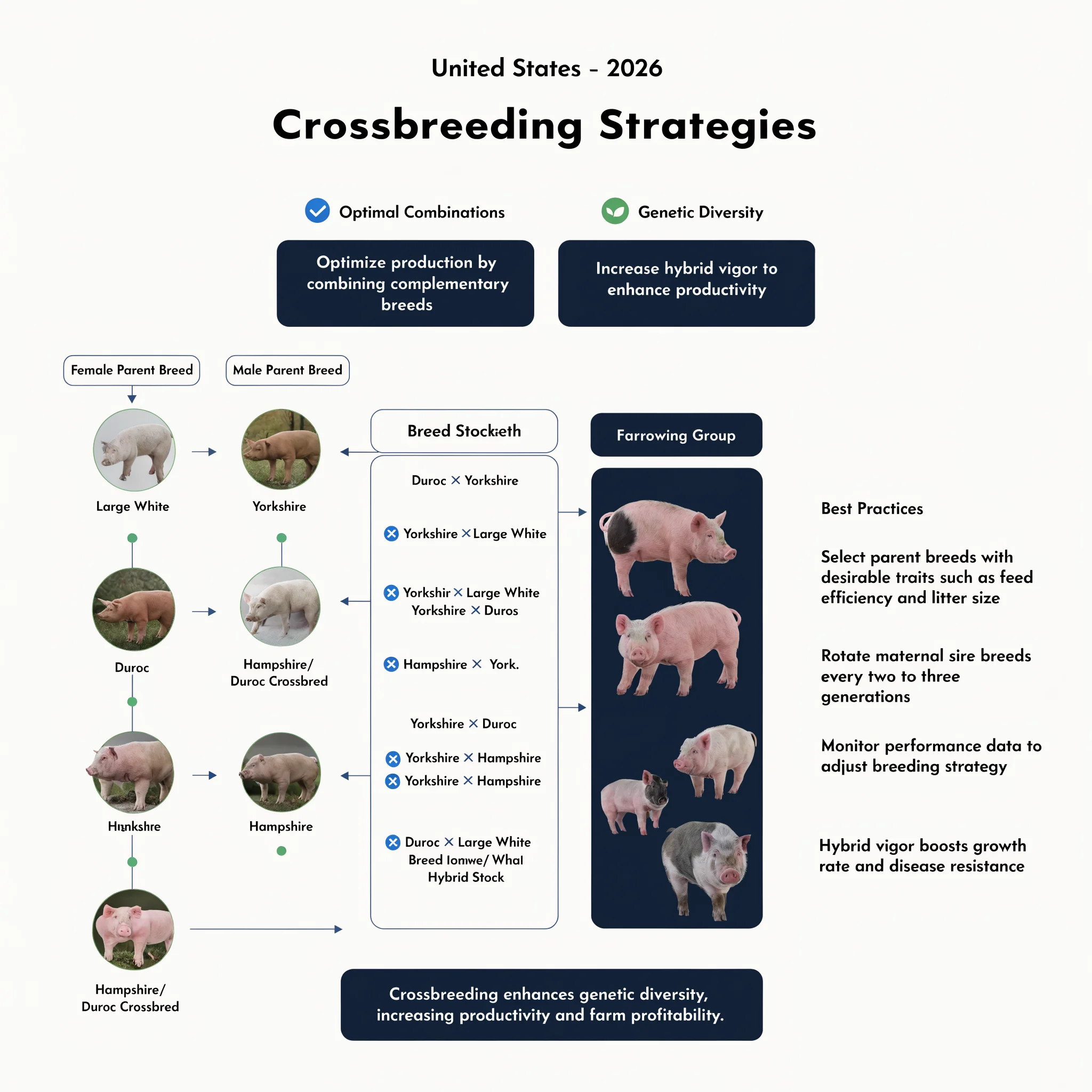
Hybrid vigour (heterosis) improves performance when combining unrelated breeds. Smart crossbreeding strategies maximise this advantage.
The Three-Breed Terminal Cross (most common in commercial production):
- F1 Females: Yorkshire × Landrace gilts (maternal heterosis improves litter size and mothering)
- Terminal Sire: Duroc or Hampshire boar (adds growth rate and carcass quality)
- Market Pigs: All offspring go to market, maximising hybrid vigour.
The Rotational Cross (for breeding stock retention):
- Rotate between three breeds systematically
- Maintain approximately 66% hybrid vigour.
- Allows selection of replacement gilts from within the herd
When implementing crossbreeding, maintain breed purity in your foundation stock. Purchase or maintain purebred animals of each breed rather than crossing your breeding stock with each other.
Age, Size, and Development Stage Considerations
Optimal Age for Breeding Stock Purchase
Gilts (Females):
- Best purchase age: 5-7 months (pre-breeding)
- Allows adaptation to your farm environment before first breeding
- First breeding typically occurs at 7-9 months and 260-300 pounds
- Observe at least 2-3 heat cycles before breeding
- Refer to our guide on reproductive management for detailed gilt development protocols
Boars (Males):
- Best purchase age: 6-8 months
- Requires additional development time before breeding use
- First use at 8-10 months minimum, 275-325 pounds
- Test breed with 2-3 females before full herd use
- Sexual maturity precedes physical maturity—don’t overuse young boars
Bred gilts or sows:
- More expensive but faster production start
- Verify pregnancy status and breeding dates
- Higher biosecurity risk (pregnant animals under stress)
- Ensure compatibility with your pig housing and farm infrastructure.
Growth Rate and Development
Animals should exhibit appropriate growth for their age:
- Consistent growth pattern (not stunted or overly fat)
- Adequate body condition score (BCS 3-3.5 on a 5-point scale)
- Well-proportioned for their stage of development
- Muscle definition without excessive fat cover
Warning signs:
- Excessively thin animals may have health or parasite issues
- Overly fat young animals may have reduced reproductive performance
- Stunted growth indicates poor nutrition or chronic health problems
Temperament and Behavior Assessment
Why Temperament Matters
Docile, manageable temperament is often overlooked but critically important for:
- Handler safety during daily management and breeding
- Reduced stress leads to better reproductive performance
- Ease of farrowing supervision and piglet processing
- Longevity in the breeding herd (aggressive animals are culled sooner)
Evaluating Temperament During Selection
Observation techniques:
- Approach test: Animal should be alert but not panicked when approached
- Touch response: Should tolerate gentle touching without excessive aggression or fear
- Handler interaction: Ask the seller to demonstrate animal handling
- Pen behavior: Observe interaction with penmates (avoid bullies or extremely timid animals)
- Loading and movement: Watch how animals respond to direction and movement pressure
Breed tendencies to consider:
- Yorkshire and Landrace generally have calmer dispositions
- Hampshires can be more excitable but are manageable
- Some heritage breeds (Large Black, Gloucestershire Old Spots) are known for docility
- Individual variation exists within all breeds
Red flags:
- Animals that charge gates or handlers aggressively
- Excessive fear responses (prolonged hiding, panic)
- Repetitive abnormal behaviors (bar biting, excessive vocalization)
- Injury evidence from fighting with penmates
Sourcing Breeding Stock: Finding Reputable Suppliers
Types of Breeding Stock Sources
Registered Breeders and Seedstock Producers
Advantages:
- Documented genetics and performance records
- Health testing and biosecurity protocols
- Expert guidance on breed characteristics
- After-sale support and breeding advice
- Registered pedigrees for purebred operations
Considerations:
- Higher initial investment per animal
- May require travel or transportation arrangements
- Premium pricing reflects quality and documentation
In practice, the farms that stay profitable long-term usually build long-term relationships with one or two trusted seedstock suppliers instead of chasing random “bargains” at auctions.
Finding quality breeders:
- National Swine Registry breed associations
- State pork producer associations
- University extension service recommendations
- National Hog Farmer directories
- Regional swine shows and exhibitions
Livestock Auctions and Sale Barns
Advantages:
- Lower purchase prices
- Immediate availability
- Multiple animals to compare
- Local accessibility
Disadvantages:
- Limited health history and genetic background
- Higher biosecurity risks from commingled animals
- No performance data on most animals
- A buyer-beware environment requires expertise
If purchasing at auction:
- Bring an experienced advisor if you’re a beginner
- Quarantine strictly for a minimum of 60 days
- Assume unknown disease exposure and test accordingly
- Budget for potential health issues post-purchase
Direct Farm Purchases
Many successful pig farmers build relationships with specific source farms that match their genetic programming and management philosophy.
Best practices:
- Visit the source farm before purchasing
- Evaluate the overall herd health and management
- Request to see parents and siblings of potential purchases
- Discuss the seller’s breeding objectives and selection criteria
- Establish ongoing supply relationships for genetic consistency
Questions to Ask Every Seller
Regardless of source, gather this information:
- What is the animal’s birth date and current age?
- Can I see performance records for parents and siblings?
- What health protocols have been followed (vaccinations, deworming)?
- What is the herd health status for major diseases (PRRS, pseudorabies)?
- What genetic defects are screened for in your breeding programme?
- What are average litter sizes and weaning weights from this line?
- What diet and nutrition programme has the animal been on?
- Can you provide references from other customers?
- What is your return or guarantee policy?
- Will you provide after-sale support and breeding consultation?
Economic Considerations and Investment Planning
Initial Purchase Pricing
Breeding stock costs vary significantly based on genetics, breed, age, and source. These are indicative ranges for 2026 and can vary by region and genetics supplier:
Typical 2026 price ranges (subject to market conditions):
| Type | Low Range | Mid Range | High Range |
|---|---|---|---|
| Commercial bred gilts | $300-$450 | $450-$650 | $650-$900+ |
| Purebred registered gilts | $400-$600 | $600-$900 | $900-$2,000+ |
| Heritage breed gilts | $350-$500 | $500-$800 | $800-$1,500+ |
| Commercial boars | $400-$600 | $600-$900 | $900-$1,500+ |
| Proven sows (bred) | $500-$700 | $700-$1,000 | $1,000-$2,000+ |
Factors affecting price:
- Genetic merit and performance records
- Show winnings or recognition
- Breed rarity and demand
- Pregnancy status (bred animals command premium)
- Age and breeding history
- Registration and pedigree documentation
Return on Investment Calculations
Quality breeding stock pays for itself through improved productivity. Consider our Pig Farming Economics Guide for comprehensive financial planning.
Simple ROI example:
Scenario: You purchase a $600 gilt versus a $300 auction gilt.
$600 gilt performance (over 3-year breeding life):
- 8 litters averaging 11 pigs born alive = 88 pigs
- Weaning rate 92% = 81 weaned pigs
- Market weight average 280 pounds at $0.65/lb = $227 per pig
- Gross return: 81 × $227 = $18,387
- Additional investment: $300
- Return per additional dollar: $61
Even small improvements in litter size, survivability, or growth rate multiply dramatically over a sow’s productive lifetime.
Hidden Costs to Budget
Beyond purchase price, factor in:
- Transportation: $50-$500 depending on distance
- Quarantine facilities: Dedicated housing and equipment
- Health testing: $100-$300 per animal for comprehensive screening
- Initial breeding preparation: Vaccinations, deworming, acclimation feeding
- Feed costs: Specialized breeding animal nutrition
- Biosecurity protocols: Footbaths, dedicated clothing, shower facilities
Special Considerations for Different Farm Scales
Small-Scale and Backyard Operations
If you’re managing a small-scale pig operation:
Prioritise :
- Temperament over maximum production traits
- Moderate-sized breeds for easier handling
- Dual-purpose genetics (meat quality AND breeding efficiency)
- Local sources to minimize transport stress
- Minimal infrastructure requirements
Recommended approach:
On many small farms I’ve seen, starting with 2-3 bred gilts from one source makes management much smoother. You avoid mixing different genetics too early, and the seller can often provide ongoing support.
- Use AI or borrow/lease boar service rather than owning a boar initially
- Focus on one or two complementary breeds
- Build relationships with local breeders for ongoing genetics access
Commercial-Scale Operations
Commercial producers require systematic genetic programmes:
Key strategies:
- Establish multi-breed rotational or terminal cross programmes.
- Purchase volume lots from single sources (genetic consistency)
- Implement gilt development programs rather than purchasing bred females
- Utilize AI extensively to access superior genetics nationwide
- Performance test and cull aggressively based on data
- Maintain genetic diversity within breed lines to avoid inbreeding
Infrastructure requirements:
- Dedicated gilt development facilities
- Breeding and gestation housing
- Comprehensive record-keeping systems
- Relationship with multiple genetic suppliers
Post-Purchase Management and Acclimation
Successful Introduction to Your Farm
First 48 hours:
- Provide quiet, low-stress environment
- Offer familiar feed if possible (gradually transition to your programme).
- Fresh, clean water available at all times
- Observation for signs of stress or health issues
- Minimize handling and interaction
First 2 weeks:
- Maintain quarantine protocols strictly
- Monitor feed intake and manure consistency
- Watch for respiratory symptoms (coughing, labored breathing)
- Check for signs of external parasites
- Observe heat cycles in gilts
Integration timeline:
- Complete quarantine period (30-60 days minimum)
- Follow-up health screening before introduction
- Gradual visual and nose-to-nose contact with existing herd
- Supervised mixing if introducing to group housing
- Continue monitoring for 2 weeks post-introduction
Record Keeping from Day One
Establish comprehensive records for each breeding animal:
- Individual identification (ear tags, tattoos, microchips)
- Birth date and source farm information
- Purchase price and date
- Complete health records and treatments
- Breeding dates and services
- Farrowing records (litter size born alive, stillborn, mummies, weaned)
- Weight checkpoints and body condition scores
- Culling decisions and reasons
Digital record-keeping systems compatible with industry software make analysis and genetic selection easier over time.
Frequently Asked Questions
How many gilts should I buy to start the breeding program?
For small operations, start with 2-4 gilts to establish your foundation. This allows you to compare performance, provides backup if one fails to breed, and maintains production flow as you rotate breeding.
Commercial operations typically purchase gilts in groups of 10-20+ to maintain consistent farrowing schedules.
Should I buy a boar or use artificial insemination?
This depends on your scale and goals. Boar ownership makes sense if you have five or more breeding females, want natural breeding, and have proper housing and handling facilities.
AI is ideal for small operations (1-4 sows), accessing superior genetics, and avoiding boar management challenges. Many farmers use a combination approach. See our breeding and reproduction guide for detailed AI protocols.
At what age does a gilt produce the best first litter?
Research shows gilts bred at 7.5-9 months of age and 260-300 pounds produce optimal first litters. Breeding too young (under 7 months) can compromise lifetime productivity and structural soundness.
Breeding too late (over 10 months) can lead to fertility issues and obesity. Aim for gilts to show 2-3 natural heat cycles before breeding.
Can I buy cheaper breeding stock and still be profitable?
While budget constraints are real, genetics represent a multiplier on all other farm investments. Cheaper breeding stock often results in smaller litters, slower growth, higher feed costs, and more health problems.
These losses quickly exceed the initial savings. Focus on value rather than the lowest price—documented performance from mid-range-priced stock usually offers the best ROI for beginners.
How do I verify breeding stock health claims from sellers?
Request written documentation: current health certificates, vaccination records, and recent disease testing. For interstate purchases, a Certificate of Veterinary Inspection (CVI) is legally required and verifies a recent veterinary examination. Reputable breeders willingly provide herd health status and often allow farm visits.
If a seller is evasive about health records, walk away—the risks far outweigh any savings.
Should I buy bred gilts or open gilts?
Open gilts (5-7 months) give you time to acclimate animals to your farm, observe heat cycles, and breed on your schedule. Bred gilts allow faster production starts but cost more and carry higher risk if they don’t adapt well during pregnancy.
For beginners, open gilts are recommended—the learning period before first breeding is valuable, and you can implement your breeding protocols from the start.
What’s the minimum number of breeding animals to avoid inbreeding?
For closed herds, maintain at minimum one boar and 10-15 unrelated females and introduce new genetics every 2-3 generations. Most small operations should plan to purchase new boars every 18–24 months rather than attempting closed herd management. AI greatly reduces inbreeding risk by accessing diverse genetics without maintaining multiple boars.
How long should breeding stock remain productive?
Well-managed sows can produce 5-8+ litters (2.5-4 years of production) if properly selected and maintained. Culling rates average 40–50% annually in commercial herds due to reproductive failures, structural issues, or declining performance.
Boars typically remain useful for 2-3 years before declining fertility or structural soundness necessitates replacement. Base retention decisions on performance data, not arbitrary age limits.
Conclusion: Building Your Foundation for Success
Selecting quality breeding stock for your pig farm is a multi-faceted decision that requires balancing genetics, health, economics, and practical management considerations. The animals you choose today will determine your production efficiency, profit margins, and management workload for years to come.
Key principles to remember:
✅ Start with clear production goals—breed selection and genetic priorities flow from your market objectives
✅ Prioritize structural soundness and health—these fundamentals cannot be compensated for with superior management
✅ Invest in documented genetics—performance records and health testing provide confidence and long-term value
✅ Source from reputable suppliers—relationships with quality breeders pay dividends through ongoing support
✅ Implement strict biosecurity—quarantine and testing protocols protect your entire operation
Whether you’re launching a small backyard operation or expanding a commercial enterprise, the breeding stock selection principles outlined in this guide provide a framework for success. Take time to evaluate animals carefully. Ask detailed questions. Verify health and genetic claims with documentation.
Remember that breeding stock selection is not a one-time event but an ongoing process of evaluation, selection, and genetic improvement. As you gain experience and collect performance data on your herd, your selection criteria will become increasingly refined and tailored to your specific production system.
For additional resources on developing your breeding programme, implementing reproductive protocols, and optimising your overall farm profitability, explore our comprehensive guides on pig breeding and reproduction, pig nutrition and feeding, and U.S. pork market dynamics.
Your foundation breeding stock represents the genetic engine of your entire pig farming operation—invest wisely, manage diligently, and reap the rewards for years to come.
External Reference Sources:
- USDA APHIS Swine Health (biosecurity and disease information)
- National Pork Board Pork Checkoff (breeding guidelines and best practices)
- University Extension Services (Iowa State, North Carolina State, University of Illinois)
- National Swine Improvement Federation (genetic evaluation protocols)
- National Swine Registry (breed associations and pedigree standards)

Our Fact Checking Process
We prioritize accuracy and integrity in our content. Here's how we maintain high standards:
- Expert Review: All articles are reviewed by subject matter experts.
- Source Validation: Information is backed by credible, up-to-date sources.
- Transparency: We clearly cite references and disclose potential conflicts.
Our Review Board
Our content is carefully reviewed by experienced professionals to ensure accuracy and relevance.
- Qualified Experts: Each article is assessed by specialists with field-specific knowledge.
- Up-to-date Insights: We incorporate the latest research, trends, and standards.
- Commitment to Quality: Reviewers ensure clarity, correctness, and completeness.
Look for the expert-reviewed label to read content you can trust.