Pig Breeding Reproduction: Farrowing, Genetics & AI Guide (2026)
TL;DR – Executive Summary
- Understand the estrous cycle first. Sows cycle every 21 days—timing is everything for successful breeding.
- Natural mating works fine for small operations. But AI offers genetic advantages without the need to keep a boar.
- Select breeding stock carefully. Conformation, temperament, and production history matter more than price.
- Gestation lasts about 114 days. Remember: “3 months, 3 weeks, 3 days.”
- Farrowing preparation starts two weeks out. Clean facilities, supplies ready, know when to intervene.
- Colostrum within the first 6 hours is critical. Piglets that miss it rarely thrive.
- Keep detailed records. Breeding dates, litter sizes, and performance data guide better decisions.
- Common mistakes are preventable. Overfeeding sows, breeding too young, and skipping quarantine top the list.
Introduction to Pig Breeding Reproduction
Pig breeding and reproduction encompass all practices involved in mating pigs, managing pregnancy, and raising healthy litters—from selecting breeding stock to weaning piglets. For small-scale producers, successful reproduction balances animal husbandry skills with practical genetics and careful timing.
Breeding pigs isn’t complicated, but it demands attention to detail. Miss the heat cycle by a day, and you’ve lost three weeks. Skip colostrum management, and you’ll lose piglets. Ignore genetics, and you’ll wonder why your pigs never quite measure up.
This guide covers pig breeding reproduction from start to finish. Whether you’re raising a few pigs for your freezer or building a small breeding operation, you’ll find practical, actionable information here. We’ve written this for beginners—folks without ag degrees who want to do right by their animals.
Pig Breeding for Beginners: Where to Start
If you’re new to raising pigs, breeding can feel overwhelming. Here’s the truth: farmers have successfully bred pigs for thousands of years without textbooks or apps. You can too.
Start with these fundamentals:
- Learn to recognize heat signs before you buy breeding stock
- Begin with one or two proven sows rather than unproven gilts
- Find a veterinarian who works with pigs before you have problems
- Keep written records from day one—even a simple notebook works
- Accept that you’ll make mistakes; learn from each one
Many university extension services offer free PDF and PowerPoint resources on pig breeding and reproduction. Search your state’s land-grant university website—Penn State, Iowa State, Purdue, and North Carolina State all maintain excellent swine libraries updated for 2026. These downloads give you reference material to review offline.
Reproductive Anatomy and the Estrous Cycle
The pig estrous cycle is the recurring reproductive period in sexually mature females, averaging 21 days from one heat to the next. Understanding this cycle—particularly the 2-3 day standing heat period—is essential for timing breeding correctly.
Female Reproductive System
Sows and gilts have paired ovaries that release multiple eggs during ovulation—typically 15-25 eggs in mature sows. The uterus has two long horns where embryos implant and develop. This anatomy explains why pigs have large litters compared to cattle or horses.
Key structures:
- Ovaries – Produce eggs and hormones
- Oviducts – Where fertilization occurs
- Uterine horns – Where piglets develop
- Cervix – Closes during pregnancy
- Vulva – External structure you’ll monitor for heat signs
The 21-Day Pig Breeding Cycle
Gilts (young females that haven’t yet farrowed) typically reach puberty at 5-7 months, though this varies by breed. Once cycling begins, expect heat every 18-24 days, with 21 days being average.
The cycle breaks down into phases:
| Phase | Duration | What’s Happening |
|---|---|---|
| Proestrus | 2-3 days | Vulva swells and reddens; sow becomes restless |
| Estrus (Standing Heat) | 2-3 days | Ovulation occurs; sow accepts mounting |
| Metestrus | 2-3 days | Post-ovulation; sow no longer receptive |
| Diestrus | 12-14 days | Quiet period until next cycle begins |
For those wanting detailed reference materials, search for “pig reproduction cycle PDF” through extension services. Visual charts showing hormone fluctuations and optimal breeding windows help many beginners understand timing.
Detecting Heat: What to Look For
Heat detection is probably the most important skill in pig breeding. Miss it, and you wait another three weeks.
Signs of approaching heat:
- Swollen, reddened vulva
- Increased vocalization
- Restlessness and reduced appetite
- Mounting other pigs
Signs of standing heat:
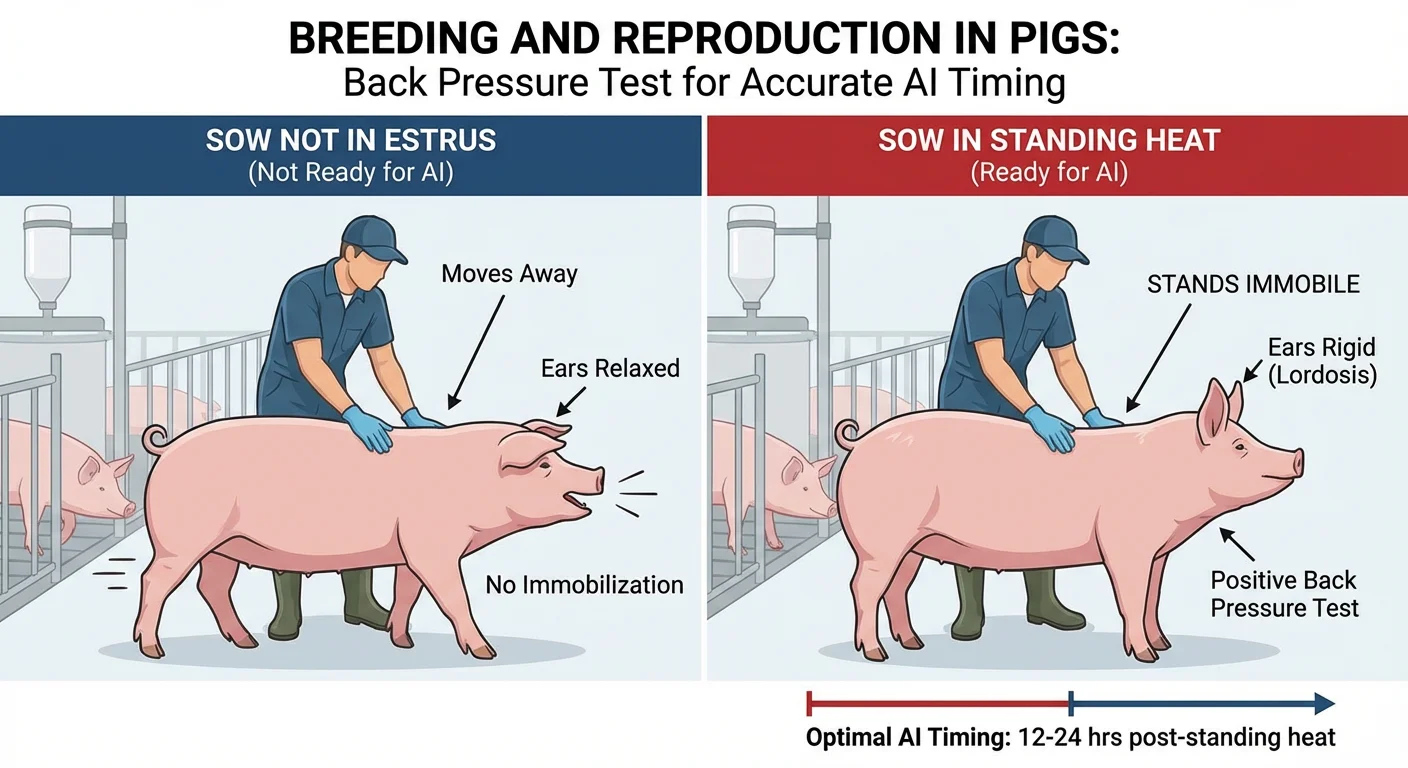
- “Locked up” stance when pressure is applied to the back
- Ears pricked forward
- Stands rigid for the riding test
- Mucus discharge from the vulva
The riding test: Apply firm pressure to the sow’s back while standing beside her. A sow in standing heat will freeze, brace her legs, and prick her ears. She’s ready.
How to Induce Heat in Pigs Naturally
Sometimes sows don’t cycle when you need them to. Before reaching for hormones, try these proven natural methods:
Boar exposure – Housing gilts near a mature boar often triggers cycling within 7-14 days. Pheromones work remarkably well. Even fence-line contact helps.
Flushing – Increasing feed intake by 50% for 10-14 days before desired breeding stimulates ovulation. Works best in thin sows.
Mixing groups – The stress of social reorganization sometimes triggers heat in stalled gilts. Combine with boar exposure for best results.
Light exposure – Ensuring 14-16 hours of light daily helps with seasonal breeding slowdowns. Use timers on barn lights during short winter days.
Relocation – Moving gilts to new housing near cycling females often does the trick.
If natural methods fail after 2-3 cycles, consult your veterinarian about hormonal options. Persistent anestrus may indicate underlying health issues.
Pig Breeding Techniques: Natural Mating vs. AI
Pig breeding techniques fall into two main categories: natural mating using a boar, or artificial insemination (AI) using collected and processed semen. Each approach has clear advantages depending on operation size, goals, and resources.
Natural Mating
For many small-scale operations, keeping a boar makes sense. Put the boar with the sow in heat, let nature work.
Advantages:
- Simple—no special equipment needed
- Boars detect heat better than most humans
- Multiple matings happen naturally
- Lower per-breeding cost with multiple sows
Disadvantages:
- Boars eat 5-6 pounds daily and need secure housing
- Aggressive boars are genuinely dangerous
- Limited genetic options
- Disease transmission risk between animals
- One boar can only service 15-20 sows effectively
Best practices for natural mating:
- Breed in the boar’s pen, not the sow’s (he’ll be more confident)
- Supervise matings when possible
- Allow 2-3 matings over the standing heat period
- Don’t overwork young boars—limit to one sow per day initially
Hand Mating vs. Pen Mating
Hand mating means you control each breeding—bringing the sow to the boar, supervising, then separating them. More labor, but you get exact breeding dates.
Pen mating means housing the boar with a group of sows. Less labor, but you won’t know the exact breeding dates—problematic for farrowing preparation.
For serious breeding programs, hand mating wins. Those dates matter.
Artificial Insemination in Pigs
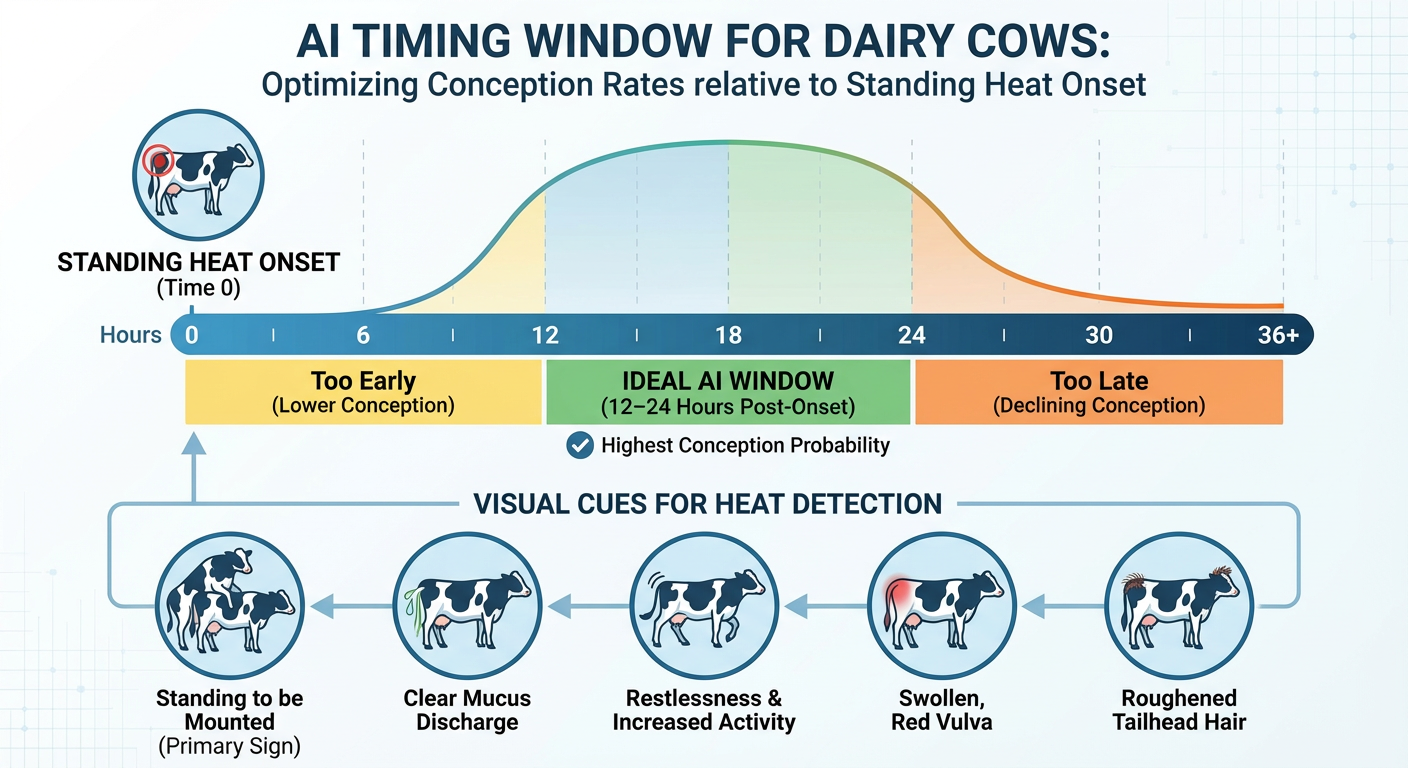
Artificial insemination in pigs is the process of depositing collected boar semen directly into the sow’s reproductive tract using specialized equipment, bypassing natural mating. AI allows access to superior genetics without maintaining a boar on-site.
Why Consider AI in 2026?
AI has transformed commercial pig production, and small-scale producers increasingly adopt it. Semen genetics and shipping logistics have improved dramatically.
Benefits for small farms:
- Access to top genetics nationwide (often $15-30 per dose)
- No boar to feed, house, or handle
- Reduced disease transmission
- Better record-keeping—you know exactly when you bred
- Can use different boars for different sows
- Try heritage breed genetics without buying a boar
The learning curve is real but manageable. Most people get competent within 3-5 breedings.
Equipment You’ll Need
- Fresh semen (ordered from suppliers, used within 3-5 days of collection)
- Insemination catheters (foam-tip for gilts, spiral-tip for sows)
- Non-spermicidal lubricant
- Clean paper towels
- Breeding record sheets
2026 tip: Several suppliers now offer semen with extended shelf life (7+ days) using improved extenders. Ask about this when ordering—it gives more flexibility for timing.
Step-by-Step AI Process
1. Confirm standing heat. Don’t waste semen on a sow that’s not ready. Do the back pressure test. If she doesn’t lock up, wait.
2. Clean the vulva. Wipe away debris with a dry paper towel. Don’t use water—it can carry bacteria inside.
3. Prepare the catheter. Apply a small amount of lubricant to the tip only.
4. Insert the catheter at an angle upward initially to avoid the bladder, then level out. For spiral-tip catheters, rotate counterclockwise as you insert. The catheter should “lock” at the cervix—you’ll feel resistance.
5. Attach the semen container. Don’t squeeze. Let the sow’s uterine contractions draw the semen in naturally. This takes 3-5 minutes.
6. Stimulate the sow. Apply back pressure, rub her flanks, and scratch behind her ears. This mimics boar presence and improves semen uptake significantly.
7. Leave the catheter in place. Wait 1-2 minutes after the container empties, then remove slowly with a slight counterclockwise rotation.
8. Record everything Date, time, semen source, sow ID, and any observations.
Timing AI for Best Results
Ovulation typically occurs 24-36 hours after standing heat begins. Sperm need 6-8 hours to capacitate before fertilizing eggs.
Best practice: Inseminate twice—once when standing heat is detected, again 12-24 hours later. This double-mating approach significantly improves conception rates.
Fresh semen works better than frozen for beginners. Order from reputable suppliers who ship with proper cooling and provide collection dates.
Selecting Breeding Stock: Boars and Sows
Selecting breeding stock means evaluating individual animals based on conformation, genetics, health, temperament, and production potential. Your breeding stock determines everything—choose well, and the pigs almost raise themselves.
What Beginners Should Look For
If you’re new to pig breeding, focus on proven animals rather than show-quality stock.
Priority traits for beginners:
- Calm temperament – Nervous or aggressive pigs make everything harder
- Sound structure – Strong legs, good feet, level topline
- Production records – Buy from someone who tracks litter data
- Health history – Vaccination records, no chronic issues
Selecting Gilts for Breeding
Look for:
- At least 14 functional teats, evenly spaced, no inverted nipples
- Good body condition—not too fat, not too thin
- Strong legs with good bone, no toeing-in or splay legs
- Breed characteristics (if raising purebreds)
- From litters of 10+ piglets with good survival rates
Avoid gilts that:
- Come from small litters (under 8)
- Show structural unsoundness
- Are extremely flighty or aggressive
- Have any signs of illness or poor thrift
Selecting Boars
Boar selection matters even more—one boar influences dozens of litters.
Priorities:
- Structural soundness – He needs to mount and breed without injury
- Testicular development – Both testicles fully descended, good size for age
- Temperament – Aggressive boars injure handlers and sows
- Performance data – Growth rate, feed efficiency, backfat if available
- Breed quality – For registered operations
Request data when buying. Good breeders track weights, days to market weight, and litter information.
Age and Weight Guidelines
| Animal | Minimum Age | Minimum Weight | Notes |
|---|---|---|---|
| Gilts | 7-8 months | 250-280 lbs | Whichever comes later |
| Boars (light use) | 7-8 months | 250+ lbs | One sow per day maximum |
| Boars (full service) | 12+ months | 300+ lbs | Can handle 2-3 sows daily |
Breeding too young stunts growth and causes farrowing problems. Patience pays.
Genetics and Heritability in Pigs
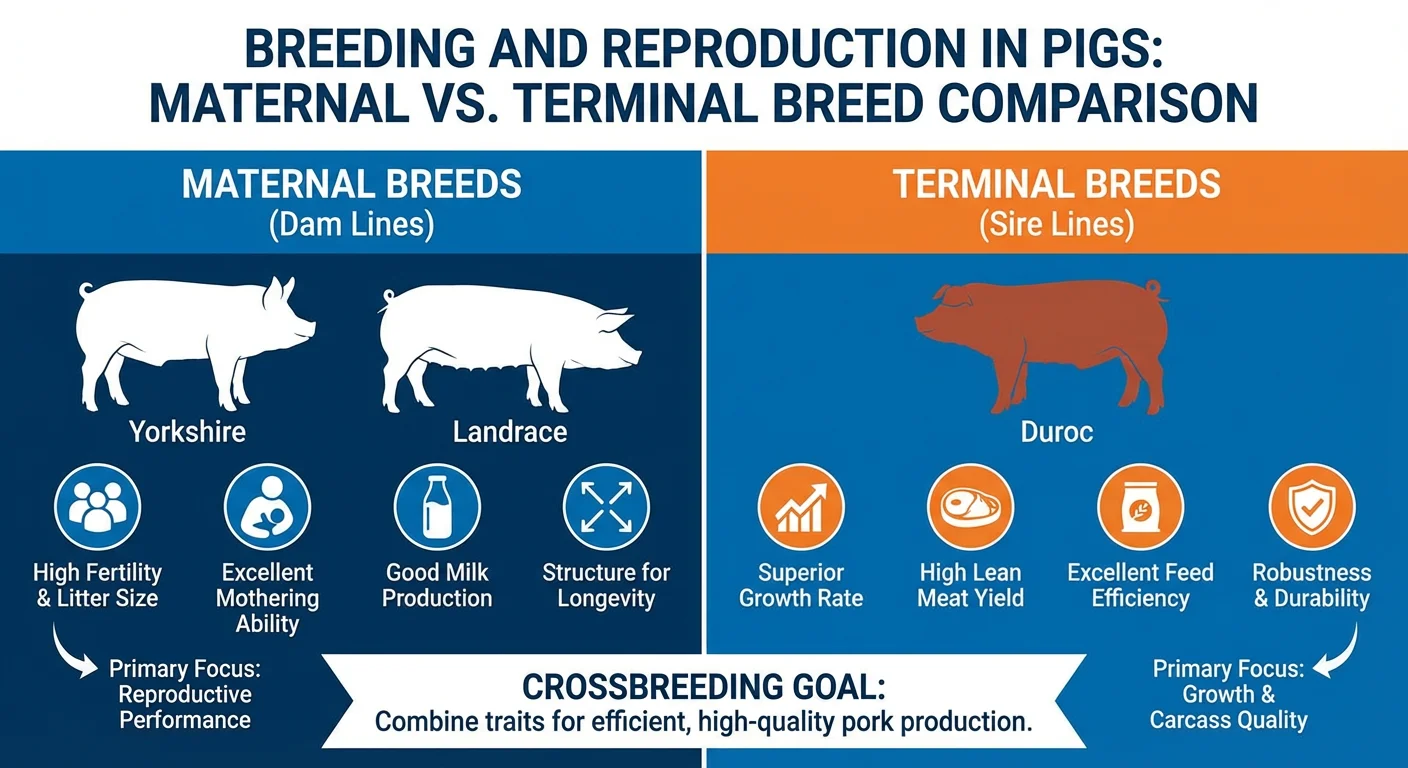
Pig genetics refers to the inherited traits passed from parents to offspring, including growth rate, litter size, meat quality, and disease resistance. Understanding heritability helps breeders make selection decisions that improve herds over generations.
Basic Genetic Concepts
Every pig carries two copies of each gene—one from the sire, one from the dam. Some traits respond quickly to selection; others depend heavily on environment and management.
Highly heritable traits (40-60%):
- Backfat thickness
- Growth rate
- Feed efficiency
- Meat quality (marbling, pH)
Moderately heritable traits (20-40%):
- Litter size at birth
- Structural soundness
Lowly heritable traits (under 20%):
- Litter size at weaning
- Disease resistance
- Mothering ability
Practical meaning: You can make rapid genetic progress on growth rate by selecting fast-growing parents. Improving litter size takes longer because the environment matters more.
Purebred vs. Crossbreeding
Purebred breeding maintains breed characteristics and allows you to sell registered stock. Progress is predictable but slower.
Crossbreeding combines breeds to capture hybrid vigor (heterosis). Crossbred sows typically wean 1-2 more piglets per litter than purebreds.
Popular crosses for small farms in 2026:
- Yorkshire × Hampshire – Good mothers, meaty offspring
- Duroc × Berkshire – Excellent meat quality, good for direct marketing
- Large Black × Tamworth – Hardy, excellent for pasture systems
- Hereford × Red Wattle – Heat-tolerant, good temperament
Making Genetic Progress Without Formal Testing
Even without EPDs or genomic testing, you can improve your herd:
- Keep production records (litter size, weaning weights, growth rates)
- Identify your consistently best-performing animals
- Select replacement gilts from top litters only
- Use boars with documented performance
- Cull animals that don’t meet standards—sentiment costs money
Genetic progress is slow but cumulative. Five years of careful selection create a noticeably better herd.
Sow Fertility Management
Sow fertility management encompasses all practices aimed at maximizing conception rates, maintaining pregnancy, and optimizing the number of live piglets born per sow annually. Good management can add 2-4 piglets per sow per year.
Factors Affecting Fertility
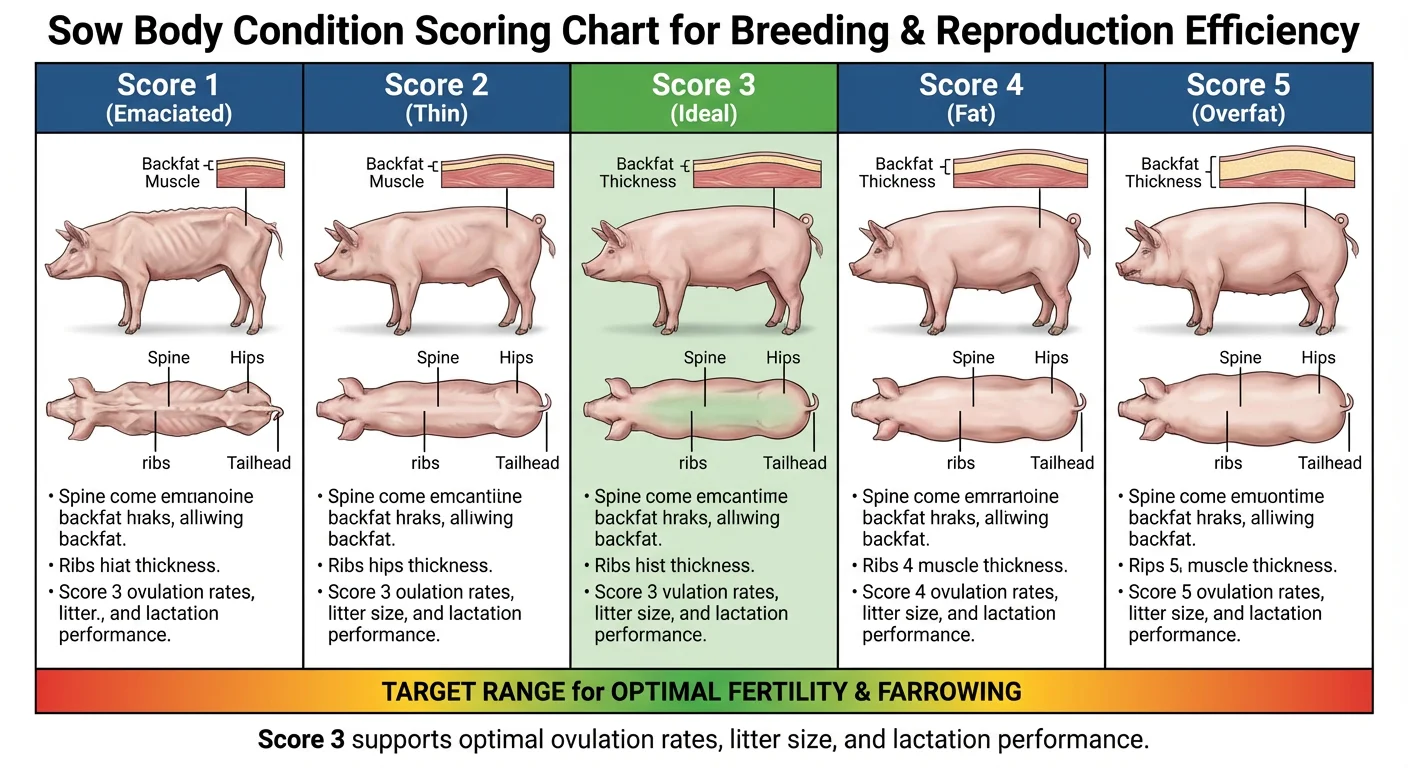
Body condition – Sows that are too fat or too thin have reduced conception rates. Aim for a body condition score of 3-3.5 at breeding (ribs felt with light pressure but not visible).
Age and parity – Gilts have smaller litters than mature sows. Fertility peaks around parity 3-5, then gradually declines.
Season – Summer heat significantly reduces fertility. Expect lower conception rates June through September.
Nutrition – Both deficiency and excess cause problems. Balance matters more than volume.
Health status – PRRS, parvovirus, and leptospirosis devastate reproductive performance.
Maximizing Conception Rates
- Breed at optimal time (12-24 hours into standing heat)
- Use double mating (two services 12-24 hours apart)
- Minimize stress around breeding—no mixing, moving, or vaccinating
- Ensure adequate boar exposure for gilts before first breeding
- Maintain proper body condition, especially in lactating sows
- Address health issues before breeding season
Managing Returns to Heat
If a sow returns to heat 18-24 days after breeding, she didn’t conceive. This happens—about 10-15% of breedings fail even with excellent management.
Track return dates carefully. Sows that fail to conceive three consecutive times should be evaluated by a veterinarian or culled.
Combating Seasonal Infertility
The summer months challenge pig fertility across the USA. Heat stress reduces conception rates, increases embryonic death, and can shorten cycles.
Combat strategies:
- Provide shade and cooling (sprinklers, misters, wallows)
- Breed during cooler morning or evening hours
- Increase AI dose slightly in summer (3 billion cells vs. 2.5 billion)
- Keep boars cool—heat stress affects sperm quality for 6+ weeks
- Accept that summer conception rates will be 10-15% lower
Gestation Management: Nutrition, Housing, and Health
Gestation in pigs lasts approximately 114 days—commonly remembered as “3 months, 3 weeks, and 3 days.” Proper management during this period ensures healthy sow condition, adequate fetal development, and successful farrowing.
Confirming Pregnancy
You won’t know immediately if breeding worked. Options for detection:
No return to heat – If the sow doesn’t cycle at 18-24 days post-breeding, she’s likely pregnant. Simple but not 100% reliable.
Ultrasound – Reliable at 25-30 days. Handheld Doppler units cost $200-500 and work well for small operations. Many producers consider this essential equipment for 2026.
Physical observation – Abdominal enlargement becomes obvious by day 90.
For detailed pregnancy detection protocols, your state extension service likely offers a pig reproduction cycle PDF with timing charts.
Nutritional Requirements
Early gestation (days 1-75):
- Moderate feeding: 4-5 pounds daily of standard sow diet
- Overfeeding now creates fat sows at farrowing—a real problem
- Ensure adequate protein (12-14%) and proper mineral balance
Late gestation (days 75-114):
- Increase to 6-8 pounds daily
- Fetal growth accelerates dramatically—70% of piglet weight gained in the final month
- Bump protein to 14-16%
- Ensure calcium and phosphorus for bone development
Critical nutrients:
- Vitamin A, D, E (often supplemented via premix)
- Folic acid (supports litter size)
- Choline (liver development)
- Clean, fresh water always available (4-6 gallons daily)
Housing Pregnant Sows
Requirements:
- Protection from temperature extremes (60-75°F ideal)
- Clean, dry bedding
- Enough space to move and exercise
- Separate feeding stations if group-housed
- Freedom from aggressive penmates
Housing options:
| System | Pros | Cons |
|---|---|---|
| Individual pens | Control, easy monitoring | Limited movement |
| Group housing | Social, more natural | Fighting, feed competition |
| Pasture | Exercise, foraging | Weather exposure, harder monitoring |
Many small farms use combination systems—individual housing around breeding and farrowing, group housing or pasture during mid-gestation.
Pre-Farrowing Health Protocols
3-5 weeks before due date:
- Administer pre-farrowing vaccinations (E. coli, Clostridium)
- Deworm if needed
- Check body condition and adjust feeding
2 weeks before:
- Move to the farrowing area for acclimation
- Begin reducing feed slightly in the final 3-4 days
- Observe for any health concerns
Preparing for Farrowing and Managing Complications
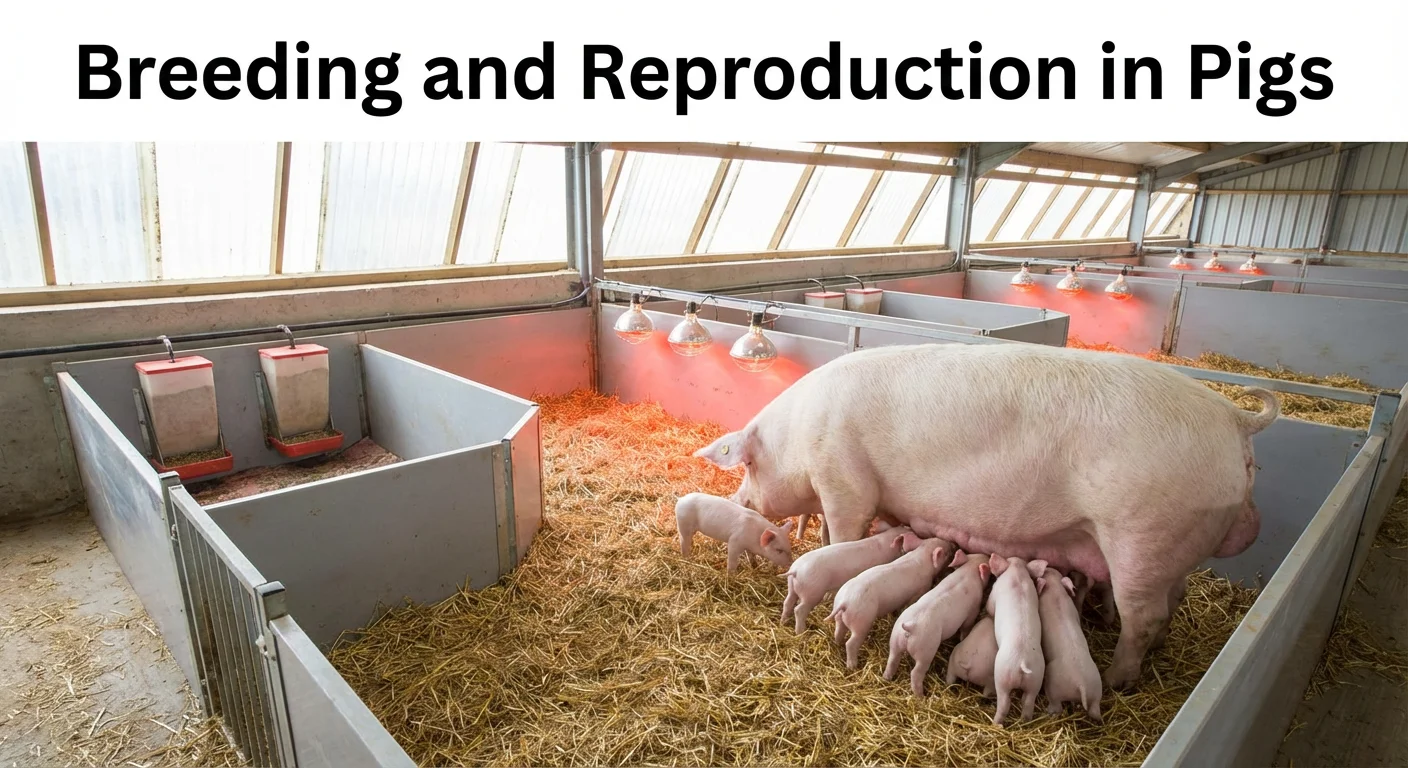
Farrowing management includes all preparations and interventions surrounding birth, from setting up facilities through the first hours after delivery. Proper management dramatically reduces piglet mortality.
The Farrowing Environment
Prepare farrowing quarters 7-14 days before the due date:
Facility preparation:
- Scrub and disinfect everything; let it dry completely
- Check all equipment—waterers, feeders, heat sources, gates
- Provide appropriate bedding (straw works well; avoid fine shavings)
- Set up supplemental heat—piglets need 85-90°F while sows prefer 60-65°F
Supplies to have ready:
- Clean towels or rags
- Iodine (7%) for navels
- Dental floss or umbilical clamps
- Oxytocin (prescription, for emergencies only)
- Record sheets and a pen
- Flashlight for night checks
- OB sleeves and lubricant
- Phone number for your vet
Signs of Approaching Farrowing
In the final week:
- Udder development increases
- The vulva relaxes and swells
In the final 24 hours:
- Milk is present when the teats are squeezed
- Extreme restlessness, nesting behavior
- Rapid breathing
- Possible mucus discharge
- Temperature drop of 1-2°F (normal is 101-102°F)
The Farrowing Process
Normal farrowing takes 2-5 hours for the entire litter. Piglets arrive every 15-30 minutes on average, though gaps up to 45 minutes aren’t unusual.
What’s normal:
- Sow alternates between resting and straining
- Piglets arrive with or without membranes
- Sows may eat placentas (normal, though some remove them)
- Afterbirth passes within 4 hours ofthe last piglet
- Some blood-tinged discharge
What’s NOT normal:
- Strong contractions for 30+ minutes produce nothing
- More than 60 minutes between piglets with active straining
- Bright red blood before or between piglets
- Sow exhausted, giving up, or unresponsive
- A visible piglet stuck in the birth canal
When and How to Intervene
Most farrowings proceed without help. But know when to step in.
Assist if:
- Strong straining produces nothing for 30 minutes
- You can see or feel a stuck piglet
- The sow is clearly exhausted or in distress
Intervention steps:
- Wash your hands and arms thoroughly with soap
- Apply generous OB lubricant
- Insert the hand gently, following the birth canal
- Locate piglet—often just inside the pelvis
- Guide out with gentle traction; never pull hard
- If you can’t resolve it quickly, call your vet
Emergencies—call the vet immediately:
- Uterine prolapse
- Retained piglets you cannot reach
- Excessive hemorrhage
- Sow in shock or non-responsive
- No progress despite intervention
Piglet Care: Colostrum, Cross-Fostering, and Weaning
Piglet care from birth to weaning determines survival rates and lifetime performance. Critical interventions in the first 24 hours—particularly colostrum intake—have permanent effects on pig health and growth.
The First Hours: Colostrum Is Non-Negotiable
Piglets are born without antibodies. They receive all their initial immune protection from colostrum—the first milk. This window closes quickly as the gut loses its ability to absorb antibodies.
Colostrum priorities:
- Every piglet must nurse within 6 hours (sooner is better)
- Weak or chilled piglets may need help reaching teats
- Ensure small piglets aren’t pushed off by larger littermates
- Split-suckling (removing half the litter temporarily) helps large litters
Signs of inadequate colostrum:
- Piglets remain gaunt after 12 hours
- Excessive vocalization
- Piglets feel cold and hollow
- Early deaths (days 2-5) from common infections
Piglets that miss adequate colostrum are more susceptible to disease throughout life, grow more slowly, and often die before weaning.
Processing Piglets
Within 24-72 hours of birth, most producers complete basic processing:
| Procedure | Timing | Purpose | Optional? |
|---|---|---|---|
| Navel dip | Birth | Prevent infection | No |
| Iron injection | Day 1-3 | Prevent anemia | No |
| Teeth clipping | Day 1-3 | Prevent teat/face injuries | Yes |
| Tail docking | Day 1-3 | Prevent tail biting | Yes |
| Ear notching/tagging | Day 1-7 | Identification | Recommended |
| Castration | Day 3-7 | If raising barrows | Situation-dependent |
Not all procedures suit every operation. Discuss with your veterinarian.
Cross-Fostering
When litter sizes vary dramatically or sows die, moving piglets between litters saves lives.
Best practices:
- Foster within the first 24-48 hours (earlier is better)
- Move piglets to sows that farrowed within 2-3 days
- Match piglet size to the new litter
- Rub fostered piglets with bedding from the new sow
- Monitor for 2-3 hours to ensure acceptance
Sows accept foster piglets much more readily in early lactation before strong individual recognition develops.
Weaning Age and Methods
| Weaning Age | Pros | Cons | Best For |
|---|---|---|---|
| 21 days | More litters/year, commercial standard | Higher piglet stress | Operations prioritizing throughput |
| 28-35 days | Better piglet development, lower mortality | Longer farrowing interval | Small farms, heritage breeds |
| 6-8 weeks | Lowest stress, most natural | Fewest litters/year | Pasture operations, premium markets |
Weaning tips:
- Start creep feeding at 2-3 weeks regardless of weaning age
- Remove the sow, not the piglets (less stress)
- Maintain a familiar environment and penmates
- Ensure piglets are eating solid feed before weaning
- Reduce sow feed before weaning to ease milk drying
Sow Lactation Management
Sow lactation management focuses on nutrition, health, and environment to maximize milk production while maintaining sow body condition for rebreeding.
Lactation Nutrition
Nursing sows need dramatically more feed than gestating sows—often 12-18 pounds daily, depending on litter size.
Underfeeding during lactation causes:
- Reduced milk production
- Excessive weight loss (more than one body condition score)
- Delayed return to heat after weaning
- Poor subsequent conception rates
- Sow breakdown over multiple parities
Feeding guidelines:
- Increase feed gradually after farrowing (reach full feed by day 5-7)
- Rule of thumb: 4 pounds base + 1 pound per nursing piglet
- Feed 2-3 times daily or use self-feeders
- Ensure constant access to fresh water—lactating sows drink 6-8 gallons daily
- Higher protein than gestation diet (16-18% vs. 12-14%)
Monitoring Milk Production
You can’t measure milk directly, but you can assess it indirectly:
Good indicators:
- Piglet growth rate (should gain 0.5-0.7 lbs daily)
- Piglet behavior (content, full bellies, quiet between nursings)
- Udder appearance (firm before nursing, soft after)
- Sow condition (gradual loss is normal; dramatic loss indicates problems)
Common Lactation Problems
Mastitis – Udder infection causing hot, hard, painful teats. Affected teats may be discolored. Requires antibiotics and anti-inflammatories.
Agalactia – Failure to produce milk. Often part of MMA syndrome (mastitis-metritis-agalactia). Emergency—piglets will starve without intervention.
Poor let-down – Sow has milk but won’t release it. Often stress-related. A calm environment and oxytocin may help.
Savage behavior – Rare, but some sows attack piglets. Remove piglets immediately. Do not rebreed these sows.
Reproductive Disorders: Identification and Management
Reproductive disorders include any condition affecting breeding, conception, gestation, or farrowing. Early identification minimizes losses and prevents spread within the breeding herd.
Infectious Reproductive Diseases
PRRS (Porcine Reproductive and Respiratory Syndrome)
- Signs: Late-term abortions, stillbirths, weak “mummified” piglets, respiratory issues
- Spread: Highly contagious via direct contact, aerosol, semen
- Management: Vaccination helps but doesn’t eliminate; it persists in recovered animals for months
- Impact: Can reduce pigs weaned per sow by 30%
Parvovirus
- Signs: Mummified fetuses at various sizes, small litters, and a few live pigs
- Spread: Very stable in the environment; gilts are most susceptible
- Management: The vaccine is cheap and highly effective
- Prevention: Vaccinate gilts twice before first breeding; annual sow boosters
Leptospirosis
- Signs: Abortions, stillbirths, weak piglets, occasional jaundice
- Spread: Rodent urine, contaminated water
- Note: Zoonotic—humans can contract it
- Management: Vaccination plus rodent control
Brucellosis
- Signs: Abortions, infertility, orchitis in boars
- Status: Reportable disease—must notify state veterinarian
- Management: Test and cull positive animals; no treatment
Non-Infectious Problems
Cystic ovaries – Cause irregular or absent cycles. Sometimes responsive to hormonal treatment.
Uterine infections – Often follow difficult farrowings or retained placentas. May require antibiotic therapy and affect future fertility.
Congenital defects – Some gilts have abnormal reproductive tracts. Cull animals that fail to conceive after 3 attempts.
Culling Guidelines
Cull breeding animals that:
- Fail to conceive after three properly timed breeding attempts
- Have two consecutive small litters (under 6 piglets born alive)
- Show chronic reproductive infections
- Savage or refuse to nurse piglets
- Have structural problems preventing normal breeding or mobility
Keeping poor performers costs more than replacing them. Document reasons for culling to identify patterns.
Record-Keeping for Pig Breeding Reproduction
Record-keeping means systematically tracking breeding dates, farrowing results, and individual animal performance to enable data-driven management decisions. You can’t improve what you don’t measure.
Essential Records
Individual sow/gilt records:
- ID number and birth date
- Breeding dates and boar/semen source
- Pregnancy confirmation date
- Farrowing date and ease of delivery
- Born alive, stillborn, or mummified counts
- Number weaned and weaning weights
- Health treatments administered
- Culling date and reason
Herd-level metrics to track:
- Farrowing rate (% of bred sows that farrow)
- Average number born alive per litter
- Pre-weaning mortality rate
- Average weaning weight
- Pigs weaned per sow per year (target: 20-25 for most small operations)
Simple Recording Systems
Option 1: Index cards. One card per sow, stored in a box. Simple and reliable. Update after each event.
Option 2: Spreadsheet, Excel, or Google Sheets with columns for each data point. Easy to calculate averages and spot trends.
Option 3: Farm management apps. Multiple options exist for smartphone/tablet use. Search for “pig farm management” in app stores. Some are free; othersare subscription-based.
Choose whatever you’ll actually use consistently. The best system is one you maintain.
Using Records for Decisions
Records answer questions like:
- Which sows consistently wean the most piglets?
- Are specific boars siring better litters?
- Is your pre-weaning mortality improving or worsening?
- When should you replace aging sows?
- Do management changes actually help?
Review records quarterly. Identify patterns. Make decisions based on data rather than impressions.
Common Mistakes Small-Scale Breeders Make
Even experienced farmers make preventable errors. Learning from common mistakes costs less than discovering them yourself.
Mistake #1: Breeding Too Young
Gilts bred before reaching adequate size have difficult farrowings, smaller litters, and stunted lifetime growth. Wait until 7-8 months AND 250+ pounds—whichever comes later.
Mistake #2: Overfeeding Pregnant Sows
Fat sows have significantly more farrowing problems—difficult births, increased piglet crushing, and reduced milk production. Keep sows in moderate body condition (score 3-3.5).
Mistake #3: Poor Heat Detection
Missing heat cycles wastes weeks. Check sows twice daily during expected heat periods. Use a boar for detection when possible—they’re better at it than humans.
Mistake #4: Skipping Quarantine
New pigs bring new diseases. Always quarantine new breeding stock for 30-60 days before introducing them to your established herd. No exceptions.
Mistake #5: No Records
“I’ll remember” becomes “which sow was that?” within months. Write everything down, starting with your first breeding.
Mistake #6: Keeping Poor Performers
Sentiment doesn’t pay bills. Sows that don’t produce need to go. Set culling standards and enforce them.
Mistake #7: Inadequate Farrowing Supervision
Piglet losses are highest in the first 72 hours. Check farrowing sows every 4-6 hours during active delivery, more frequently if problems arise.
Mistake #8: Early Weaning Without Preparation
Abrupt early weaning stresses piglets severely. Ensure creep feeding is established before weaning and minimize environmental changes.
Sustainability, Heritage Breeds, and Small-Scale Herd Contributions
Small-scale pig breeding contributes to agricultural sustainability through breed preservation, local food systems, and management diversity that complements commercial production.
Heritage Breed Conservation in 2026
Commercial pork focuses on a handful of highly productive genetics. Heritage breeds—Gloucestershire Old Spots, Large Blacks, Mulefoots, Red Wattles, Guinea Hogs—depend on small farms for survival.
Why heritage breeds matter:
- Preserve genetic diversity for future needs
- Maintain traits suited to extensive, low-input systems
- Provide unique products for niche markets
- Connect consumers to agricultural history
Heritage breeds are particularly suited for small farms:
- Large Black – Excellent grazers, calm temperament, good mothers
- Gloucestershire Old Spots – Hardy, good foragers, distinctive appearance
- Tamworth – Active foragers, lean meat, heat-tolerant
- Berkshire – Superior meat quality, adaptable, good temperament
- Red Wattle – Hardy, fast-growing, excellent meat quality
Pasture and Outdoor Systems
Small farms often raise pigs outdoors—on pasture, in woodlots, or on crop residue. These systems align with growing consumer demand for higher-welfare pork.
Advantages:
- Reduced housing costs
- Improved animal welfare perception
- Soil building, when properly managed
- Pigs with distinct fat composition and flavor
- Premium marketing opportunities
Challenges:
- More land required
- Weather exposure management
- Predator protection
- Parasite control
- Different fencing requirements
Direct Marketing Strategies for 2026
Small breeding operations can capture significantly more value through direct sales:
Products to sell:
- Breeding stock (registered or commercial)
- Weaner pigs to other farmers
- Finished pigs are being directly delivered to consumers
- Specialty cuts and processed products
Marketing angles that resonate:
- Heritage/rare breed story
- Pasture-raised, outdoor access
- Known farm origin, transparent practices
- Superior eating quality
- Local food system support
Social media, farmers’ markets, and farm websites remain effective channels. Some producers find success with buying clubs and CSA-style meat subscriptions.
Your Role in Swine Diversity
Your operation matters more than you might think. The diversity and resilience small farms provide strengthen the entire pig industry. Every heritage breed litter, every alternative management system, every direct connection between farmer and consumer contributes to a more robust food system.
Frequently Asked Questions
Where can I find breeding and reproduction in pigs PDF resources?
University extension services provide the most reliable free PDF guides on pig breeding and reproduction.
Search your state’s land-grant university website—Iowa State, Purdue, Penn State, NC State, and Texas A&M all maintain comprehensive swine libraries. The Pork Checkoff (pork.org) also offers downloadable breeding guides.
These resources are regularly updated and written by swine specialists. For visual reference materials, search “pig reproduction cycle PDF” to find charts showing hormone patterns and optimal breeding windows.
What’s the typical pig breeding cycle timeline?
The complete pig breeding cycle runs approximately 21 days from one heat to the next. Standing heat—when the sow accepts mating—lasts 2-3 days within that cycle. After successful breeding, gestation takes about 114 days (3 months, 3 weeks, 3 days).
Lactation typically runs 3-8 weeks, depending on your weaning strategy.
Sows return to heat 4-7 days after weaning, allowing the cycle to begin again.
What should beginners prioritize when starting pig breeding?
Focus on fundamentals: learn heat detection before buying breeding stock, start with proven sows rather than untested gilts, establish a veterinarian relationship before problems occur, and keep records from day one.
Begin with natural mating before attempting AI. Don’t over-complicate things—good observation skills matter more than expensive equipment. Accept that mistakes will happen; the goal is learning from each one.
How can I induce heat in pigs without using hormones?
Boar exposure is the most effective natural method—house gilts within sight and smell of a mature boar for 7-14 days.
Flushing (increasing feed by 50% for 10-14 days before desired breeding) stimulates ovulation in thin animals.
Mixing gilt groups, relocating animals to new housing, and ensuring 14-16 hours of daily light exposure also help. If natural methods fail after 2-3 cycles, consult your veterinarian about underlying issues.
How do I know if my sow is pregnant?
The simplest method is watching for return to heat—if she doesn’t cycle at 18-24 days post-breeding, she’s likely pregnant.
For more certainty, handheld ultrasound units reliably detect pregnancy at 25-30 days and cost $200-500.
Physical signs like abdominal enlargement become obvious by day 90. Some producers use blood tests at 25+ days, though this requires sending samples to a lab.
What’s the most common cause of piglet death before weaning?
Crushing by the sow accounts for approximately 50% of pre-weaning piglet deaths, followed by starvation (inadequate colostrum or milk) and chilling.
Most crushing occurs in the first 72 hours when piglets are most vulnerable.
Prevention strategies include proper farrowing facility design, adequate supplemental heat for piglets, ensuring colostrum intake, and frequent monitoring during the first three days after birth.
Moving Forward
Pig breeding reproduction rewards patience, observation, and willingness to learn. The fundamentals haven’t changed much over centuries—healthy animals, proper timing, good nutrition, careful attention. What’s improved is our understanding of why these things matter and how to optimize them.
Start with what you can manage well. Get comfortable with heat detection and natural mating before tackling AI. Keep records from your first breeding. Learn from every litter—the successes and the failures.
Small-scale pig breeding contributes something the industry genuinely needs: diversity, experimentation, connection between farmers and consumers, and preservation of genetics that would otherwise disappear. Your three sows matter. Your heritage boar matters. The knowledge you develop and share matters.
Build your skills, track your results, and don’t be afraid to ask questions. The pig farming community remains one of the most helpful in agriculture.
Good luck with your breeding program.