Pig Nutrition: Stages, Feed Charts, and FCR Targets
Pig nutrition is the largest single cost center on almost every hog operation in the United States, and it is also the one most producers guess at. This guide gives you published benchmark figures—daily intake and amino acid targets by weight phase, realistic feed conversion ranges, and the short list of feeds that must never reach a pig—along with the caveats that decide when those benchmarks apply to your herd and when they do not. If you are still setting up, start with our small-scale pig farming in the USA guide.
Quick Answer
Pigs require 36 essential nutrients in addition to water. Published benchmarks for high lean-gain barrows put daily feed intake near 3.1 lbs at 45–90 lbs and 6.2 lbs at 225–270 lbs, with standardized ileal digestible lysine falling from 1.56% in early nursery diets to 0.63% at market weight. Overall feed conversion typically lands between 2.8 and 3.5 with commercial genetics. Every figure shifts with genetics, sex, and environment.
Key Takeaways
- Intake benchmarks are phase-specific, not a percentage rule. Published figures run about 3.1 lbs daily at 45–90 lbs and 6.2 lbs at 225–270 lbs for high lean-gain barrows.
- SID lysine falls steeply with weight—roughly 1.56% in early nursery diets down to 0.63% at market weight in the same reference tables.
- Crude protein is the wrong number to shop on. Standardized, easily digestible lysine is what limits growth.
- Published tables differ by genetics and sex. Separate recommendations exist for high, medium, and low lean-gain lines and for barrows versus gilts.
- Water is the first limiting nutrient. Restricted water cuts feed intake within hours, which makes every other target unreachable.
- Feeding meat-containing food waste to swine is regulated, with requirements that vary by jurisdiction.
How to Use the Numbers on This Page
Every figure here is a published benchmark, not a prescription for your herd. The reference tables these numbers come from state plainly that specific genetic populations, economics, environmental conditions, nutrient availability, and nutrient interactions may require significant deviations from them.
That caveat is not boilerplate. It is the reason two competent producers can run different rations on the same weight of pig and both be right. Treat what follows as a starting point to measure against, then adjust on what your own scale and feed records tell you.
What Pigs Need: The Six Nutrient Groups
Pigs require 36 essential nutrients in addition to water—24 nutrients plus 10 amino acids and 2 fatty acids that must be supplied in the diet, according to the Merck Veterinary Manual’s nutritional requirements for pigs. Water is counted separately from that list.
For practical ration decisions, this guide groups those nutrients into six working categories: water, carbohydrates, fats, protein and amino acids, minerals, and vitamins. That grouping is a convenience for organizing feeding decisions, not the classification scheme behind the count of 36.
Pigs are monogastric—single-stomached, like humans—which means they cannot ferment fiber the way cattle do. Everything they need has to arrive in a digestible form. Our guide to how a pig’s digestive system works covers why that constraint shapes every ration decision that follows.
Water: The First Limiting Nutrient
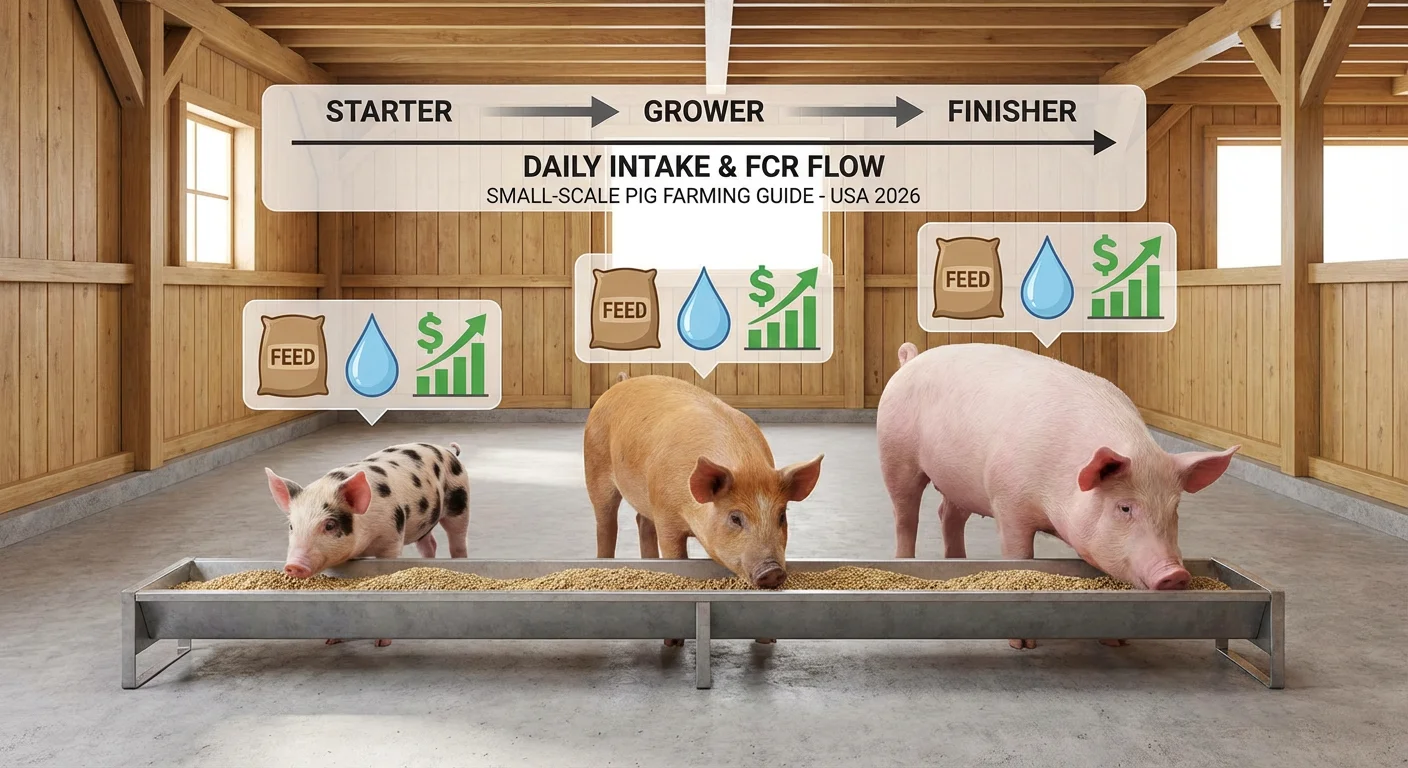
Water is the nutrient pigs need most and the one most likely to be quietly restricting your herd right now. When water is restricted, feed intake drops within hours rather than days. A pig that cannot drink stops eating, and every other nutrient calculation on this page becomes meaningless.
Two different rules of thumb circulate for estimating water need, and they are not conversions of one another. One expresses drinking water as a ratio to feed eaten, commonly quoted around 2 to 3 parts water per part of feed. The other expresses it as a share of body weight, commonly quoted around 2 to 3 gallons per 100 lbs daily. They can disagree for the same pig because intake responds to stage, ambient temperature, feed moisture, and diet composition, and each rule holds those variables differently. Use them as sanity checks on your delivery capacity, not as a target to hit.
What is worth measuring directly is flow rate. A waterer that drips is technically working and can still hold back a pen. Beyond volume, contamination and mineral load matter—pig water quality covers testing thresholds and the specific problems that show up in well water.
Energy, Minerals, and Vitamins
Energy drives everything else. Corn supplies most of the metabolizable energy—the portion of gross energy a pig can actually use after digestive and urinary losses—in typical U.S. diets. Too little slows growth; too much builds backfat instead of lean.
Minerals and vitamins are needed in small amounts and cause outsized problems when short. Calcium and phosphorus build bone and are the two most commonly imbalanced. Zinc deficiency produces parakeratosis, a thickening and cracking of the skin. Excess of one mineral can block absorption of another, which is why balance beats supplementation. The detail lives in our guide to vitamins and minerals for pigs.
Fiber deserves a brief mention. Pigs digest it poorly, but some fiber supports gut function, and too much dilutes energy density. The interaction between the three macronutrients is covered in balancing protein, energy, and fiber.
Why SID Lysine Beats Crude Protein
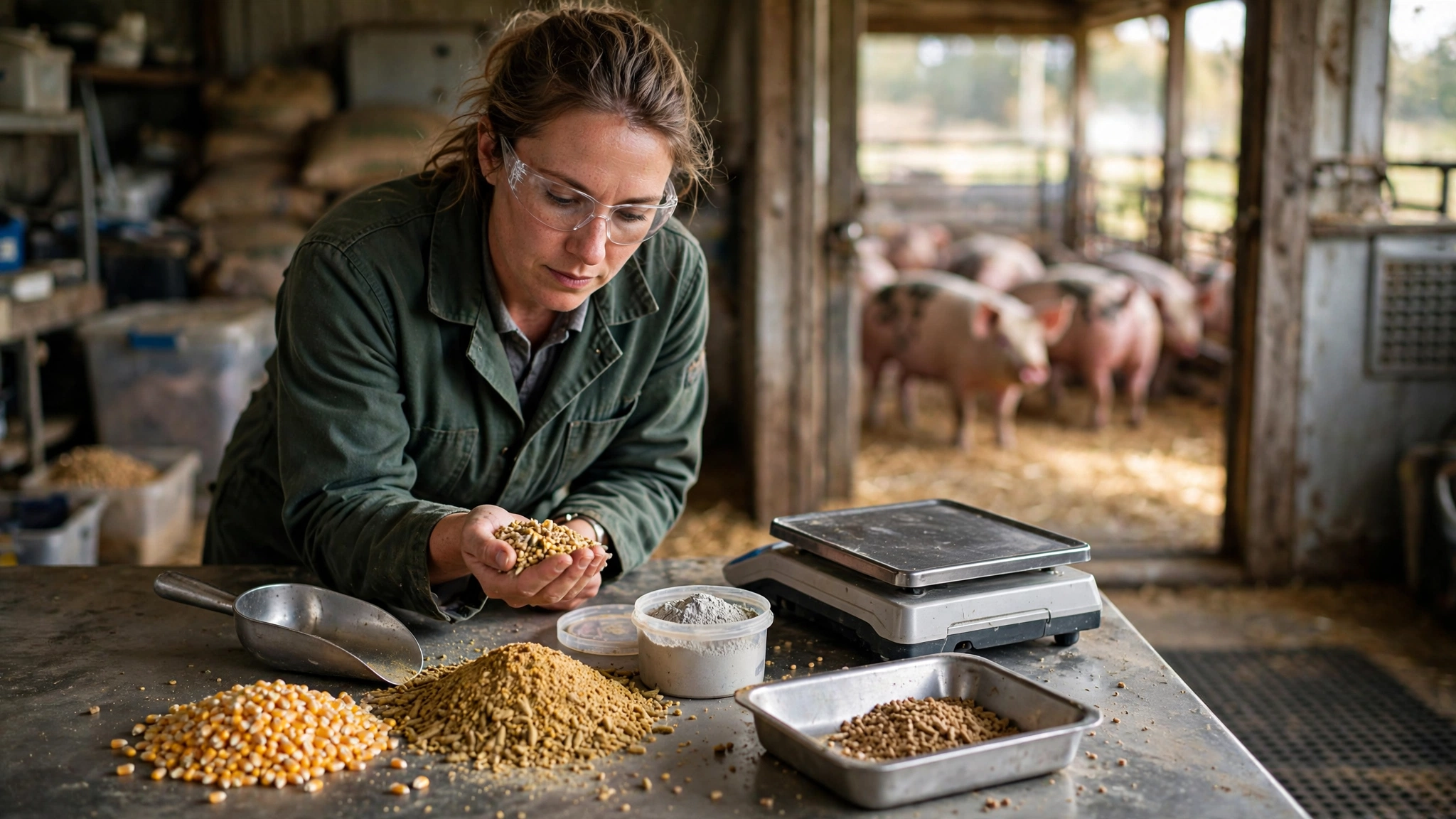
Crude protein percentage tells you how much nitrogen is in a feed, not how much of it a pig can use—which is why standardized ileal digestible (SID) lysine, the amount of the amino acid lysine absorbed before the end of the small intestine, is the figure that reference tables are built around.
Lysine is the first limiting amino acid in corn-soybean meal diets, meaning it runs out first and caps how much muscle a pig can build regardless of what the other amino acids are doing. Two feeds can both read “18% crude protein” on the tag and deliver meaningfully different SID lysine, because protein source and processing change digestibility.
The practical consequence: if you are comparing feeds on the crude protein line alone, you are comparing the wrong number. Ask for the SID lysine value.
Reading Reference Tables Correctly
Published nutrient tables are formulated for a defined animal under defined conditions, and the same reference will publish several sets of numbers rather than one. The National Swine Nutrition Guide tables from the Pork Information Gateway publish separate growing-finishing recommendations for high, medium, and low lean-gain genetic lines, with distinct columns for barrows and gilts within each.
There is a second layer to this. The NRC—the National Research Council, whose Nutrient Requirements of Swine is the reference standard for U.S. swine diets, currently the 2012 edition with an update in progress — publishes minimums rather than feeding targets. Those values were deliberately set at the level below which deficiency appears, partly to discourage oversupplementation. Reading an NRC minimum as a feeding target is one of the more common errors in small-farm rations.
So: identify which line your pigs resemble, note the sex split, and treat any single published number as the center of a range rather than a specification.
Pig Nutrition by Growth Stage
Nutrient density falls sharply as pigs grow while daily intake climbs. In the National Swine Nutrition Guide tables for high lean-gain barrows, SID lysine drops from 1.56% in the earliest nursery phase to 0.63% in the final finishing phase, while assumed daily intake rises from 0.35 lbs to 6.2 lbs over the same span.
Starter (roughly 10–50 lbs)
Newly weaned pigs have immature digestive systems that cannot handle the corn-soy diets adult pigs process easily. Starter feeds use highly digestible protein sources and cost more per pound than anything else you will buy—but pigs eat very little of it, so total spend stays modest. Published nursery benchmarks put phase 1 intake near 0.35 lbs daily at 9–11 lbs of body weight, rising to about 2.20 lbs by 25–45 lbs.
This is the highest-leverage feeding period on the farm. Pigs that stall in the first two weeks after weaning rarely fully recover the gap. Feed free-choice, keep it fresh, and discard anything wet or stale. The first days are covered in feeding weaned piglets.
Grower (roughly 50–125 lbs)
Grower diets sit on a corn-soybean meal base and cost considerably less than starter feed. In the high lean-gain barrow tables, the 45–90 lb phase carries a SID lysine recommendation of 1.10% against assumed intake of 3.1 lbs daily.
This is the phase of fastest lean deposition. Free-choice feeding maximizes gain; restricted feeding at a modest discount to free-choice intake produces a leaner carcass at the cost of a few days on feed.
Finisher (roughly 125–280 lbs)
Finishing represents the largest share of lifetime feed consumption. In the same reference tables, the 225–270 lb phase for high lean-gain barrows carries a SID lysine recommendation of 0.63% against assumed intake of 6.2 lbs daily—less than half the lysine concentration of the earliest nursery diet.
Efficiency declines through this phase as maintenance costs rise and more of each pound of gain goes to fat rather than lean. Most U.S. market pigs are sold in the 250–280 lb range for this reason.
Published Benchmark Figures by Phase
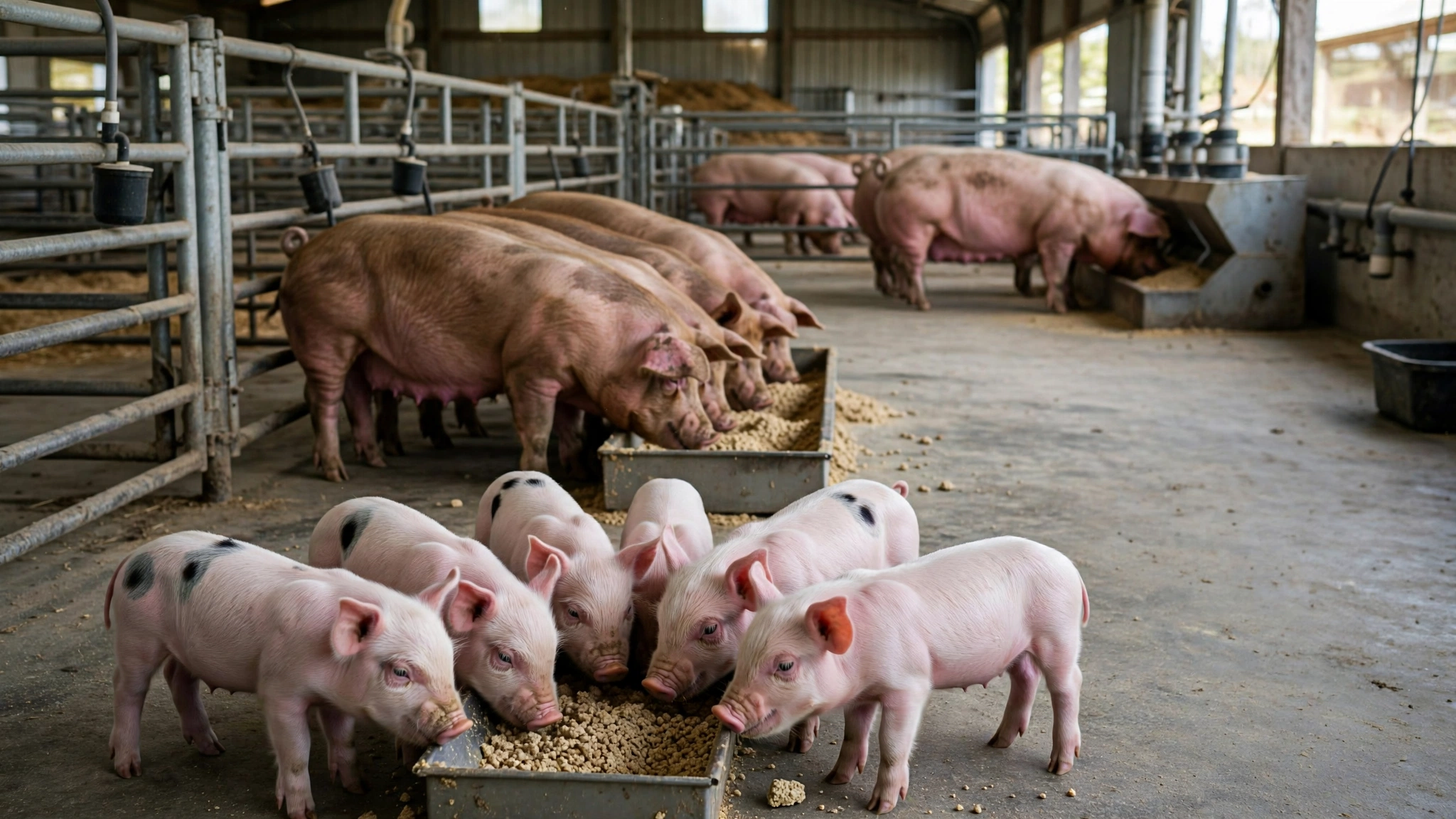
These rows are drawn from the National Swine Nutrition Guide tables for high lean-gain barrows and are reproduced as anchor points, not as a complete ration specification. The source publishes full phase tables for high, medium, and low lean-gain lines, with separate barrow and gilt columns.
| Phase | Body weight | SID lysine | Assumed daily intake |
|---|---|---|---|
| Nursery phase 1 | 9–11 lbs | 1.56% | 0.35 lbs |
| Nursery phase 4 | 25–45 lbs | 1.25% | 2.20 lbs |
| Grow-finish phase 1 | 45–90 lbs | 1.10% | 3.1 lbs |
| Grow-finish phase 5 | 225–270 lbs | 0.63% | 6.2 lbs |
Gilts, medium and low lean-gain lines, and the intermediate phases all carry their own values in the source tables. Pull the row that matches your pigs rather than interpolating from these four.
If you are mixing your own rather than buying complete feeds, the calculation method and ingredient inclusion rates are set out in pig feed formulation basics.
How Much to Feed: Reading the Intake Benchmarks
Daily intake is best read off a phase table rather than calculated from a percentage of body weight. The two published anchor points above illustrate why: 3.1 lbs at 45–90 lbs works out near 5% of body weight, while 6.2 lbs at 225–270 lbs is closer to 2.5%. A single percentage rule cannot describe both ends of the curve, which is why reference tables assign intake by phase instead.
Three factors shift real intake away from any published figure. Cold weather raises it, because pigs burn feed to hold body temperature. Sustained heat suppresses it, which is why summer-finished pigs often run behind. Low-energy feed raises intake by volume, as pigs eat toward an energy target they cannot reach.
For budgeting, work from cumulative feed rather than daily figures, and build in a margin for waste and spillage. Then correct against what you actually deliver—a feed record beats every estimate on this page.
Will Pigs Stop Eating When Full?
No. Pigs regulate intake toward an energy target rather than to a sense of fullness, and given a high-energy feed and no restriction they will over-consume and lay down fat.
This explains a specific and common failure: gestating sows left on full feed become over-conditioned, which is associated with difficult farrowings and reduced milk yield. It is also why finishing pigs on free-choice high-energy diets can grade fatter than intended.
Growing pigs on free-choice feed are largely self-regulating within useful limits. Breeding stock are not, and must be fed to a measured amount.
Free-Choice Versus Limit Feeding
Free-choice feeding—feed available at all times—maximizes growth rate and is the simplest system to manage. Limit feeding delivers a measured amount two or three times daily at a discount to free-choice intake, producing a leaner carcass and less waste, at the cost of more labor.
For a handful of pigs raised for the freezer, free choice is the sensible default. If you sell on a carcass grid that penalizes backfat, limit feeding through the last several weeks is worth the labor.
Feeder adjustment matters more than most producers expect. Set the feeder so roughly half the pan bottom stays covered when feed flows. Too open and pigs root feed onto the floor; too closed and you restrict intake without meaning to. Check weekly as pigs grow.
Feed Conversion and What It Costs
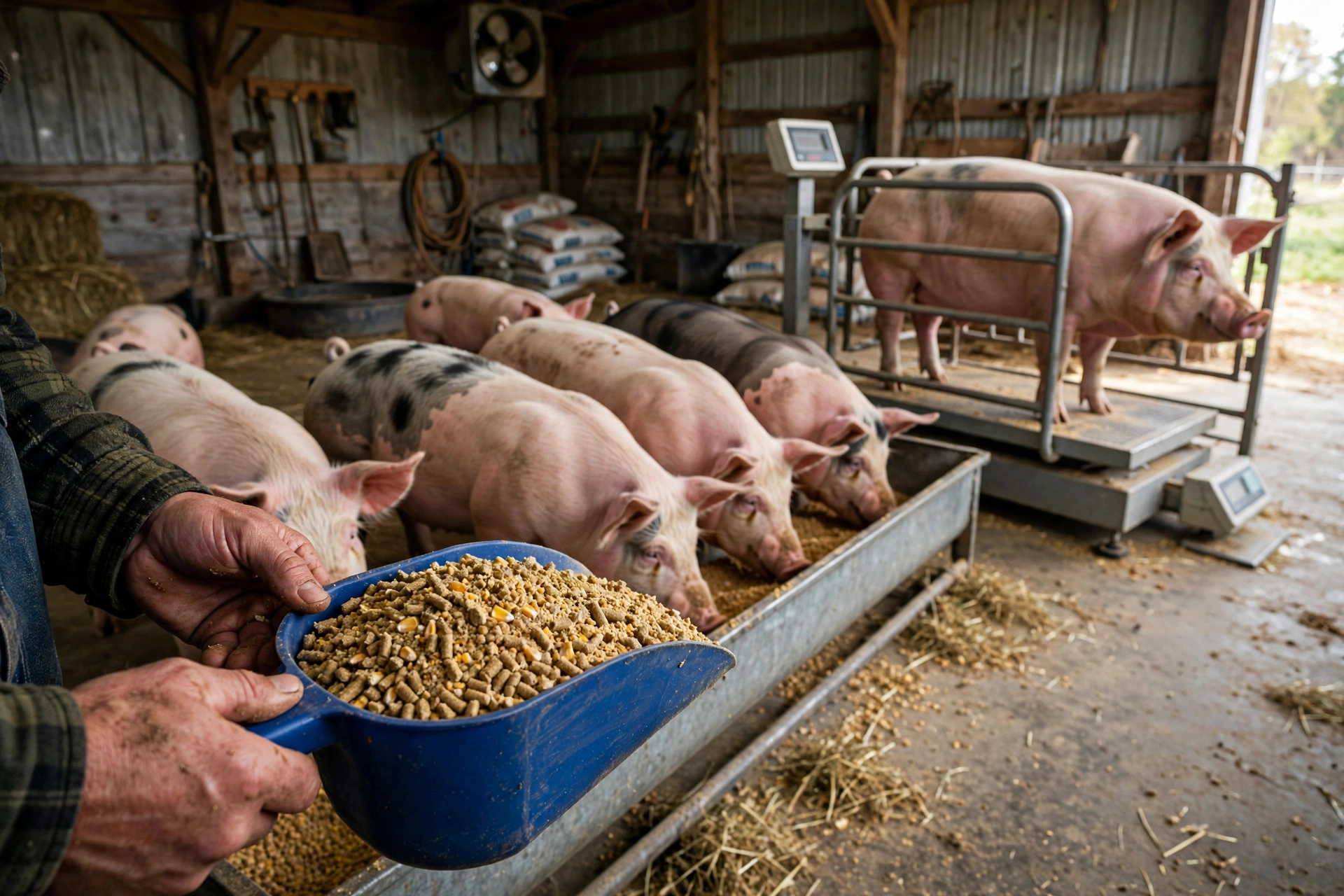
Feed conversion ratio is pounds of feed divided by pounds of gain, and it moves profitability more than the price on the bag. An FCR of 3.0 means 3 lbs of feed produced 1 lb of live weight. Lower is better.
Average daily gain (ADG) is the companion number—pounds of live weight added per day. Both are outputs of your system, not inputs you can set.
FCR Benchmarks by System
The figures below are overall industry benchmarks, not performance you should expect to reproduce on any given farm. Health status, housing, season, and genetics all move them.
| Stage or system | Benchmark FCR | Notes |
|---|---|---|
| Nursery | 1.5–2.0 | Best efficiency of the whole cycle |
| Grower | 2.2–2.8 | Still highly efficient |
| Finisher | 3.2–4.0 | Declines as pigs mature |
| Overall, commercial genetics | 2.8–3.5 | General benchmark under good management |
| Overall, heritage or pasture systems | Commonly higher | Normal for the system, not a fault |
That last row matters. Published FCR benchmarks almost always describe commercial genetics in confinement, and a small producer running heritage breeds on pasture who measures well above 3.5 may conclude something is wrong. Usually nothing is. Heritage breeds convert less efficiently and typically sell at a premium intended to cover the difference. Compare yourself to your own system across groups, not to a confinement barn.
Cost Per Pound of Gain, Not Cost Per Bag
The cheaper bag frequently produces more expensive pork. Compare feeds on cost per pound of gain, which folds conversion into the price. The worked example below uses illustrative figures to show the arithmetic, not market prices.
| Feed A | Feed B | |
|---|---|---|
| Price per 50 lb bag | $15.00 | $18.00 |
| Price per lb | $0.30 | $0.36 |
| FCR achieved | 4.0 | 3.2 |
| Feed for 200 lbs of gain | 800 lbs | 640 lbs |
| Total cost | $240.00 | $230.40 |
| Cost per lb of gain | $1.20 | $1.15 |
Feed B costs 20% more per bag and delivers pork for less. The gap widens with head count. Run this calculation with your own prices and your own measured FCR—the conclusion depends entirely on both.
Four things move FCR in practice: health status, because sick pigs eat poorly and convert badly; temperature, because pigs outside their comfort zone spend feed on thermoregulation; feeder adjustment, because feed on the floor is counted as consumed; and water delivery, for the reason covered above. Genetics set the ceiling; management determines whether you reach it.
If you are weighing complete feeds against mixing your own, the economics are worked through in ready-made vs custom feed, and feed’s place in whole-farm profitability is covered in pig farming economics.
What Pigs Must Never Be Fed
Feeding meat, or food waste that has come into contact with meat, to swine is regulated or prohibited under applicable federal and state rules, and the specific requirements vary by jurisdiction. The concern is disease transmission, including foreign animal diseases capable of closing export markets. Before feeding any food waste, confirm what your state permits and what licensing it requires—our guide to U.S. pork market and regulations covers the regulatory landscape, and your state department of agriculture is the authority on the rules that apply to you.
Beyond that, the practical cautions are:
- Moldy or spoiled feed. Mycotoxins—toxic compounds produced by molds growing on grain—are associated with reduced intake and impaired performance. Discard rather than dilute.
- Raw beans and raw potatoes. Both are commonly restricted in swine diets because of compounds that interfere with digestion. Handling and processing requirements differ by ingredient, so check a current feed reference before including either rather than assuming any single preparation method makes them safe.
- Salt without adequate water. Salt is a required part of the diet, but salt toxicity is a recognized risk where water is restricted.
- Sudden diet changes. Transition over several days. Abrupt switches disrupt gut function and cost days of gain.
Meat-free kitchen and garden scraps can supplement a diet, but keeping them to a modest share of total intake matters: above that, they dilute the balanced portion of the ration and reintroduce the deficiencies a complete feed was formulated to prevent. Scraps are also highly variable in moisture and energy, which makes them impossible to formulate around.
Feed quality connects directly to disease resistance—the relationship between nutrition’s role in herd immunity is closer than most producers assume.
Breeding Stock: What Changes
Breeding animals are fed to a body condition target rather than to appetite, which inverts how market hogs are managed. A finisher diet fed to a breeding herd tends to produce over-conditioned sows and weaker reproductive performance.
The principles in brief. Gestating sows are fed a restricted amount through early gestation and increased as fetal growth accelerates in the final weeks—overfeeding early is the more common error. Lactating sows carry the highest nutrient demand of any class, scaled to litter size. Boars are fed to stay fit rather than fat. Replacement gilts are grown on a moderate-energy diet to reach breeding condition without excess fat, never on a high-energy finisher.
Body condition scoring beats a calendar. Ribs should be felt under light pressure but not visible. The full protocol, with the amounts that go with each stage, is set out in feeding pregnant and lactating sows.
Frequently Asked Questions
How much should a 200 lb pig eat a day?
Read it off a phase table rather than a percentage rule. Published benchmarks for high lean-gain barrows assume 6.2 lbs daily across the 225–270 lb phase, so a 200 lb pig sits somewhat below that. The figure shifts with genetics, sex, feed energy density, and temperature—sustained heat suppresses intake noticeably. Weigh feed delivered over a week and divide; that number beats any published estimate for your own herd.
Will pigs stop eating when full?
No. Pigs eat toward an energy target rather than to a sense of fullness, and on high-energy feed with unlimited access they will over-consume and deposit fat. Growing pigs self-regulate acceptably on free-choice feed. Breeding stock do not—gestating sows left on full feed become over-conditioned, which is associated with farrowing difficulty and reduced milk production. Feed breeding animals a measured amount.
What nutrient do pigs need the most?
Water, by a wide margin in both volume and consequence. Water restriction cuts feed intake within hours, which puts every other nutrient target out of reach no matter how well the ration is formulated. Estimation rules vary—some express need relative to feed eaten, others relative to body weight—and they can disagree for the same pig. Check waterer flow rate directly rather than assuming water appearing means water sufficient.
How long can pigs go without feed?
Longer than they can go without water, but this is not a margin worth using. Pigs deprived of water stop eating within hours, and prolonged water deprivation is dangerous. Young piglets have minimal reserves and should never be left without access to feed and water. If pigs have gone off feed rather than been kept from it, treat that as a health signal and investigate rather than waiting it out.
What can pigs not eat?
Meat and meat-contaminated food waste are regulated or prohibited for swine feeding, with requirements varying by state—check with your state department of agriculture before feeding any food waste. Also avoid moldy feed, which carries mycotoxins. Raw beans and raw potatoes are commonly restricted because of compounds that interfere with digestion. Salt is required in the diet but poses a toxicity risk where water is restricted.
Can a pig gain 3 pounds a day?
Average daily gain of that size is at the far edge of what is reported, achievable only briefly during peak growth with superior genetics and excellent conditions. It is not a benchmark to manage toward. Pushing intake to chase it generally adds fat rather than lean and worsens feed conversion. Track your own ADG across groups and compare it to your own history—that comparison is more useful than any published maximum.
Conclusion
Sound pig nutrition comes down to three things you can act on this week. Read intake and amino acid targets off the phase table that matches your genetics and sex, rather than from a single percentage rule that fails at both ends of the growth curve. Check water flow before adjusting anything else, because restricted water quietly caps intake no matter how good the ration is. And compare feeds on cost per pound of gain rather than cost per bag, using your own measured conversion.
Every number on this page is a published benchmark carrying its own conditions. A livestock scale and a record of feed delivered will give you your real conversion within one group of pigs—and that figure, from your herd, outranks every benchmark here.
Rebecca Hayes
Explore More: Browse every article in Pig Nutrition and Feeding.