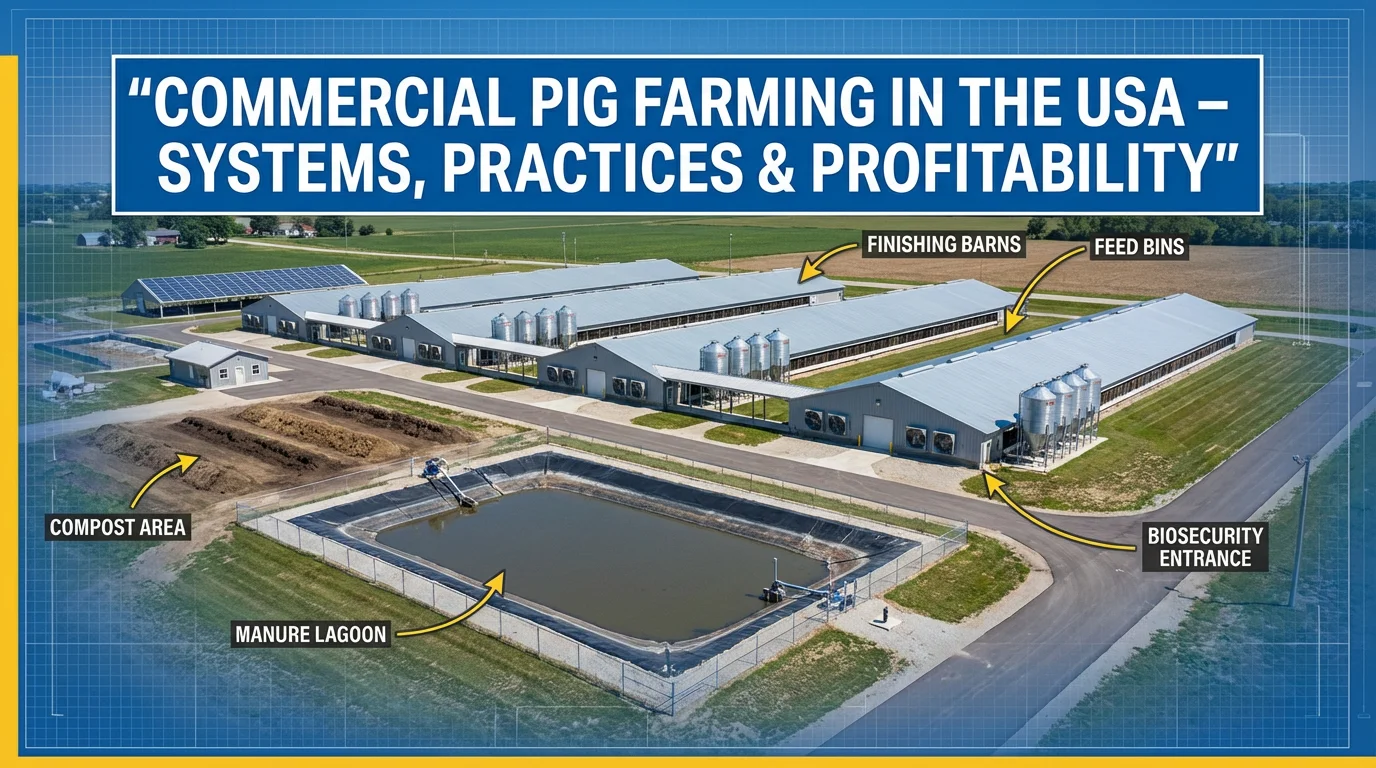
Commercial Pig Farming in the USA: Systems, Practices & Profitability (2026)
TL;DR – Quick Guide to Commercial Pig Farming
- Commercial pig farming means raising pigs primarily for market sale. Scale ranges from 100 sows to thousands—but profitable operations exist at every size.
- Choose your production system carefully. Farrow-to-finish, wean-to-finish, and feeder-to-finish each have different capital and management requirements.
- Feed costs drive profitability. Expect feed to represent 65-75% of total production costs; efficiency here determines success or failure.
- Biosecurity isn’t optional. Disease outbreaks devastate commercial operations. Invest in prevention protocols from day one.
- Regulations vary by state. Environmental permits, waste management plans, and animal welfare standards differ significantly across the country.
- Modern technology improves margins. Automated feeders, environmental controls, and herd management software deliver measurable ROI.
- Start with a business plan. Know your costs, target markets, and break-even points before building infrastructure.
- The U.S. pork industry is evolving. Consumer demand for transparency, welfare-friendly practices, and sustainable production creates opportunities for differentiated producers.
Introduction: Understanding Commercial Pig Farming in the USA
Commercial pig farming in the USA encompasses all operations that raise animals primarily for sale—whether to processors, direct consumers, or other farmers. Unlike backyard pig-keeping for home consumption, commercial production focuses on profitability, efficiency, and market access.
This guide serves small-scale and medium-scale producers: operations running anywhere from 50 to 2,500 sows or finishing 500 to 25,000 market hogs annually. We’re not writing for mega-operations with 10,000+ sows. We’re writing for family farms, diversified operations, and entrepreneurs entering the commercial pig farming business in the USA.
Here’s the reality: the U.S. pork industry has consolidated dramatically over the past 40 years. In 1980, over 660,000 farms raised pigs. Today, fewer than 60,000 operations produce hogs commercially. But consolidation doesn’t mean small and medium producers can’t compete. Niche markets, direct sales, and differentiated production systems create profitable opportunities that large integrators can’t easily capture.
This guide covers everything from production system selection through regulatory compliance, with practical tables, cost breakdowns, and real-world examples. Whether you’re expanding an existing operation or starting fresh, you’ll find actionable guidance for commercial pig production in 2026.
For those just getting started with pigs, our complete guide to small-scale pig farming covers foundational concepts before scaling up.
What Is Commercial Pig Farming? Defining the Industry
Commercial pig farming is the business of raising pigs for sale at a profit, involving systematic breeding, feeding, health management, and marketing practices designed to produce consistent, marketable animals efficiently.
Let’s be clear about terminology. “Commercial” doesn’t necessarily mean massive industrial operations. A 200-sow farrow-to-finish farm selling 4,000 market hogs annually is a commercial operation. So is a 50-sow operation producing feeder pigs for other farms. The defining characteristic isn’t size—it’s the intent to generate profit through systematic production.
Commercial vs. Hobby Operations
| Characteristic | Commercial Operation | Hobby/Backyard Operation |
|---|---|---|
| Primary goal | Profit generation | Personal consumption, enjoyment |
| Scale | 50+ sows or 200+ market hogs/year | Under 50 market hogs/year |
| Business structure | LLC, partnership, corporation | Often informal |
| Regulatory requirements | Permits, inspections, reporting | Minimal (varies by state) |
| Record-keeping | Detailed production/financial records | Optional |
| Market focus | Processors, wholesale, direct sales | Personal use, occasional sales |
The U.S. Commercial Pig Industry: Key Statistics (2026)
Understanding the broader industry context helps position your operation.
Production statistics:
- Approximately 74 million pigs marketed annually in the U.S.
- Top producing states: Iowa, Minnesota, North Carolina, Illinois, Indiana
- Average market hog weight: 280-290 pounds
- Total U.S. pork production: ~28 billion pounds annually
Industry structure:
- Under 60,000 farms with pigs (down from 660,000+ in 1980)
- Top 20 producers control approximately 45% of sow inventory
- Average commercial farm size increasing, but significant mid-size sector remains
- Contract production represents 25-30% of hog marketings
For detailed market analysis and pricing trends, see our U.S. pork market and regulations guide.
How Many Pigs Are on a Commercial Farm? Scale and Classification
One common question: how many pigs make a farm “commercial”? There’s no universal threshold, but industry classifications typically break down as follows:
Farm Size Categories
| Classification | Sow Inventory | Market Hogs/Year | Typical Characteristics |
|---|---|---|---|
| Small commercial | 50-200 sows | 1,000-4,000 | Family-operated, often diversified |
| Medium commercial | 200-1,000 sows | 4,000-20,000 | Dedicated staff, specialized facilities |
| Large commercial | 1,000-5,000 sows | 20,000-100,000 | Multiple sites, professional management |
| Industrial | 5,000+ sows | 100,000+ | Corporate ownership, integrated systems |
This guide is intended for small to medium commercial operations.
- Sow operations: 50-1,000 sows
- Finishing operations: 500-20,000 head capacity
- Typical land requirements: 10-200 acres depending on system
Economies of Scale vs. Management Intensity
Bigger isn’t always more profitable per unit. Small and medium operations often achieve:
- Lower overhead per pig than large operations
- Better disease control through simpler animal flows
- Premium market access (direct sales, niche markets)
- More flexible response to market changes
The trade-off: smaller operations require higher management intensity per pig and may face higher per-unit costs for inputs like feed and veterinary services.
Pig Production Systems: Choosing Your Model
Selecting the right pig production system fundamentally shapes your operation’s economics, management requirements, and market position. Here’s what you need to know.
Farrow-to-Finish Operations
Definition: A single operation handles all production phases—breeding, farrowing, nursery, growing, and finishing—until pigs reach market weight.
Advantages:
- Complete control over genetics, health, and production
- Capture value at every stage
- No dependency on outside pig sources
- Better disease control (closed herd potential)
Disadvantages:
- Highest capital investment
- Most complex management
- Requires expertise across all production phases
- Longer cash flow cycle (breeding to market sale: 10-11 months)
Typical scale: 100-500 sows for small-medium commercial operations
Capital requirements: $1,500-2,500 per sow capacity (2026 estimates, varies significantly by region and facility type)
Wean-to-Finish Operations
Definition: Purchase weaned pigs (typically 12-20 lbs at 3-4 weeks old) and raise them to market weight.
Advantages:
- Lower capital than farrow-to-finish
- Simpler management (no breeding/farrowing expertise needed)
- Faster cash flow cycle (5-6 months from purchase to sale)
- Easier to scale up or down based on market conditions
Disadvantages:
- Dependent on outside pig supply
- Disease introduction risk with each pig purchase
- Less control over genetics
- Pig purchase price affects profitability significantly
Typical scale: 1,000-10,000 head capacity
Capital requirements: $150-300 per pig space (finishing facility)
Feeder Pig to Finish (Grower-Finisher)
Definition: Purchase feeder pigs (typically 40-60 lbs) and finish to market weight.
Advantages:
- Lowest capital requirements
- Shortest production cycle (3-4 months)
- Simplest management
- Good entry point for new producers
Disadvantages:
- Narrow margins—pig purchase price critical
- No control over early pig development
- Dependent on consistent feeder pig supply
- Disease risk with purchased pigs
Typical scale: 500-5,000 head capacity
Seedstock and Feeder Pig Production
Some operations specialise in breeding stock, or feeder pig production, rather than market hogs.
Seedstock producers:
- Sell breeding gilts and boars to other farms
- Require superior genetics and health status
- Higher value per animal but smaller market
Feeder pig producers:
- Maintain sow herds but sell pigs at 40-60 lbs
- Avoid finishing facility investment
- Dependent on feeder pig market prices
Choosing Your System: Decision Framework
| Factor | Best Fit |
|---|---|
| High capital available, want full control | Farrow-to-finish |
| Moderate capital, want simpler management | Wean-to-finish |
| Limited capital, testing the market | Feeder pig to finish |
| Strong genetics program, specialized markets | Seedstock production |
| Good farrowing facilities, limited finishing space | Feeder pig production |
For detailed breeding considerations regardless of system, see our pig breeding and reproduction guide.
![Suggested Image: Interior of modern pig finishing barn | ALT: Modern pig production systems USA 2026]
Commercial Pig Farm Setup: Facilities and Infrastructure
Setting up a commercial pig farm requires careful planning of facilities, equipment, and infrastructure. If you take shortcuts in this area, you risk incurring years of inefficiency, disease issues, and repair expenses.
Essential Facility Components
Breeding/Gestation (farrow-to-finish and seedstock operations):
- Breeding area with boar housing or AI facilities
- Gestation housing (individual stalls or group pens)
- Breeding records and heat detection systems
Farrowing:
- Farrowing crates or pens (one per sow plus 10-15% extra)
- Supplemental heat for piglets (heat lamps, mats, or creep areas)
- Climate control for sow comfort
- Easy-clean flooring
Nursery:
- Climate-controlled environment (critical for young pig health)
- Adjustable temperature (85°F down to 70°F as pigs grow)
- Appropriate flooring for young pig feet
- Adequate feeder and waterer space
Growing/Finishing:
- Largest facility investment for most operations
- Space requirement: 7-8 sq ft per pig (grow-finish)
- Adequate ventilation for ammonia control
- Durable, easy-clean flooring
- Efficient feed delivery systems
Space Requirements (Reference Table)
| Production Phase | Space per Pig (sq ft) | Feeder Space | Waterer Ratio |
|---|---|---|---|
| Nursery (15-50 lbs) | 3-4 | 4 pigs per hole | 1 per 15 pigs |
| Grower (50-125 lbs) | 5-6 | 4 pigs per hole | 1 per 15 pigs |
| Finisher (125-280 lbs) | 7-8 | 3-4 pigs per hole | 1 per 12 pigs |
| Gestation (group) | 16-20 | Individual or ESF | 1 per 12 sows |
| Farrowing | 35-50 (crate + creep) | Individual sow | 1 per sow |
Indoor vs. Outdoor Systems
Indoor confinement:
- Precise environmental control
- Lower labor per pig
- Better biosecurity
- Higher capital cost
- Regulatory scrutiny on welfare
Outdoor/pasture systems:
- Lower facility costs
- Consumer appeal (welfare perception)
- Different disease challenges
- Higher labor requirements
- Weather-dependent production
Hybrid systems:
- Outdoor breeding/gestation with indoor farrowing/finishing
- Combines welfare appeal with critical-phase control
- Growing market segment for differentiated pork
For sustainable and pasture-based approaches, see our sustainable and organic pig farming guide.
Best Commercial Pig Breeds for USA Operations
Breed selection directly impacts growth rate, feed efficiency, carcass quality, and maternal performance. For commercial pig production in the USA, most operations use crossbreeding programs.
Maternal Lines (Sow Breeds)
Yorkshire (Large White)
- Excellent litter size and milking ability
- Good structural soundness
- Most common maternal breed in U.S.
Landrace
- Outstanding litter size
- Excellent milking and mothering
- Often crossed with Yorkshire
Chester White
- Good mothering ability
- Durable and long-lived
- Popular in some regions
Typical maternal cross: Yorkshire × Landrace (F1 females)
Terminal Lines (Boar Breeds)
Duroc
- Superior meat quality (marbling, color)
- Excellent growth rate
- Most popular terminal sire in U.S.
Hampshire
- Lean, muscular carcasses
- Good feed efficiency
- Less marbling than Duroc
Berkshire
- Premium meat quality
- Slower growth
- Niche market premium
Pietrain
- Extreme muscling
- Excellent leanness
- Stress susceptibility concerns
Commercial Crossbreeding Programmes
Most commercial operations use three- or four-way crossbreeding methods.
Three-way cross example: Duroc boar × (Yorkshire × Landrace) female = Market hog
Benefits:
- Hybrid vigor improves survival, growth, reproduction
- Combines maternal traits (litter size, milk) with terminal traits (growth, meat quality)
- Consistent, predictable offspring
Breed Selection by Market
| Target Market | Recommended Cross | Key Traits |
|---|---|---|
| Commodity pork | Duroc × YL cross | Growth, efficiency, yield |
| Premium/branded | Berkshire cross or purebred | Meat quality, marbling |
| Niche/heritage | Purebred heritage (Berkshire, Red Wattle, etc.) | Unique flavor, story |
| Outdoor systems | Duroc or Hampshire crosses | Hardiness, adaptability |
Commercial Pig Farming Business Plan: Essential Components
Successful business plans for commercial pig farming share common elements. Whether you are looking for funding or just planning your business, take care of these things.
Business Plan Framework
1. Executive Summary
- Operation overview and goals
- Production system and scale
- Market strategy
- Funding requirements
- Projected returns
2. Market Analysis
- Target markets (processors, direct, other farmers)
- Pricing trends and projections
- Competition analysis
- Differentiation strategy
3. Production Plan
- Production system (farrow-to-finish, wean-to-finish, etc.)
- Facility requirements and timeline
- Genetics program
- Health and biosecurity protocols
- Feed program
4. Management and Staffing
- Owner/operator roles
- Staffing requirements and costs
- Training needs
- Advisory relationships (veterinarian, nutritionist)
5. Financial Projections
- Startup costs and capital requirements
- Operating cost projections
- Revenue projections
- Cash flow analysis
- Break-even analysis
- Sensitivity analysis (feed price changes, market price changes)
6. Risk Management
- Disease risk mitigation
- Market risk strategies
- Insurance coverage
- Regulatory compliance plan
For comprehensive economic analysis, see our pig farming economics guide.
Startup Cost Estimates (2026)
| Item | Small Commercial (200 sows F-F) | Medium Commercial (500 sows F-F) |
|---|---|---|
| Breeding/gestation facilities | $150,000-250,000 | $350,000-500,000 |
| Farrowing facilities | $200,000-350,000 | $450,000-700,000 |
| Nursery facilities | $75,000-150,000 | $175,000-350,000 |
| Finishing facilities | $300,000-500,000 | $750,000-1,200,000 |
| Feed storage/handling | $50,000-100,000 | $100,000-200,000 |
| Waste management | $75,000-150,000 | $150,000-300,000 |
| Breeding stock | $75,000-150,000 | $175,000-350,000 |
| Working capital | $100,000-200,000 | $250,000-500,000 |
| Total estimated | $1,025,000-1,850,000 | $2,400,000-4,100,000 |
Note: Costs vary dramatically by region, building type, and whether constructing new or retrofitting existing facilities.
Pig Farm Profitability: Economics and Cost Structure
Understanding pig farm profitability requires detailed knowledge of costs and revenue drivers. Here’s the breakdown for commercial operations.
Cost Structure Overview
| Cost Category | % of Total Costs | Key Drivers |
|---|---|---|
| Feed | 65-75% | Corn/soy prices, feed efficiency |
| Labor | 8-12% | Automation level, wage rates |
| Facilities/depreciation | 5-10% | Building costs, equipment life |
| Veterinary/health | 3-5% | Disease status, prevention program |
| Utilities | 2-4% | Climate control, fuel costs |
| Marketing/transportation | 2-4% | Distance to market, direct vs. wholesale |
| Other (supplies, insurance, etc.) | 3-5% | Varies by operation |
Feed Cost Breakdown
Feed dominates costs. A typical market hog consumes 700-900 lbs of feed from weaning to market.
Example calculation (2026 costs):
- Feed cost: $280-320 per ton ($0.14-0.16 per lb)
- Feed consumption: 800 lbs per market hog
- Feed cost per hog: $112-128
At market prices ranging from $0.80 to $1.00 per pound of live weight, and with each hog weighing 280 pounds at market, the gross revenue per hog is calculated as follows:
- Gross revenue per hog: $224-280
- Feed cost: $112-128
- Other costs: $40-60
- Net margin per hog: about $40–90, depending on feed and hog prices
Margins fluctuate dramatically with feed and market prices.
Break-Even Analysis
For a farrow-to-finish operation:
Fixed costs (annual, 200-sow operation):
- Depreciation: $40,000-60,000
- Insurance: $8,000-15,000
- Property taxes: $5,000-10,000
- Base labor: $50,000-80,000
- Loan payments: Variable
Variable costs per pig marketed:
- Feed: $110-130
- Veterinary/health: $8-15
- Utilities: $4-8
- Marketing: $5-10
- Supplies: $3-6
Break-even calculation: Total variable cost + (Fixed costs ÷ Pigs marketed) = Break-even cost per pig
For a 200-sow operation marketing 4,000 pigs annually:
- Variable cost: ~$140 per pig
- Fixed cost allocation: ~$30 per pig
- Break-even: ~$170 per pig (or ~$0.61 per lb at 280 lbs)
Key Profitability Drivers
Factors you can control:
- Feed conversion efficiency
- Pigs weaned per sow per year
- Pre-weaning and post-weaning mortality
- Labor efficiency
- Health status (fewer treatments, better growth)
Factors you can influence:
- Market timing
- Market channel selection
- Contract vs. spot sales
- Value-added opportunities
Factors you can’t control:
- Feed ingredient prices
- Market hog prices
- Regulatory changes
- Disease outbreaks (regional)
Farm Management: Biosecurity, Health, and Operations
Effective management separates profitable commercial operations from struggling ones. Three areas demand constant attention: biosecurity, herd health, and operational efficiency.
Biosecurity Protocols
Biosecurity prevents disease introduction and spread. For commercial operations, this isn’t optional—it’s survival.
Essential protocols:
Perimeter security:
- Controlled farm access points
- Visitor logs and restrictions
- Vehicle cleaning/disinfection
- Wildlife exclusion fencing
Personnel protocols:
- Downtime requirements (24-48 hours after pig contact elsewhere)
- Dedicated farm clothing and footwear
- Shower-in procedures (high-health herds)
- No farm-to-farm employee sharing
Animal flow:
- All-in/all-out production by room or building
- Isolation facilities for new animals
- No commingling of age groups
- One-way pig flow (young to old areas)
Supply management:
- Feed truck sanitation protocols
- Dedicated farm equipment
- Dead animal removal procedures
- Rodent and pest control programmes
For detailed health management protocols, see our pig health and disease management guide.
Herd Health Programmes
Work with a swine veterinarian to establish:
Vaccination protocols:
- Breeding herd vaccines (PRRS, parvo, lepto, erysipelas, E. coli)
- Growing pig vaccines (circovirus, mycoplasma, influenza)
- Timing schedules by production phase
Monitoring programmes:
- Regular health checks and mortality tracking
- Diagnostic testing protocols
- Performance benchmarking
Treatment protocols:
- Standard treatment procedures
- Drug withdrawal compliance
- Treatment records
Staffing and Labor Management
Labour requirements (rough estimates):
| Operation Type | Pigs per Full-Time Worker |
|---|---|
| Farrow-to-finish (modern) | 2,500-4,000 pigs marketed per year |
| Wean-to-finish | 4,000-6,000 pigs marketed per year |
| Finishing only | 5,000-8,000 pigs marketed per year |
Key staffing considerations:
- Morning and evening chores regardless of operation size
- Weekend and holiday coverage requirements
- Specialized skills for breeding/farrowing
- Training and cross-training needs
Waste Management
Commercial operations must manage manure responsibly—both for environmental compliance and neighbour relations.
Common systems:
Lagoon systems:
- Anaerobic lagoons for liquid storage
- Land application of effluent
- Requires adequate land base and permits
Deep pit storage:
- Under-building storage (6-12 months capacity)
- Pumped and land-applied
- Common in confinement systems
Composting:
- Solid manure management
- Lower-volume operations or mortality disposal
- Produces usable soil amendment
Manure management requirements:
- Nutrient management plans
- Application records
- Setback distances from water/property lines
- Potential permit requirements
Regulatory Considerations for Commercial Pig Farms
Commercial pig farming operates within multiple regulatory frameworks. Understanding requirements before building saves costly mistakes.
Federal Regulations
https://www.nass.usda.gov/USDA:
- Swine health regulations (interstate movement, disease reporting)
- Premise identification requirements
- Traceability requirements
- Market hog inspection requirements
FDA:
- Veterinary Feed Directive (VFD) rules for medicated feeds
- Drug withdrawal requirements
- Feed safety regulations
EPA:
- Clean Water Act (large operations may require NPDES permits)
- CERCLA (superfund) reporting for large operations
- Emergency planning requirements
State Regulations
Requirements vary significantly by state:
Environmental permits:
- Concentrated Animal Feeding Operation (CAFO) permits
- State-level water quality permits
- Manure management plans
- Odor regulations (some states)
Agricultural regulations:
- Premise registration
- Brand inspection (some states)
- Movement permits
- Disease reporting requirements
Zoning and land use:
- Agricultural zoning requirements
- Setback distances
- Neighbor notification requirements
Animal Welfare Considerations
Welfare standards increasingly affect market access:
Current landscape:
- California Proposition 12 requires certain housing standards for pork sold in California
- Some processors require welfare certification
- Restaurant and retail chains implementing sourcing standards
- Consumer demand for welfare-friendly production growing
Common welfare certifications:
- Pork Quality Assurance Plus (PQA Plus)—industry standard
- Certified Humane
- Animal Welfare Approved
- Global Animal Partnership
For complete regulatory details, see our U.S. pork market and regulations guide.
Technology and Modern Practices in Commercial Pig Farming
Technology increasingly differentiates profitable operations from struggling ones. Here’s what’s relevant for small to medium commercial producers in 2026.
Environmental Control Systems
Automated ventilation:
- Temperature-responsive fan staging
- Minimum ventilation for air quality
- Emergency backup systems
- ROI: Improved performance, reduced mortality, lower energy costs
Heating systems:
- Zone heating for farrowing/nursery
- Heat mats, lamps, or radiant systems
- Energy-efficient options paying off quickly
Feeding Technology
Automated feeding systems:
- Reduced labor for daily feeding
- More consistent feed delivery
- Feed monitoring and inventory tracking
- Best ROI in operations with multiple buildings
Electronic sow feeding (ESF):
- Individual sow feeding in group housing
- Meets welfare requirements while controlling intake
- Significant capital cost but enables group gestation
Monitoring and Data Management
Herd management software:
- Individual animal tracking
- Breeding and farrowing records
- Performance analysis
- Compliance documentation
Environmental monitoring:
- Remote temperature alerts
- Ventilation failure alarms
- Water system monitoring
- Peace of mind and reduced losses
Camera systems:
- Remote herd observation
- Farrowing monitoring
- Security
- Increasingly affordable
Practical Technology ROI
| Technology | Typical Cost | Payback Period | Best Fit |
|---|---|---|---|
| Automated ventilation | $10,000-30,000/barn | 2-4 years | All confinement operations |
| Feed delivery system | $15,000-50,000 | 3-5 years | Multi-building operations |
| Herd management software | $500-2,000/year | Immediate (labor savings) | All sizes |
| Environmental monitoring | $1,000-5,000 | 1-2 years | All confinement operations |
| ESF systems | $1,500-2,500/sow space | 4-7 years | Operations converting to group housing |
Sustainability in Commercial Pig Production
Sustainability increasingly matters—both for regulatory compliance and market access. Here’s what commercial producers should consider.
Environmental Sustainability
Manure management opportunities:
- Nutrient recovery for fertilizer value
- Biogas capture and energy generation
- Composting for value-added products
- Precision application to match crop needs
Energy efficiency:
- LED lighting (50-70% reduction)
- Variable-speed fans
- Heat recovery systems
- Solar integration where practical
Water conservation:
- Low-flow waterers
- Cooling system efficiency
- Water recycling where appropriate
Economic Sustainability
Long-term profitability requires:
- Diversified market channels
- Risk management strategies
- Continuous efficiency improvement
- Debt management and capital planning
Social Sustainability
Maintaining community support:
- Odor management and neighbor relations
- Local employment
- Transparent practices
- Community engagement
For comprehensive sustainability practices, see our sustainable and organic pig farming guide.
Production Schedules and Planning
Successful commercial operations plan production cycles carefully. Here are reference schedules for common systems.
Farrow-to-Finish Production Schedule
| Event | Timing | Notes |
|---|---|---|
| Breeding | Day 0 | Natural or AI |
| Pregnancy confirmation | Day 25-30 | Ultrasound or return to heat |
| Move to farrowing | Day 110-112 | 3-5 days before due date |
| Farrowing | Day 114 (avg) | “3 months, 3 weeks, 3 days” |
| Weaning | Day 135-149 | 3-5 weeks lactation |
| Sow rebreeding | Day 139-156 | 4-7 days post-weaning |
| Pigs to nursery | Weaning | Until 40-60 lbs |
| Pigs to grow and finish | Weeks 8-10 | Until market weight |
| Market | Weeks 24-26 | 270-290 lbs |
Sow productivity targets:
- Farrowing rate: 85-92%
- Born alive: 12-14+ piglets
- Weaned per litter: 10-12+ piglets
- Litters per sow per year: 2.3-2.5
- Pigs weaned per sow per year: 24-28+
Wean-to-Finish Production Schedule
| Event | Timing | Weight | Notes |
|---|---|---|---|
| Receive weaned pigs | Day 0 | 12-18 lbs | From sow operation |
| Nursery phase | Weeks 1-6 | 18-60 lbs | High-care environment |
| Grower phase | Weeks 7-14 | 60-150 lbs | Transition diets |
| Finisher phase | Weeks 15-22 | 150-280 lbs | Market preparation |
| Marketing | Weeks 22-26 | 270-290 lbs | Target weight |
Performance targets:
- Mortality: Under 4% (weaning to market)
- ADG: 1.8-2.2 lbs/day (overall)
- FCR: 2.6-3.0 (wean to finish)
- Days to market: 150-170
For detailed feeding schedules and nutrition by phase, see our pig nutrition and feeding guide.
Finding Pig Production Systems Resources (PDF and Downloads)
Many producers search for “pig production systems PDF” resources. Here’s where to find reliable, current information:
University Extension Resources
Top sources:
- Iowa State University Extension – Comprehensive swine resources, production guides, economic analysis tools
- Purdue University Pork Page – Production manuals, facility guides, economic worksheets
- Penn State Extension – Small-scale production guides, pasture systems
- North Carolina State Extension – Waste management, facility design, production guides
Industry Resources
Pork Checkoff (pork.org):
- PQA Plus certification materials
- Production guides
- Biosecurity resources
- We Care initiative materials
National Pork Producers Council:
- Legislative and regulatory updates
- Market information
- Producer resources
What to Look For
When downloading production guides, verify:
- Publication date (prefer last 3-5 years)
- Source credibility (university, USDA, industry organizations)
- Applicability to your scale and system
- Regional relevance (some recommendations vary by climate/region)
Frequently Asked Questions
What is commercial pig farming?
Commercial pig farming is the business of raising pigs primarily for sale at a profit, using systematic breeding, feeding, and management practices. Scale ranges from 50+ sows to thousands—the defining characteristic is profit-focused production rather than personal consumption. Commercial operations maintain business structures, detailed records, and market relationships.
How many pigs are typically on a commercial farm?
Small commercial farms may run 50-200 sows or market 1,000-4,000 pigs annually. Medium commercial operations typically have 200-1,000 sows or market 4,000-20,000 pigs per year. Large commercial farms exceed 1,000 sows. There’s no single threshold—profitability matters more than pig count.
Is pig farming profitable in the USA?
Pig farming can be profitable, but margins are tight and volatile. Typical net margins range from $10 to $50 per market hog in average years, with some years showing losses. Success factors include excellent feed efficiency, low mortality, controlled costs, and market diversification. Operations consistently beating industry benchmarks on pigs weaned and feed conversion generally profit; those at or below average often struggle.
What’s the best production system for beginners?
Feeder pig to finish (buying 40–60 lb. pigs and finishing them to market) offers the lowest capital requirements and simplest management for beginners. Wean-to-finish is the next step up. Farrow-to-finish requires the most expertise and capital but offers the most control and potential profit capture. Start simpler and add complexity as you gain experience.
How much does it cost to start a commercial pig farm?
Startup costs vary dramatically. A small farrow-to-finish operation (200 sows) might require $1-2 million, including facilities, breeding stock, and working capital. Finishing-only operations require less—perhaps $200,000-500,000 for 1,000-2,000 head capacity. Many producers start smaller, building infrastructure over time or retrofitting existing buildings.
What breeds are best for commercial pig farming?
Most commercial operations use crossbreeding programmes, combining maternal breeds (Yorkshire, Landrace) for litter size and milking ability with terminal sires (Duroc, Hampshire) for growth and meat quality. A typical cross: Duroc boar × Yorkshire-Landrace female. Niche operations may use heritage breeds (Berkshire, Red Wattle) for premium markets.
Conclusion: Building a Sustainable Commercial Pig Operation
Commercial pig farming in the USA remains viable for well-managed small and medium operations, despite industry consolidation. Success requires:
- Clear production system selection matching your capital, skills, and goals
- Rigorous cost management with feed efficiency as the primary focus
- Strong biosecurity protecting your herd investment
- Regulatory compliance understood before building
- Market relationships providing consistent outlets
- Continuous improvement based on records and benchmarking
The industry continues evolving. Consumer demand for transparency, welfare, and sustainability creates differentiation opportunities. Technology improves efficiency and lowers labour costs. Market volatility remains, but risk management tools exist.
Start with solid planning. Build or retrofit facilities appropriate to your scale. Establish veterinary and market relationships before filling buildings with pigs. Track everything, benchmark against industry standards, and continuously improve.
Commercial pig farming isn’t easy. But for those who approach it systematically, understand the economics, and execute consistently, it provides viable livelihoods and genuine opportunities.
Good luck with your operation.
Quick Reference: Key Numbers for Commercial Pig Farming
| Metric | Target Range |
|---|---|
| Pigs weaned/sow/year | 24-28+ |
| Farrowing rate | 85-92% |
| Pre-weaning mortality | Under 10% |
| Nursery mortality | Under 3% |
| Grow-finish mortality | Under 2% |
| Feed conversion (wean-finish) | 2.6-3.0 |
| ADG (wean-finish) | 1.8-2.2 lbs/day |
| Market weight | 270-290 lbs |
| Days to market (from weaning) | 150-170 |
| Feed cost as % of total | 65-75% |
| Labor (pigs marketed/FTE) | 3,000-6,000 |