Commercial Pig Feed Management: Cutting Waste and Feed Cost
Commercial pig feed management is the set of decisions that determine how much of the feed you buy actually becomes pork — and on most finishing sites, that gap is worth more than any ration change. Feed is the largest single cost line in pork production, which means the barn floor is where margin is won or lost. For the wider production picture, see our guide to commercial pig farming in the USA.
Quick Answer
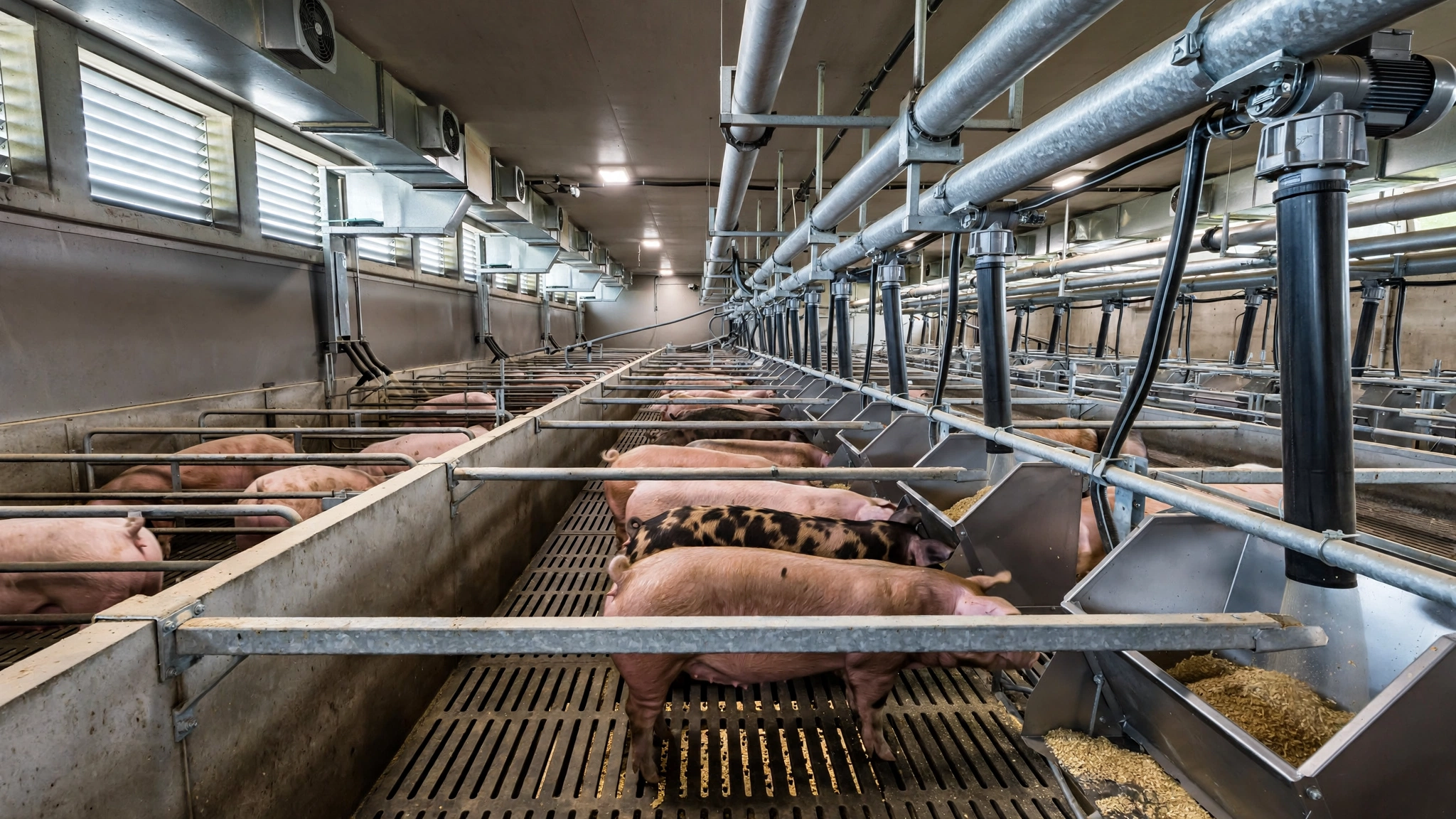
Commercial pig feed management covers phase feeding, feeder adjustment, feed quality, inventory control, and performance measurement. It differs from feed formulation: formulation decides what goes in the diet, and management decides how much of it reaches the pig. Published feed wastage estimates range from roughly 2% to 8% depending on feeder design, and every percentage point has a direct dollar value per pig marketed.
Key Takeaways
- Feed is the largest single cost in pork production, but its published share ranges from about half to three-quarters of cost depending on the system and the year.
- Feed disappearance is not feed intake — it includes everything the pigs wasted.
- Feeder coverage recommendations from credible sources span roughly 25% to 70% of the pan. There is no single correct setting.
- Weekly out-of-feed events reduced final body weight by 8 lbs in published research.
- A finishing F/G of 3.00 is average; 2.40 is the top of the published benchmark range.
Why Feed Cost Share Is Not a Fixed Number
Feed is the largest single cost line in pork production, but any source quoting one exact percentage is describing one system in one year. Published estimates range from roughly 52% to 80% of production cost, and the spread is not an error—it reflects three variables.
The first is the denominator. Total cost includes facilities, depreciation, and interest; variable cost does not. The same farm reports a much higher feed share on a variable-cost basis.
The second is the production system. A finishing-only operation purchases feeder pigs, and that purchase is a large cost line that a farrow-to-finish operation does not carry, which pushes feed’s share down even when the feed bill is identical.
The third is the grain price at the moment of measurement. Corn and soybean meal move enough that the same operation reports meaningfully different feed shares in consecutive years.
The practical consequence: benchmark your feed cost as a share of your own total cost and track the direction it moves rather than comparing it to a figure from an article.
What Commercial Farmers Actually Feed Pigs
Commercial U.S. diets are built on corn and soybean meal, supplemented with a vitamin and trace mineral premix, salt, and a calcium and phosphorus source. Distillers’ dried grains with solubles (DDGS—a co-product of ethanol production) are widely included, and synthetic amino acids allow crude protein to be reduced without shorting the pig.
Diets are formulated to meet metabolizable energy (ME—the energy in feed actually available to the pig after digestive and urinary losses) and standardized ileal digestible lysine, not crude protein. Pigs do not require protein as such; they require the individual amino acids that protein supplies. Our guide to pig feed formulation covers how those targets are set and how pigs digest their feed, explaining why digestibility rather than total content drives the numbers.
Why There Is No Single Best Commercial Feed
The best diet is the one that meets the pig’s requirement at that weight at the lowest cost per pound of gain, which changes with genetics, sex, health status, and ingredient prices. A high-lean gilt at 100 lbs and a barrow at 240 lbs need materially different diets—published recommendations put standardized ileal digestible lysine near 1.10% of the diet in early grower phases and near 0.63% in the final finisher phase for high-lean lines.
That is a difference of nearly half, in the same barn and the same group of pigs. Anyone selling a single bag as the solution for the entire turn is offering convenience, not efficiency. Whether to buy that convenience is a real decision—our comparison of ready-made and custom feed works through the trade-off.
Commercial Pig Feed Management by Growth Phase
Phase feeding matches diet nutrient density to the pig’s changing requirement, and it is the cheapest efficiency gain available because it requires no new equipment. Six dietary phases across the grow-finish period are common in U.S. commercial production.
| Phase | Body weight (lbs) | Nutrient density | Notes |
|---|---|---|---|
| 1 | 45–90 | Highest | Requirement peaks relative to intake |
| 2 | 90–135 | High | Lean deposition still climbing |
| 3 | 135–180 | Moderate | Lean gain peaks ~125–140 lbs, then declines |
| 4 | 180–225 | Lower | Fat deposition accelerating |
| 5 | 225–270 | Lowest | Intake highest, requirement lowest |
The economics are asymmetric: the largest single gain comes from moving from one phase to two. Each additional phase still improves profitability and reduces nutrient excretion, but the marginal benefit shrinks each time.
Feed Budgets Beat Weighing Pigs
A feed budget triggers the phase change based on cumulative pounds of feed delivered rather than on estimated pig weight. At a feed efficiency of 2.8, a pig starting at 50 lbs consumes 63 lbs of feed to reach 80 lbs and 160 lbs cumulatively to reach 120 lbs. Multiply by head count, and the bin tells you when to switch. Eliminate scales, guesswork, and two-week phases due to weighing delays.
Where Feed Actually Disappears
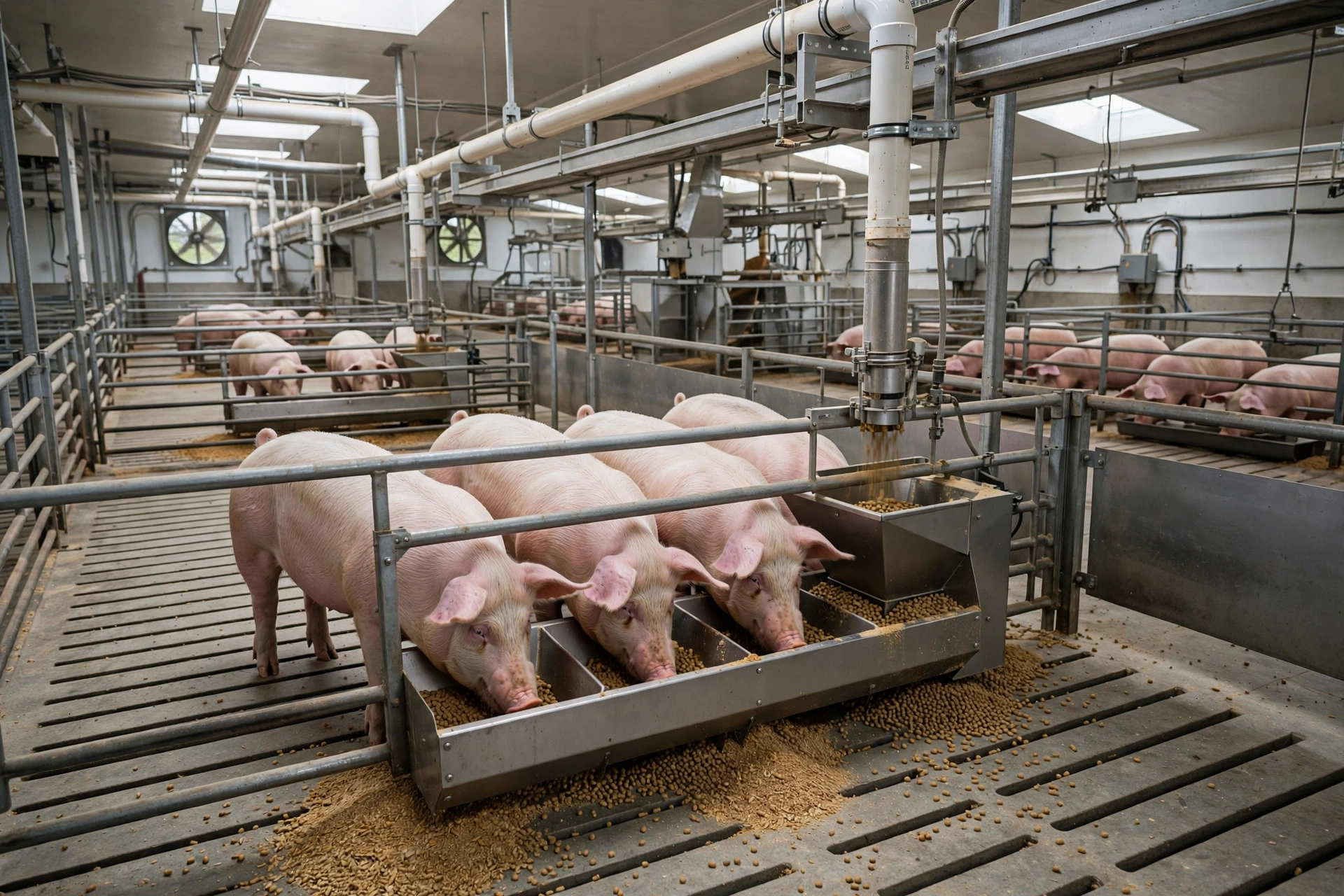
Feed leaves the system through four routes, and only one of them is the pig. Research measuring feed that fell on and through the floor across 11 self-feeder designs found wastage ranging from 2.1% to 7.7% (Taylor and Curtis, 1989, reported in Pork Information Gateway factsheet 07-01-09).
The important finding there is not the average. It is that the spread between feeder designs was wider than the average itself—the equipment decision outweighs the daily management decision.
| Route | How it shows up | How to detect it |
|---|---|---|
| Feeder wastage | Feed on the floor or in the pit | Visual pan check: F/G worse than gain suggests |
| Storage spoilage | Caked, moldy, or bridged feed | Bin inspection; moisture at walls |
| Shrink in handling | Delivered tons exceed fed tons | Reconcile delivery tickets to bin readings |
| Pests | Birds and rodents around bins and pads | Droppings, gnaw marks, spillage patterns |
One Percentage Point of Wastage, in Dollars
The relationship is simple enough to run with your own numbers: total pounds of feed per pig × 1% × feed cost per pound. Using a 2.8 feed efficiency and a feed cost of $0.12 per pound, the published calculation gives $0.71 per pig marketed for each percentage point of wastage eliminated (Pork Information Gateway, factsheet 07-01-09, 2010).
Two cautions. That is one percentage point of total feed disappearance — moving from 5% wastage to 4% — not a relative reduction in wastage. And the dollar figure carries 2010 feed prices. Run the arithmetic with your own delivered cost per pound and your feed efficiency; the structure holds even though the number does not.
There is a manure-side effect as well. The same source calculates that a 2% reduction in feed wastage reduces nitrogen and phosphorus in manure by approximately 3%, based on an assumed 35% nutrient retention. On a nutrient-management-constrained site, that is acreage.
Feeder Adjustment: Where the Sources Disagree
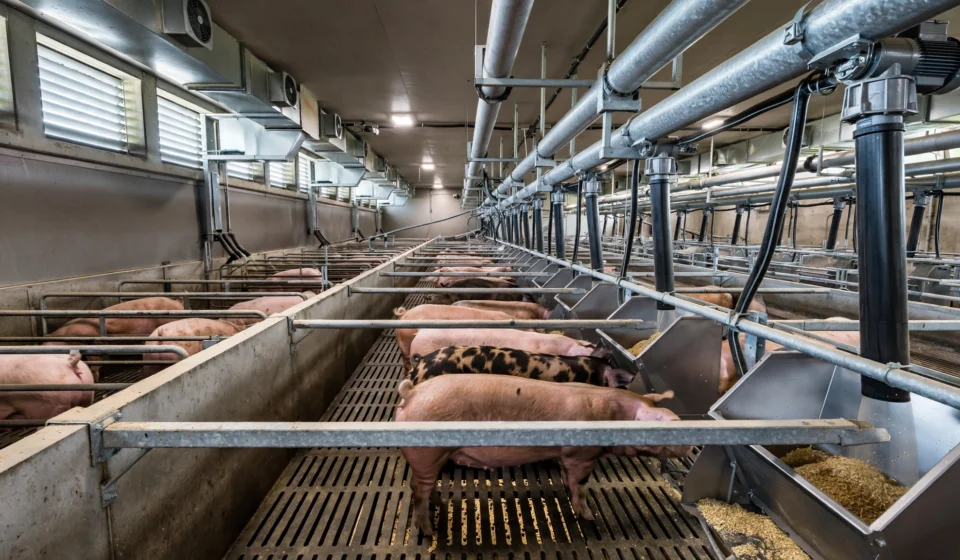
There is no single correct feed pan coverage, and credible sources genuinely disagree on this point. Published recommendations include about half the trough bottom covered, roughly one-third of the pan, and a pan filled only 40–50%. Recent commercial work goes further and suggests the target should be higher at placement and lower in late finishing rather than fixed for the whole turn.
That spread — roughly a quarter to three-quarters of the pan across sources — tells you something more useful than any single number would. Feeder design, feed form, particle size, pig weight, and pen density all shift the relationship between the setting and what actually reaches the floor. A gap setting that produces correct coverage on one feeder model produces something else on another.
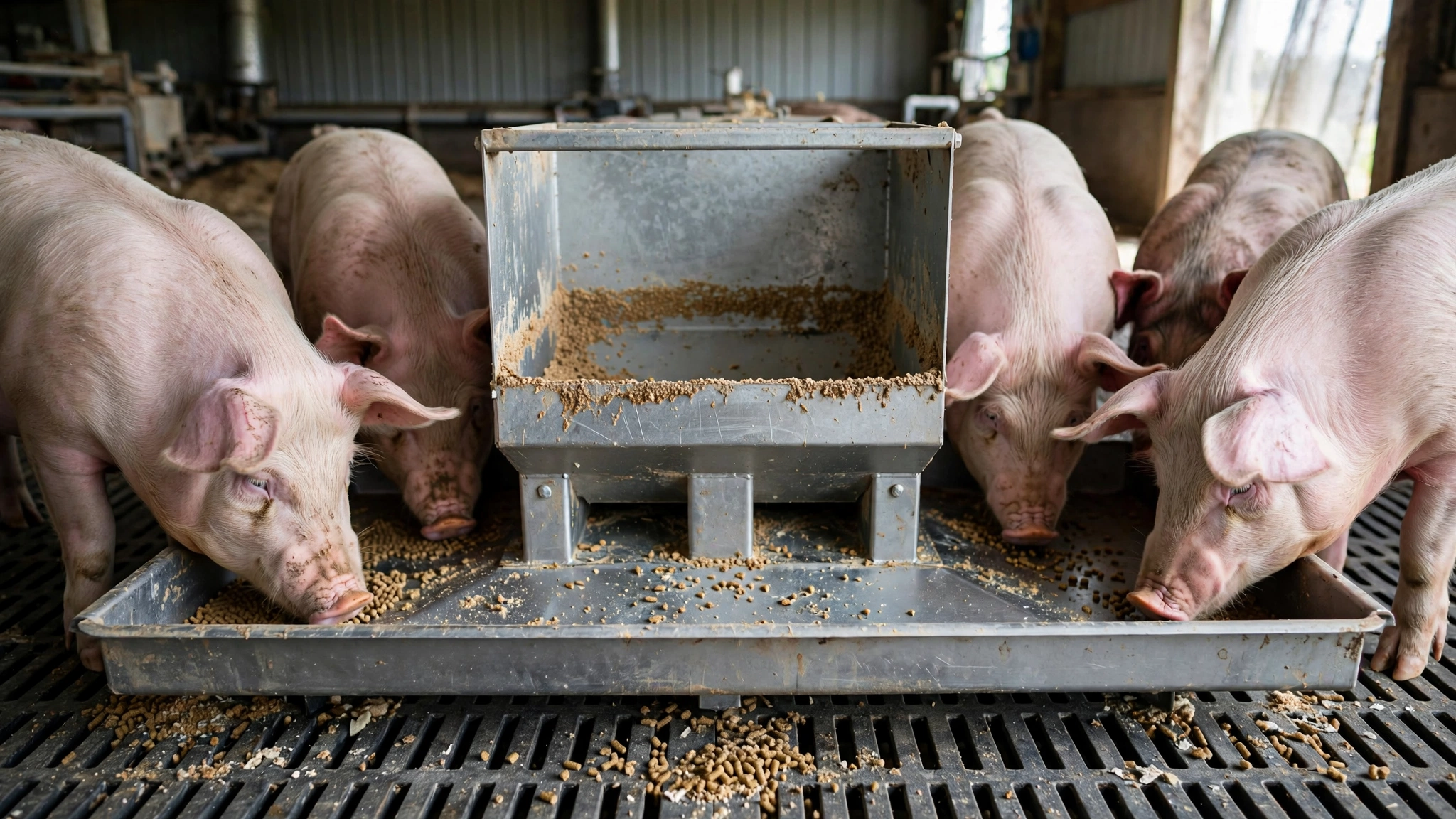
So the operational answer is not a number; it is a routine:
- Close the adjustment completely after cleaning, then open just enough for food to flow
- Assess coverage on the pan, not on the gap dial
- Reassess at least at placement, mid-finishing, and late finishing—settings that were right in week two are not right in week sixteen
- Clear caked feed from corners with a hook rather than opening the adjustment
- Repair or replace worn feeders; wear changes flow characteristics independently of the setting
If the setting is too tight, intake drops and fighting increases. If the feeder is too open, food will go to the pit. Both cost money, in opposite directions, which is why this process is a daily judgment rather than a one-time setup task.
Feed Form and Particle Size
Feed processing changes efficiency independently of the formula, and it is a management lever rather than a nutrition one. Published work indicates that grinding ingredients into meal or pelleting the complete feed is associated with feed efficiency improvements in the range of 3–5% per pig, as summarized by the UC Davis CLEAR Center.
Treat that as a published range, not a guarantee—the gain depends on the starting particle size, the pelleting process, and how much of the pellet survives transport and augering.
The management question is narrower than the nutrition one: when does feed form become a problem worth acting on? The signals are practical. Bridging in the bin or feeder. Visible fines accumulating in the pan while pigs sort for whole pellets. Dust levels are rising in the room. Feed efficiency is drifting, even though the diet hasn’t changed. Any of those means that the physical form of the feed, not its formulation, needs attention.
A Full Bin Is Not Continuous Feed Availability
Inventory management is about preventing out-of-feed events, not about knowing how many tons are in the silo. This distinction is where feed management stops being purchasing and starts being performance control.
Published research found that pigs exposed to out-of-feed events on a weekly basis gained less than pigs with continuous access, ending 8 lbs lighter at market (Brumm and coworkers, 2008, Journal of Swine Health and Production). Out-of-feed events also increase the incidence of gastric ulcers. Younger pigs were affected more than older pigs, which could partially compensate through higher subsequent intake.
Note where that cost appears. The feed invoice doesn’t include it because the feed was never bought. It appears eight pounds down the line in a close-out that looks mildly disappointing for no obvious reason.
A bin can be a third full while a feeder is empty because the failure is usually between the bin and the pan: a bridged bin, a stopped auger, a plugged drop tube, or a feed order placed a day late. Practical controls include load cells on bins for real-time inventory, routine physical checks of feeders rather than bins, and placing the heaviest pigs—which consume the most—nearest the auger switch, so the first feeder to run short is the one that trips the alarm for the whole barn.
Storage conditions matter alongside availability. Moisture entry causes caking and bridging, and mycotoxins — toxic compounds produced by molds growing on grain, capable of reducing intake and damaging health at concentrations that are invisible in the bin — make ingredient testing part of feed management rather than an occasional formality.
Automated and Precision Feeding Systems
Automated systems solve delivery reliability and labor, not diet quality. Augers, drop tubes, load cells, and computerized dispensing reduce the chance of an out-of-feed event and make phase transitions on a feed budget almost automatic — which is exactly where their return sits.
Precision feeding goes further, adjusting diet composition toward the individual pig or pen rather than the group average. The technology is real, and the modern feed infrastructure it depends on is described in our walkthrough of a modern commercial pig farm.
The honest limitation: precision equipment does not fix a feeder adjusted wrong, a bin admitting moisture, or a barn running 10°F above the comfort zone. It automates good management; it does not substitute for it. On sites where the basics are not yet controlled, the capital returns more in feeders and bin monitoring than in individual-pig systems.
Environment Is a Feed Cost
Barn temperature changes feed consumption measurably, which makes ventilation a feed management issue rather than only a housing one. Finishing pigs sit in a thermoneutral zone of roughly 55°F to 75°F.
Above 75°F, feed intake falls by approximately 0.05 to 0.08 lbs for every degree Fahrenheit, and growth rate falls with it. Below 55°F, pigs eat approximately 0.03 to 0.05 lbs more per degree simply to hold body temperature—growth may hold steady, but feed efficiency worsens because that extra feed becomes heat rather than gain.
A barn running 8°F cold all winter is buying feed that leaves as warmth. That is a controller setting, not a nutrition problem.
Measuring What You Manage: FCR and Close-Outs
Feed conversion ratio (FCR, also written as feed-to-gain or F/G) is pounds of feed divided by pounds of gain—but the number is only as honest as the two figures behind it.
Published benchmarks for pigs from 50 lbs to a 260 lb market weight place F/G at 3.00 for average performance, 2.80 for good, 2.65 for excellent, 2.50 for superior, and 2.40 at the top of the range, with corresponding days to market of 120 down to 98. Those come from a defined starting and ending weight, so they are a reference point rather than a current national standard.
Feed Disappearance Is Not Feed Intake
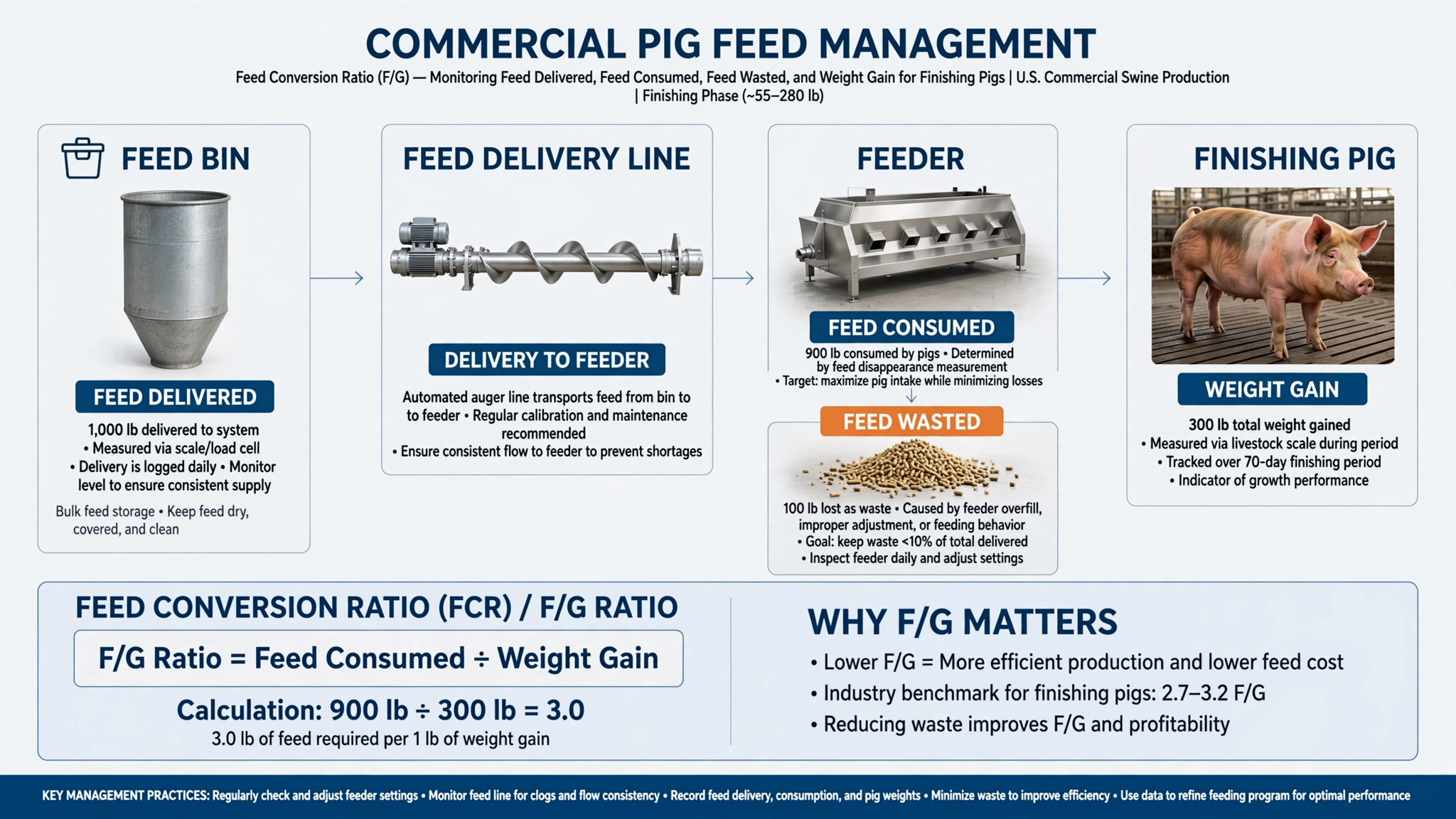
On-farm feed measurement is almost always feed disappearance — feed delivered minus feed remaining — which represents feed consumed plus feed wasted. It does not compensate for wastage in any form.
This is why a barn can post a poor F/G with pigs that are eating and growing perfectly well. The feed left. It just did not leave through the pig. Field FCR is therefore a combined measure of biological efficiency and wastage, and improving it can mean fixing either.
Why Two Close-Outs Often Are Not Comparable
Comparing groups is only fair when the inputs behind the ratio match. Before concluding that one barn outperformed another, check that both share the following:
- Starting weight—pigs entered lighter have a lower F/G over the same finishing period
- Ending weight—efficiency worsens as pigs get heavier, so a heavier out-weight penalizes the ratio
- Mortality and removals—feed consumed by pigs that died or were pulled still sits in the numerator, with no gain in the denominator
- Diet energy density and form — higher energy and pelleting both improve F/G independently of management
- Measurement method—feed disappearance calculated from delivery tickets is not the same as feed weighed into pens
Adjustment factors exist for entry weight, market weight, energy level, and pellet versus meal form, and applying them before comparison is what separates a meaningful close-out review from a monthly argument. Without adjustment, the group that looks best is often just the group that was weighed most favorably. For the underlying nutritional targets these numbers are measured against, see our pig nutrition and feeding guide.
Frequently Asked Questions
What do commercial farmers feed pigs?
Commercial U.S. pig diets are based on corn and soybean meal, with distillers dried grains, synthetic amino acids, a vitamin and trace mineral premix, salt, and calcium and phosphorus sources. Diets change across the grow-finish period, with roughly six phases common, because nutrient requirements fall as pigs grow heavier while feed intake rises. The specific formula varies by genetics, sex, health status, and ingredient prices.
What is a good feed conversion ratio for finishing pigs?
Published benchmarks for pigs finished from 50 lbs to 260 lbs place 3.00 as average, 2.80 as good, 2.65 as excellent, and 2.40 at the top of the range. Those figures assume that specific weight range, so comparing your own number to them requires matching entry and market weights. A field FCR also includes feed wastage, so a poor number may reflect feeder management rather than the diet.
How much feed does a commercial pig eat?
Under favorable conditions, feed intake rises from roughly 2.9 lbs per day at 60 lbs body weight to about 5.8 lbs per day for gilts and 6.3 lbs per day for barrows at 260 lbs. Barrows generally consume more than gilts from about 80 lbs onward without a corresponding increase in lean gain, which is the basis for split-sex feeding. Temperature, health status, and floor space all shift actual intake.
How do I reduce feed waste on a commercial pig farm?
Adjust feeders on a routine rather than at setup only, assess coverage on the pan rather than the gap setting, and reassess as pigs grow. Repair or replace worn feeders, since wear changes feed flow independently of the setting. Clear caked feed with a hook instead of opening the adjustment. Keep bins sealed against moisture and control birds and rodents around feed pads.
Does phase feeding actually save money?
Yes, and the largest single gain comes from moving from one diet to two. Each additional phase continues to reduce both diet cost and nutrient excretion, but the marginal benefit shrinks as phases are added. Phase feeding works by avoiding overfeeding expensive nutrients late in the period and underfeeding them early, and it requires no new equipment if managed on a feed budget.
Are automated feeding systems worth it?
They solve delivery reliability and labor rather than diet quality, so their return depends on how often your site currently runs into feed outages or delayed phase transitions. Load cells and computerized dispensing pay back most clearly where out-of-feed events are recurring. On sites where feeders are poorly adjusted or bins take moisture, basic equipment and routine fixes usually return more per dollar than precision systems.
Conclusion
Effective commercial pig feed management comes down to three habits. Measure your own feed cost share and F/G against your own history rather than against percentages quoted in articles, because the published spread is wide for legitimate reasons. Treat feeder adjustment as a repeated judgment across the turn, since credible sources disagree on the target and the right setting changes as pigs grow. And manage inventory for continuous availability rather than for tonnage — the cost of an out-of-feed event shows up in the close-out weight, not on the feed bill.
Tom Bradley
Explore More
Browse all of our commercial pig farming guides for more on U.S. production systems, facilities, and farm economics.