Pig Breeds in the USA: How to Choose the Right One
Pig breeds are not interchangeable, and the differences that matter to you are rarely the ones a breed list highlights. A breed that suits a confinement barn selling into the commodity market is often the wrong animal for someone raising eight pigs a year for named customers.
This guide is organized around the decision rather than the catalog: what the industry actually counts, what separates commercial lines from heritage stock, and how to match either to the operation you are running. If you are still working out the shape of that operation, start with our small-scale pig farming in the USA guide.
Quick Answer
The National Pork Board names eight major swine breeds raised in the United States: Berkshire, Chester White, Duroc, Hampshire, Landrace, Poland China, Spotted, and Yorkshire. Commercial operations build most systems from a handful of these, while heritage producers work with slower-growing breeds sold into direct markets. The right breed depends on the market you sell into, not on the breed’s reputation.
Key Takeaways
- Eight breeds carry the industry’s “major” designation — and three of them, Chester White, Poland China, and Spotted, are routinely left out of popular breed lists.
- Heritage does not mean British. Several American breeds are heritage stock, and several British breeds are not heritage in the U.S. sense.
- Profitability is set by your market, not your breed. The same animal performs differently against a commodity grid than against a customer waiting list.
- Temperament belongs in the decision, not the footnotes — handling difficulty shows up as labor, fencing cost, and risk.
- Breed choice follows infrastructure. Match the animal to the system you already have rather than rebuilding the system for the animal.
The Eight Major Pig Breeds Raised in the USA
Eight breeds carry the major designation in the United States, and the National Pork Board’s list is the one the industry works from: Berkshire, Chester White, Duroc, Hampshire, Landrace, Poland China, Spotted, and Yorkshire.
What the Industry Actually Counts
Compare that list to the breeds most articles feature and a gap appears. Chester White, Poland China, and Spotted are all on the industry’s list and are all routinely missing from popular roundups, while breeds with no place on it are given full sections.
This matters practically. A producer sourcing breeding stock in the Midwest will encounter Chester White and Poland China genetics in real sale barns and registries. A reader whose research never mentioned them arrives unprepared for what is actually available.
What Each Breed Is Noted For
The following summarizes what the National Pork Board identifies as each breed’s recognized strengths. Read it as a starting point for narrowing your options, not as a ranking.
| Breed | Noted for |
|---|---|
| Berkshire | Fast and efficient growth, reproductive efficiency, meat flavor and value |
| Chester White | Mothering ability, durability, soundness, muscle quality |
| Duroc | Product quality, carcass yield, fast growth, lean-gain efficiency |
| Hampshire | Lean muscle, high carcass quality, minimal backfat, large loin eyes, mothering ability |
| Landrace | Heavy milkers, length of body, high percentage of carcass weight in ham and loin |
| Poland China | Large frame, length of body, leanness, muscle; excellent feeders |
| Spotted | Feed efficiency, rate of gain, carcass quality, productivity, docility, durability |
| Yorkshire | Muscle, high proportion of lean meat, low backfat, soundness, durability |
Notice how much overlap there is. Five of the eight are credited with some form of growth or carcass strength. That overlap is the point: at the level of a breed summary, these animals are more alike than different, and the decision has to be made on other grounds.
Telling Them Apart on Sight
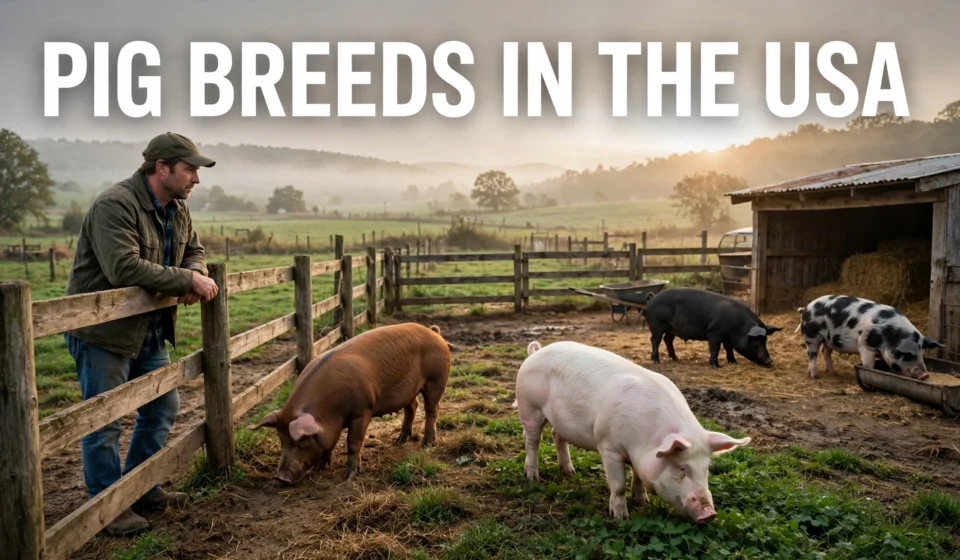
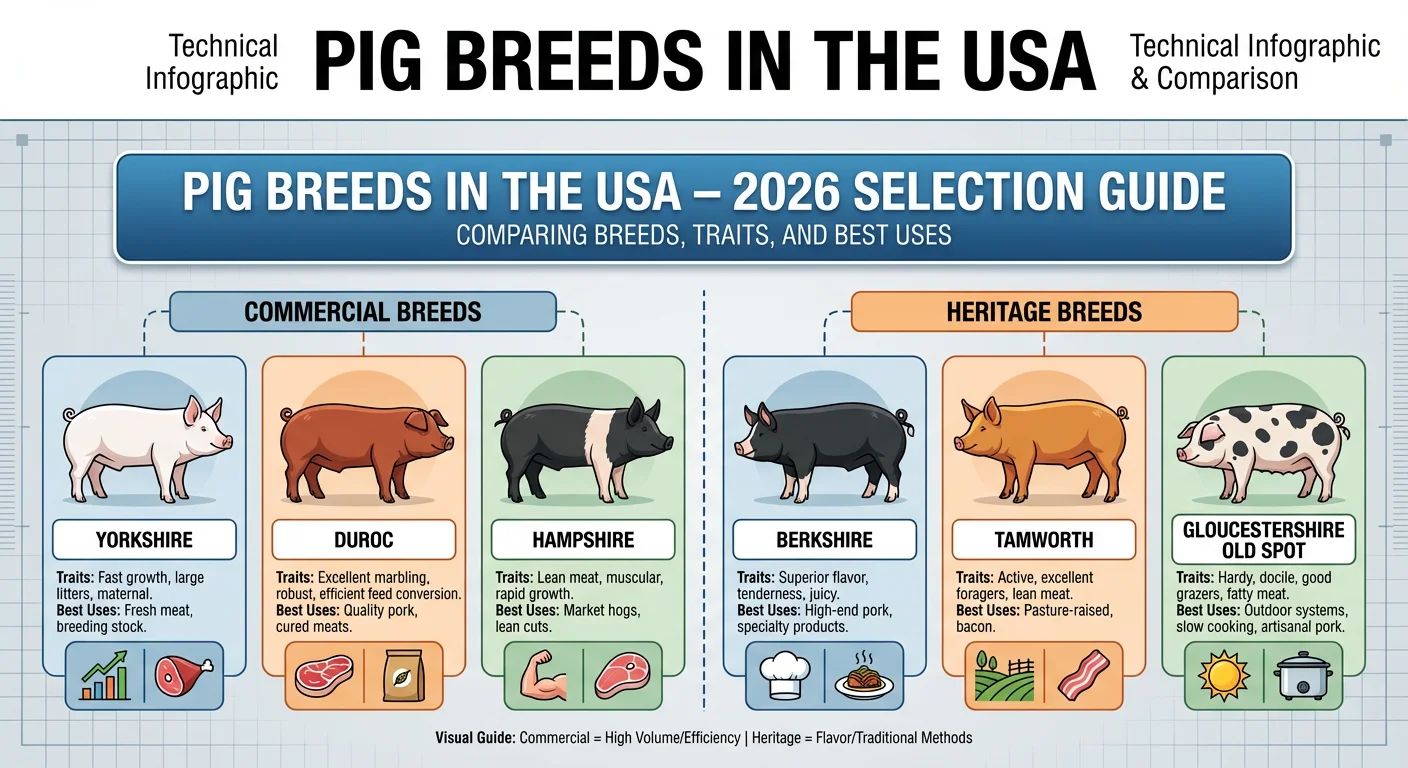
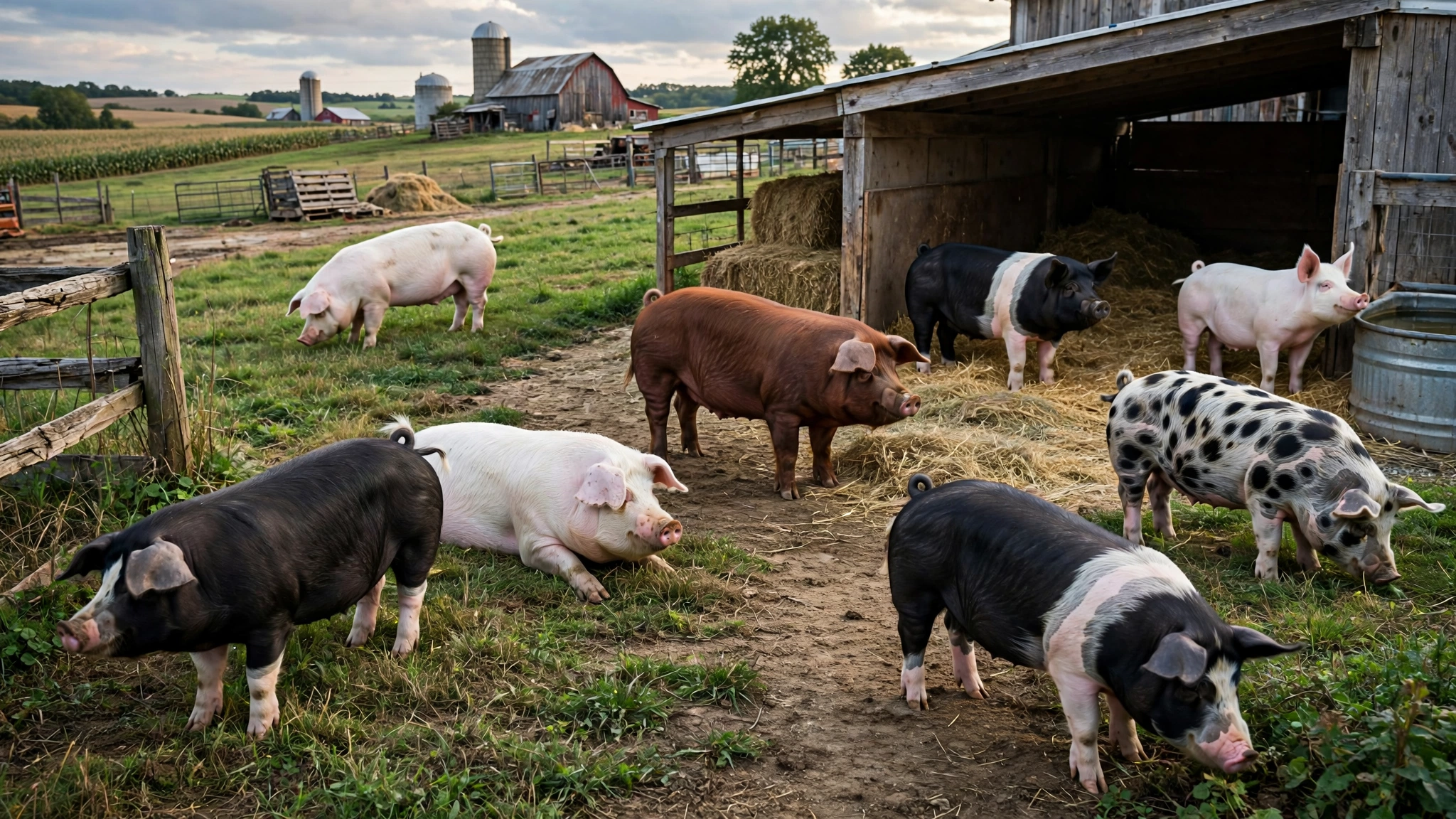
Several of the eight are identifiable by color and ear carriage. The National Pork Board describes Yorkshire as white with erect ears, Landrace and Chester White as white with droopy ears, Duroc as red with drooping ears, Hampshire by its belt, and Spotted by large black-and-white spots.
For the breeds that source does not describe visually, and for the dozens of breeds outside the major eight, the Oklahoma State University breeds of livestock database is the standard U.S. reference. It is worth having open when you are looking at animals rather than reading about them.
Commercial or Heritage: What Actually Separates Them
The line between commercial and heritage breeds is about what each was selected for over generations, not about age or nostalgia.
What Each Was Selected For
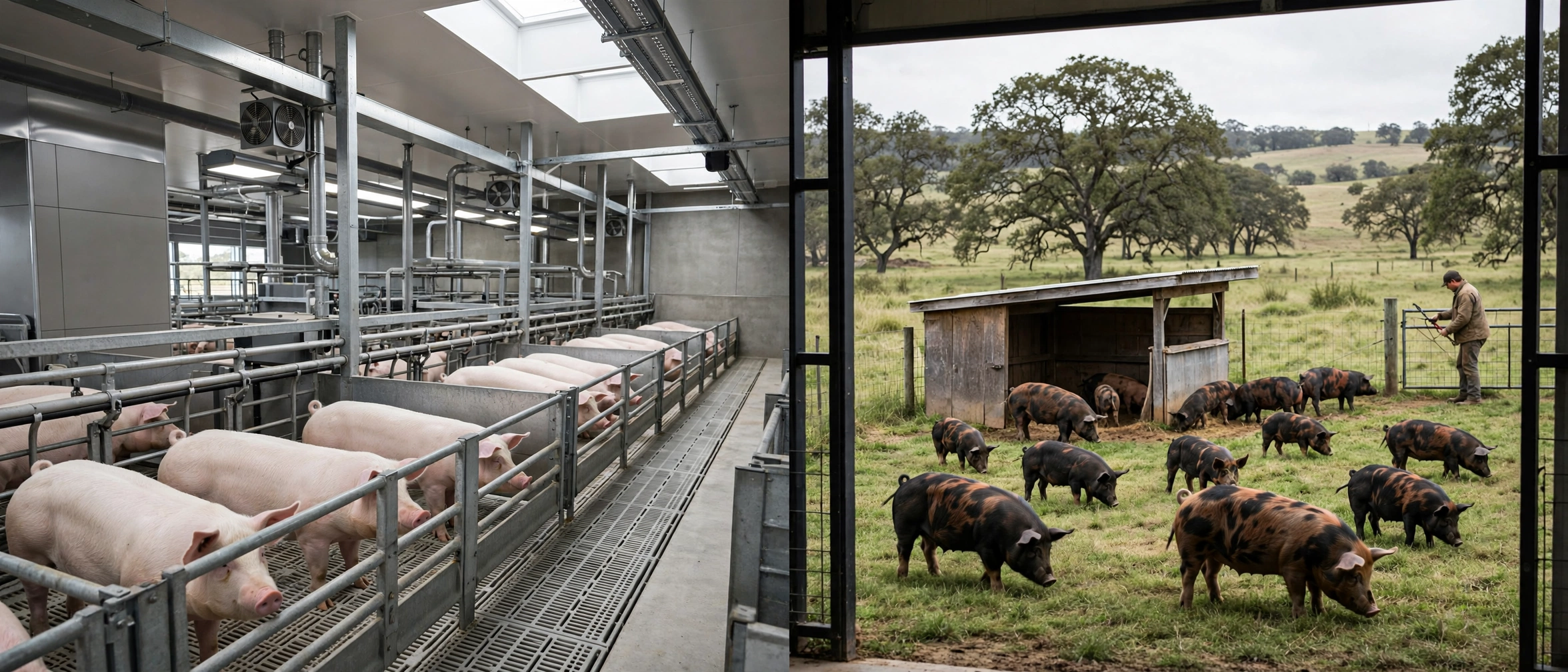
Commercial lines have been shaped by decades of selection for the traits a confinement system and a packing plant reward: growth rate, feed efficiency, carcass yield, and consistency across large groups. Consistency is the underrated one — a packer buying thousands of pigs needs them to arrive alike.
Heritage breeds were shaped by different pressures, and often by simply not being selected intensively at all. What survives in them tends to be hardiness, foraging ability, mothering instinct, and meat characteristics that were never bred out because nobody was optimizing for lean yield.
Neither set of traits is better. They are answers to different questions, and the question you are answering is set by where your pigs go when they leave.
Why “Heritage” Is Not a Synonym for British
A common confusion is worth clearing up: heritage is a conservation category, not a nationality. The Livestock Conservancy maintains the U.S. conservation priority list, and it includes breeds developed in America alongside imports.
Several American breeds carry heritage status. Several British breeds raised in the U.S. do not sit in the same category as the American rare breeds. Treating “heritage” as shorthand for “old British breed” leads people past American stock that is often better adapted to their region and easier to source locally.
If your interest is specifically in rare and conservation-priority breeds, that is a different search from the major eight, and it belongs in its own conversation.
What a Breed Name Does and Does Not Tell You
A breed name describes a population, not the animal in front of you — and the gap between the two is where most disappointment with a breed decision comes from.
Variation Within a Breed
Two Durocs from different herds can differ more from each other than the average Duroc differs from the average Hampshire. That is not a flaw in the breed; it is what happens when hundreds of breeders select independently for decades toward different goals.
One breeder may have selected for growth in a confinement setting. Another may have selected for hardiness on pasture, or for show ring conformation, or for temperament because they have children helping with chores. All three produce animals entitled to the same breed name.
The practical consequence is that the herd matters more than the breed. When you have narrowed to two or three breeds, the remaining work is finding a breeder whose selection goals resemble yours — not deciding which breed name is best in the abstract.
This is also why breed-level performance figures should be treated cautiously. A number attached to a breed name is an average across populations that were selected for different things, and your animals come from one of those populations rather than from the average.
Purebred, Crossbred, and Commercial Lines
Much of U.S. production does not use purebred animals at all. Commercial systems commonly cross a maternal line, selected for litter size and milk, with a terminal sire selected for growth and carcass traits, so the market pig is a cross rather than a member of any single breed.
That matters when you read breed material. A description of what Yorkshire or Duroc genetics contribute to a crossbreeding program is not the same thing as a description of what a purebred Yorkshire or Duroc is like to raise on its own. The first is about a role in a system; the second is about an animal in your pen.
If you are buying feeder pigs rather than breeding stock, you may be buying crosses regardless of what the seller calls them. Ask directly.
What Registration Proves
Registered stock comes with documented parentage. That is genuinely useful — it tells you the animal is what it is claimed to be, and it lets a breeder show you the line behind it.
What registration does not prove is performance, temperament, or suitability for your system. A registered animal from a herd selected for traits you do not need is not better for you than an unregistered animal from a herd selected for traits you do.
Decide first whether you need documented parentage. If you plan to sell breeding stock, you probably do. If you are finishing pigs for meat, the paperwork may be buying you nothing.
Which Pig Breed Is Most Profitable?
No breed is profitable on its own — profitability is a function of the market you sell into, and the same animal can be the right or wrong choice depending on that market alone.
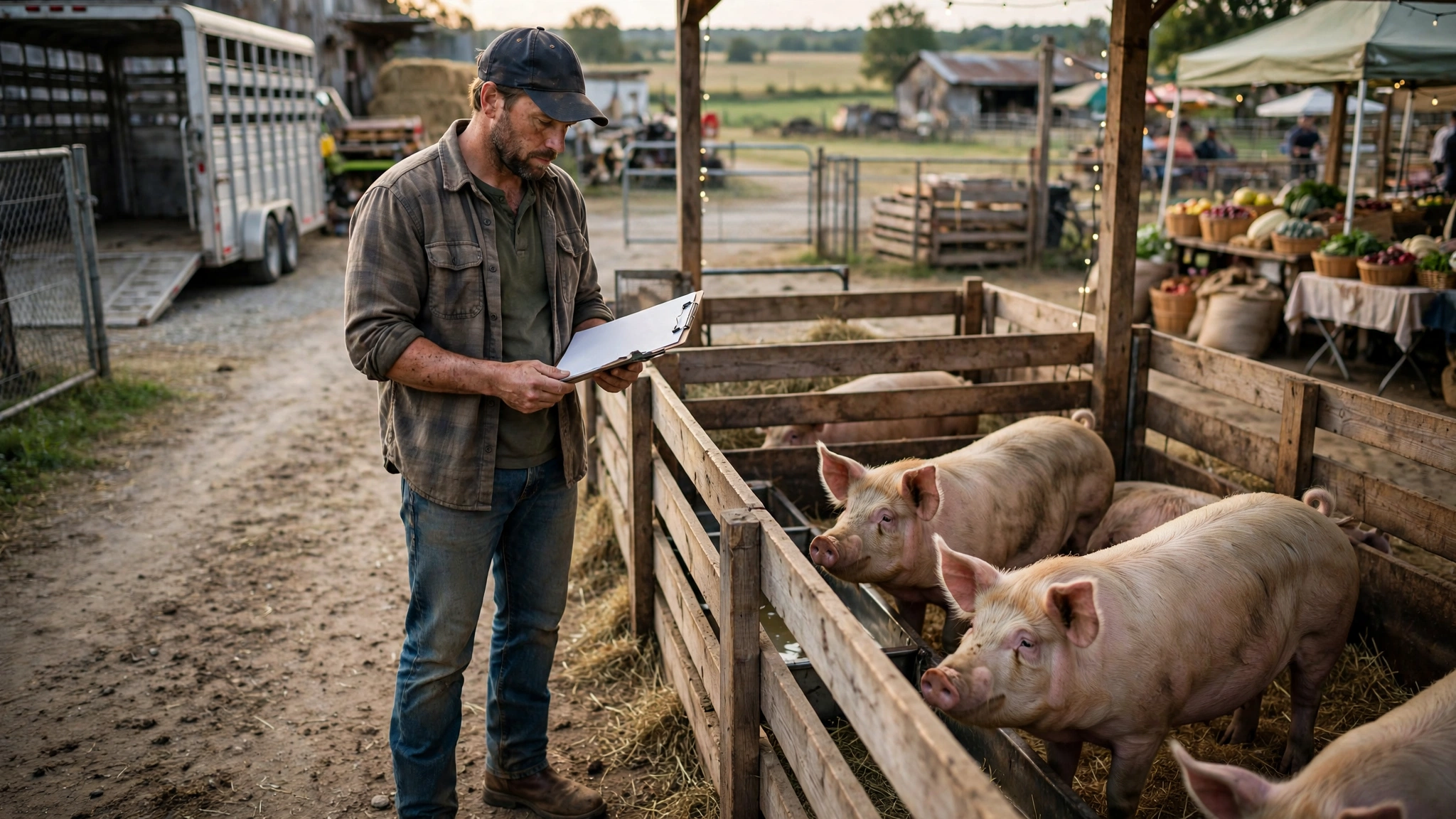
This is the question producers ask most, and the honest answer is uncomfortable because it moves the decision somewhere less convenient. You cannot choose a breed and inherit a margin. You choose a market, and the market tells you which breed fits.
Why the Market Decides, Not the Breed
Consider what each market rewards.
A commodity buyer pays on a grid built around carcass measurements and consistency. Nothing on that grid asks what the pork tastes like. A breed that produces exceptional flavor and slower growth is penalized twice in that system — once for the extra days on feed and once for carcass traits the grid does not reward.
A direct customer buys on something else entirely: flavor, appearance, your farm’s story, and the fact that they know you. That buyer is not comparing your pork to a commodity price. A breed that would be penalized on a grid can be exactly right here.
The pig did not change. The scoring system did.
Commodity Versus Direct Sale
The practical consequence is that breed selection should come after market selection, not before. Decide who buys your pigs, then work backward.
If you do not yet know who buys them, that is the problem to solve first — and it is a business question rather than a genetics question. Our pig farming economics guide covers how to think about the cost side of that decision.
One caution about the figures circulating on this topic. Growth rates, feed conversion, and price premiums vary so widely by system, genetics within a breed, and management that breed-level averages are close to meaningless for planning. Treat any confident number attached to a breed name with suspicion, and measure your own.
Temperament: The Criterion Most Lists Skip
Temperament belongs in the selection decision rather than in a closing note, because handling difficulty converts directly into labor, fencing cost, and risk on a small farm.
Breed summaries mention it rarely, and when they do it sits at the bottom of a pros-and-cons list. That placement is backwards for anyone working alone or with family labor.
What Handling Difficulty Actually Costs You
A calm pig can be moved, sorted, loaded, and treated by one person. A reactive pig needs two people and better facilities for the same tasks, every time, for months. That difference is invisible in a breed comparison and unmistakable on the third loading day.
It also shows up in your infrastructure. Animals that test containment harder need better fencing, and that cost arrives before the first pig does — as covered in our guide to pig fencing.
Among the major eight, the National Pork Board specifically credits Spotted with docility. For the rest, temperament is better assessed by visiting the herd you are buying from than by reading a breed description, because variation within a breed is substantial and individual breeders select differently. Watch how the animals react when someone walks into the pen.
Matching a Breed to Your Operation
Start from the system you already have, not from the breed you find most appealing, because the system is expensive to change and the breed is not.
Backyard, a few pigs a year. Prioritize temperament and manageable size over production traits you have no way to capture. A faster-growing pig saves you nothing if you are not selling on weight and days, and it may cost you if it is harder to handle. Your real constraints are handling, space, and how much feed you can store — not carcass yield. Work out the space question first, since it caps everything else: our guide to how much space do pigs need covers what the ground can carry.
Small farm selling direct. Meat characteristics and a story your customers can repeat matter more than growth rate here, because your buyer is choosing you rather than comparing carcasses. Consistency matters less than it does anywhere else — a customer who liked last year’s pork will accept some variation this year. What you cannot afford is a breed your local processor handles badly or your customers find unfamiliar, so ask both before you commit.
Pasture-based systems. Foraging ability, hardiness, and weather tolerance move to the front. A breed selected for generations in climate-controlled housing has had no reason to retain heat tolerance, cold tolerance, or the instinct to work a paddock. The reverse is also true: an animal that thrives outdoors may convert feed unremarkably indoors. Match the animal to where it will actually live, and factor in that outdoor systems test containment harder.
Commercial production. Efficiency and consistency dominate, and most operations at this scale work with crossbred systems rather than purebreds — maternal lines chosen for litter size and milk, terminal sires chosen for growth and carcass traits. At that point the question stops being “which breed” and becomes “which combination,” which is a different decision with its own logic. The reasoning behind those crosses belongs in our breeding and reproduction guide.
Whatever the scale, the quality of the individual animals you buy matters more than the breed name on the paperwork. What to look for when evaluating stock is set out in selecting pig breeding stock.
Where to Go Deeper
This guide is deliberately a map rather than an encyclopedia. Individual breeds deserve more room than a summary table can give them, and the detail lives in dedicated articles rather than here.
By breed. Each of the major eight has its own history, its own regional concentration, and its own set of tradeoffs that only become visible at length.
By purpose. Choosing for meat production, for pasture systems, or for a backyard operation are three different searches with three different answers.
By system. Crossbreeding, breeding stock selection, and conservation breeding each carry their own logic.
Browse the category archive linked below for everything published so far, and use the summary above to decide which direction is worth your time.
Frequently Asked Questions
What are the five major breeds of pigs?
There is no official five. The National Pork Board identifies eight major swine breeds in the United States: Berkshire, Chester White, Duroc, Hampshire, Landrace, Poland China, Spotted, and Yorkshire. Lists of five typically feature the breeds most visible in commercial crossbreeding programs and drop the others, which is why Chester White, Poland China, and Spotted are so often missing.
What is the most common pig breed in the US?
Popularity depends on how you count — registrations, purebred herds, or presence in commercial crossbred systems all give different answers, and they change over time. Rather than relying on a ranking, look at what breeders in your region actually have available. The National Pork Board’s list of major breeds is the reliable starting point for which breeds are established in U.S. production.
What is the most profitable pig breed?
None, on its own. Profitability comes from the match between the animal and the market. A breed rewarded by a commodity carcass grid may earn nothing extra from a direct customer, and a breed that commands attention at a farmers market may be penalized by a packer. Choose the market first, then the breed that fits it, then measure your own results.
What is the friendliest pig breed?
Temperament varies more within breeds than most comparisons admit, because individual breeders select differently. Among the major eight, the National Pork Board specifically notes docility in the Spotted breed. Beyond that, the reliable method is to visit the herd you are buying from and watch how the animals respond to a person entering the pen.
What is the best pig breed for beginners?
The one you can handle and source locally. For a first group, prioritize calm temperament and a breeder close enough to call with questions over any production trait. A nearby breeder who answers the phone is worth more to a beginner than a superior pedigree three states away, and handling ease determines whether the experience is manageable.
What is the rarest pig breed in the USA?
Rarity is tracked rather than guessed. The Livestock Conservancy maintains the U.S. conservation priority list for livestock breeds and updates the status of rare pig breeds as populations change. Consult the current list rather than any article, including this one, since a breed’s status can move between categories from year to year.
Conclusion
Choosing among pig breeds comes down to three moves. Start with the market rather than the animal, because the market decides which traits get paid for and which are invisible. Weigh temperament as seriously as production traits, since handling difficulty is a cost you pay every day rather than once. And match the breed to the system you already own, because rebuilding infrastructure around an animal is the expensive way to make that decision.
The eight major breeds are a starting list, not a shortlist. Narrow them by what you are selling and to whom, then go deep on the two or three that survive that filter.
Explore More: Browse every article in Pig Breeds in the USA.