Farrow-to-Finish vs. Wean-to-Finish: Which Pig Production System Is Right for You?
Table of Contents
- Introduction
- What Is Farrow-to-Finish Pig Farming?
- What Is Wean-to-Finish Pig Farming?
- Other Production Systems: Farrow-to-Wean and Farrow-to-Feeder
- Head-to-Head Comparison: Costs, Biosecurity, and Profitability
- Which System Best Fits Your Operation?
- Regulatory and Welfare Considerations
- Key Numbers at a Glance
- FAQ
- Explore More
- Conclusion
- About the Author
Introduction
Choosing the right pig production system is one of the most consequential decisions a U.S. pig farmer will make — it determines your capital requirements, biosecurity exposure, labour needs, and, ultimately, your profit margin.
According to USDA NASS 2024 data, the U.S. swine industry houses approximately 74.1 million hogs at any given time, produced across a diverse mix of production models ranging from fully integrated farrow-to-finish operations to specialised wean-to-finish contract sites. Understanding these systems is central to any serious commercial pig farming operation.
With an MSc in animal nutrition and over 10 years of experience in swine feed and growth optimisation, I’ve worked with producers across multiple production models.
The system you choose doesn’t just affect your barn design — it shapes every nutritional decision, every biosecurity protocol, and every financial projection you’ll make.
This guide compares the two dominant U.S. production systems — farrow-to-finish and wean-to-finish — alongside key alternatives, so you can match the right model to your goals, resources, and risk tolerance.
A sound production system also connects directly to your pig farming economics — capital investment, cash flow timing, and break-even analysis all differ significantly between models.
What Is Farrow-to-Finish Pig Farming?
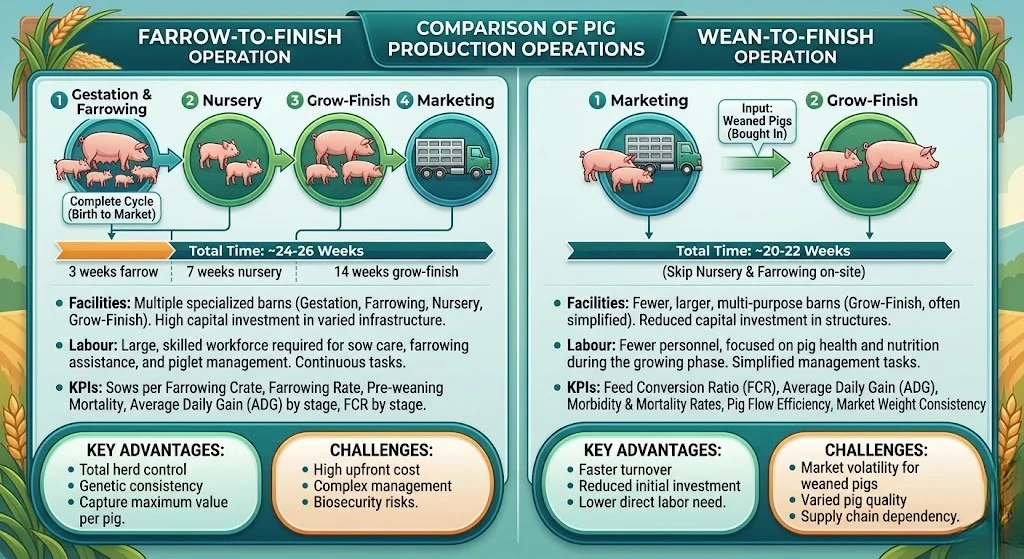
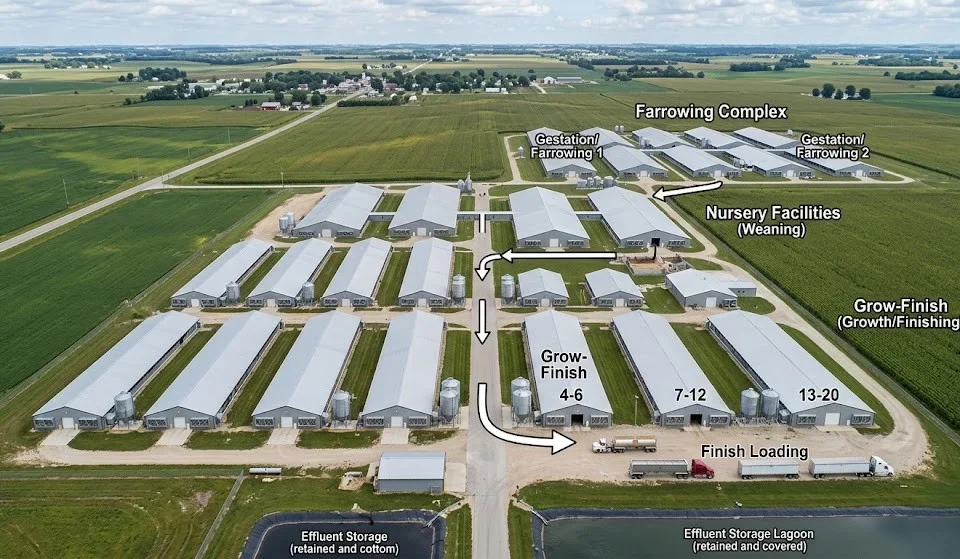
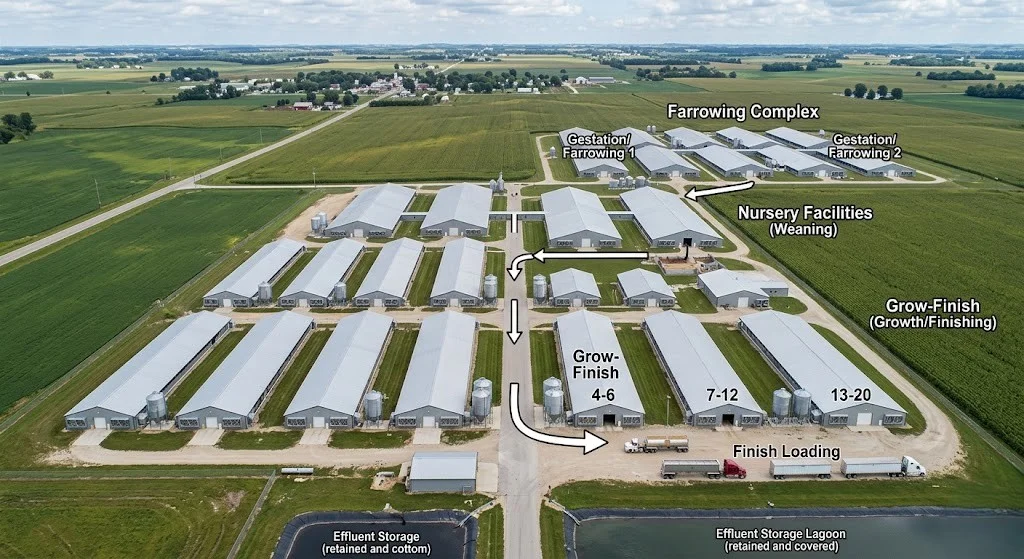
Farrow-to-finish is the most integrated pig production model in the U.S. — a single operation manages sows through breeding, gestation, farrowing, and piglet rearing, then grows those pigs all the way to market weight (typically 270–280 lbs).
Every stage of the pig’s life happens on one site or within one tightly controlled system.
This model represents the traditional backbone of American pork production. According to the USDA Economic Research Service (2024), farrow-to-finish operations account for approximately 38% of U.S. hog operations but produce a disproportionately high share of total output due to their integrated efficiency.
How it works, stage by stage:
- Breeding/Gestation (Day 0–114): Sows are bred via artificial insemination or natural service, confirmed pregnant, and housed in gestation barns for approximately 114 days
- Farrowing (Day 114–135): Sows move to farrowing crates where they give birth and nurse piglets for 17–21 days
- Nursery (21–70 days of age): Weaned piglets move to nursery barns, growing from approximately 12 lbs to 50–60 lbs
- Grow-Finish (70–175 days of age): Pigs grow from 50 lbs to 270–280 lbs market weight in grow-finish barns
Capital requirements are substantial. A new 2,400-sow farrow-to-finish facility in the U.S. costs $8M–$14M to build fully equipped in 2024–2025, according to Iowa State University Extension estimates. However, the return on that investment comes through full control of every production stage — genetics, nutrition, health, and timing.
Actionable Tip: If you’re evaluating farrow-to-finish, run a detailed cash flow projection for the first 18 months. This model has a long ramp-up period before revenue starts – your first market pigs won’t ship until 5–6 months after your first sows farrow.
U.S. Example: A 1,200-sow farrow-to-finish operation in Story County, Iowa, achieved a rate of 32.4 pigs weaned per sow per year in 2024 by implementing a 21-day weaning protocol and all-in/all-out farrowing room management — outperforming the national average of 28.5 by nearly 14%.
What Is Wean-to-Finish Pig Farming?
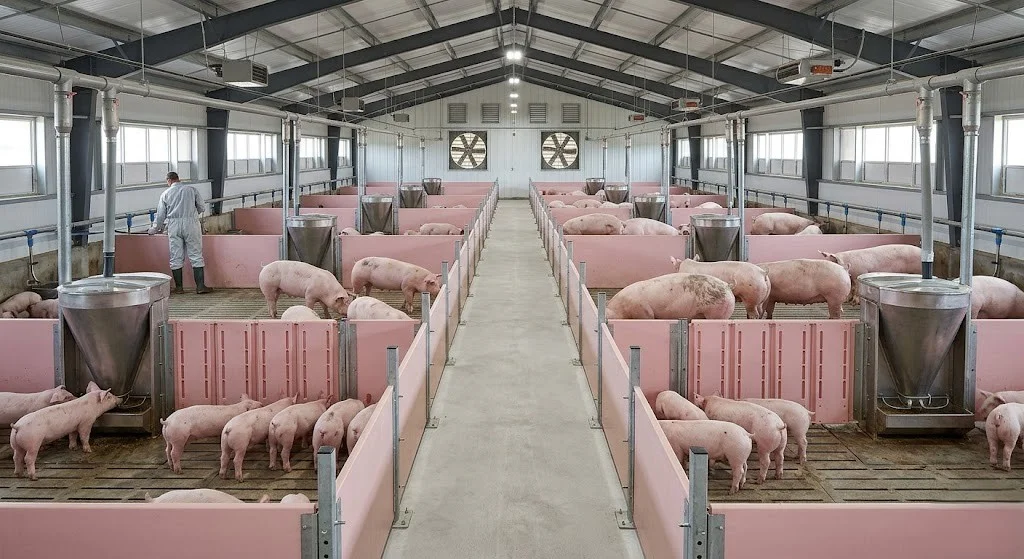
Wean-to-finish is a production model in which a farm receives weaned piglets — typically 12–15 lbs at 17–21 days of age — from a separate farrowing operation, then grows those pigs through the nursery and grow-finish stages to market weight on a single site. There is no sow herd on a wean-to-finish farm.
This model has grown significantly in the U.S. since the 1990s, driven by the contract production system. According to the National Pork Producers Council (NPPC), wean-to-finish now accounts for a large and growing share of hog production in the U.S., particularly in contract grower arrangements with major integrators.
How it works:
- Pig Placement: Weaned pigs (17–21 days old, 12–15 lbs) arrive from a farrowing source—either a company-owned sow farm or a farrow-to-wean contract operation
- Nursery Phase (on-site): Pigs grow from 12–15 lbs to 50–60 lbs in the same barn they’ll finish in, using a wean-to-finish barn design with adjustable pen dividers
- Grow-Finish Phase (on-site): Pigs continue in the same space to market weight, typically 270–280 lbs
The key innovation in wean-to-finish is the elimination of the nursery-to-finish move. Traditional systems required pigs to be physically moved from nursery barns to separate grow-finish barns at 50–60 lbs, which was a stressful transition that consistently caused a growth check of 5–7 days. Wean-to-finish barns eliminate this move entirely.
A 2024 University of Minnesota swine research study found that wean-to-finish systems reduced average days-to-market by 4–6 days compared to traditional two-site nursery/finish systems, representing $3–$5 per pig in feed and fixed cost savings.
Actionable Tip: Wean-to-finish barn design is critical. Pen dividers must be moveable so pen density can be adjusted as pigs grow. Plan for 2.5 sq ft per pig at placement, expanding to 8 sq ft per pig at finish – fixed pens are one of the most common and costly design mistakes.
U.S. Example: A contract wean-to-finish grower in Duplin County, North Carolina, managing 2,500 head per turn for a major integrator reported average days-to-market of 164 days in 2024 — 6 days faster than their previous two-site system — saving approximately $12,500 per production turn.
Other Production Systems: Farrow-to-Wean and Farrow-to-Feeder
While farrow-to-finish and wean-to-finish dominate U.S. commercial production, two additional specialised models serve important roles in the industry.
Farrow-to-Wean:
In this model, the operation focuses exclusively on sow management and piglet production. Pigs are weaned at 17–21 days and sold or transferred to separate nursery/finish sites. This model maximises the number of pigs produced per sow per year and allows for maximum biosecurity focus on the most vulnerable animals — the sow herd and newborn piglets.
Farrow-to-wean sites are typically company-owned or managed under tight biosecurity in major integrator systems. They have the highest biosecurity protocols of any production stage because a disease introduced to the sow herd can affect every downstream production site that receives pigs from that source.
Farrow-to-Feeder:
This model takes pigs from farrowing through the nursery phase, selling feeder pigs (50–80 lbs) to separate grow-finish operations. It is more common in smaller, independent operations where the producer has strong expertise in early pig management but limited finish barn capacity.
According to USDA NASS 2024, farrow-to-feeder operations represent approximately 12% of U.S. hog operations, concentrated in states like Missouri, Kentucky, and Tennessee, where independent production remains more prevalent than in the major Corn Belt integrator states.
| System | Stages Managed | Pigs Sold At | Best For |
|---|---|---|---|
| Farrow-to-Finish | All stages | Market weight (270–280 lbs) | Fully integrated operations |
| Farrow-to-Wean | Breeding through weaning | 12–15 lbs weaned | Sow specialists, integrators |
| Farrow-to-Feeder | Breeding through nursery | 50–80 lbs feeder pigs | Independent producers with nursery expertise |
| Wean-to-Finish | Nursery through finish | Market weight (270–280 lbs) | Contract growers, single-site operations |
Actionable Tip: Farrow-to-feeder can be a lower-capital entry point into pig production, but feeder pig price volatility is significant. Use USDA Agricultural Marketing Service reports on feeder pig prices to build realistic revenue projections before committing to this model.
Head-to-Head Comparison: Costs, Biosecurity, and Profitability
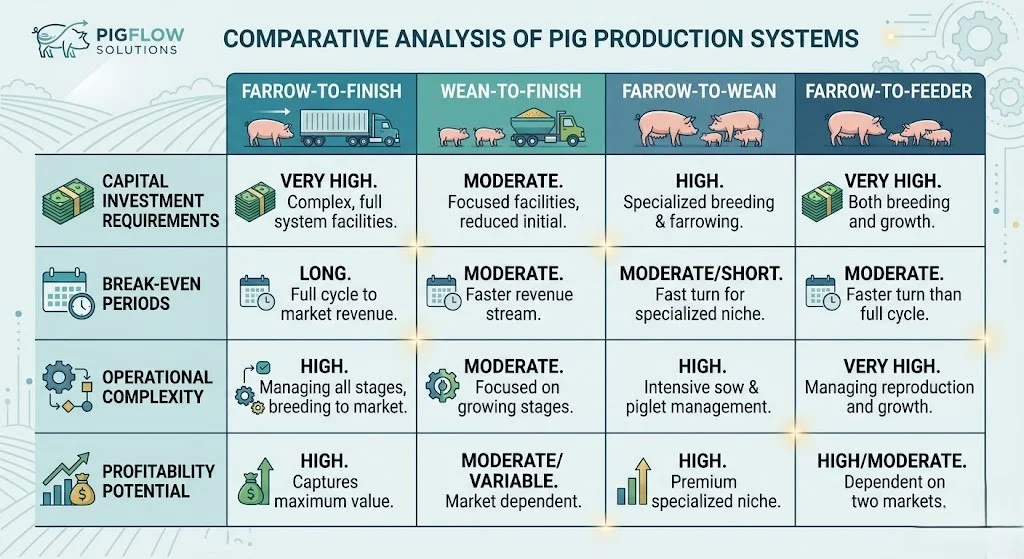
Choosing between production systems depends on four variables: capital investment, operational complexity, biosecurity risk, and revenue stability. Here is how the two dominant systems compare across each dimension.
Capital Investment
| Item | Farrow-to-Finish (2,400 sows) | Wean-to-Finish (2,500 head/turn) |
|---|---|---|
| Building cost | $8M–$14M | $1.2M–$2.0M |
| Equipment | Included above | Included above |
| Sow inventory | $600K–$900K | None |
| Annual feed cost | $1.8M–$2.4M | $600K–$900K |
| Break-even timeline | 7–12 years | 4–7 years |
Biosecurity Risk
Farrow-to-finish operations carry higher biosecurity complexity — more animal classes on one site mean more potential disease interactions. A PRRS introduction that affects the sow herd simultaneously disrupts farrowing performance, nursery health, and finish pig throughput.
Wean-to-finish sites, by contrast, have a simpler biosecurity profile — one animal class, one production stage, no breeding animals. However, they are entirely dependent on the health status of the pigs they receive. A disease-positive source farm sends health problems directly to your barn.
According to the Secure Pork Supply Plan, both systems require documented site-specific biosecurity plans, but the risk management priorities differ significantly between them.
Profitability
Farrow-to-finish operations capture margin across the full production cycle — when weaned pig prices are high, they benefit from having their own supply. When market hog prices are strong, they capture that margin too.
This full-cycle exposure has both positive and negative effects: when any stage underperforms, it affects the whole system.
Wean-to-finish contract growers typically receive a fixed payment per pig space per year from integrators — commonly $40–$60 per pig space annually in 2024–2025, according to industry benchmarks — which provides revenue stability regardless of market hog prices. The trade-off is a ceiling on upside.
Actionable Tip: Independent wean-to-finish producers who buy their own weaned pigs face the most volatile financial position, exposed to both weaned pig purchase price risk and market hog sale price risk simultaneously. Hedging strategies using CME lean hog futures are essential for this model.
Which System Fits Your Operation?
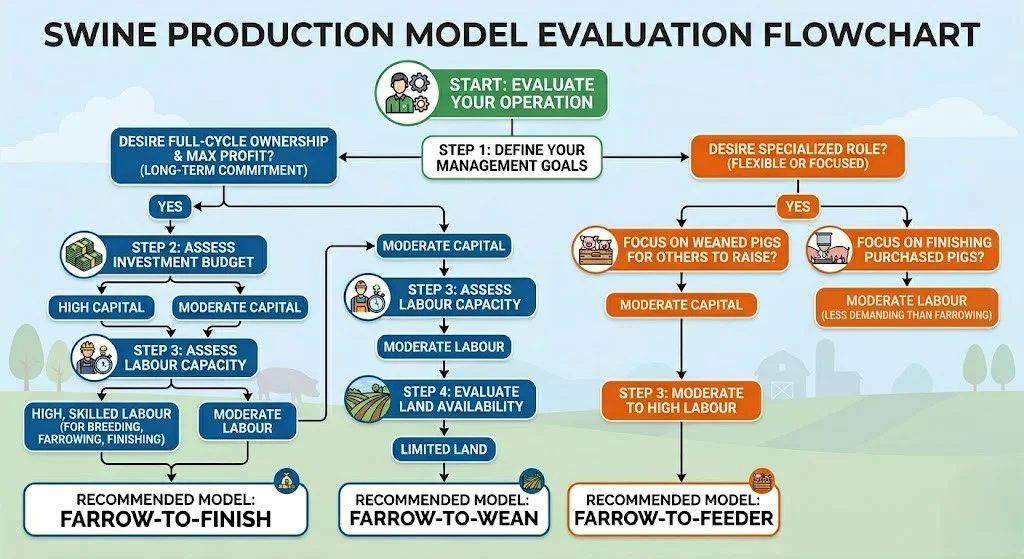
Selecting the right production system requires honest assessment of your capital, expertise, risk tolerance, and long-term goals. Use this framework:
Choose Farrow-to-Finish if:
- You have access to $8M+ in capital or financing
- You want full control over genetics, nutrition, and production timing
- You have or can hire expertise across all production stages
- You want to capture margin across the full pig life cycle
- You’re building a multi-generational family farming operation
Choose Wean-to-Finish (Contract) if:
- You have $1.5M–$2.5M in capital for barn construction
- You prefer predictable revenue over variable market exposure
- You want to focus operational expertise on grow-finish management
- You’re entering the industry without prior sow management experience
- You want a faster path to cash flow-positive operations
Choose Farrow-to-Wean if:
- You have deep expertise in sow management and reproduction
- You want to specialize in the highest-value stage of production
- You’re part of an integrator system supplying multiple finish sites
- Biosecurity focus and sow herd health are your primary strengths
Choose Farrow-to-Feeder if:
- You have strong nursery management skills
- You want lower capital requirements than full farrow-to-finish
- You have access to reliable feeder pig buyers in your region
- You’re willing to accept feeder pig price volatility
Sound pig nutrition and feeding management differ significantly across these systems — particularly in the critical weaning and early nursery phases — so match your nutritional expertise to your chosen model.
Regulatory and Welfare Considerations
All U.S. pig production systems must comply with a common regulatory framework, but certain regulations have system-specific implications.
EPA CAFO Regulations: Any operation with 2,500 or more swine over 55 lbs, or 10,000 or more swine under 55 lbs, is classified as a large CAFO and requires an NPDES permit for manure management. Farrow-to-finish operations are more likely to trigger CAFO thresholds due to their mixed animal population.
FDA Veterinary Feed Directive (VFD): All systems using medically important antibiotics in feed or water must have a valid VFD signed by a licensed veterinarian. This requirement, fully in effect since 2017 under FDA Guidance for Industry #213, applies equally across all production models.
California Proposition 12: Effective January 2024, California’s Prop 12 requires that pork sold in California come from sows housed with at least 24 sq ft of usable floor space. This regulation directly affects farrow-to-finish and farrow-to-wean farms that raise breeding sows. According to the National Pork Producers Council, compliance requires significant barn modifications for many existing operations.
PQA Plus Certification: The National Pork Board’s Pork Quality Assurance Plus program is the industry standard for welfare and food safety documentation. Certification is required by most major pork packers and integrators regardless of production system.
Actionable Tip: Check your state’s specific CAFO thresholds before selecting a production system and scale — several states, including Iowa, Minnesota, and North Carolina, have additional state-level environmental requirements beyond federal EPA standards.
Key Numbers at a Glance
| Metric | Farrow-to-Finish | Wean-to-Finish |
|---|---|---|
| Capital investment | $8M–$14M (2,400 sow) | $1.2M–$2.0M (2,500 head) |
| Break-even timeline | 7–12 years | 4–7 years |
| Days to market from birth | 160–175 | 130–145 (from placement) |
| Labor requirement | 8–12 FTE | 1–3 FTE |
| Biosecurity complexity | High | Moderate |
| Revenue stability | Variable (market-dependent) | Stable (contract) or Variable (independent) |
| FCR benchmark | < 2.7 | < 2.65 |
| Pigs per sow per year | 28–32 | N/A |
| Contract payment (per pig space/year) | N/A | $40–$60 |
| CAFO threshold risk | Higher | Lower |
FAQ
What is the difference between farrow-to-finish and wean-to-finish pig farming?
Farrow-to-finish operations manage the entire pig life cycle — from breeding sows to market weight — in one integrated system. Wean-to-finish operations receive weaned piglets (17–21 days old) from a separate farrowing source and grow them to market weight. The key difference is whether the farm manages a sow herd.
Farrow-to-finish requires significantly more capital and expertise but captures margin across the full production cycle.
Which pig production system is most profitable in the USA?
Profitability depends heavily on market conditions, management quality, and capital structure. Farrow-to-finish operations have higher earning potential in strong hog markets but greater downside risk. Wean-to-finish contract growers have more stable, predictable income but limited upside.
Independent wean-to-finish producers face the most market exposure. According to USDA ERS 2024 data, top-quartile farrow-to-finish operations consistently outperform contract wean-to-finish on a per-pig margin basis in favourable market years.
How many pigs can a wean-to-finish barn hold?
A standard wean-to-finish barn in the U.S. is designed for 1,000–2,500 head per turn. Pen density starts at 2.5 sq ft per pig at weaning and expands to 8 sq ft per pig at market weight, requiring moveable pen dividers.
Most contract grower agreements specify barn capacity based on the integrator’s production system requirements.
What is farrow-to-wean pig farming?
Farrow-to-wean is a specialised production model that focuses exclusively on sow management and piglet production. Pigs are weaned at 17–21 days and sold or transferred to separate nursery or wean-to-finish sites.
This model is common in major integrator systems and allows maximum biosecurity focus on the sow herd, which is the most valuable and biosecurity-sensitive asset in pork production.
How does biosecurity differ between production systems?
Farrow-to-finish operations manage multiple animal classes on one site, increasing biosecurity complexity — a disease introduction can affect the sow herd, nursery pigs, and finishing pigs simultaneously. Wean-to-finish sites have a simpler single-class biosecurity profile but are entirely dependent on the health status of incoming pigs.
Both systems require documented biosecurity plans aligned with the USDA’s Secure Pork Supply framework.
What regulations apply to all U.S. pig production systems?
All U.S. commercial pig operations must comply with EPA CAFO regulations for manure management, FDA Veterinary Feed Directive rules for antibiotic use, USDA Animal Disease Traceability requirements, and state-level environmental permits.
Farrow-to-finish and farrow-to-wean operations that house breeding sows must additionally comply with California Proposition 12 welfare standards for pork sold in California. Most major packers and integrators require PQA Plus certification.
Explore More
From the Commercial Pig Farming Series:
⏳ Overview of Commercial Pig Farming in the USA (coming soon)
✅ History of Commercial Pig Production in America
✅ Top Pig-Producing States in the USA
✅ Inside a Modern Commercial Pig Farm
⏳ The Role of Technology in Pig Farming (coming soon)
⏳ Contract Pig Farming in the USA (coming soon)
⏳ Feed Management for Commercial Pigs (coming soon)
⏳ Biosecurity in Large-Scale Pig Farms (coming soon)
Conclusion
The choice between farrow-to-finish and wean-to-finish isn’t simply a barn-design decision—it’s a strategic business decision that shapes your capital structure, operational complexity, and revenue model for decades. Farrow-to-finish gives you full control and full market exposure. Wean-to-finish contract production gives you stability and a faster path to positive cash flow.
Neither is universally superior — the right system is the one that matches your capital, expertise, and risk tolerance.
Start with an honest assessment of those three factors, build your financial projections around realistic benchmarks, and choose the model you can execute at the highest level.
For a complete view of the industry these systems operate within, return to the Commercial Pig Farming in the USA Complete Guide.