Understanding the Pig Digestive System: A Farmer’s Guide
Discover how the pig digestive system works. Understand swine monogastric digestion and gut microbiome health to maximise feed efficiency and herd profits.
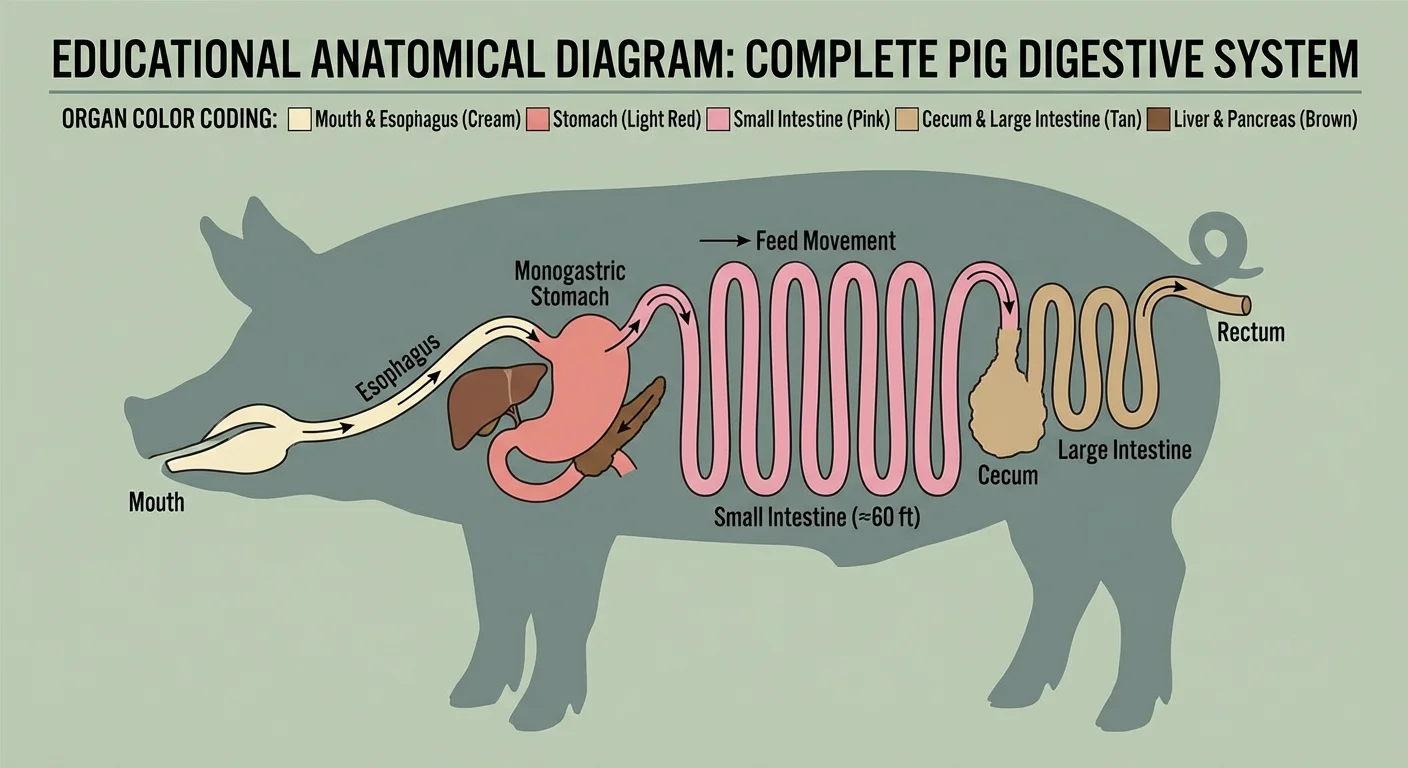
The pig digestive system is a simple yet highly efficient process that allows pigs to convert feed into energy, growth, and overall health.
As a monogastric animal, a pig has a single-chambered stomach, and its digestion relies on a precise sequence of enzymatic and microbial actions.
In this guide, you’ll learn how the pig digestive system works step by step—from the stomach to the intestines—with simple explanations and practical insights.
To better understand how digestion connects to diet, you can also explore our complete guide on pig nutrition and feeding.
Since a large portion of a pig’s immune system is located in its gut, proper digestion plays a key role in overall health and disease prevention.
For a more profound look at this connection, see our guide on pig health and disease management.
Table of Contents
- The Monogastric Stomach Explained
- The Role of the Small Intestine in Swine Digestion
- The Large Intestine and Water Absorption
- Optimizing the Pig Gut Microbiome
- Common Digestive Issues and Feed Management
- Digestive System Efficiency Comparison
- Frequently Asked Questions
- Conclusion
The Monogastric Stomach Explained
The pig’s stomach is the command centre for the initial chemical breakdown of the feed. As a monogastric animal, a pig relies on a single-chambered stomach that utilises strong hydrochloric acid and specialised digestive enzymes, like pepsin, to break down complex proteins.
According to 2024 USDA agricultural data, the stomach of a fully grown adult market hog can hold approximately 2 gallons of feed and water at any given time.
However, food does not stay here long; the average retention time in the stomach is only about 2 to 3 hours before the partially digested mixture, known as chyme, is forced into the intestinal tract.
You must recognise that the stomach is highly sensitive to the physical structure of the feed you provide. If you feed whole, unprocessed grains, the stomach acids cannot effectively penetrate the tough outer hulls, resulting in undigested nutrients passing straight into the manure pit. Conversely, if you grind the feed into an ultra-fine powder, the stomach digests it too rapidly, which directly causes severe, bleeding gastric ulcers that can result in sudden death on the finishing floor.
Actionable Tip: Set your feed mill or request your feed supplier to grind your corn and soybean meal to a uniform particle size of exactly 700 to 800 microns. This precise measurement perfectly balances rapid enzymatic digestion with the physical scratch factor needed to maintain a healthy stomach lining.
When you evaluate your feeding strategy, always prioritise the physical form of the ration. Pelleted feeds often improve the efficiency of the pig digestive system because the heat and pressure of the pelleting process partially pre-digest the starches, reducing the workload on the stomach.
By mastering the balance of particle size and feed form, you ensure maximum nutrient extraction right at the start of the digestive process.
The Role of the Small Intestine in Swine Digestion
Once the acidic chyme leaves the stomach, it enters the small intestine, which is the absolute powerhouse of nutrient absorption in the pig’s digestive system.
The small intestine of a mature pig measures an astonishing 60 feet in length and is lined with millions of microscopic, finger-like projections called villi.
These villi exponentially increase the surface area available to pull nutrients into the bloodstream. A healthy commercial pig absorbs approximately 80% of all amino acids, fats, and simple carbohydrates through the walls of its small intestine.
In 2024, swine nutrition benchmarks demonstrated that pigs suffering from damaged intestinal villi—often caused by severe weaning stress or sudden dietary changes—experience a massive 15% to 20% reduction in daily weight gain.
When the villi are blunted or destroyed, the pig simply cannot absorb the expensive proteins and energy you put into the feeder. The pancreas and gallbladder continuously pump essential bile and buffers into the first section of the small intestine to neutralise the harsh stomach acids and further break down fats.
Actionable Tip: Incorporate exogenous feed enzymes, such as phytase and xylanase, into your nursery and early grower diets.
These enzymes help break down complex plant fibres in the small intestine, unlocking previously trapped phosphorus and energy, thereby maximising absorption and reducing your overall feed costs.
If you recently reviewed the pig nutrition growth stages guide, you know that newly weaned piglets possess highly immature small intestines.
You must provide them with easily digestible, highly processed ingredients like dried whey to prevent overwhelming their limited enzymatic capacity.
Protecting the structural integrity of the small intestine ensures that your feed dollars convert directly into lean muscle instead of costly manure.
The Large Intestine and Water Absorption
After the small intestine extracts valuable proteins and carbohydrates, the remaining indigestible plant fibres and liquid waste move to the large intestine.
The large intestine in a pig consists of the cecum, colon, and rectum, measuring roughly 16 feet in total length.
The large intestine does not absorb amino acids, but it plays a major role in fluid balance and the fermentation of complex dietary fibres.
According to recent 2025 agricultural extension studies, a healthy pig large intestine absorbs nearly 90% of the water passing through the lower gut, returning it to the bloodstream and preventing deadly dehydration.
This section of the pig digestive system relies heavily on bacterial fermentation. Millions of beneficial microbes break down the tough, fibrous hulls of grains and turn them into volatile fatty acids (VFAs).
The pig then absorbs these VFAs and uses them as a secondary, slow-release energy source. If bacterial pathogens like Salmonella or Lawsonia compromise the large intestine, the pig will immediately develop severe diarrhoea, rapidly losing water and electrolytes.
Actionable Tip: Check the flow rate of your nipple drinkers weekly to ensure pigs receive adequate hydration.
A finisher pig requires a water flow rate of at least 1 quart per minute to properly maintain fluid balance within the large intestine and facilitate the smooth passage of waste.
When planning your pig barn design, you must prioritise convenient access to clean water. Without sufficient water intake, the large intestine will pull too much moisture from the waste, resulting in severe constipation and a complete cessation of feed intake.
By understanding the fluid dynamics of the large intestine, you safeguard your herd against dehydration and ensure steady, uninterrupted daily weight gain.
Optimizing the Pig Gut Microbiome
The pig gut microbiome is a complex, bustling ecosystem containing billions of microscopic bacteria, fungi, and protozoa that live symbiotically within the digestive tract.
These microscopic workers are not just passengers; they are a fundamental component of the pig’s digestive system.
The microbiome breaks down complex carbohydrates, produces essential vitamins, and aggressively crowds out dangerous pathogens.
A 2024 university veterinary study revealed that pigs with a highly diverse and balanced gut microbiome exhibited a 12% higher resistance to common respiratory and enteric diseases compared to pigs with poor gut flora.
When you administer high doses of broad-spectrum antibiotics, you inadvertently nuke this delicate microbiome.
Antibiotics destroy the harmful bacteria that cause an infection, but they also wipe out the helpful microorganisms that maintain the pig’s effective feed digestion.
Rebuilding this microscopic ecosystem takes time, during which your feed conversion ratio will suffer significantly.
Managing the microbiome is now a primary focus of modern commercial pig farming operations aiming to reduce antibiotic dependency.
Actionable Tip: Supplement your pig diets with high-quality prebiotics and probiotics immediately following any necessary antibiotic treatment or stressful event, such as weaning or transport, to rapidly re-seed the gut with beneficial bacteria.
You must treat the microbiome as if it were a separate organ. By feeding fermentable fibres, such as sugar beet pulp or specific oat hulls, you provide the exact fuel that beneficial bacteria need to thrive.
A robust, thriving gut microbiome actively lowers the pH of the lower intestine, creating a hostile, acidic environment where deadly pathogens simply cannot survive or multiply.
Common Digestive Issues and Feed Management
Even with the best feed formulations, the pig digestive system is highly susceptible to management-induced failures. The most economically devastating digestive issue on modern farms is the development of gastric ulcers.
When strong stomach acids eat away at the protective lining of the upper stomach, ulcers form. This can lead to internal bleeding, pale skin, lethargy, and even death.
Up to 20% of finisher pigs in the United States exhibit some degree of gastric ulceration at the time of slaughter, directly correlating to compromised feed management practices.
The primary trigger for gastric ulcers is feed outages. If a pig’s stomach stays empty for more than 12 to 18 hours, the hydrochloric acid that is always being made starts to break down the stomach wall.
Also, making sudden and big changes to a pig’s diet—like quickly switching from a high-dairy feed to a tough corn-soy feed—can upset its digestive system and lead to serious gut inflammation and diarrhoea.
Actionable Tip: Implement strict daily feeder inspections to ensure feed flows freely and the pans never run dry.
If a feed outage occurs, slowly reintroduce feed over a 24-hour period rather than letting hungry pigs gorge themselves, which spikes stomach acid production.
You must manage your feed bins and delivery augers with absolute precision. Bridging in the feed bin or a broken auger motor can easily cause a 24-hour feed outage across an entire barn, triggering an ulcer outbreak within days.
By maintaining consistent, uninterrupted access to appropriately ground feed, you protect the physical integrity of the pig’s digestive system and secure your financial investment in the herd.
Digestive System Efficiency Comparison
| Digestive Segment | Length / Capacity | Primary Function | Best For |
|---|---|---|---|
| Stomach (Monogastric) | 2 Gallons | Acidic breakdown, pepsin enzyme action. | Initial chemical digestion and feeding sterilisation. |
| Small Intestine | 60 Feet | Villi absorb 80% of amino acids and sugars. | Maximum nutrient extraction into the bloodstream. |
| Large Intestine | 16 Feet | Water absorption, bacterial fermentation. | Fluid balance and energy extraction from fibre. |
Pro Tip from James Cooper:
Never underestimate the impact of water quality on the pig’s digestive system. High levels of sulphates or iron in your well water will actively bind to dietary phosphorus and zinc in the small intestine, rendering your expensive feed supplements completely useless. Test your farm’s water supply annually and install inline dosers to correct pH levels if necessary.
Frequently Asked Questions
Why is a pig called a monogastric animal?
A pig is considered a monogastric animal because it possesses a single-chambered stomach, very similar to humans and dogs. This differs from ruminants, like cows or sheep, which have complex, multi-chambered stomachs designed to ferment massive quantities of roughage and grass.
How long does it take a pig to digest its food?
In a healthy commercial pig, the entire digestive process—from eating the feed to passing the solid waste—typically takes between 24 and 36 hours.
The feed spends about 2 to 3 hours in the stomach, 4 to 6 hours in the small intestine, and the remainder fermenting in the large intestine.
Can pigs digest whole kernels of corn?
No, pigs cannot effectively digest whole kernels of corn. Their monogastric stomach acids cannot break through the tough outer seed hull.
You must grind or crack the corn to a uniform size (around 700 microns) to expose the internal starches to the pig’s digestive enzymes.
What causes sudden diarrhoea in grower pigs?
Sudden diarrhoea, or scouring, is usually caused by an abrupt change in feed ingredients, bacterial infections such as E.
coli, or a disruption in the gut microbiome. A sudden lack of clean drinking water can also shock the digestive system and trigger severe intestinal distress.
Do pigs need grit to digest their food like chickens?
No, pigs do not need grit. Chickens lack teeth and rely on a gizzard filled with stones to grind their food.
Pigs have strong teeth to chew their feed, and their highly acidic monogastric stomach chemically breaks down the food without the need for swallowed stones.
Conclusion
Maximising your farm’s profitability requires a deep, mechanical understanding of the pig digestive system.
You are operating a biological machine that converts raw corn and soybeans into high-value lean muscle.
By optimising feed particle size to protect the monogastric stomach, safeguarding the small intestine’s villi, and actively managing the bacterial microbiome in the large intestine, you guarantee that every ounce of feed is used efficiently.
Prevent feed outages at all costs to avoid gastric ulcers, and never compromise on access to clean water.
When you align your feeding strategies with the natural biology of swine digestion, you drastically lower your production costs.
To further refine your feeding strategies and ingredient selections, return to our complete pig nutrition feeding guide.