Inside a Modern Commercial Pig Farm: How Today’s Operations Really Work
Table of Contents
- What Defines a Modern Commercial Pig Farm
- Farm Layout and Production Zones
- Housing Systems and Barn Technology
- Feeding and Nutrition Management
- Health, Biosecurity, and Veterinary Protocols
- Staffing and Daily Operations
- Data, Technology, and Precision Farming
- Key Numbers at a Glance
- FAQ
- Explore More
- Conclusion
Introduction
The U.S. swine industry produces over 130 million market hogs annually, and the backbone of that output is the modern commercial pig farm – a highly engineered operation that looks nothing like the family barn of 50 years ago.
Today’s farms are biosecure facilities built around data, precision nutrition, and controlled environments, running 24/7 with systems designed to maximise animal welfare and production efficiency simultaneously.
If you’re involved in commercial pig farming at any scale, understanding how a full-scale modern operation is built and managed gives you a critical competitive benchmark.
After 20+ years running a 5,000-head operation in North Carolina, I’ve watched this industry transform from gut-feel management to data-driven precision.
The farms that are winning today aren’t just bigger – they’re smarter. This guide walks you through every major system inside a modern commercial pig farm, from layout and housing to technology and staffing, so you know exactly what best-in-class looks like.
What Defines a Modern Commercial Pig Farm
A modern commercial pig farm is not a single barn — it’s an integrated production system. Most operations today run between 1,000 and 10,000+ head at any given time, organised around a continuous flow of animals moving through defined production stages: farrowing, nursery, grow-finish, and, in some cases, breeding/gestation.
According to USDA NASS 2024 data, the average U.S. hog operation with 500 or more head manages approximately 4,200 animals per site. The top 5% of operations — those with 5,000+ head — account for more than 85% of total U.S. pork production. These numbers tell you that scale and systems are inseparable in modern swine production.
The difference between a modern farm and an outdated one is defined by five pillars: controlled environment housing, precision nutrition delivery, documented biosecurity protocols, technology-assisted monitoring, and professional workforce management. Farms that have all five running in sync consistently achieve feed conversion ratios (FCR) below 2.7 lbs of feed per lb of gain – the industry benchmark for top-tier performance.
The financial case is equally clear. A well-run 2,400-sow farrow-to-finish operation can generate $1.2M to $2.5M in gross revenue annually, depending on market prices and production efficiency. Understanding the systems behind those numbers is the first step to building or benchmarking your own.
Farm Layout and Production Zones
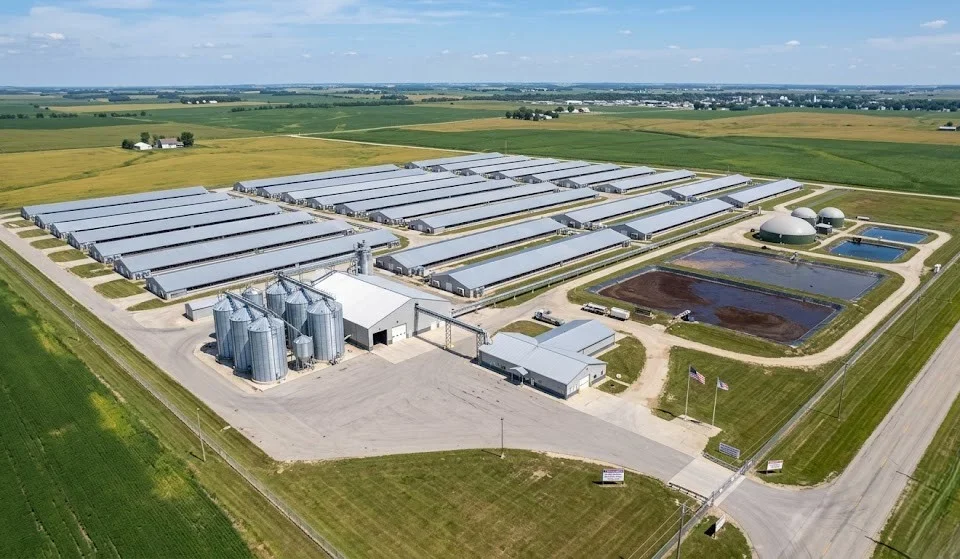
Modern commercial pig farms are designed around traffic flow and contamination control. Every square foot has a purpose, and the physical layout directly affects biosecurity, labour efficiency, and animal performance.
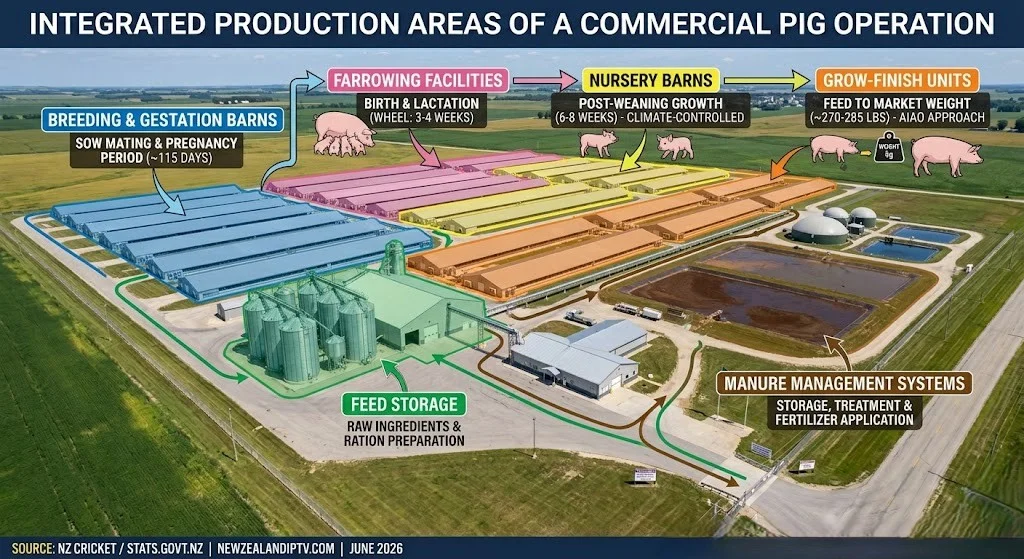
The Line of Separation is the most important concept in modern farm layouts. It’s a physical and procedural boundary that separates the “clean” inside of the farm from the “dirty” outside world. Employees, vehicles, and supplies must pass through designated entry points — typically a shower-in/shower-out facility — before crossing this line.
A standard farrow-to-finish site with 2,400 sows is typically divided into the following zones:
| Zone | Function | Typical Size |
|---|---|---|
| Breeding/Gestation Barn | Sow management post-weaning to farrowing | 20,000–30,000 sq ft |
| Farrowing House | Sow farrowing and piglet care (0–21 days) | 10,000–15,000 sq ft |
| Nursery Barn | Weaned piglets (21–70 lbs) | 15,000–20,000 sq ft |
| Grow-Finish Barn | Market hogs (70–280 lbs) | 40,000–60,000 sq ft |
| Feed Mill / Storage | Feed delivery and on-site mixing | 5,000–10,000 sq ft |
| Utility / Manure Systems | Lagoon, pit pumping, equipment | Varies by site |
According to a 2024 Iowa State University Extension report, farms with clearly defined production zones and dedicated loading/unloading areas reduce disease introduction risk by up to 40% compared to open-access layouts.
Actionable Tip: If you’re designing or upgrading your layout, prioritise a dead-end road approach — truck traffic should never loop through the farm. Loading chutes for market hogs should be located at the perimeter, away from all animal housing.
U.S. Example: A 5,000-head finishing site in Duplin County, North Carolina, uses a “campus” layout with four parallel barns, a centralised feed bin system, and a single entry point with a manned biosecurity station. Their average days-to-market is 168 days, which is 6 days faster than the national average.
Housing Systems and Barn Technology
The barn is the most capital-intensive investment on a modern pig farm, and the technology inside it directly drives performance.
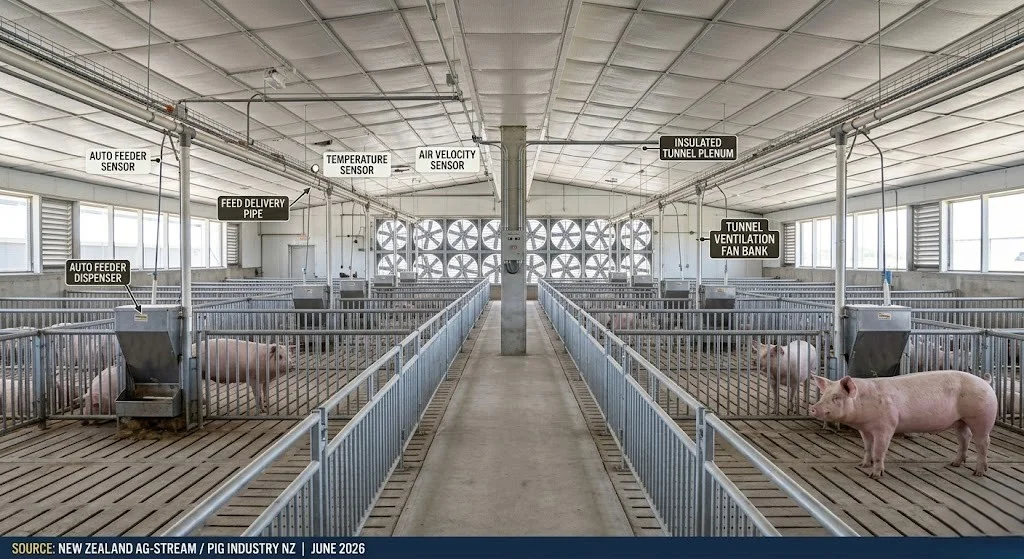
Today’s commercial barns are climate-controlled, sensor-monitored, and designed around animal welfare standards that continue to evolve under USDA and state-level regulations.
Ventilation is the single most critical barn system. Modern operations use tunnel ventilation — a system of large exhaust fans at one end and air inlets at the other — to maintain optimal temperatures year-round. Target temperatures vary by stage: farrowing rooms are kept at 85–90°F near the creep area for piglets, while grow-finish barns are maintained at 65–75°F for finishing pigs.
A 2024 USDA Agricultural Research Service study found that maintaining temperature within 3°F of the target throughout the grow-finish period improves average daily gain (ADG) by 8–12%.
Flooring in modern barns is almost exclusively concrete slats over a manure pit. Slatted floors allow waste to fall through, reducing ammonia exposure and pathogen contact.
Pen density is regulated: current industry best practice, supported by NPPC welfare guidelines, is 8 sq ft per market hog in finishing.
Lighting in breeding barns is now computer-controlled, with 16-hour light cycles used to optimise sow oestrus cycling and boar activity – a technique that has shown a 5–7% improvement in farrowing rates in peer-reviewed University of Minnesota swine research.
Actionable Tip: Invest in variable-speed fan controllers before upgrading any other barn system. They typically pay back in energy savings alone within 18–24 months, and they protect animals from temperature spikes during power fluctuations.
U.S. Example: In 2023, a 1,200-sow operation in Ottumwa, Iowa, retrofitted its three grow-finish barns with computerised tunnel ventilation. Within one production cycle, mortality dropped from 4.1% to 2.8%, saving approximately $38,000 annually.
Feeding and Nutrition Management
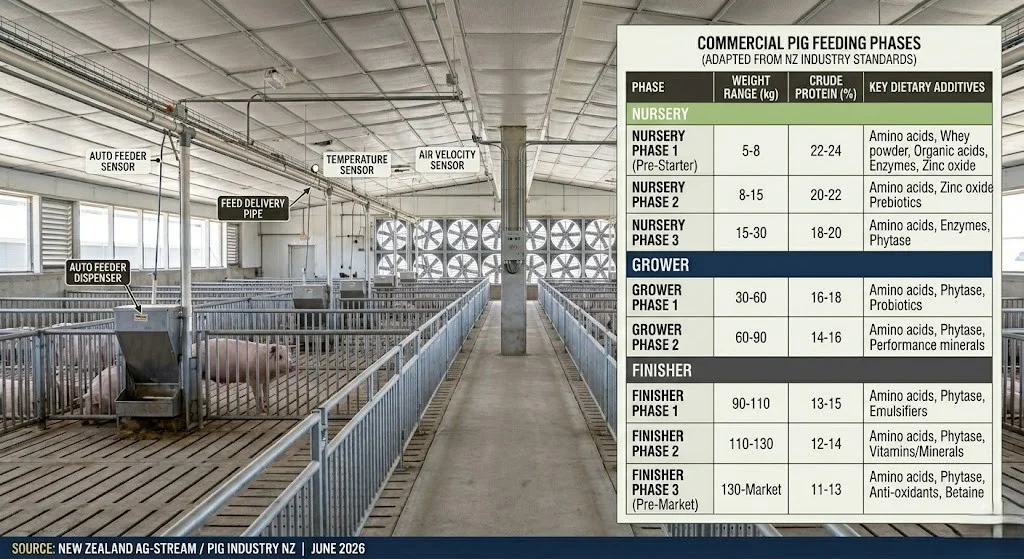
Feed represents 60–70% of total pig production costs in the U.S. (USDA ERS, 2024), which is why modern commercial farms treat nutrition management as a precision science, not a commodity purchase.
Phase feeding is the basis of modern feeding systems. This means changing the diet as pigs grow to meet their exact nutritional needs. A standard commercial program runs 4–6 phases from nursery through market, with corn-soybean meal as the base and lysine as the primary limiting amino acid driving formulation decisions.
Top operations use computerised feed delivery systems – augers, conveyor tubes, and automated drop feeders that dispense exact rations at timed intervals. These systems reduce feed waste by 8–12% compared to manual ad-libitum feeding (Iowa State Extension, 2024).
Water delivery is equally engineered. Modern farms use nipple or cup drinkers with pressure-regulated systems — one water point per 10–12 pigs is the recommended standard.
Water intake directly drives feed intake: pigs consume approximately 2.5 lbs of water per lb of dry feed, so drinker malfunctions are immediate production problems.
| Growth Phase | Weight Range | Crude Protein % | Key Additive |
|---|---|---|---|
| Starter 1 | 10–25 lbs | 22–24% | Plasma protein, ZnO |
| Starter 2 | 25–50 lbs | 20–22% | Phytase, probiotics |
| Grower | 50–125 lbs | 18–20% | Phytase, lysine |
| Finisher 1 | 125–200 lbs | 16–18% | Ractopamine (optional) |
| Finisher 2 | 200–280 lbs | 14–16% | Phytase |
Actionable Tip: Run a feed audit every 90 days. We recommend weighing the delivered feed against inventory and comparing it to the expected FCR. A 0.1-point improvement in FCR on a 5,000-head finish site saves approximately $18,000–$22,000 per turn.
U.S. Example: A contract grower in Clinton County, Iowa, implemented a 5-phase feeding program with computerised dispensing in 2023. Their FCR dropped from 2.92 to 2.71 over two production turns — a savings of over $60,000 in feed costs annually.
Sound pig nutrition and feeding management are always the fastest levers for improving bottom-line performance.
Health, Biosecurity, and Veterinary Protocols
Disease is the fastest way to destroy profitability on a commercial pig farm. A single PRRS (Porcine Reproductive and Respiratory Syndrome) outbreak can cost a 2,400-sow operation $300,000–$500,000 in losses within one production cycle.
This is why health, pig health, and disease management are non-negotiable systems, not afterthoughts.
Modern operations run tiered biosecurity protocols based on the Secure Pork Supply (SPS) Plan framework developed in coordination with USDA APHIS. The three tiers are:
- Tier 1 — Perimeter Control: Fencing, signage, controlled vehicle access, dead pig disposal systems (rendering pickup, composting, incineration)
- Tier 2 — Farm Entry Control: Shower-in/shower-out for all personnel, 48-hour downtime between pig contact on other farms, dedicated farm clothing and footwear
- Tier 3 — Internal Biosecurity: All-in/all-out production by room or barn, segregated airspace between production stages, disinfection protocols between turns
Veterinary oversight on modern commercial farms is proactive, not reactive. Most large operations have a swine veterinarian on retainer who visits monthly, reviews production records, and signs off on Veterinary Feed Directives (VFDs) for any medically important antibiotics used in feed or water – a requirement under the FDA’s Guidance for Industry #213, fully implemented since 2017.
Vaccination programmes are site-specific and developed in consultation with your veterinarian, based on regional disease pressures. Core vaccines for most U.S. commercial operations include PRRS, PCV2 (porcine circovirus 2), Mycoplasma hyopneumoniae, and erysipelas.
Actionable Tip: Track mortality by barn, by week, and by source of pig. Patterns in mortality data are almost always the first signal of an emerging health challenge, appearing 2–3 weeks before clinical signs become obvious to daily barn workers.
U.S. Example: A 3,600-sow operation in Sioux County, Iowa, implemented a strict 48-hour downtime policy for all employees in 2022. Over the following 18 months, they recorded zero new PRRS introductions — their longest PRRS-free period in a decade.
Staffing and Daily Operations
A 2,400-sow farrow-to-finish operation typically requires 8–12 full-time employees to run at full efficiency. Staffing is one of the most underestimated challenges in modern swine production — the USDA reported in 2024 that labour shortages affected 63% of U.S. hog operations with 1,000+ head.
Modern farms organise their workforce around specialised roles rather than generalist farmhands:
| Role | Responsibilities | Typical Count (2,400-sow) |
|---|---|---|
| Farm Manager | Overall operations, records, vendor relations | 1 |
| Farrowing Technician | Sow care, piglet processing, weaning | 2–3 |
| Breeding/Gestation Tech | Heat detection, AI, pregnancy checks | 1–2 |
| Nursery/Finishing Tech | Daily checks, feeding, sorting | 2–3 |
| Maintenance Tech | Equipment, ventilation, utilities | 1 |
Training and retention are the most significant labour challenges we face. Top operations invest in structured onboarding programmes — typically 90 days of supervised training — and use incentive pay tied to production KPIs, such as farrowing rate, pre-wean mortality, and days-to-market.
Daily operations follow a documented Standard Operating Procedure (SOP) for every task — from morning health checks to end-of-day barn walkthroughs. SOPs reduce variability, protect animal welfare, and are required documentation for PQA Plus certification (Pork Quality Assurance Plus), the industry’s primary welfare and food safety program administered by the NPPC.
Actionable Tip: Post your top 5 daily SOPs in each barn — laminated, in both English and Spanish. Labour studies from Purdue University Extension show that bilingual SOP signage reduces procedural errors by up to 30% in mixed-language workforces.
Data, Technology, and Precision Farming
The modern commercial pig farm runs on data. Production management software, environmental sensors, and electronic identification systems have transformed what it means to “know your numbers” in swine production.
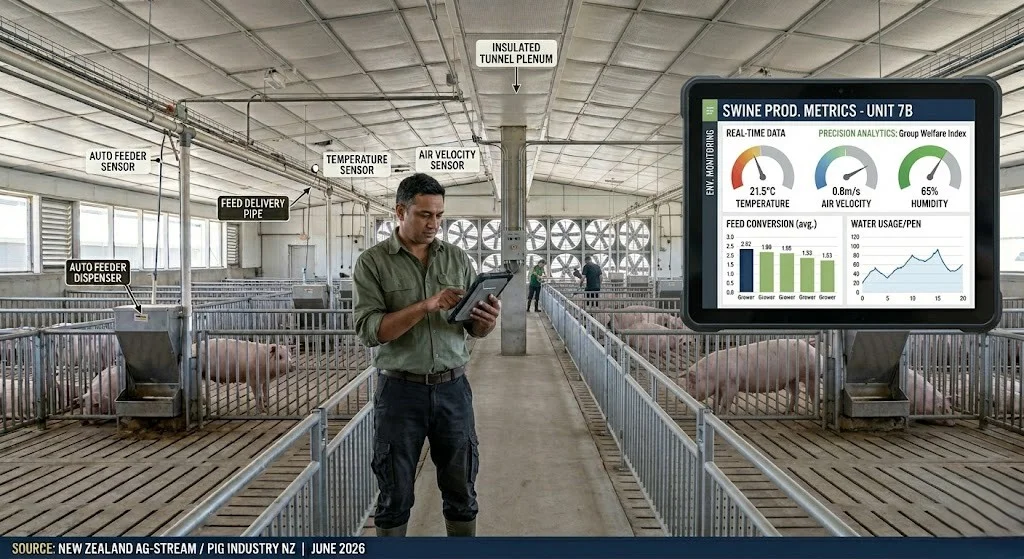
Production management software — platforms like PigCHAMP, Pig Vision, or AgriWebb — tracks every animal event: farrowing, weaning, vaccination, treatment, weight, and mortality. Top farms review production dashboards daily and benchmark against rolling 12-month averages and industry KPIs.
Environmental monitoring systems collect real-time data on temperature, humidity, CO₂, and ammonia levels in every barn. When parameters go out of range, the system sends alerts to farm managers’ smartphones, often catching ventilation failures before they affect any animals.
Electronic Sow Feeding (ESF) systems, now standard in gestation barns on progressive operations, use RFID ear tags to identify individual sows and dispense exactly the right ration for each animal’s body condition score and reproductive stage. A 2024 University of Illinois study found ESF-equipped farms achieved a 6.2% improvement in average litter size compared to group-fed controls.
RFID and premise ID systems are increasingly required for traceability. Under the USDA’s updated Animal Disease Traceability (ADT) rule (effective March 2023), all breeding swine moved interstate must be officially identified.
Actionable Tip: Start with one data system and use it completely before adding another. The most significant data mistake farms make isn’t collecting too little — it’s collecting data they never analyse.
U.S. Example: A 1,800-sow operation in Yadkin County, North Carolina, adopted a cloud-based production dashboard in 2024. Within 6 months, they identified that one farrowing room consistently ran 3°F warmer than programmed — a ventilation calibration issue that had been suppressing litter survival rates for over a year.
Key Numbers at a Glance
| Metric | Industry Benchmark (Top 25%) |
|---|---|
| Pigs weaned per sow per year | 28–32 |
| Pre-wean mortality | < 10% |
| Nursery mortality | < 2% |
| Grow-finish mortality | < 2.5% |
| Average daily gain (ADG) | > 2.0 lbs/day |
| Feed conversion ratio (FCR) | < 2.7 |
| Days to market (280 lbs) | 160–170 |
| Farrowing rate | > 88% |
| Labor hours per pig marketed | < 0.5 hrs |
| Biosecurity incidents per year | 0 (target) |
FAQ
How many pigs does a typical commercial pig farm have?
According to USDA NASS 2024 data, the average U.S. commercial hog operation with 500 or more head manages approximately 4,200 animals per site. The largest U.S. operations run over 50,000 head across multiple sites. Most mid-size commercial farms fall in the 2,000–10,000 head range across a single or multi-site production system.
What does a commercial pig farm smell like, and how do farms manage odour?
Odour on modern pig farms comes primarily from hydrogen sulphide and ammonia produced during manure decomposition. Top operations manage odour with covered manure pits, biofilters on ventilation exhaust, manure injection into fields rather than surface application, and vegetative buffers around the perimeter. Many states now require odour management plans for new CAFO permits.
How long does it take to raise a pig to market weight?
On a modern commercial farm, pigs reach a market weight of approximately 280 lbs in 160–175 days from birth, including 21 days in the farrowing house, 35–42 days in the nursery, and 90–100 days in the grow-finish barn. Top-performing operations with optimised genetics and nutrition consistently achieve the lower end of this range.
What regulations must a commercial pig farm comply with?
U.S. commercial pig farms must comply with EPA CAFO regulations for manure management, USDA APHIS requirements for animal disease traceability, FDA Veterinary Feed Directive rules for antibiotic use in feed, state-level environmental permits, and — increasingly — state animal welfare laws such as California’s Prop 12. PQA Plus certification from the NPPC is the industry’s standard for welfare and food safety documentation.
How much does it cost to build a modern commercial pig barn?
Construction costs for new commercial pig barns ranged from $120 to $180 per square foot in 2024–2025, according to Iowa State University Extension estimates. A 1,000-head grow-finish barn (approximately 20,000 sq ft) costs $2.4M to $3.6M to build fully equipped. Land, utilities, manure systems, and regulatory compliance add significantly to total project costs.
What is the most common cause of financial loss on a commercial pig farm?
Feed cost volatility and disease outbreaks are the two primary drivers of financial loss. Feed represents 60–70% of total production costs, so corn and soybean meal price swings directly impact margins.
A single PRRS outbreak on a 2,400-sow farm can cost $300,000–$500,000 in production losses. Risk management tools, such as futures contracts, crop insurance, and livestock revenue protection (LRP) programmes, are essential for long-term financial stability.
Explore More
From the Commercial Pig Farming Series:
✅ History of Commercial Pig Production in America
✅ Top Pig-Producing States in the USA
⏳ Pig Farming Systems: Farrow-to-Finish vs. Wean-to-Finish (coming soon)
⏳ The Role of Technology in Pig Farming (coming soon)
⏳ Contract Pig Farming in the USA (coming soon)
⏳ Feed Management for Commercial Pigs (coming soon)
⏳ Biosecurity in Large-Scale Pig Farms (coming soon)
Conclusion
A modern commercial pig farm is an engineered system in which every variable — environment, nutrition, health, labour, and data — actively drives a measurable outcome.
The farms winning in today’s U.S. pork market aren’t cutting corners; they’re out-managing the competition on the details. Whether you’re benchmarking an existing operation or planning a new one, the standards outlined in this guide represent what top-quartile U.S. production looks like in 2026.
Start with the systems that have the highest ROI for your current operation — typically ventilation, biosecurity, and feeding precision — and build from there. For a broader view of the industry these systems serve, return to the Commercial Pig Farming in the USA Complete Guide.