Balanced Pig Diet: How Protein, Energy, and Fiber Work Together
A balanced pig diet is not a list of numbers you check off one by one. It’s a set of relationships, and pulling on one moves the others. Make a ration more energy dense, and the pig eats less of it—so it now takes in less protein per day, while the protein percentage on the tag never changes.
That single interaction explains a surprising share of disappointing results. The individual targets were right; the relationships between them were not. Learning to see those relationships is what separates following a recipe from actually reading a ration, and it underpins every other decision in pig nutrition and feeding.
Short Answer
A balanced pig diet supplies energy, amino acids, minerals, and vitamins in proportions matched to the pig’s stage—not in isolation, but relative to one another. Energy controls appetite and therefore controls the intake of every other nutrient. Protein matters only through the amino acids it carries, with lysine as the reference point. Fiber is minimized in growing and finishing diets, where it dilutes energy, and is deliberately increased in gestation diets to control weight gain and keep the sow satisfied on a restricted allowance.
Key Takeaways
- Pigs eat to meet energy needs, so energy density sets the effective dose of every other nutrient
- Crude protein is a weak target—digestible lysine predicts performance far better
- Surplus protein is excreted as nitrogen, costing money twice over
- Fiber is a liability in finishing diets and a genuine requirement in gestation diets
- No grain balances a pig’s diet on its own, at any stage
What Makes a Balanced Pig Diet
A balanced swine diet contains the necessary nutrients in the correct proportions to nourish the animal properly. The required nutrients are energy, amino acids, minerals, and vitamins. Fat is required to supply essential fatty acids but is usually adequate in practical diets, and water—though an important nutrient—is normally provided free choice and so is not considered for diet formulation purposes. University of New Hampshire Extension
Two things are conspicuously missing from that list: crude protein and fiber. Neither is a nutrient a pig requires. Protein is a carrier for amino acids. Fiber is a by-product of ingredient choice. Both shape the nation profoundly, but neither is fed for its own sake—and forgetting that is where most of the confusion begins.
The Six Nutrient Groups
| Group | What the pig actually needs | How it’s expressed |
|---|---|---|
| Water | Free access, clean | Not formulated |
| Energy | Fuel for maintenance and gain | NE, kcal/kg |
| Amino acids | Ten essential AAs | SID lysine + ratios |
| Minerals | Macro and trace | % or ppm |
| Vitamins | Fat- and water-soluble | Via premix |
| Fatty acids | Essential FAs | Usually adequate |
Amino acids are the building blocks of proteins; ten are essential, meaning the pig cannot manufacture them and must receive them in feed. SID stands for standardized ileal digestibility—a measure of how much of an amino acid the pig absorbs before the feed reaches the large intestine.
Minerals and vitamins arrive through a premix and follow their own logic, as covered in our guide to vitamins and minerals for pigs. This article stays with the three that interact most visibly on the farm.
Why Balance Beats Any Single Number
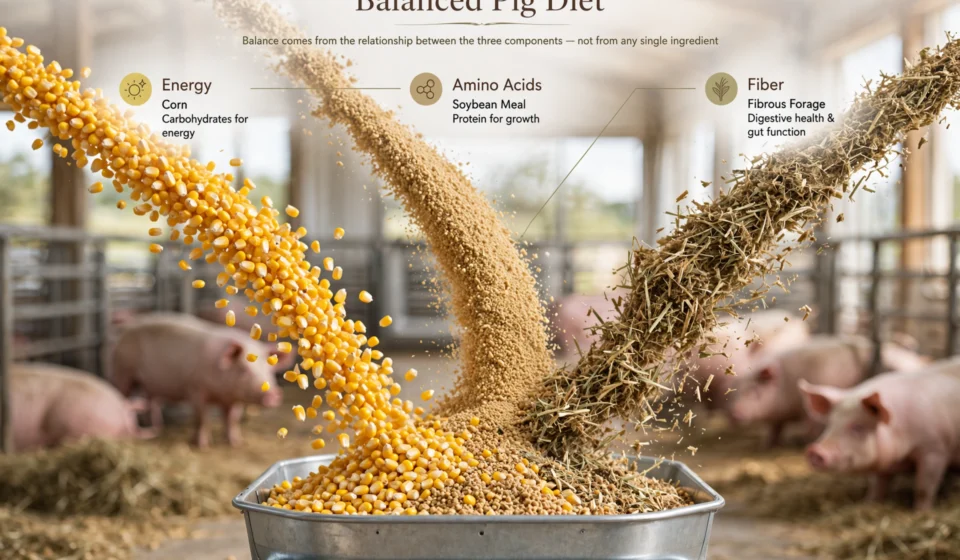
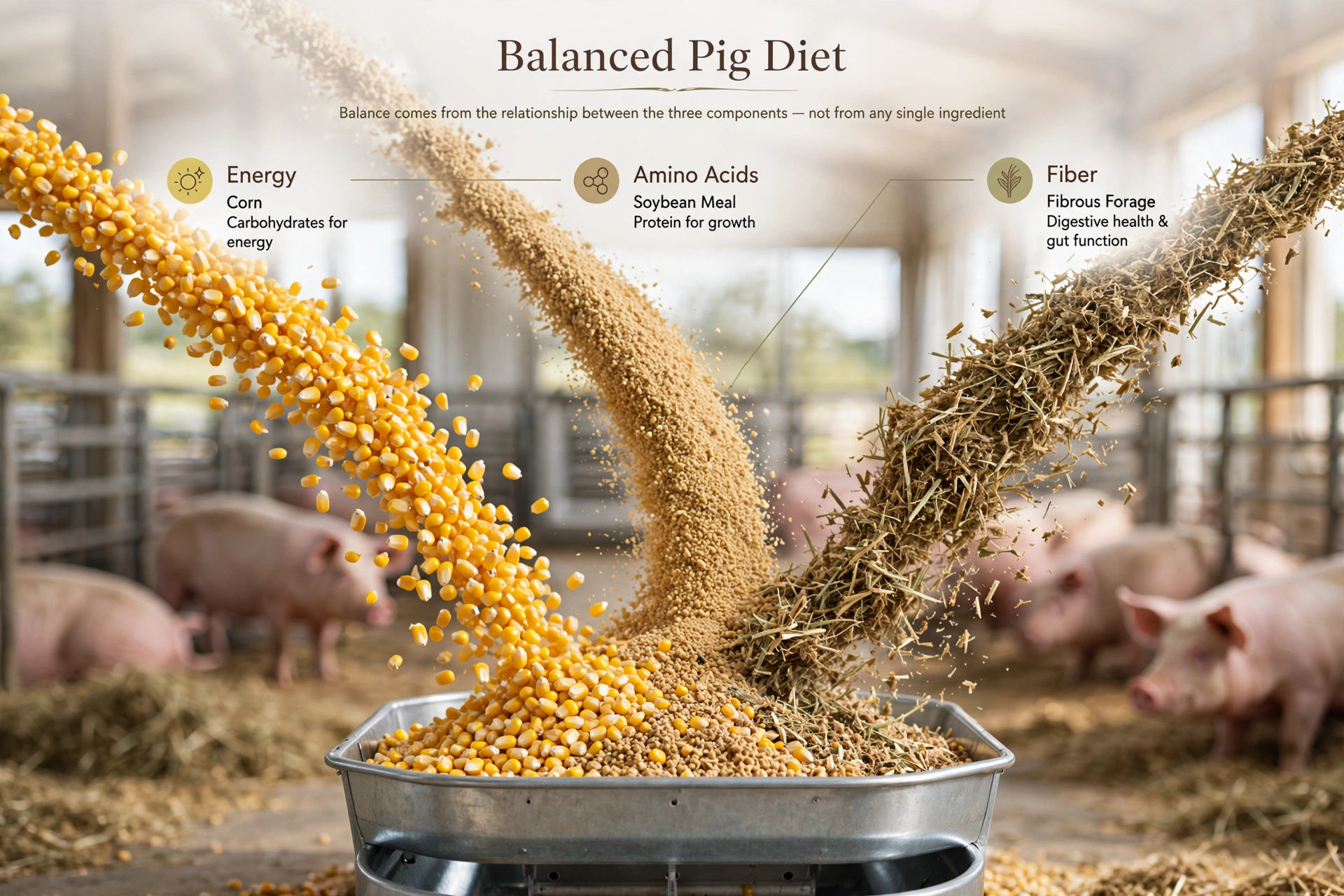
All grains are deficient in protein quantity and quality, as well as in minerals and vitamins. Corn is an excellent energy source, and soybean meal an excellent amino acid source—a pairing the Pork Information Gateway identifies as the foundation of practical swine rations since soybean meal can be fed as the only supplemental protein source for swine. University of New Hampshire ExtensionUniversity of New Hampshire Extension
The complication is that neither side of the equation holds still. Nutrient content in grains shifts with cultivar, stage of maturity at harvest, soil and climatic conditions, growing location, and time in storage, while requirements vary with genetics, age, weight, sex, and function — even among animals of the same weight. A ration based on assumed averages is a ration based on two moving targets at once. University of New Hampshire Extension
Actionable tip: When performance drifts with no obvious cause, check whether an ingredient changed before you question the formula. A new corn load two points lower in protein shifts the entire balance while every figure on your spec sheet stays exactly where it was.
Feed problems also present as health problems, which is why ration review belongs inside routine herd health work rather than sitting apart from it.
Protein: It’s Really About Amino Acids
Why Crude Protein Misleads
Crude protein is nitrogen content multiplied by a conversion factor. It reports how much protein is present. It says nothing about whether the pig can absorb it, and nothing about whether it contains the specific amino acids the pig is short of.
Digestibility here means the share of a nutrient the pig absorbs rather than passes through undigested. Two feeds with identical protein content can differ by ten percentage points or more in what actually reaches the bloodstream.
This is why a 16% crude protein diet built on highly digestible soybean meal routinely beats an 18% diet built on a poorly digestible protein source. The higher number loses because only absorbed amino acids build tissue.
Lysine as the Reference
Lysine is an essential amino acid—one the pig cannot manufacture and must obtain from its feed. It is the first limiting amino acid in corn-soybean diets, meaning it runs out before any other, so it caps how much protein the pig can build regardless of what else is present. It is also used almost entirely for protein synthesis rather than diverted to energy, which makes it a stable anchor.
Under the ideal protein concept—a framework that expresses every essential amino acid as a percentage of lysine rather than as its own separate target—threonine sits near 65% of lysine, methionine plus cystine near 60%, and tryptophan around 18%.
Get lysine right, and the ratios carry most of the remaining load. Get crude protein right, but you may still be short on lysine, which is the more expensive mistake.
Can You Feed Pigs Too Much Protein?
Yes, and it costs you in two ways.
Pigs cannot store surplus amino acids. Anything above the requirement gets deaminated—a process that strips the nitrogen group off an amino acid so the remaining carbon skeleton can be burned for energy. The nitrogen leaves the urine. You paid protein prices for calories that corn would have supplied for a fraction of the cost.
The second cost lands in the manure pit. Higher nitrogen excretion means more ammonia in the barn air and more nitrogen in the manure, which tightens the constraints on land application. Nitrogen excretion is a recognized consideration when protein supplements are selected. University of New Hampshire Extension
Excess protein does not poison a pig the way excess selenium does. It quietly wastes money and creates an environmental liability.
Low-Protein Diets with Added Amino Acids
The practical response is to reduce crude protein while supplying the limiting amino acids directly. Synthetic amino acids — purified lysine, threonine, methionine, and tryptophan manufactured by fermentation — allow you to cut soybean meal inclusion without cutting the amino acid supply.
This works, but not indefinitely. Reviews of low-protein swine diets report a counterintuitive effect: as crude protein falls, requirements for the first limiting amino acids actually rise. The pig needs nitrogen to synthesize the non-essential amino acids it previously received in surplus, and that nitrogen has to come from somewhere. Reductions beyond roughly a quarter below conventional levels have shown reduced feed efficiency unless further amino acids—valine and isoleucine among them—are supplemented as well.
Actionable tip: Treat protein reduction as a staged change, never a single decision. Drop crude protein moderately with the first four limiting amino acids supplemented; confirm performance holds across a full group; then evaluate whether going further justifies the added amino acid cost.
Energy: The Nutrient That Drives Intake
DE, ME, and NE
Metabolizable energy and net energy are not different amounts of energy. They are the same feed measured after different losses have been subtracted—each system counting what the pig still keeps at a later stage of digestion.
| System | Subtracts | Best used for |
|---|---|---|
| Digestible energy (DE) | Fecal losses | Rough comparisons |
| Metabolizable energy (ME) | + urine and gas losses | Conventional corn-soy diets |
| Net energy (NE) | + heat produced during digestion | Diets with varied fiber levels |
The gap between ME and NE widens as ingredients diverge in fiber content. Fibrous feedstuffs lose a large share of their metabolizable energy as heat during fermentation; fat loses very little. Two diets identical on an ME basis can differ meaningfully in NE—and the pig responds to NE, not to the number on your spreadsheet.
How Energy Density Changes Everything Else
Show Image
This is the interaction most feeding guides pass over entirely.
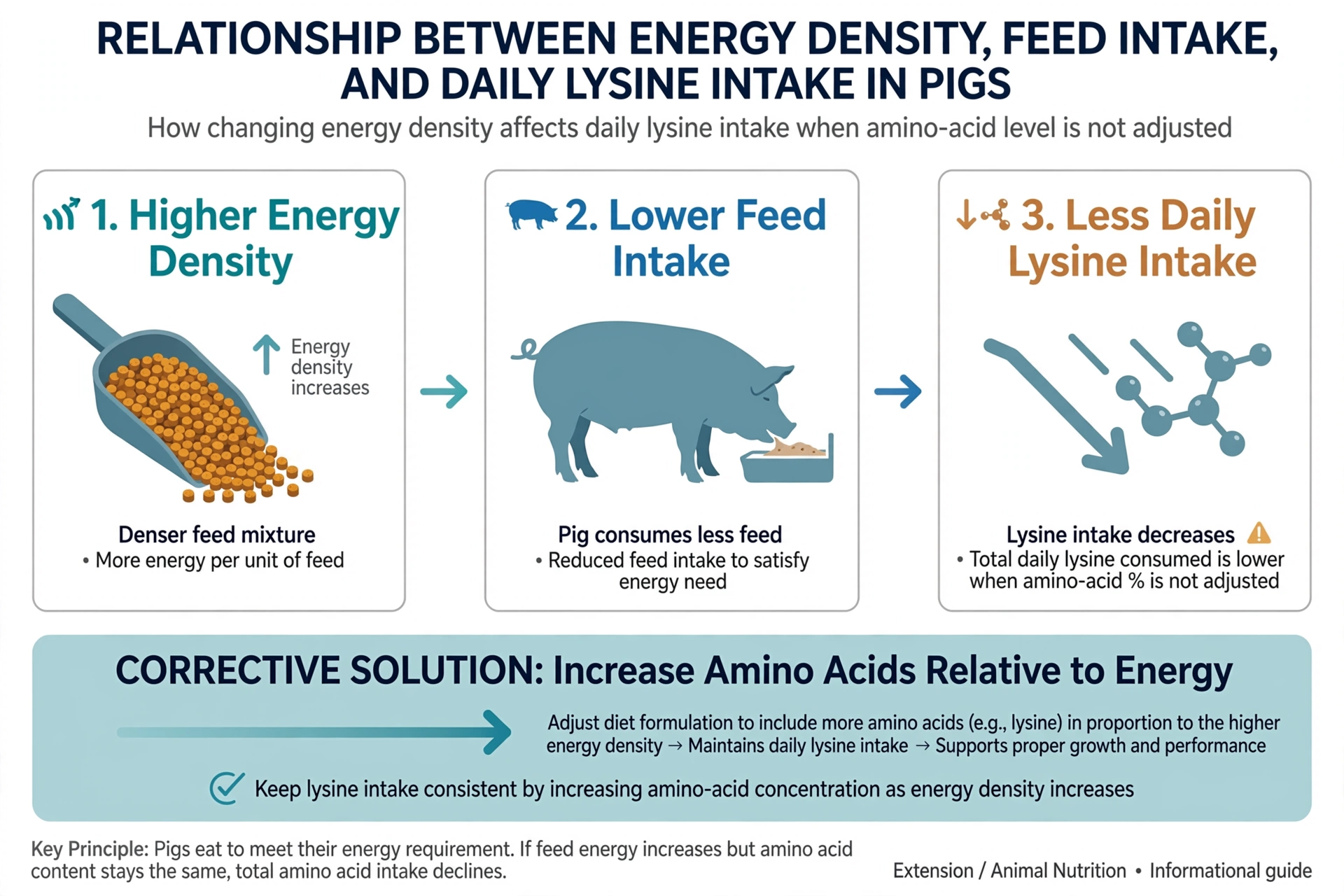
Pigs eat primarily to satisfy energy requirements. Raise a diet’s energy density, and the pig eats less of it. If the amino acid percentage stays where it was, the pig now consumes fewer grams of lysine per day — despite nothing on the tag having moved.
The fix is to express amino acids relative to energy rather than as a flat percentage of the diet. Add fat to a finisher ration, and lysine has to rise alongside it, or you have created a quiet deficiency while appearing to upgrade the feed.
The reverse holds too. Dilute energy with a fibrous coproduct, and the pig eats more to compensate—but only up to the physical capacity of its gut. Past that ceiling it simply falls short, which is why how pigs digest fiber sets a strict limit on how far dilution can usefully go.
Adding Fat
Fat may be added to increase the energy density of the diet in growing-finishing pigs with low feed intakes and in high-producing lactating sows. Both cases share the same constraint: the animal cannot physically consume enough volume to meet its energy needs, so the energy has to be concentrated instead. uspto
The lactating sow is the clearest illustration. A sow supporting a large litter cannot eat enough of a standard-density diet, and whatever she cannot take in comes out of her own body reserves—which then costs you at her next breeding.
Fiber: Liability in One Diet, Requirement in Another
Fiber generates more confusion than any other topic in swine nutrition, because the correct answer flips depending on which pig is standing in front of you.
Why Grow-Finish Diets Stay Low in Fiber
Pigs are monogastric omnivores and, compared with ruminants, generally require diets higher in energy and lower in fiber — which is why significant amounts of grain are included in swine rations, as University of New Hampshire Extension explains.
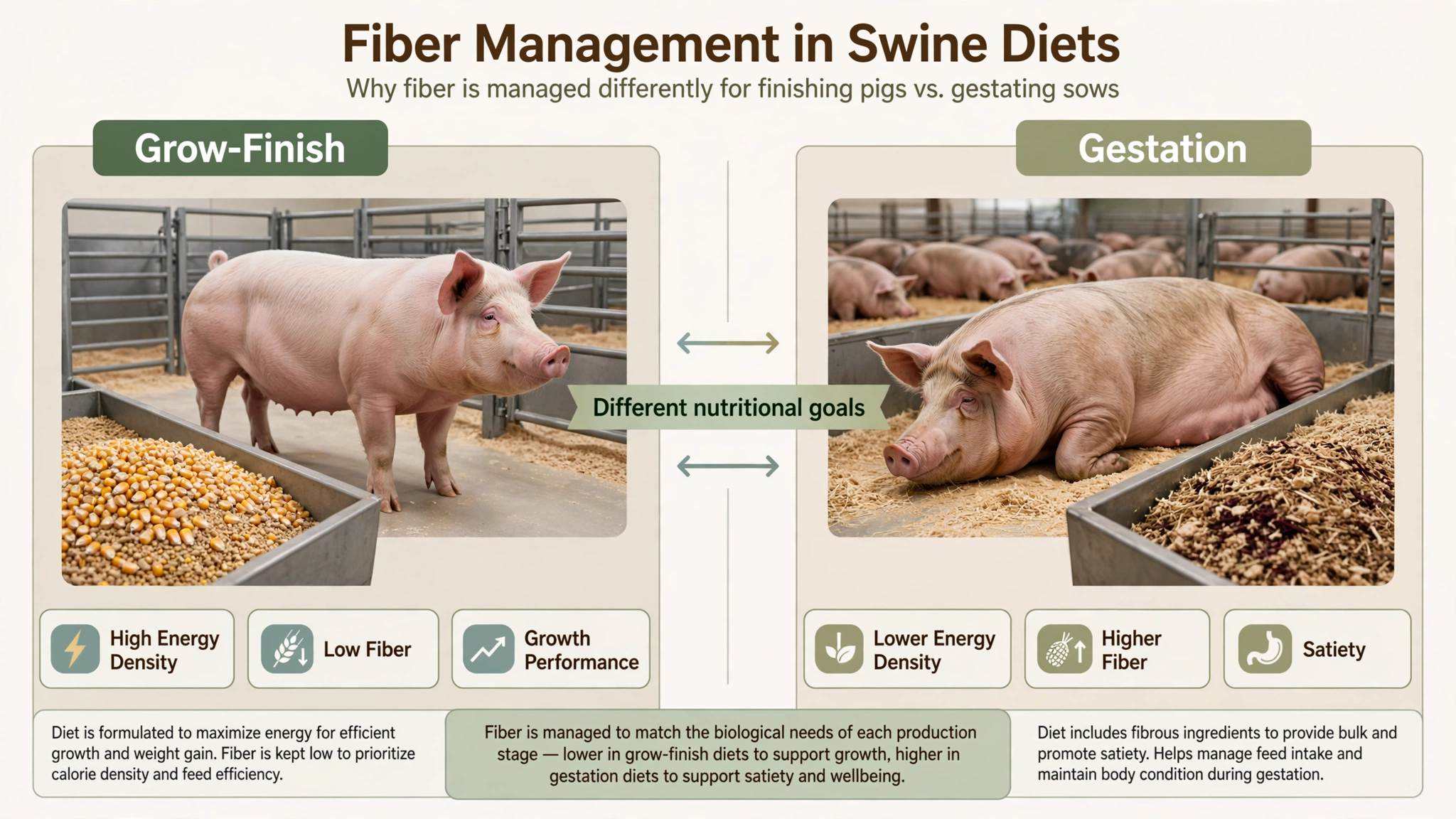
Monogastric means single-stomached. Unlike a cow, a pig has no rumen full of microbes to ferment fiber into usable energy, so most fiber passes through as bulk rather than fuel. In a finishing diet, fiber is largely dilution: it occupies gut volume, lowers energy density, and slows gain.
High-energy, low-fiber diets are fed to swine to meet the energy requirements of growing-finishing animals. uspto
Why Gestation Diets Go the Other Way
Show Image
For gilt developer and gestation diets, lower energy and higher fiber levels can be used to control weight gain. uspto
The gestating sow faces the opposite problem from the finisher. She needs comparatively little energy, but restricting her to a small portion of a dense ration leaves her hungry—which surfaces as stereotypic behavior, repetitive actions such as bar-biting or sham chewing that signal frustration, along with restlessness and aggression around feeding time.
Raising fiber solves both halves at once. It lowers energy density so she can eat a satisfying volume, and it slows passage so she stays full longer. What is a liability in a 250-pound finisher becomes a deliberate management tool in the gestation barn.
Actionable tip: Do not judge a gestation diet against finisher standards. The question is whether the sow holds condition without appearing hungry—that is the target, not a fiber percentage borrowed from a different stage.
How the Three Interact
| Change this | This moves | Correction |
|---|---|---|
| ↑ Energy density (add fat) | ↓ Feed intake → ↓ daily amino acid intake | ↑ lysine to match |
| ↑ Fiber | ↓ Energy density → ↑ intake, to a ceiling | Confirm intake can actually rise |
| ↓ Crude protein | ↓ Supply of limiting amino acids | Supplement lys, thr, met, trp |
| Switch to a fibrous coproduct. | ME overstates real value | Formulate on NE |
| ↑ Energy without ↑ amino acids | Fatter carcass, poorer lean gain | Hold the AA-to-energy ratio |
One rule underlies all five rows: hold amino acids in ratio to energy, not as a fixed percentage of the diet.
Balance by Growth Stage
Show Image
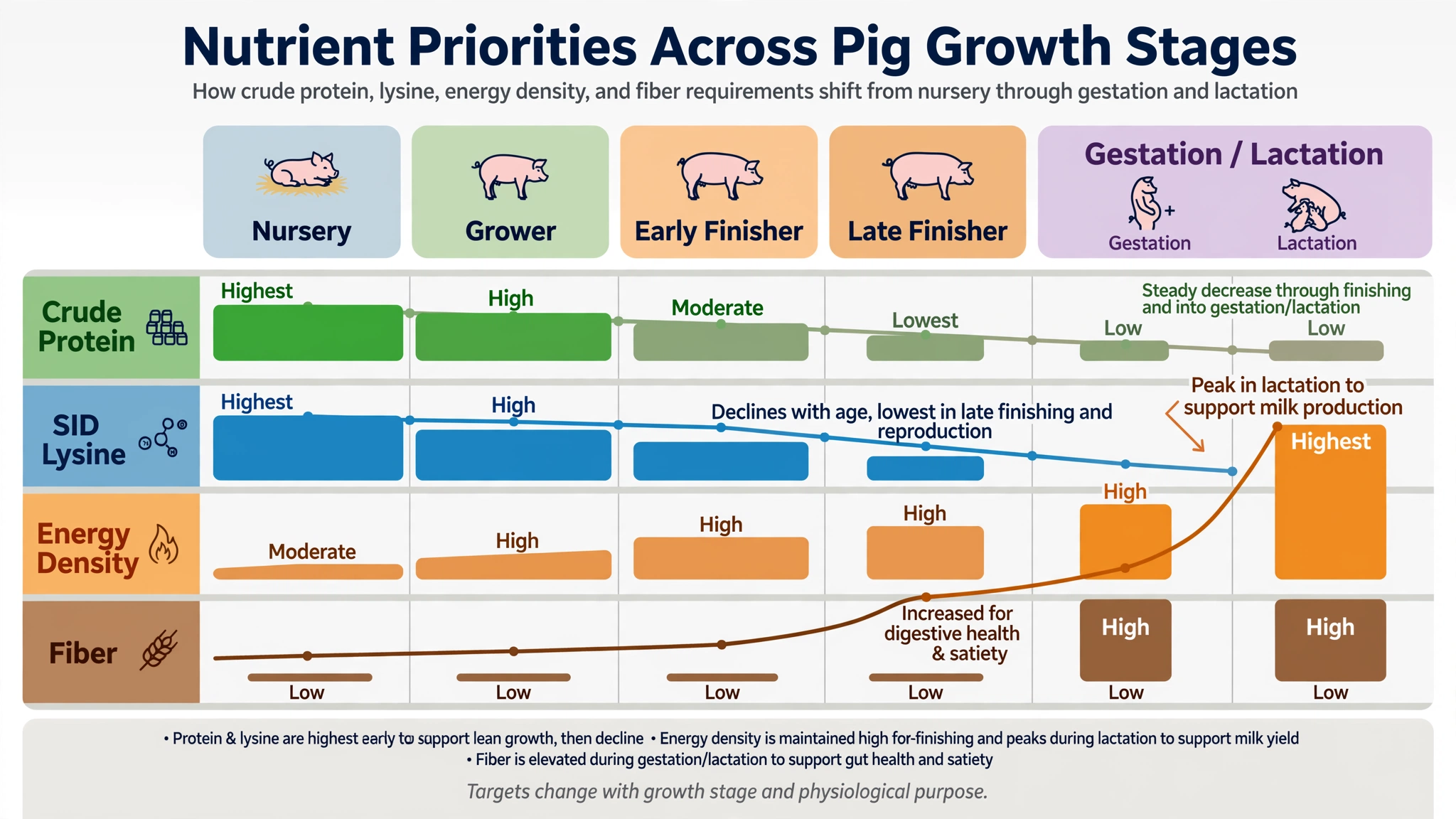
| Stage | Crude Protein | SID Lysine | Energy | Fiber |
|---|---|---|---|---|
| Nursery Phase 1 | 22–24% | 1.35–1.45% | Highest | Minimal |
| Nursery Phase 2 | 20–22% | 1.25–1.35% | High | Minimal |
| Grower | 16–18% | 1.00–1.10% | Moderate | Low |
| Early Finisher | 15–16% | 0.80–0.90% | Moderate | Low |
| Late Finisher | 13–14% | 0.65–0.75% | Moderate | Low |
| Gestation | 13–14% | 0.50–0.55% | Lowest | Highest |
| Lactation | 17–18% | 1.00–1.10% | Highest | Low |
Gestation and lactation sit at opposite extremes—in the same animal, sometimes weeks apart. Nothing demonstrates the point better: there is no such thing as a balanced ration in the abstract, only a ration balanced for a specific pig at a specific moment.
Whether you buy these diets pre-mixed or blend them on-farm changes the economics but not the targets; the trade-offs are laid out in our comparison of ready-made or custom feed.
Signs Your Balance Is Off
- Good gain, disappointing carcass — energy is running ahead of amino acids
- Poor gain on adequate feed — an amino acid or energy shortfall, or fiber diluting the ration past what intake can offset
- Sharp ammonia smell in the barn — likely excess crude protein being excreted as nitrogen
- Sows losing condition through lactation — energy density too low to meet demand within physical intake capacity
- Restless, aggressive gestating sows—energy restricted without enough fiber to deliver satiety
- Performance drops with no formula change—an ingredient’s actual composition moved beneath you
Turning these targets into a working mix — ingredient selection, ratios, and the arithmetic behind them — is covered step by step in pig feed formulation.
Frequently Asked Questions
What is a balanced diet for a pig?
A balanced diet supplies energy, amino acids, minerals, and vitamins in proportions matched to the pig’s stage, weight, and purpose. In practice, that means a cereal grain base for energy; a protein source such as soybean meal for amino acids; a source of calcium and phosphorus; salt; and a vitamin-mineral premix. No single ration is balanced for every pig — a gestating sow and a nursery pig need nearly opposite formulations.
What is a high-protein food for pigs?
Soybean meal at roughly 48% crude protein is the standard high-protein ingredient in U.S. swine diets and can serve as the only supplemental protein source. Fish meal, dried whey, and spray-dried plasma offer higher protein and better digestibility but cost considerably more, so their use is generally confined to Phase 1 nursery diets where palatability and digestibility justify the expense.
Can you feed pigs too much protein?
Yes. Pigs cannot store surplus amino acids, so excess protein is stripped of its nitrogen—excreted in urine—and the remainder is burned as an expensive energy source. You pay protein prices for calories while increasing ammonia in the barn and nitrogen in the manure. Overfeeding protein is a financial and environmental problem rather than a direct health risk to the animal.
What should not be fed to pigs?
Meat, meat products, and any food that has contacted meat are prohibited under U.S. swine feeding regulations in most states because of disease transmission risk. Moldy or spoiled feed carries mycotoxin risk and should be rejected outright. Beyond legal restrictions, avoid feeding any single ingredient in excess — even a safe one — since a large inclusion of one feedstuff unbalances the ration regardless of that ingredient’s own quality.
Conclusion
A balanced pig diet is a system of relationships, not a list of boxes to tick. Three principles carry most of the practical value:
- Energy governs intake and, therefore, the effective dose of every other nutrient. Express amino acids relative to energy.
- Crude protein is a proxy, and a weak one. Digestible lysine is the figure that predicts performance.
- Fiber has no universal target. Minimize it for growth; deploy it deliberately for gestation.
When performance drifts, resist the urge to adjust one number in isolation. Ask which relationship moved. That is almost always where the answer has been waiting.
— Rebecca Hayes, Swine Nutrition Specialist
Explore More
Browse all guides in our Pig Nutrition and Feeding category.