Pig Water Quality: Thresholds, Testing, and Where Water Actually Goes Wrong
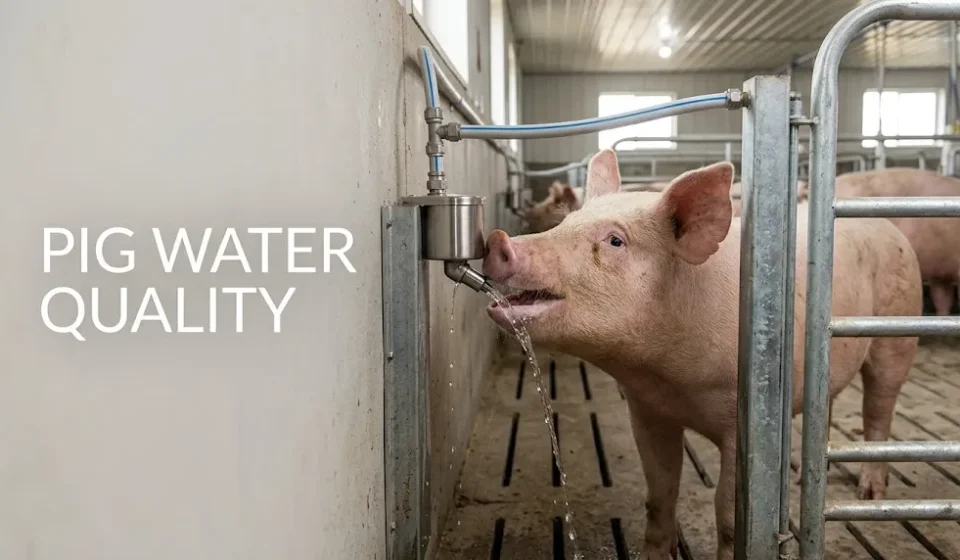
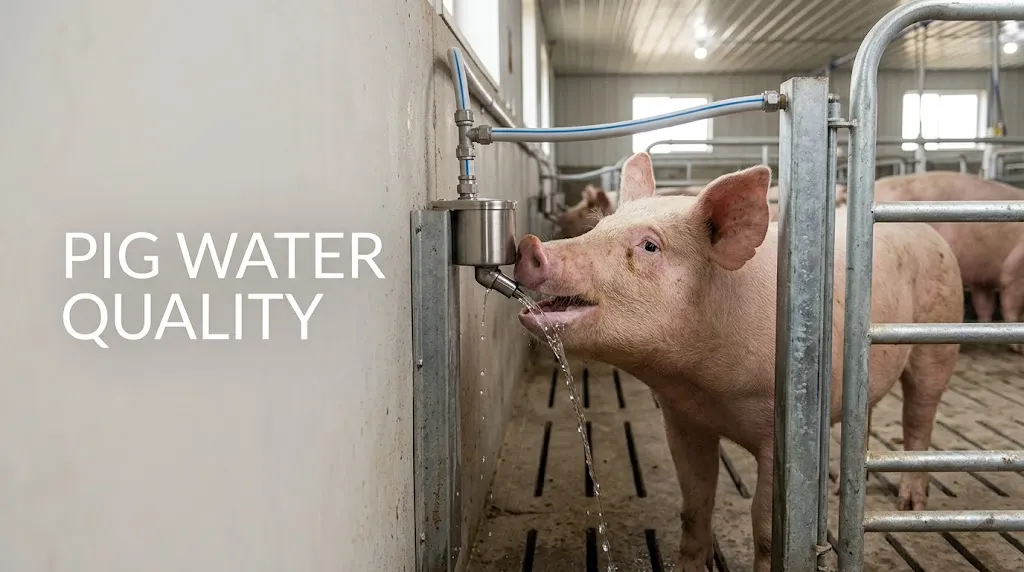
Pig water quality is the chemical, physical, and microbiological condition of the drinking water available to pigs at the drinker. It covers source chemistry, contamination, and the condition of the delivery system that carries water from the well to the pen—and the problem is rarely where producers look for it first. A clean well does not guarantee clean water at the drinker. This guide sits within our wider resource on pig nutrition and feeding.
Quick Answer
Pig water quality is assessed on total dissolved solids, nitrate and nitrite, sulfate, pH, iron, hardness, and microbial contamination—and on whether the delivery system preserves that quality on the way to the pig.
- Nitrate plus nitrite: recommended limit 100 mg/L for swine; nitrite alone should not exceed 10 mg/L
- TDS: below 1,000 ppm generally considered safe; above 7,000 ppm may present risk to sows and stressed growing pigs
- Flow rate: commonly 250–500 mL/min for nursery and 500–1,000 mL/min for grow-finish—ranges, not universal targets
- Sample at the drinker, not only the source, because biofilm and blockages degrade water that left the well clean
Thresholds vary by source and production stage, so the figures below are practical reference ranges rather than universal legal limits.
Key Takeaways
- Human water standards are largely irrelevant to pigs and are usually far stricter than pigs tolerate.
- The recommended limit for nitrate plus nitrite in swine drinking water is 100 mg/L, with nitrite alone not exceeding 10 mg/L.
- TDS below 1,000 ppm is generally considered safe; above 7,000 ppm may present risk.
- Flow rate recommendations are ranges—roughly 250–500 mL/min for nursery and 500–1,000 mL/min for grow-finish.
- Excessive flow wastes water: 23.2% wastage was recorded at 2,080 mL/min versus 8.6% at 650 mL/min.
Why Human Water Standards Are Not the Right Benchmark for Pigs
The right question is not whether water meets a human drinking-water standard, but whether it is suitable for the species, the production stage, and the delivery system carrying it.
Most water quality criteria published for humans have little relevance to the pig, and with the possible exception of microbiological contamination, human standards are lower — often much lower — than what pigs will tolerate. This is the single most useful correction in the subject, because it changes what a failed water test actually means.
The nitrate case makes it concrete. The recommended limit of nitrates plus nitrites in swine drinking water is 100 mg/L, while human drinking water is recommended to contain no more than about 10% of that level. Experiments with swine suggest human nitrate guidelines probably do not apply to pigs after weaning.
The practical consequence: a well that fails a human potability test has not necessarily failed for pigs. Before spending on treatment, check the result against swine-specific thresholds rather than the number on the lab’s human-standard report.
One caution runs the other way. Microbiological contamination is the exception where human standards are not conservative for pigs, and water-borne pathogens connect directly to herd health rather than to chemistry—which is why water belongs inside your farm biosecurity measures rather than beside them.
Pig Water Quality Standards at the Source
Source testing establishes the chemical baseline. North Carolina State University Extension identifies total dissolved solids, pH, iron, hardness, and nitrate/nitrite as a good initial screening panel; if any come back unsatisfactory, further analysis is needed to identify the specific contaminant.
| Parameter | Generally acceptable | Needs investigation | Why it matters |
|---|---|---|---|
| TDS | Below 1,000 ppm | Above 1,000 ppm | A total figure only—depends on which dissolved salts produced it |
| Nitrate + nitrite | Below 100 mg/L | 100 mg/L and above | Nitrite toxicity risk rises with dietary sources |
| Nitrite alone | Below 10 mg/L | 10 mg/L and above | Binds hemoglobin, impairing oxygen transport |
| Nitrate alone | Below 300 ppm | 300 ppm and above | May generate toxic nitrite levels |
| pH | 6.5–8.5 | Outside: 6.5–8.5 | Corrodes plumbing and affects water medications |
Read the table as a diagnostic guide rather than a set of treatment triggers. Crossing into the right-hand column means investigate, not treat.
Total Dissolved Solids
TDS measures the total concentration of dissolved inorganic matter—calcium, magnesium, and sodium in bicarbonate, chloride, or sulfate form, with traces of iron and manganese. It is also referred to as salinity.
According to the Pork Information Gateway, water with TDS below 1,000 ppm is generally considered safe for swine, while water exceeding 7,000 ppm may present risk to gestating or lactating sows and to growing pigs under stress. Between those figures, judgment applies rather than a rule — and because TDS is a sum, the same reading can come from harmless minerals or from something that matters.
A peer-reviewed 2022 study at South Dakota State University, published in Veterinary Sciences, tested newly weaned pigs on water containing TDS from sulfate salts and found the levels supplied had no apparent impact on feed intake, water intake, or growth performance. It is a useful reference point against the assumption that any elevated TDS reading demands action.
Nitrate, Nitrite, and Nitrate Plus Nitrite
Three different figures circulate here, and they are not interchangeable. Nitrate plus nitrite combined carries a recommended swine limit of 100 mg/L. Nitrite alone should not exceed 10 mg/L. Nitrate alone is a separate reading, and NC State Extension notes that a level of 300 ppm of nitrate may be sufficient to produce enough nitrite to cause toxicity in swine.
The mechanism explains the hierarchy. Nitrates convert to the more toxic nitrites, which bind hemoglobin and impair the blood’s oxygen-carrying capacity—so nitrate matters as a precursor, while nitrite matters directly.
Nitrate readings between 100 and 300 ppm occupy a middle zone where the water alone is unlikely to harm pigs, but combined dietary sources matter. Levels above 300 ppm also contribute to higher total salt content, compounding the problem.
Sulfate: Where the Evidence Genuinely Conflicts
Sulfate is the parameter where credible sources disagree most, and the disagreement has a traceable cause.
General livestock guidance places sulfate at 1,500–2,500 ppm, producing temporary diarrhea, with 3,500 ppm considered unfit for sows—but that guidance derives largely from ruminants, whose digestive physiology handles sulfur differently. Research specific to swine, summarized by Pork Information Gateway, has shown pigs experiencing diarrhea withstanding concentrations around 1,650–1,800 mg/L without average daily gain or feed conversion being affected.
These findings should not be interpreted as establishing 1,650–1,800 mg/L as a universal safe limit for all pigs or production conditions. They establish that ruminant-derived thresholds are stricter than swine evidence supports, which is a different claim.
Two practical points follow. Reverse osmosis removes sulfates effectively and can reduce loose stools, but such systems are costly and have not been shown to improve growth performance. And dietary sulfur sources—distillers’ dried grains in particular—add to total sulfur intake, so water sulfate should never be evaluated in isolation from the ration.
pH, Iron, and Hardness
The acceptable pH range for groundwater is 6.5 to 8.5, and pH rarely is a health or performance concern on its own since most samples fall within it.
Its real importance is pharmaceutical. Pork Information Gateway notes that knowing a barn’s pH matters when using pH-sensitive medications: if the pH is wrong for a given product, the medication can precipitate out in the water, reducing its efficacy and building residues in the delivery system. Contact the product supplier for specific instructions rather than adjusting on your own.
pH outside the acceptable range also corrodes the water system, which can contaminate water with iron, copper, lead, and cadmium—a case where a chemistry problem becomes a plumbing problem and then a different chemistry problem.
What Happens Between the Well and the Drinker
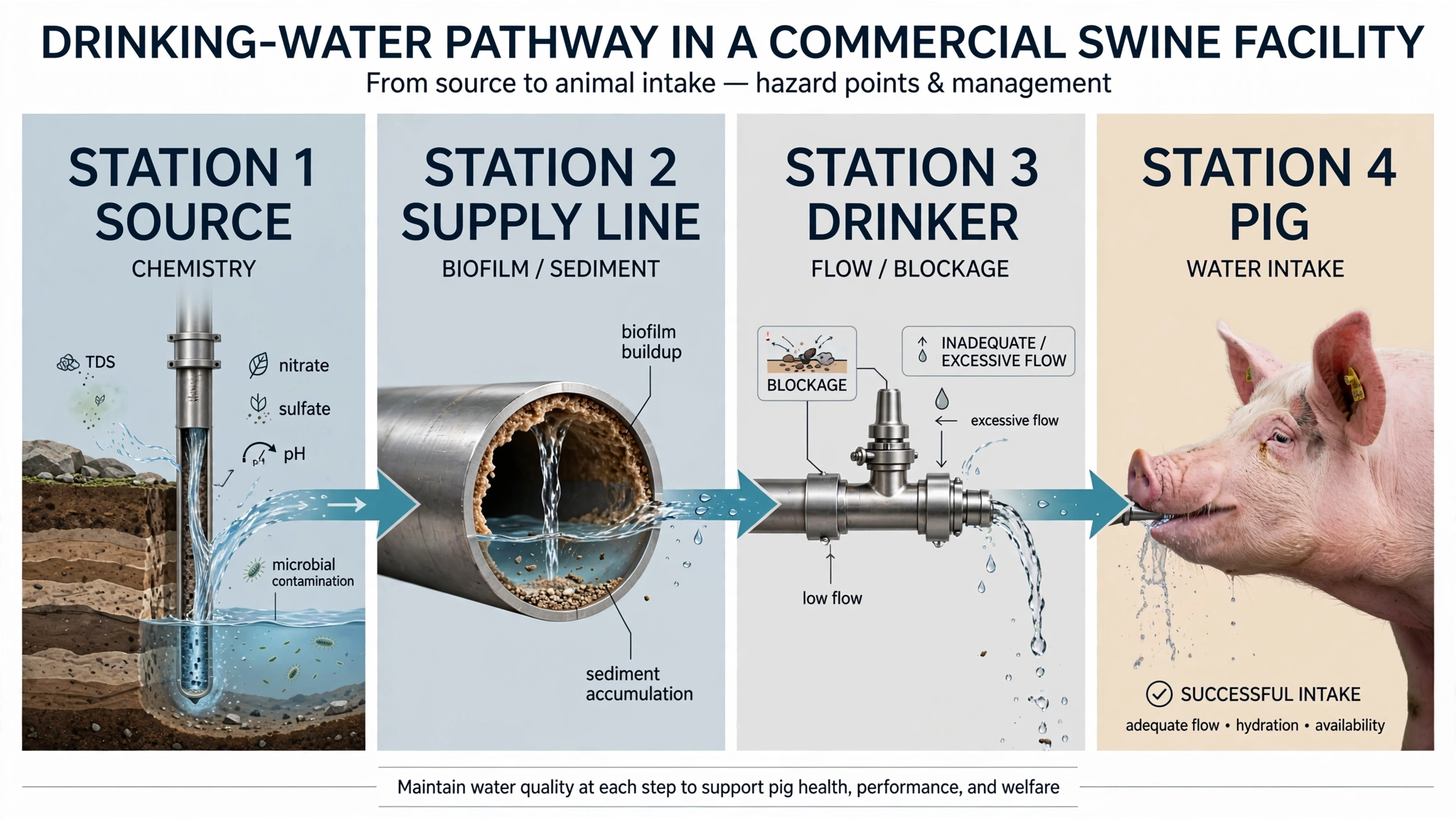
Water quality degrades after the source, which is why a clean well test does not settle the question. Dirty water lines and biofilm buildup negatively affect both water quality and flow rate.
Biofilm is a layer of microorganisms that establishes on the inside surfaces of water lines, and it is self-reinforcing: once present, it traps solids and organic matter, narrows the effective line diameter, and seeds the water passing through it. Some water medications and additives can contribute nutrients that support biofilm formation.
Dead-end lines are the worst case. Water sits, and stagnant water grows biofilm faster than moving water. Loop systems or frequent flushing reduce the risk.
A workable routine:
- Check and clean lines at least twice a year, using a peroxide- or citric-acid-based product suited to your water parameters
- Flush between groups, during the empty-pen window when all-in/all-out flow allows it
- Remove and clean nipples that clog—flushing the main line does not clear a blocked drinker
- Re-check flow after cleaning, since biofilm and solids affect delivery independently of source pressure
- Sample at the drinker, not only at the well, if you want to know what pigs are actually drinking
The physical layout that makes any of this practical is part of your barn water systems and infrastructure, and it is worth planning before a problem appears.
Where the Problem Occurs
| Where | Typical problem | What to check |
|---|---|---|
| Source | Nitrate, sulfate, TDS, microbial | Laboratory test |
| Supply line | Biofilm, sediment, stagnation | Flush and inspect |
| Drinker | Blockage, inadequate or excessive flow | Timed flow test |
| Pig | Reduced intake, dehydration signs | Observe pigs and meter water use |
Flow Rate: A Water-Availability Parameter, Not Just a Plumbing Specification
Water quality answers whether the water is suitable. Flow rate answers whether the pig can get enough of it when it needs it.
Published recommendations are ranges, not universal single targets. Pork Information Gateway places nursery delivery around 250–500 mL/min, grower-finisher around 500–1,000 mL/min, and the breeding herd near 1,000 mL/min. Some national guidance runs higher — New South Wales Department of Primary Industries, writing for Australian conditions, gives 500 mL/min for nursery pigs and 1,000–1,500 mL/min for grow-finish. Treat your own drinker type, line pressure, and pig size as the deciding factors rather than adopting one figure as a rule.
Measuring Flow Yourself
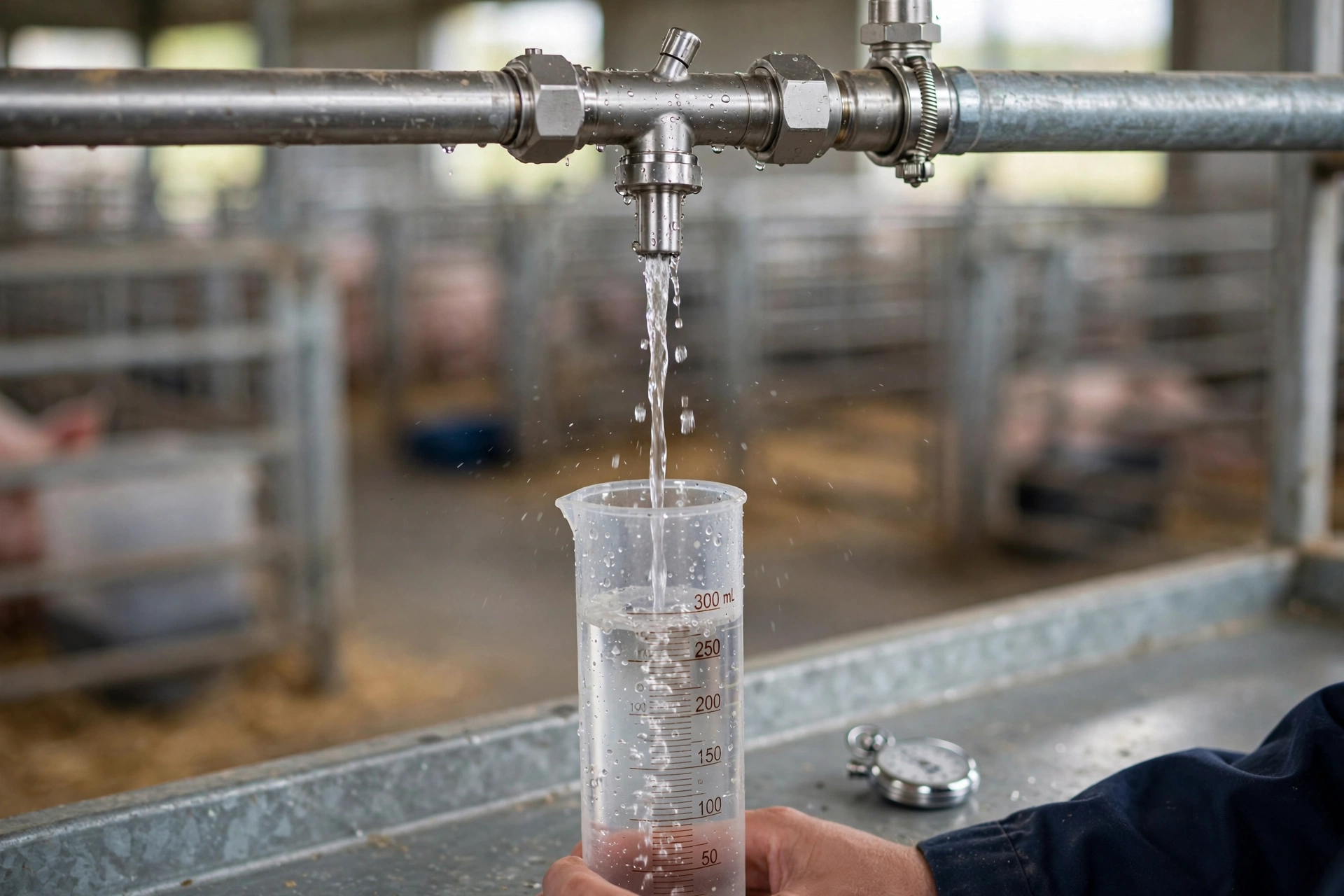
No special equipment is needed. Hold a measuring container under the nipple, trigger it continuously for a timed 30 or 60 seconds, then convert the collected volume to milliliters per minute. Repeat on a rotating sample of drinkers rather than the same one each time—the drinker at the end of the line behaves differently from the one nearest the supply.
Why Too Much Flow Is Also a Problem
Higher flow does not mean better hydration. Pork Information Gateway documents wastage of 23.2% at a flow of 2,080 mL/min compared with 8.6% at 650 mL/min — nearly triple the loss.
That water leaves as manure volume rather than as pork. It also raises barn humidity, which ventilation then has to remove, and dilutes water medications delivered through the line.
Supply-line capacity sets an upper bound on what any single drinker delivers. If total flow into a barn is insufficient for the number of drinkers in simultaneous use, some drinkers develop reduced or no flow precisely when demand peaks—during hot weather, or right after feeding.
How to Test Pig Water Quality
Start with the screening panel — TDS, pH, iron, hardness, and nitrate/nitrite — and expand only if a result comes back unsatisfactory. Ordering the full spectrum on a first test spends money on parameters that rarely explain anything.
Where to sample matters as much as what you test.
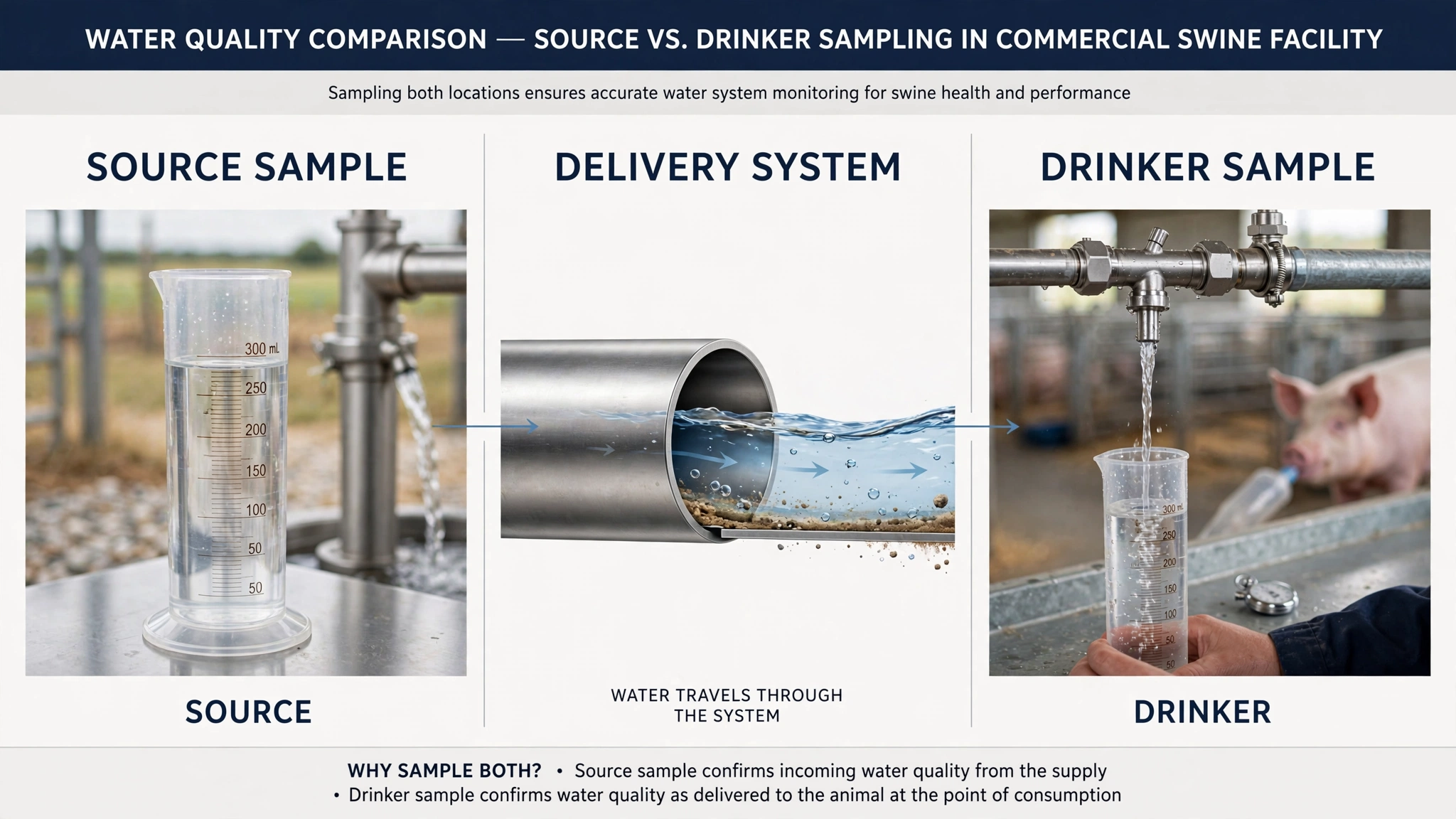
The Two-Sample Rule
The source sample tells you what enters the barn.
The drinker sample tells you what reaches the pig.
If they differ, investigate the water lines, storage, treatment system, or drinker — not the well.
Test at minimum annually, and additionally whenever the source changes, after well work or nearby construction, following heavy rain or flooding if the well is shallow, or when performance drops without another explanation.
Use a lab that reports against livestock thresholds where possible, or convert the results yourself against the swine-specific figures above rather than the human-standard interpretation printed on most residential reports.
Three Mistakes to Avoid
- Don’t judge pig water solely by human drinking-water limits. They are generally stricter than pigs require and will send you treating problems the pig does not have.
- Don’t test only at the well. A clean source sample says nothing about biofilm or a blocked nipple.
- Don’t increase nipple flow automatically when pigs drink less. Reduced intake has several possible causes, and raising flow without diagnosing which one increases wastage while leaving the actual problem in place.
Signs Water Is the Problem
Falling water consumption is often the earliest measurable signal that something is wrong, and it usually moves before feed intake does. The University of Minnesota’s guidance notes that monitoring water use can quickly reveal that a problem exists—while emphasizing that a change in consumption does not identify the cause on its own.
That distinction matters. A drop in water use is equally consistent with a clogged nipple, a disease break, a ventilation failure raising or lowering barn temperature, or a genuine palatability issue from the source. Water meters on each barn make the signal visible; diagnosis still requires walking the barn.
Dehydration signs in the pigs themselves — reduced skin elasticity, sunken eyes, lethargy, and reduced urine output — indicate a problem that has already progressed. Signs of illness that overlap with water problems belong in the broader context of pig health and disease management, since water is one differential among several.
One reliable check costs nothing: walk the pens and trigger drinkers by hand. A surprising share of water problems are a single blocked nipple in a pen where pigs have quietly been underdrinking for a week.
When Treatment Is Worth It
Treatment is worth it when a specific contaminant has been identified above a swine-specific threshold and the cost is proportionate to the problem it solves. It is not worth it as a precaution against a human-standard test result.
Reverse osmosis addresses dissolved salts and sulfates effectively but carries a high installation cost, and the evidence does not support a growth-performance return from installing it where sulfate is merely elevated rather than extreme. Filtration handles sediment and some iron. Line sanitation addresses biofilm, and it is often one of the least expensive interventions to try first.
The sequence that avoids wasted money: test the source, test at the drinker, clean the lines, verify flow, and then re-test. Most farms find the problem before reaching the treatment question. Water is also the nutrient the digestive tract depends on before any other, which is worth understanding alongside how pigs digest their feed.
Frequently Asked Questions
How do I keep pig water clean?
Clean water at the source is only half of it. Clean and sanitize water lines at least twice yearly with a peroxide or citric-acid-based product, flush lines between groups while pens are empty, and remove and clean nipples that have clogged. Avoid dead-end line runs where water stagnates. Test both the source and a drinker sample, since a clean well test does not confirm what pigs actually receive at the nipple.
What should I use for pig water?
Any water source meeting swine-specific thresholds for TDS, nitrate, sulfate, and microbial contamination is suitable—well water, municipal supply, or treated surface water. Judge it against livestock standards rather than human drinking water criteria, which are generally stricter than pigs require. What matters more than the source type is knowing its test results and confirming the delivery system is not degrading the water on the way to the pig.
How long can a pig go without water?
There is no dependable “safe” number of hours to use as a management target. Water interruption should be treated as an immediate problem rather than something to measure tolerance against—pigs stop eating when water is unavailable, so the cost begins accumulating well before any visible sign appears. The practical implication is monitoring rather than tolerance: daily drinker checks and barn-level water metering catch an interruption in hours instead of days.
How many gallons of water does a pig drink per day?
Intake rises with body weight, feed intake, and ambient temperature, and lactating sows have the highest demand of any class. Because this is a question about quantity rather than quality, the stage-by-stage figures and the water-to-feed ratio are covered in our pig nutrition and feeding guide rather than here.
Does pH really matter in pig drinking water?
Rarely for health, since most water tests are within the acceptable 6.5–8.5 range, and pH is seldom a performance concern on its own. It matters for two other reasons. Some medications delivered through the water line are pH-sensitive and can precipitate out if the pH is wrong, reducing efficacy and leaving residues in the system. And pH outside the acceptable range corrodes plumbing, which can introduce iron, copper, lead, and cadmium into the water.
Is high sulfate water dangerous for pigs?
The thresholds commonly quoted derive largely from ruminant guidance and are stricter than swine evidence supports. Research summarized by Pork Information Gateway has shown pigs with diarrhea withstanding sulfate concentrations around 1,650–1,800 mg/L without average daily gain or feed conversion being affected—though that finding does not establish those levels as universally safe. Evaluate water sulfate alongside dietary sulfur sources such as distillers dried grains, since total intake is what the pig experiences.
Conclusion
Pig water quality is not just a laboratory result: it is the condition of the water at the point where the pig drinks it. A useful assessment therefore combines source chemistry, microbial condition, line cleanliness, and drinker flow.
Three habits follow from that. Judge test results against swine-specific thresholds rather than human drinking water standards, which are generally far stricter than pigs require. Sample at the drinker as well as the source, because biofilm and blocked nipples degrade water that is left in the well clean. And treat flow rate as a limit on intake rather than a plumbing detail—verifying it takes a container and a stopwatch, and both too little and too much cost money.
Rebecca Hayes
Explore More
Browse all of our pig nutrition guides for more on feeding, rations, and nutrient management in U.S. pig production.