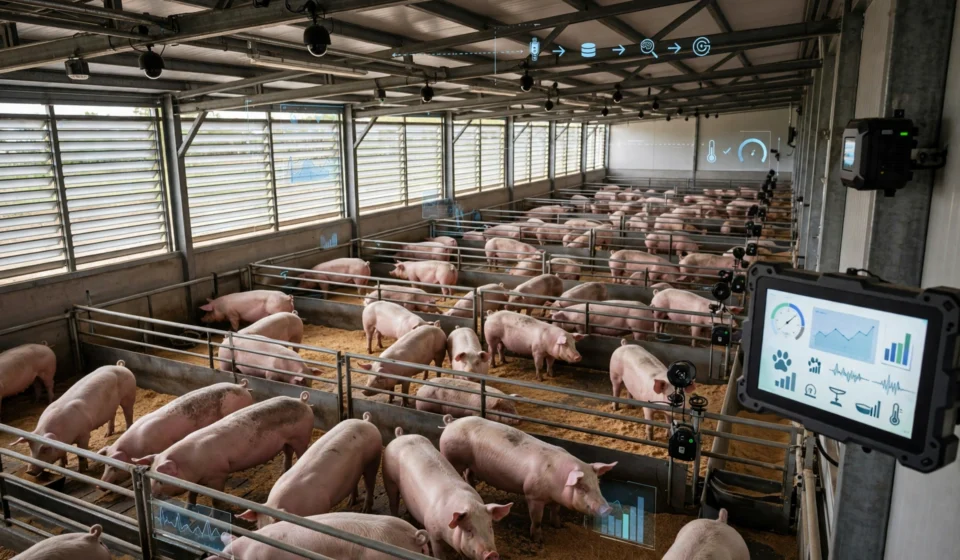
Smart Pig Farming: What the Technology Measures and What It Decides
Smart pig farming is easier to sell than it is to deploy. Walk any trade show floor and you will find ear tags that promise individual health alerts, cameras that claim to weigh pigs without a scale, and dashboards that turn a barn into a live feed of numbers. Some of it works on U.S. farms right now. Some of it is a research paper dressed up to look like a product brochure.
The distinction matters more than the technology itself. A producer running a commercial pig farming operation does not need a survey of what is theoretically possible—they need to know which tools are mature enough to justify capital and which are still solving problems in a university barn rather than a production one.
This guide works through the technology in three layers: what the sensors actually measure, what the software does with that measurement, and what decisions come out the other end.
Short Answer
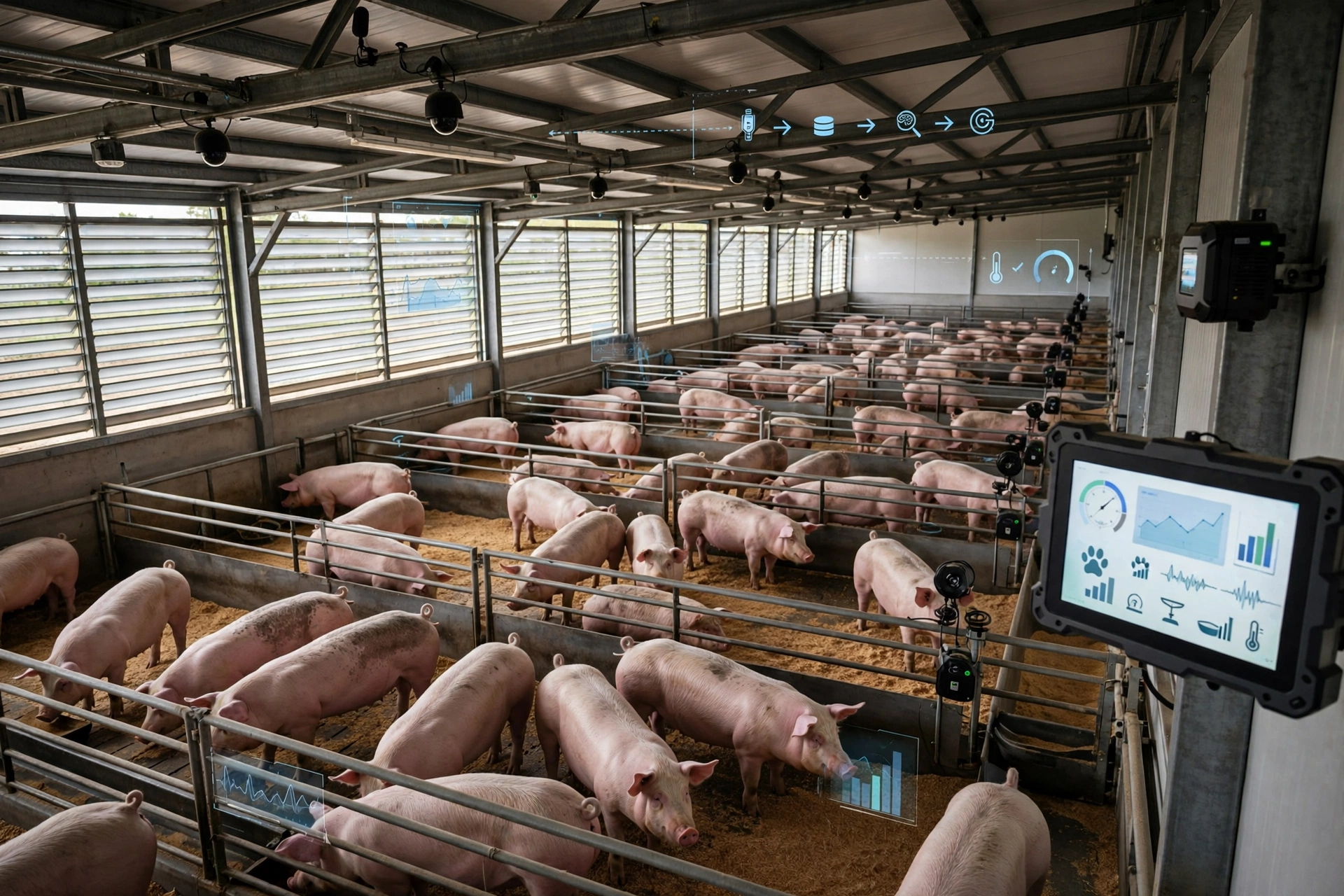
Smart pig farming uses sensors, cameras, and software to monitor pigs continuously and convert that data into management decisions. Cameras and microphones handle most commercial monitoring because they are contactless and cheaper to maintain than devices attached to animals. The software detects patterns a person watching intermittently would miss — a drop in feed intake, a change in movement, a rise in coughing — and raises an alert. Adoption in the U.S. is limited less by what the technology can do than by what it costs relative to the value it returns.
Key Takeaways
- Cameras and sound sensors dominate commercial use because they touch no animal and need less maintenance
- Pigs are the hardest livestock species to fit with wearables—they chew, they grow fast, and their skin resists adhesives
- Most installed systems monitor the pen, not the individual pig, despite marketing that implies otherwise
- The value is in the alert, not the data; a system that generates numbers nobody acts on generates nothing
- Cost, not capability, is the main barrier to U.S. adoption
What Smart Pig Farming Actually Means
Smart pig farming is the use of connected sensors and analytical software to monitor animals and their environment continuously, replacing intermittent human observation with a constant data stream.
The core promise is straightforward. A stockperson walking a barn twice a day sees each pig for a few seconds. A camera sees it all day. Problems that develop over hours—reduced movement, a pig that stops competing at the feeder, and a cough spreading through a pen—surface days earlier when something is always watching.
Smart Farming and Precision Livestock Farming
You will encounter both terms, often in the same paragraph, and the distinction is thinner than it looks.
Precision livestock farming (PLF) is the formal industry and academic term. It enables management of livestock herds using technologies such as AI and IoT, combining sensors and devices with intelligent software to extract key farming information and provide management strategies that let farmers monitor animals automatically. Smart pig farming is the plainer, more commercial phrasing of the same idea.
Treat them as interchangeable in practice. PLF signals a research or technical context; smart farming signals a commercial one.
IoT — the Internet of Things — refers to the networking layer underneath: physical devices with sensors that transmit data to a central system rather than storing it locally or requiring manual collection.
A Note on “AI” — Two Very Different Things
This deserves its own heading because the collision is genuine and causes real confusion in swine literature specifically.
In technology contexts, AI means artificial intelligence — software that recognizes patterns in data and makes predictions, typically through machine learning.
In pig farming, AI has meant artificial insemination for decades. It is one of the most established abbreviations in the industry, long predating any computing usage. A producer reading “AI adoption on swine farms” in a 1995 paper and a 2026 paper is reading about two entirely unrelated subjects.
The safest habit is to write the term out on first use and let context carry it afterward. Throughout this article, AI means artificial intelligence. The reproductive technique is covered separately under artificial insemination and does not appear again here.
Layer One: What the Sensors Measure
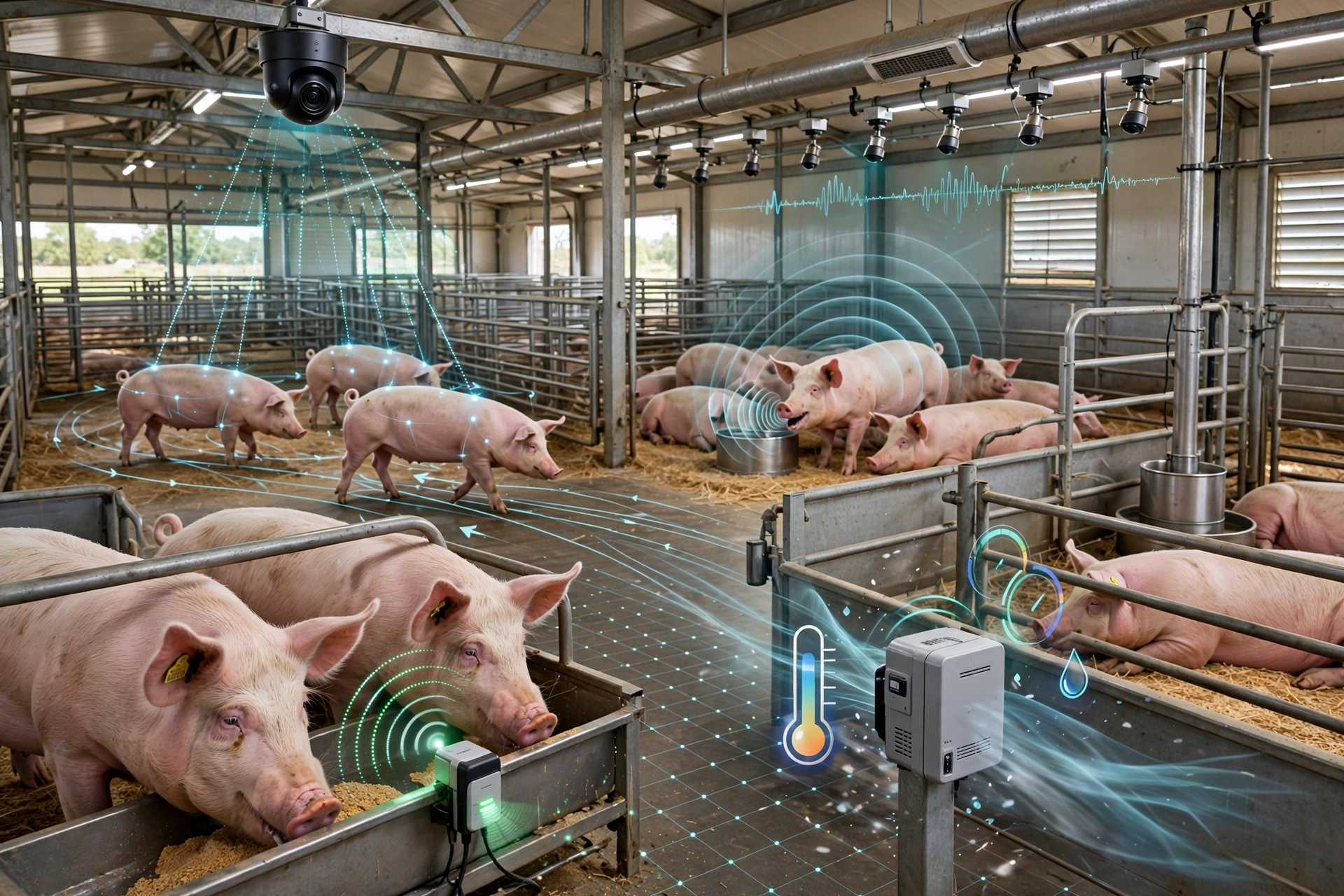
Sensors divide into two families: contactless systems that observe the pig from a distance and contact-based systems attached to the animal. The economics strongly favor the first.
Cameras and Computer Vision
Computer vision is software that extracts information from images—identifying an object, tracking its movement, and estimating its size.
Cameras are the workhorse of commercial smart pig farming, and the reason is cost. Given the expense of hardware and maintenance on large-scale commercial farms, contact-based tracking solutions are generally not preferred; contactless monitoring using video cameras has grown in popularity because of its low cost and sustainability compared with contact-based sensors.
What vision systems deliver today:
- Weight estimation from body dimensions, replacing scale runs that stress animals and consume labor
- Movement and activity tracking, where reduced activity often precedes visible illness
- Aggression detection—if an aggressive event occurs, the system can raise an alarm that includes the location and moving trajectory of the aggressor
- Feeding behavior, including how long individual pigs spend at the feeder
The main limitation is inherent to the animal. Pigs in a pen look alike, move unpredictably, and cluster together — which makes reliably tracking one specific pig across a full day considerably harder than tracking a car on a road.
Sound and Cough Monitoring
Microphones paired with pattern-recognition software listen for respiratory sounds. Coughing is one of the earliest audible indicators of respiratory disease, and a system that counts coughs per hour across a room can flag a developing problem before a person walking through would register anything unusual.
This is among the more mature applications, partly because sound analysis needs no individual identification—a rising cough count in a room is actionable on its own. It fits naturally into routine herd health management rather than requiring a separate workflow.
RFID and Ear Tags
RFID — radio frequency identification — uses a chip that transmits a unique ID when it passes a reader. In pigs, RFID ear tags are standard for identification at feeders, sorting gates, and electronic sow feeding stations.
RFID answers, “Which pig is this?” It does not, on its own, answer how this pig is doing—that requires additional sensors, which is where the difficulty begins.
Why Wearables Are Harder on Pigs Than Any Other Species
This is the part the vendor literature skips, and it explains why smart pig farming looks different from smart dairy farming.
Wearable technology has advanced quickly in cattle, where collar-mounted sensors are commonplace. Transferring that technology to pigs fails on four separate counts, as documented in a peer-reviewed review of ear tag sensor systems. Smart collars designed for cows and companion animals are prohibitively expensive for monitoring the large numbers of animals a pig operation carries. They are also too large and heavy for small piglets, and electronic pet collars are easily damaged by the chewing behavior of pigs. Skin-worn adhesive sensors, meanwhile, are not suited to hairy pigs, and human-style wearables run over $50 per device—cost prohibitive at pig-barn scale.
Add to this that a pig may increase its body weight more than twentyfold between weaning and market, so any device fitted early cannot simply stay in place.
The result is that pig-specific wearables are being purpose-built rather than adapted, and they remain earlier in development than cattle equivalents. When a vendor pitches individual wearable monitoring for pigs, ask specifically how the device handles chewing, growth, and per-animal cost across your herd size.
Layer Two: What the Software Analyzes
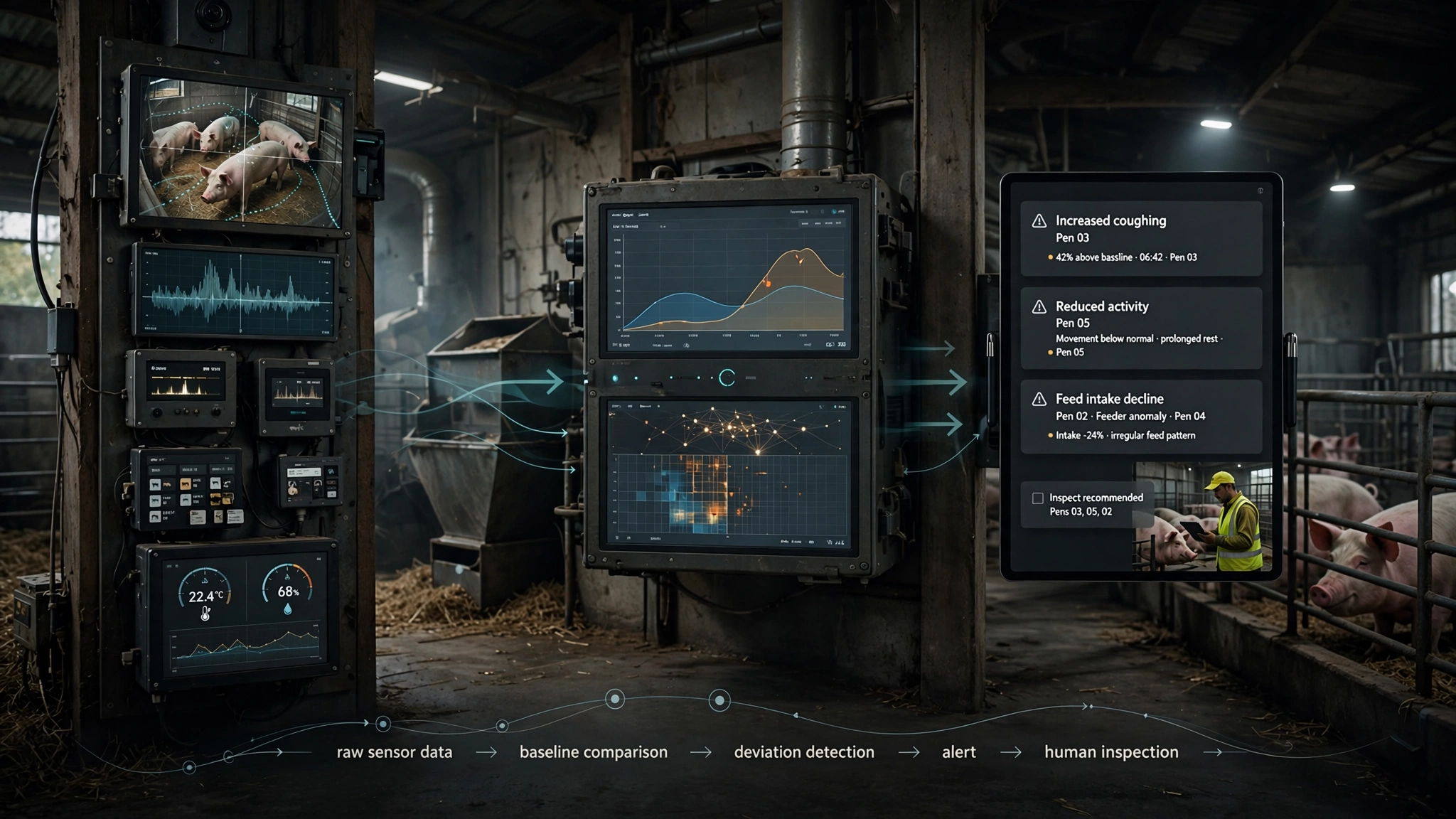
A sensor produces a measurement. Software turns measurements into meaning. Between those two steps sits most of the value — and most of the difficulty.
From Raw Data to an Alert
Machine learning is software that improves its predictions by finding patterns in large datasets rather than following rules a programmer wrote in advance.
The workflow runs in four stages: continuous data collection, establishing a normal baseline for that group, detecting deviation from that baseline, and issuing an alert with enough context to act on.
Stage two is where systems commonly disappoint. A baseline built on one barn, one genetic line, and one season may not transfer to a different operation. Expect a learning period, and expect false alerts during it.
Actionable tip: Judge a system by its alerts, not its dashboard. A platform producing a hundred readings a day that nobody opens is a subscription, not a tool. Ask a vendor how many alerts a typical farm receives per week and what share turn out to be genuine—that ratio predicts whether staff will keep responding after month three.
Herd-Level Versus Individual-Level Resolution
Marketing language leans heavily on individual animal care. Installed reality is mostly otherwise.
Most sensor systems on pig farms—imaging cameras, microphones, and climate control—serve herd-level monitoring and lack the resolution to pick up vital signs of individual pigs. There is also a shortage of swine behavioral data available to train machine learning models validated through multiple checks, and the tools for gathering field data, storing it, and applying predictive analytics remain premature, though they continue to improve.
This is not a reason to dismiss the technology. A cough alert for a room is genuinely useful even without knowing which pig coughed. But it does mean the pitch and the product often describe different capabilities.
| Level | What it tells you | Maturity |
|---|---|---|
| Room / pen | Cough rate, average activity, climate | Commercially mature |
| Group within a pen | Feeder competition, aggression events | Emerging |
| Individual pig | Body temperature, per-animal vital signs | Largely research stage |
A 2025 systematic review of precision livestock farming applied to swine farms analyzed 75 studies published between 2019 and 2024 and found 37% focused on animal identification and monitoring and 28% on animal welfare — confirming that identification and observation, rather than individual physiological measurement, remain the center of gravity in this field.
Layer Three: What Decisions It Actually Drives
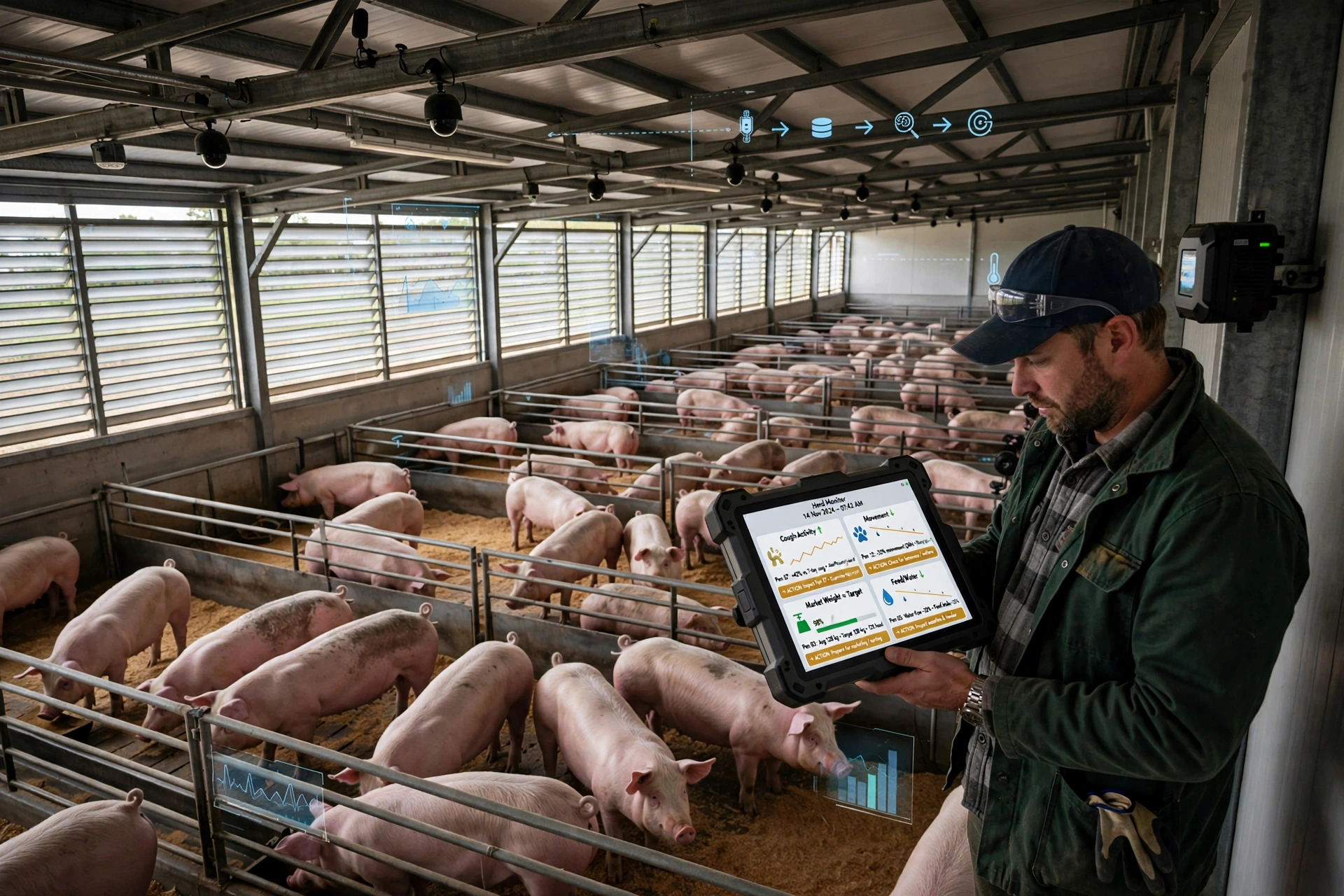
Technology earns its cost at the point a decision changes. Here is where each data stream lands:
| Data stream | Signal detected | Decision-driven |
|---|---|---|
| Cough count per room | Rising respiratory sounds | Early veterinary intervention before spread |
| Activity level | Reduced movement in a pen | Targeted inspection of that pen |
| Camera weight estimate | Group approaching market weight | Marketing timing, sort decisions |
| Feeder occupancy | Individual pigs not competing | Identify pigs being outcompeted |
| Feed intake trend | Group-level drop | Investigate feed, water, or health |
| Water consumption | Sudden decline | Equipment failure or early illness |
Weight estimation deserves particular attention, because marketing timing is one of the few decisions where better data converts directly into revenue. Selling a group underweight leaves money on the table; selling overweight incurs discounts. Which of these matters most depends on your production system and where you sit in the supply chain.
Precision Feeding
Precision feeding delivers a diet matched to a specific animal or group rather than a single ration to an entire barn, using RFID identification at the feeder to blend from two or more feed sources.
The application is furthest along in sow housing, where electronic sow feeding stations recognize each sow and dispense her individual allowance. In grow-finish barns, systems that blend rations to match a group’s changing requirements exist but remain far less common on U.S. farms.
The nutritional reasoning behind why this matters — and why a diet correct for one stage is wrong for another — belongs to pig nutrition and feeding rather than to the technology discussion. The technology only automates a decision the nutrition determines.
What US Farms Have Actually Adopted
Research output and on-farm reality are further apart in this field than in most.
Systems that are genuinely common in U.S. commercial production today: RFID identification, electronic sow feeding, automated environmental control, and farm management software for records and performance tracking.
Systems appearing but not yet standard: camera-based weight estimation, cough monitoring, and vision-based behavior analysis.
Systems still predominantly in research: individual physiological monitoring, predictive health models validated across multiple farms, and pig-specific wearables.
The barrier is financial rather than technical. A 2025 choice-experiment study of U.S. swine producers examining willingness to pay for welfare-oriented PLF found that cost constraints limit adoption—the technology to reduce piglet crushing exists, but uptake in the U.S. swine industry remains limited.
Which is a familiar pattern to anyone who has evaluated capital for a modern commercial pig farm. The question is never whether a technology works in isolation, but whether it returns more than the next-best use of the same money.
Where Smart Pig Farming Is Still Immature
Four honest limitations worth carrying into any vendor conversation:
Individual-level monitoring at scale. Tracking one pig among fifty, all day, reliably, remains difficult. Systems claiming this should be tested in your own barn before purchase.
Cross-farm model transfer. A model trained on one farm’s data frequently performs worse on another. Ask whether validation happened on farms resembling yours.
Integration. Sensors, feeders, and management software often come from different vendors with limited interoperability, leaving producers to reconcile separate systems manually.
Alert fatigue. A system producing frequent false positives gets ignored within weeks, and an ignored system provides zero value regardless of its technical sophistication.
Actionable tip: Before committing capital, define the single decision you most want to improve—marketing timing, respiratory disease detection, or sow condition. Buy the system that improves that one decision measurably. Platforms that promise to improve everything typically improve nothing enough to notice.
Frequently Asked Questions
What type of technology is used in pig farming?
The main categories are identification systems such as RFID ear tags, monitoring systems including cameras and microphones, automated feeding equipment such as electronic sow feeders, environmental control systems for ventilation and temperature, and management software for records and performance tracking. Cameras and sound monitoring are the fastest-growing categories because they require no contact with the animal.
How is artificial intelligence used in pig farming?
Artificial intelligence analyzes data that sensors collect, identifying patterns a person would miss. Practical applications include recognizing individual pigs in camera footage, estimating body weight from images, detecting aggression, counting coughs to flag respiratory disease early, and predicting health problems before clinical signs appear. Note that in swine contexts, AI has long meant artificial insemination—an entirely different subject.
What is precision livestock farming?
Precision livestock farming, or PLF, is the management of livestock using connected sensors and analytical software to monitor animals individually or in small groups rather than treating the herd as one unit. In pigs it covers camera monitoring, sound analysis, RFID identification, and precision feeding. It is essentially the technical term for what commercial vendors call smart farming.
Is smart farming technology worth it for a small pig operation?
It depends on which decision you are trying to improve rather than on herd size alone. Environmental monitoring and basic record-keeping software scale down to small operations reasonably well. Camera-based systems and electronic sow feeding carry fixed installation costs that are difficult to justify below a few hundred head. Start with the single most expensive recurring problem on your farm and evaluate whether a technology addresses that specific problem.
What is the newest technology in pig farming?
The most active development areas are vision-based individual pig tracking, machine learning models that predict disease before clinical signs, and pig-specific wearable sensors designed around the chewing behavior and rapid growth that make adapted cattle devices unsuitable. These are advancing quickly but remain closer to research than to standard commercial practice on U.S. farms.
Conclusion
Smart pig farming is real, useful, and consistently oversold. Three things are worth holding onto:
- Contactless beats contact. Cameras and microphones dominate commercial use because pigs are uniquely hostile to wearable devices, and that constraint is physical rather than temporary.
- Most systems watch the room, not the pig. That is still valuable — but it is not what the marketing implies, and the gap is worth confirming before you buy.
- The alert is the product. Data nobody acts on has no value. Evaluate any system by what it makes you do differently.
Pick the one decision you most want to improve, and buy for that. The barn that adopts one technology well outperforms the barn that adopts five badly.
— Tom Bradley, Pig Farming Expert & Commercial Farm Management Specialist
Explore More
Browse all guides in our Commercial Pig Farming category.