
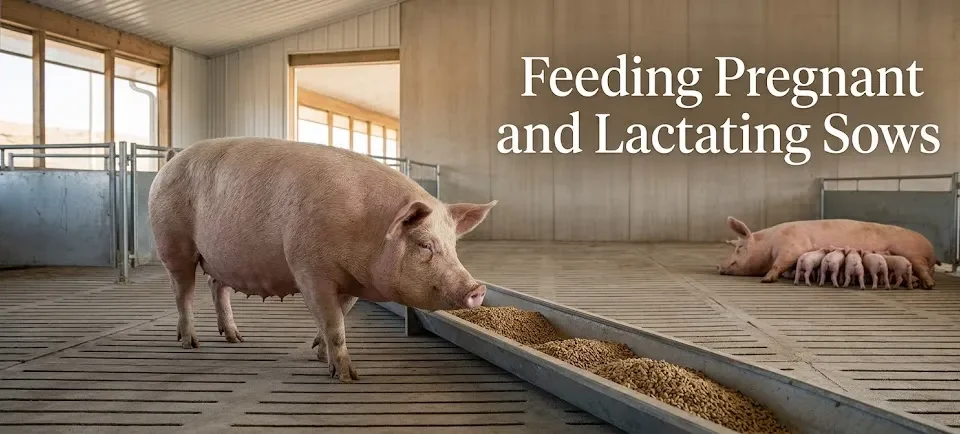
Feeding Pregnant and Lactating Sows: Two Phases, One Continuous Decision
Feeding pregnant and lactating sows is often treated as two separate jobs with two separate feed tags, but the number you put in front of a sow during gestation largely decides how much she will eat while nursing. If you overfeed her in gestation, she eats less in lactation, loses more condition, and comes back to heat slower. This guide sits within our wider resource on pig nutrition and feeding.
Quick Answer
Gestation feeding aims to maintain body condition and support fetal growth on a limited allowance — commonly around 4 to 6 pounds per day of a corn-soybean meal diet. Lactation feeding aims for maximum intake, since the sow cannot eat enough to cover milk output and will draw on body reserves regardless.
- The two phases are linked: high backfat at farrowing reduces lactation feed intake
- Gestation allowance is usually constant from about day 3 to day 100, then increases
- Lactation intake averages around 11.5 lb/day, with a wide spread between farms
- Condition should be measured, not guessed—visual scoring is the weakest link
Key Takeaways
- Lactation intake may fall by as much as 0.3 lb per day for every 0.04 inch of backfat above 0.75 inch at farrowing.
- Gestation feeding levels producing backfat of 0.83 inch or more at farrowing reduce early lactation intake.
- Survey data put average lactation intake at 11.5 lb/day, ranging from 8 to 15 lb between the bottom and top 10% of producers.
- Most farms gain nothing from varying the gestation allowance between day 3 and day 100.
- Gilts are still growing and should not be fed by body condition category.
Why Gestation and Lactation Pull in Opposite Directions
The two phases have opposite objectives, and that is the single most important thing to understand about sow feeding.
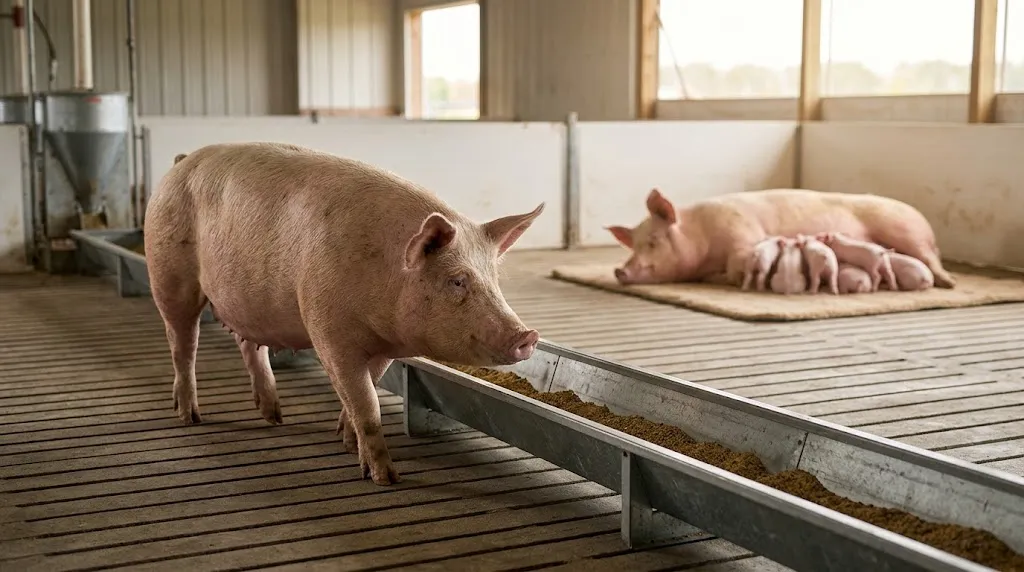
In gestation, the sow’s requirement is modest. She needs maintenance energy, the small demand of fetal and mammary development, and—depending on her condition—some recovery of body reserves. Intake is deliberately limited, because a sow given free access will overshoot.
In lactation, the objective inverts completely. A sow producing milk for a large litter cannot physically eat enough to cover the output, so she mobilizes body reserves no matter how well she is fed. The goal shifts from restriction to maximizing what she will voluntarily consume.
The link between them is physical. Fat deposited in gestation suppresses appetite in lactation, so gestation overfeeding does not bank reserves for later—it removes the sow’s ability to use feed when she needs it most. Feeding her more in gestation makes her eat less when eating matters.
The Cost of Every Extra Fraction of an Inch
Published work quantifies the exchange rate. High backfat at farrowing—above roughly 0.85 inch—decreases lactation feed intake, and the decrease may be as much as 0.3 lb per day for every 0.04 inch of backfat above 0.75 inch, according to research summarized by Pork Information Gateway citing Dourmad (1991), Revell et al. (1998), and Young et al. (2004).
A separate threshold points in the same direction: gestation feeding levels that result in backfat of 0.83 inch or more at farrowing reduce lactation intake, especially in early lactation, in most genotypes.
Run that arithmetic over a three-week lactation, and the loss is substantial—and it was created months earlier, in a gestation stall, by a scoop that was slightly too generous.
Feeding Pregnant Sows Through Gestation
| Stage | Typical allowance | Source and conditions |
|---|---|---|
| Around mating (gilts) | 4.5–5.0 lb/day, 2–3 days | Pork Information Gateway |
| Day 3–100, climate-controlled crates | As little as 4 lb/day | Penn State Extension |
| Day 3–100, general | About 4–6 lb/day | UMN Extension |
| Day 3–100, pens or cold conditions | 6–7 lb/day | Penn State Extension |
| Day 100 to farrowing | Add 2.0 lb/day | Pork Information Gateway |
| Lactation | To appetite: 11.5 lb/day average, 8–15 lb range | Pork Information Gateway |
These are reference ranges drawn from different sources under different housing and diet conditions, not a single feeding schedule. Set your own allowance from the condition your sows actually reach, and adjust from there.
Gestating sows are limit-fed to control weight gain and body condition while supporting fetal growth, and the University of Minnesota Extension notes that producers commonly feed a gestation diet at about 4 to 6 pounds daily.
To put numbers behind that, gestating sows need roughly 6,000 to 8,000 kilocalories of metabolizable energy daily to achieve good body condition and weight gain, and feeding 4.5 pounds daily of a normal corn-soybean meal diet meets those needs. Adjust from there based on the condition you are actually achieving.
Early and Mid-Gestation: Steady Is Better Than Clever
On most farms, there is no advantage to feeding anything other than a constant daily intake from day 3 to day 100 of gestation.
That deserves emphasis, because elaborate, stepped feeding schedules circulate widely and add labor without adding return. Set the allowance based on the sow’s condition at breeding, feed it consistently, and reassess the condition rather than the calendar.
Gilts are the exception at the front end: 4.5 to 5.0 lb/day for the two to three days around mating are recommended, after which they move on to a regular schedule.
Two adjustments matter more than any schedule. Cold conditions raise the requirement—Penn State Extension notes that sows in climate-controlled gestation crates may need as little as four pounds daily, while gilts in pens or any gestating female in cold conditions may need six or seven. And thin sows cost more to maintain than fat ones: with less insulation, higher activity, and more time standing, their maintenance requirement can be higher by as much as 1.25 lb of feed per day.
Late Gestation: The One Planned Increase
Energy and nutrient requirements rise with advancing pregnancy, particularly in the last ten days, and Pork Information Gateway recommends feeding sows 2.0 lb extra from day 100 until farrowing.
That increase prevents loss of body stores and prepares the sow for higher lactation intake without adverse effects. Note what it is not: it is not push condition upward. The increase covers a real, documented rise in requirement during the final fetal growth phase.
The Farrowing Transition
The days immediately around farrowing are where good gestation management is most easily undone. Overfeeding in the final days before farrowing can depress lactation intake, so the increase belongs before that window, not inside it.
Feed is typically reduced or withheld on the day of farrowing itself and then built back up. The build-up matters more than the reduction, and it is covered in the next section.
The litter’s side of that transition—establishing intake in the piglets themselves—is covered in our guide to feeding weaned piglets.
Feeding Lactating Sows
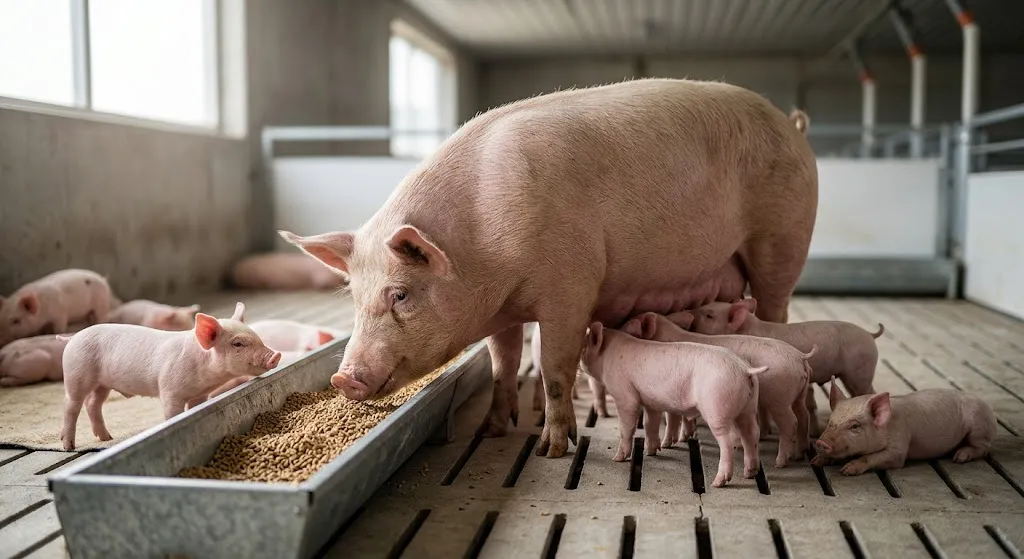
Lactating sows should receive a nutrient-dense lactation diet fed ad libitum, because the objective is maximum voluntary intake rather than a controlled allowance. Survey data put average lactation feed intake at 11.5 lb per day, with a range of 8 to 15 lb per day between the bottom and top 10% of producers.
That spread is the story. Roughly a two-fold difference in the same production stage, and while genotype, lactation length, parity, and disease level explain part of it, much of the difference comes down to feeding management rather than diet formulation.
Building Intake After Farrowing
Feed is increased stepwise after farrowing rather than offered at a full level immediately, because a sow pushed too fast can go off feed entirely—a setback that costs more than the days it takes to build gradually.
Practical points that move the number:
- Feed more often. Multiple small feedings suit a sow with limited appetite better than one large drop.
- Keep the feed fresh. Remove refusals rather than topping up over them; stale feed in a warm farrowing room is quickly rejected.
- Treat each sow individually. Skilled stockpeople given time to manage sows as individuals probably do more to increase intake than any single other factor.
- Watch the first-litter females. They have smaller appetites and are still growing.
Why Lactation Intake Fails
When a sow will not eat in lactation, four causes account for most cases.
She was too fat at farrowing. The exchange rate above applies, and nothing done in the farrowing room reverses it.
The room is too warm. Heat suppresses appetite in lactating sows more than in almost any other class of pig.
She isn’t drinking. Milk is mostly water, and a sow with restricted water intake will not sustain feed intake. Flow rate at the drinker is the first thing to verify—our guide to water quality and flow at the drinker covers how to measure it.
She is sick. Off-feed in a freshly farrowed sow is a clinical sign, not just a management problem, and it belongs with your veterinarian.
What to Give a Sow After Farrowing
A freshly farrowed sow should be offered her lactation diet, gradually increased over the first days, alongside unrestricted clean water. There is no separate post-farrowing feed she requires beyond that.
Note carefully: questions about medications for sows around farrowing are veterinary decisions, not feeding decisions. This guide does not name drugs, doses, or products for use in pregnant or nursing sows, because those decisions require a veterinarian who has examined your animals.
Measuring Body Condition Objectively
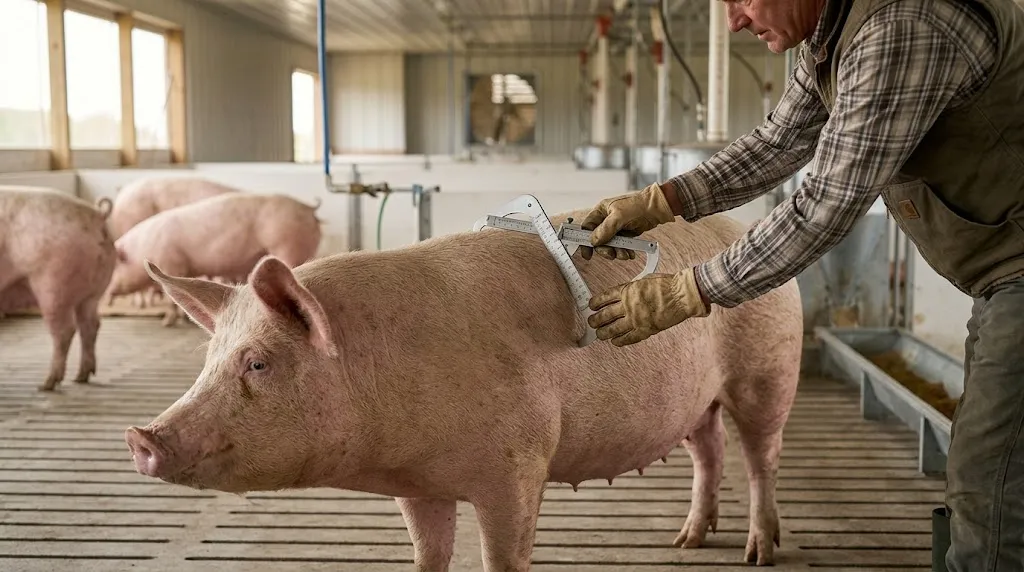
Every feeding decision above depends on knowing the sow’s condition, and visual scoring is the weakest link in the chain because different people score the same sow differently.
| Method | What it measures | Labor | Limitation |
|---|---|---|---|
| Visual BCS | Subjective appearance, usually 1–5 | Lowest | Varies between and within assessors |
| Ultrasound backfat | Fat depth at the last rib | Highest | Equipment, training, time per sow |
| Sow caliper | Angularity at the last rib, in units | Low | Not recommended for gilts |
The sow body condition caliper, described by Knauer and Baitinger, measures the angle from the spinous process at the last rib and converts it to units, with each unit equal to 5 mm. Compared with ultrasound backfat, it substantially reduces labor.
Peer-reviewed evaluation in the Journal of Swine Health and Production confirmed the link that makes this worth doing: as caliper measurements increased, average daily feed intake during lactation decreased. Intake was highest for sows in the leanest caliper category and lowest for sows in categories 4 and 5.
There is also a herd-level use for the measurement. PIC recommends reevaluating operation-wide feeding and body condition management when more than 30% of females fall below 15 caliper units at farrowing—a threshold that points at the feeding system rather than at individual sows.
The Judgment Call That Surprises Most Producers
Do not cut feed for over-conditioned sows. PIC’s guidance states that reducing gestation feed does not greatly affect body condition and may push sows below maintenance energy needs, producing other negative effects. Such sows typically reduce their condition during lactation on their own, and the discipline required is not to overfeed them again in the next cycle.
This runs against instinct. The correction for a fat sow is not a diet—it is fixing the gestation allowance that made her fat next time.
Gilts Are Not Sows
Gilts should not be categorized by body condition or fed below a floor level, because they are still growing while carrying their first litter.
The physiology differs measurably. In late gestation, maintenance represents approximately 80% of the energy requirement for mature sows but only about 60% for gilts, since gilts partition more energy toward their own growth. A feeding table built for mature sows underfeeds a gilt at exactly the point where her lifetime productivity is being set.
PIC does not recommend using a caliper on gilts to determine feeding levels and advises never feeding them below a stated energy floor throughout gestation. Underfeeding gilts bred at heavier weights damages their long-term performance. The first breeding weight and the feeding program that supports it connect directly to the wider picture in our guide to breeding and reproduction in pigs.
Common Feeding Mistakes
- Treating gestation and lactation as unrelated. The gestation scoop sets the ceiling on lactation intake.
- Overfeeding in the last days before farrowing. The planned increase belongs at day 100, not day 112.
- Cutting feed for a fat sow. does little for condition and may drop her below maintenance.
- Feeding gilts from the sow table. Different maintenance share, different growth demand, different floor.
- Scoring conditions by eye alone. Assessors disagree, and the feeding decision inherits the error.
- Guessing scoop weight. Weigh the contents of your scoop and re-check periodically, since feed density changes.
- Ignoring farrowing room temperature. Heat suppresses lactation intake more than most producers expect.
Frequently Asked Questions
What kind of feed should lactating sows eat?
A nutrient-dense lactation diet, fed to appetite rather than to a fixed allowance, alongside unrestricted clean water. Lactation diets are formulated to higher energy and amino acid density than gestation diets because the sow physically cannot eat enough to cover milk output. Feed it fresh, offer it in multiple smaller feedings during the first days after farrowing, and remove refusals rather than topping up over them.
How much feed does a lactating sow need?
Survey data put average lactation intake at about 11.5 lb per day, with a range of 8 to 15 lb between the bottom and top 10% of producers. Requirement scales with litter size and milk output, which is why lactation is fed to appetite rather than to a table. The wide spread between farms reflects feeding management more than diet formulation—feeding frequency, feed freshness, water availability, room temperature, and condition at farrowing all move the number.
What should I feed my pregnant sow?
A gestation diet fed at a controlled allowance, commonly around 4 to 6 pounds daily of a corn-soybean meal diet, adjusted to the individual sow’s body condition and her environment. Gestation diets are higher in fiber and lower in energy density than lactation diets because intake is deliberately limited. Cold housing raises the requirement, and thin sows need more than fat ones because their maintenance cost is higher.
When should I switch a pregnant sow to lactation feed?
Requirements rise in the last ten days of gestation, and published guidance recommends 2.0 lb extra from day 100 until farrowing. Many farms make the diet change in that window as well. What matters more than the exact switch day is avoiding overfeeding in the final days before farrowing, since that suppresses early lactation intake — the increase belongs at the start of the late-gestation window, not immediately before farrowing.
Why won’t my sow eat after farrowing?
Four causes account for most cases: she was too fat at farrowing, the room is too warm, she is not drinking enough, or she is sick. Check water flow at her drinker first, since milk is largely water and restricted drinking suppresses eating. Then check room temperature. A sow that remains off feed is showing a clinical sign rather than a feeding problem and should be seen by your veterinarian.
What antibiotics are safe for pregnant or nursing sows?
This is a veterinary question, not a feeding question, and this guide does not answer it. Drug selection, dosing, route, and withdrawal periods for breeding females depend on the specific product label and on a veterinarian who has examined your animals. Discuss any medication for a pregnant or lactating sow with your veterinarian rather than selecting a product based on general information.
Conclusion
Feeding pregnant and lactating sows well rests on three habits. Treat the two phases as one decision, because backfat added in gestation is subtracted from lactation intake at a measurable rate. Measure the condition rather than eyeballing it, since every allowance you set inherits the accuracy of that assessment. And feed gilts on their own terms—they are still growing, and the feeding program built for mature sows shortchanges them at the point where their productive life is being decided.
Rebecca Hayes
Explore More
Browse all of our pig nutrition guides for more on feeding, rations, and nutrient management in U.S. pig production.