Commercial Pig Breeding Cycle: Days, Intervals, and Where Schedules Slip
The commercial pig breeding cycle is a repeating sequence of four intervals—service, gestation, lactation, and return to estrus—and the length of that sequence, not the size of any single litter, determines how many pigs a sow farm produces in a year. Understanding the arithmetic matters more than memorizing the biology, which our pillar guide to breeding and reproduction in pigs covers in depth.
Quick Answer
The commercial pig breeding cycle runs roughly 140 days from one farrowing to the next: about 114 days of gestation, around 21 days of lactation, and 4 to 7 days from weaning back to estrus. At that interval a sow produces approximately 2.6 litters per year. Shortening lactation shortens the cycle, but only up to the point where the sow’s return to estrus and subsequent litter size begin to suffer.
Key Takeaways
- Gestation is about 114 days — the origin of the “3 months, 3 weeks, 3 days” memory aid.
- The estrous cycle is normally 21 days, with a range of 18 to 24 days.
- Wean-to-estrus interval is usually 4 to 6 days, and many farms allow up to 7.
- A 140-day farrowing interval yields about 2.6 litters per sow per year.
- Sows commonly produce around seven litters before productivity declines.
The Two 3-3-3 Rules in Pig Production
There are two different “3-3-3” rules in pig farming, and they answer two different questions. Both refer to farm pigs—swine—and neither has any connection to the 3-3-3 rule for guinea pigs or the one used in dog adoption.
The gestation rule is a memory aid for pregnancy length: 3 months, 3 weeks, and 3 days, which totals about 114 days. It tells you when a litter arrives once a sow is bred.
The cycle rule describes the sow’s full production loop: roughly 3 months pregnant, 3 weeks nursing, and about 3 days back to heat. It tells you how often litters arrive—and it is the version that governs annual output.
The second is the one this article is built on, because a sow farm is scheduled by the loop, not by the pregnancy. The gestation figure is fixed biology. The other two intervals are management decisions, and that is where the year is won or lost.
The Four Intervals in the Commercial Pig Breeding Cycle
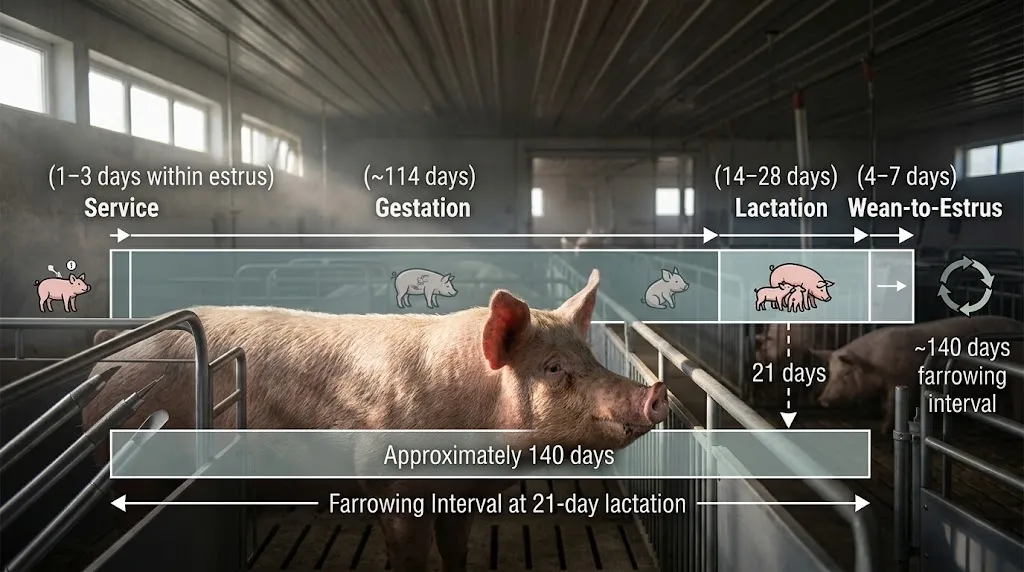
The commercial pig breeding cycle is a sum, not a single number. Four intervals stack end to end, and only two of them can be meaningfully shortened.
| Interval | Typical length | Adjustable? |
|---|---|---|
| Service (breeding) | 1–3 days within estrus | No—set by the sow’s heat |
| Gestation | ~114 days | No—fixed biology |
| Lactation | 14–28 days | Yes, the main management lever |
| Wean-to-estrus | 4–7 days | Partially—through condition and management |
| Farrowing interval | ~140 days at 21-day lactation | — |
Add the four, and you get the farrowing interval: the number of days from one farrowing to the next. Divide 365 by that figure, and you have litters per sow per year.
At 114 + 21 + 5 days, the interval is 140 days, which gives 2.6 litters annually. That single line of arithmetic is the reason weaning age is one of the most consequential decisions on a sow farm.
There is a fifth category that belongs in the calculation but not in the table: non-productive days (NPD) — any day a breeding-age female is neither pregnant nor nursing. Those days do not appear in a textbook cycle, and they are where most farms actually lose ground.
Breeding: Timing the Service
Service timing is anchored to standing estrus — the period when a sow or gilt will hold still under pressure and accept mating — not to a fixed number of days after weaning.
The estrous cycle in sows and gilts is normally 21 days, though it can range from 18 to 24, according to the University of Wisconsin Extension. The duration of heat itself varies widely: as little as 12 hours in gilts and 60 hours or more in mature sows. That spread is why calendar-based breeding fails and daily heat detection does not.
For natural service, the Merck Veterinary Manual describes hand mating in which the female is mated two or three times during estrus, with the first service on the first day of standing estrus and subsequent matings at 24-hour intervals. Confirmed matings should be recorded — a point that sounds administrative until a farrowing date is missing from the schedule three months later.
Most U.S. commercial herds use artificial insemination rather than natural service. Note the abbreviation collision: in swine literature, AI has meant artificial insemination for decades, and artificial intelligence is spelled out to avoid confusion. Which females enter the breeding herd at all is a separate decision, covered in our guide to selecting pig breeding stock.
Gestation: The 114 Days You Cannot Compress
Gestation lasts about 114 days and is the one interval in the cycle that management cannot shorten. Everything scheduled around it — farrowing room availability, staffing, weaning groups — works backward from that fixed length.
Practically, this makes gestation the planning anchor. Breed a group on a known date, and the farrowing date is known within a two-to-three-day window, which is what makes batch systems possible at all.
Gestation is also where the next cycle is quietly determined. Body condition built or lost during these 114 days sets the sow’s appetite during lactation, and appetite during lactation sets how quickly she returns to estrus. The mechanics of that link are covered in how sows are fed through gestation and lactation.
Farrowing and Lactation Length
Lactation length is the primary lever on cycle length, and it typically runs 14 to 28 days in U.S. commercial production.
The trade-off is direct. Every day cut from lactation is a day cut from the farrowing interval, which raises litters per sow per year. But shortening lactation too far extends the wean-to-estrus interval, reduces conception, and lowers the size of the following litter—so the gain in cycle speed is paid back in reproductive performance.
The biological reason is uterine involution: the uterus loses length and weight through the first two to three weeks of lactation, and that recovery has to happen before the next pregnancy. Wean before it is substantially complete and the sow breeds back poorly.
| Lactation length | Farrowing interval | Litters/sow/year |
|---|---|---|
| 14 days | ~133 days | ~2.7 |
| 21 days | ~140 days | ~2.6 |
| 28 days | ~147 days | ~2.5 |
Assumes 114 days gestation and a 5-day wean-to-estrus interval. Your own figures will differ.
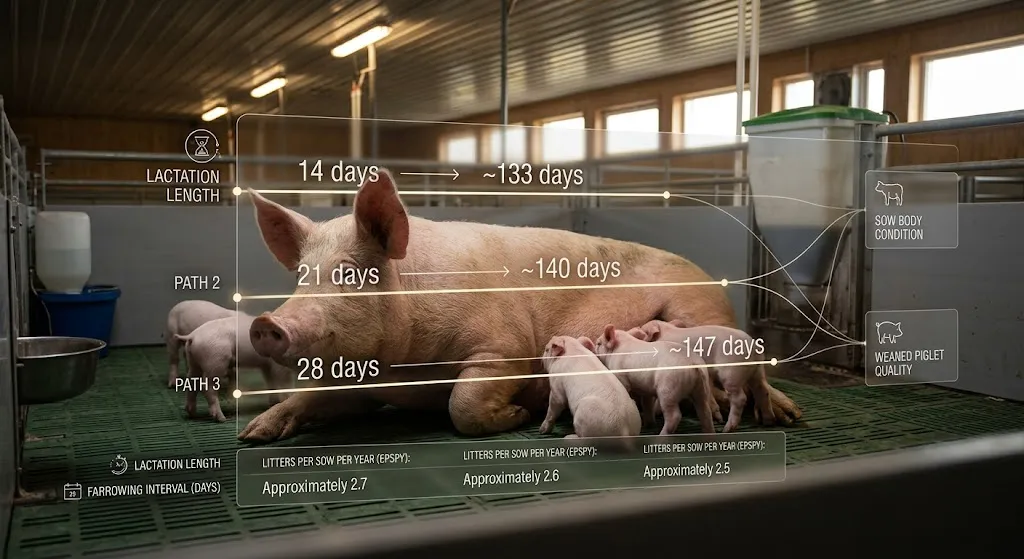
Note how small the differences are. Fourteen days of lactation length moves annual output by roughly 0.2 litters—while carrying real risk to the sow’s next cycle and to the piglets, whose transition depends on establishing feed intake after weaning.
Wean-to-Estrus Interval
Wean-to-estrus interval (WEI) is the time from weaning a litter to the sow returning to estrus, and Penn State Extension notes that a reliable sow returns within about 4 to 6 days, with many producers allowing up to 7 days for signs of estrus to appear.
WEI is the interval most sensitive to what happened earlier in the cycle. A sow that ate poorly during lactation or arrived at farrowing over-conditioned and therefore ate poorly takes longer to cycle. So does a sow weaned before uterine involution has progressed.
Because it is measurable and responsive, WEI is the single most useful early-warning number on a sow farm. It moves before the farrowing rate does and before the litter size does—and it moves for reasons you can act on.
How Many Litters per Year Can a Sow Produce?
A commercial sow typically produces about 2.4 to 2.6 litters per year, calculated as 365 divided by her farrowing interval. Reaching that figure requires the cycle to run without interruption, which is a stricter condition than it sounds.
The theoretical maximum with a 14-day lactation and a 4-day return is roughly 2.7. The practical difference between a well-run herd and an average one is rarely the top figure—it is how often the cycle stalls. This is why herds are benchmarked on pigs weaned per sow per year (PSY) rather than on litters alone: PSY captures litter size, pre-weaning survival, and cycle speed in one number.
Where the Schedule Slips
Cycles are lost to non-productive days, not to biology. Every day a breeding female is neither pregnant nor lactating is a day subtracted from the year, and the losses compound quietly across a herd.
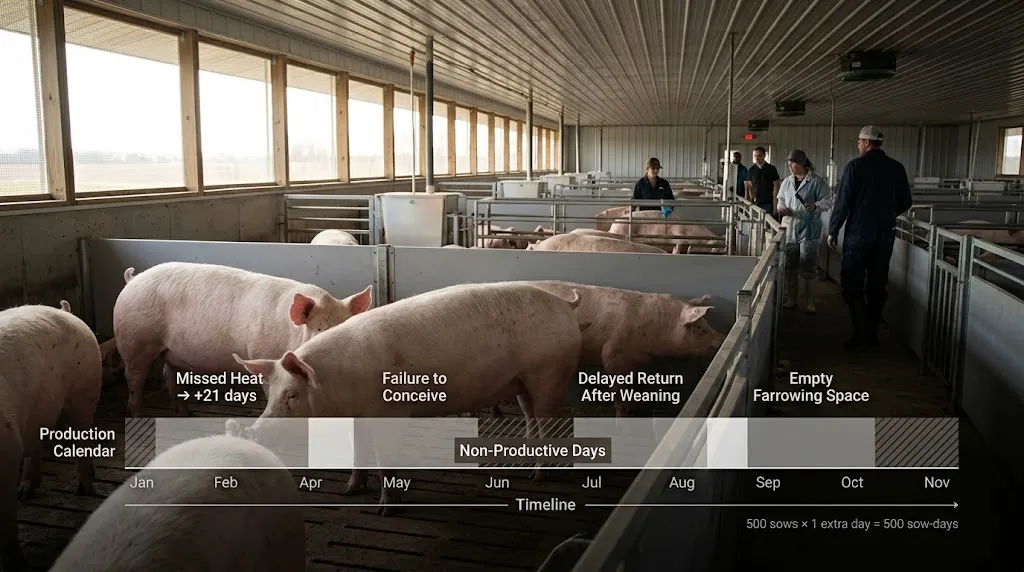
The recurring causes:
- Missed heat. A sow whose estrus goes undetected waits roughly another 21 days for the next cycle. One missed observation costs three weeks.
- Failure to conceive. Penn State Extension lists failure to conceive after two or more attempts among the involuntary culling reasons, alongside anestrus and abortion.
- Delayed return after weaning. A sow that takes 12 days instead of 5 has donated a week.
- Empty farrowing space. Rooms sitting idle between groups are the site-level version of the same loss, and they trace back to how the farrowing room and site flow were planned.
Here is the part that changes behavior: a single day added to the average cycle, across a 500-sow herd, removes roughly 500 sow-days from the year. That is not a rounding error — it is the equivalent of several sows’ entire annual output, lost to a schedule rather than to an animal.
Sow Lifetime and Culling
A sow commonly produces around seven litters before productivity declines, according to Penn State Extension, which makes replacement rate a structural feature of the cycle rather than an occasional event.
Culling divides into two categories. Voluntary culling removes sows for farrowing difficulties, poor litter sizes, poor lactation or rearing ability, poor maternal behavior, or productivity below the herd average. Involuntary culling is forced—anestrus, failure to conceive after repeated attempts, abortion, injury, lameness, or disease.
The distinction matters for scheduling. Voluntary culls can be timed to the flow. Involuntary culls arrive unannounced and leave a gap in a breeding group that was planned months earlier.
Batch Farrowing and Site Flow
Batch farrowing groups sows so that they farrow together in defined windows rather than continuously, which converts the individual sow cycle into a site-wide schedule.
The advantage is all-in/all-out flow: rooms fill and empty as units, allowing complete cleaning between groups and producing uniform pig groups downstream. Weaning, nursery placement, and finishing all inherit that structure.
The cost is rigidity. A sow that misses her batch does not slot into the following week — she waits for the next batch, which can be three or five weeks out. Batch systems trade flexibility for flow, and they demand tighter heat detection than continuous systems to keep that trade favorable.
Frequently Asked Questions
What is the 3-3-3 rule for pigs?
Two versions exist for farm pigs, and neither relates to guinea pigs or dogs. The gestation version is a memory aid: pregnancy lasts about 3 months, 3 weeks, and 3 days, totaling roughly 114 days. The production cycle version describes the sow’s full loop—approximately 3 months pregnant, 3 weeks nursing, and about 3 days back to heat. The first tells you when a litter arrives; the second tells you how often litters arrive.
What is the breeding cycle for pigs?
The estrous cycle is normally 21 days, ranging from 18 to 24, and describes the interval between one heat and the next. The full production cycle is different and longer: about 114 days of gestation, 14 to 28 days of lactation, and 4 to 7 days from weaning back to estrus — roughly 140 days at typical settings. Producers use “breeding cycle” for both, so it is worth confirming which one is meant.
How many times a year can you breed pigs?
A commercial sow is typically bred about 2.4 to 2.6 times per year, since each cycle occupies roughly 140 to 150 days. The figure comes from dividing 365 by the farrowing interval rather than from any biological limit on breeding frequency. Reaching the upper end requires that no cycles are lost to missed heats, conception failures, or delayed returns after weaning.
How many litters can a sow have in a lifetime?
Sows commonly produce around seven litters before productivity declines, which at roughly 2.5 litters per year corresponds to about three years in the breeding herd. Some females are culled far earlier for reproductive failure, lameness, or injury, while others remain productive longer. Herd average parity — the average number of litters across the sow herd — is tracked precisely because it reflects how well the herd is holding onto its productive females.
At what age can a boar breed?
Boars reach puberty before they reach breeding fitness, and commercial practice is to begin using them after they are physically mature enough to serve reliably and to produce adequate semen volume and quality. Using a boar too early tends to produce poor conception rates and can damage his long-term willingness to work. Fertility should be confirmed before a boar is relied on in a breeding schedule.
What is a wean-to-estrus interval and why does it matter?
WEI is the number of days from weaning a litter to the sow showing estrus again, usually 4 to 6 days, with many farms allowing up to 7. It matters because it is the most responsive number in the cycle: it lengthens when lactation feed intake was poor, when the sow was over-conditioned at farrowing, or when she was weaned too early. Because it moves before farrowing rate or litter size does, it works as an early warning.
Conclusion
The commercial pig breeding cycle rewards arithmetic over intuition. Treat the cycle as a sum of four intervals rather than a diagram because only lactation length and wean-to-estrus are genuinely adjustable, and the gains from each are smaller than they look. Watch non-productive days rather than litter size, since a missed heat costs three weeks while a slightly smaller litter costs a few pigs. And track the wean-to-estrus interval as your early-warning number—it moves first, and it moves for reasons you can fix.
Mike Jennings
Explore More
Browse all of our pig breeding guides for more on reproduction, farrowing, and sow herd management in U.S. pig production.