
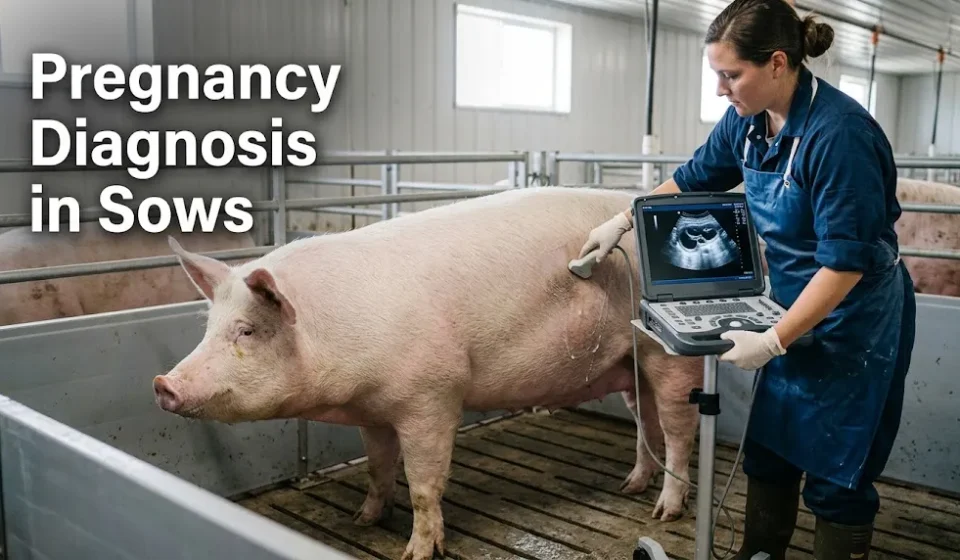
Pregnancy Diagnosis in Sows: Methods, Timing and Accuracy
Pregnancy diagnosis in sows is the process of confirming, as early and as reliably as possible, whether a mated female is carrying a litter — and the decision that matters most is not which machine to buy but when to look.
The same ultrasound scanner is excellent on day 28 and close to useless on day 15. This guide covers the methods in the order a mated female actually passes through them, and sits within our wider resource on breeding and reproduction in pigs.
Quick Answer
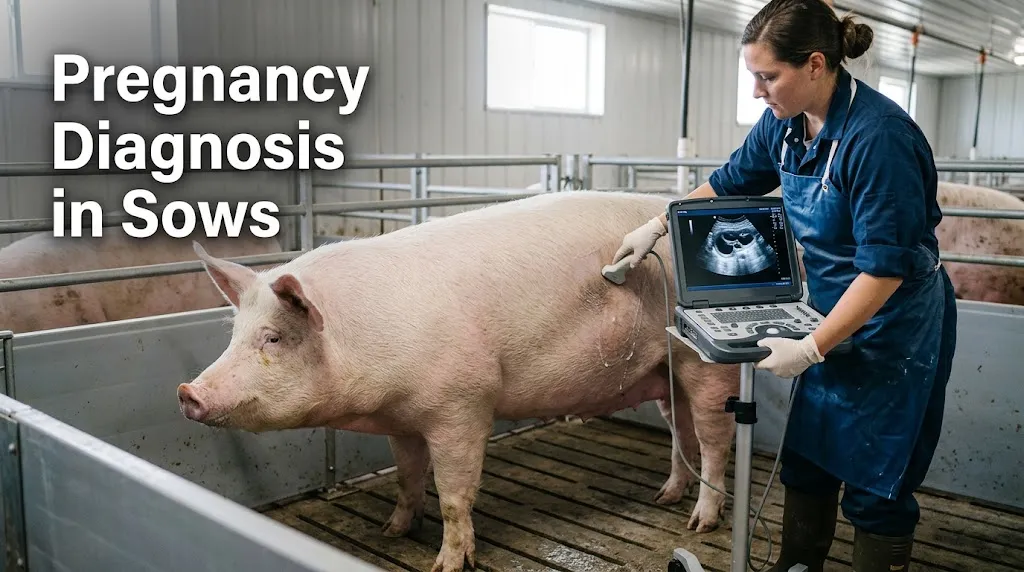
Most non-pregnant females are identified without any equipment, by watching for return to estrus around day 21. Real-time (B-mode) ultrasound is the primary diagnostic tool, used between days 24 and 35 when uterine fluid pockets are at their clearest. Doppler exceeds 95% accuracy only after day 29, and A-mode loses reliability before day 28 and after day 80. Days 38 to 50 are a poor checking window and should be avoided.
Key Takeaways
- Herds average around 70 non-productive days per sow, and roughly 20% of mated females fail to farrow, according to the National Pork Board’s Pork Information Gateway.
- Within that 20%, about 40% are detected by return to estrus near day 21 and a further 35% by real-time ultrasound between days 24 and 35.
- Fluid pockets in the uterus are largest and clearest between days 24 and 35, which is why that window is the standard scanning period.
- A female confirmed pregnant between days 24 and 35 does not need rechecking before farrowing.
- Avoid pregnancy checks between days 38 and 50; recheck after day 50 instead.
- False positives and false negatives cluster in the first three weeks after breeding, whichever tool is used.
Why Timing Decides Accuracy More Than Equipment Does
Every pregnancy test in swine detects a proxy, not the pregnancy itself. Return to estrus detects the absence of a functioning pregnancy. A-mode and Doppler detect fluid and blood flow. Real-time ultrasound detects fluid pockets first and fetal structures later. Each proxy appears, peaks and fades on its own schedule, which is why an accuracy figure quoted without a day attached is close to meaningless.
The practical consequence: a farm with a modest scanner and disciplined timing will outperform a farm with an excellent scanner used whenever someone has a spare hour.
Where the 20% Actually Goes
Of every hundred females mated, roughly twenty will not farrow. Where that failure gets caught determines how many non-productive days it costs.
| When the failure is detected | Share of the failures | Method |
|---|---|---|
| Around day 21 | 40% | Boar exposure and visual detection |
| Days 24–35 | 35% | Real-time ultrasound |
| Later pregnancy loss | 25% | Not captured by early detection |
These percentages describe the distribution within the roughly 20% of mated females that do not reach farrowing, as reported by the Pork Information Gateway. They are not a share of all pregnancies, and they are not breed- or herd-specific figures.
Read the table twice, because it contains the central argument of this guide. The single largest share of detectable failure — 40% — requires no equipment at all. A quarter of failures cannot be caught early by any tool, because the pregnancy was real when it was diagnosed and was lost afterward. What a scanner buys you is the middle 35%, and that is a genuine and worthwhile return, but it is not the whole problem.
Days 18–24: Return to Estrus
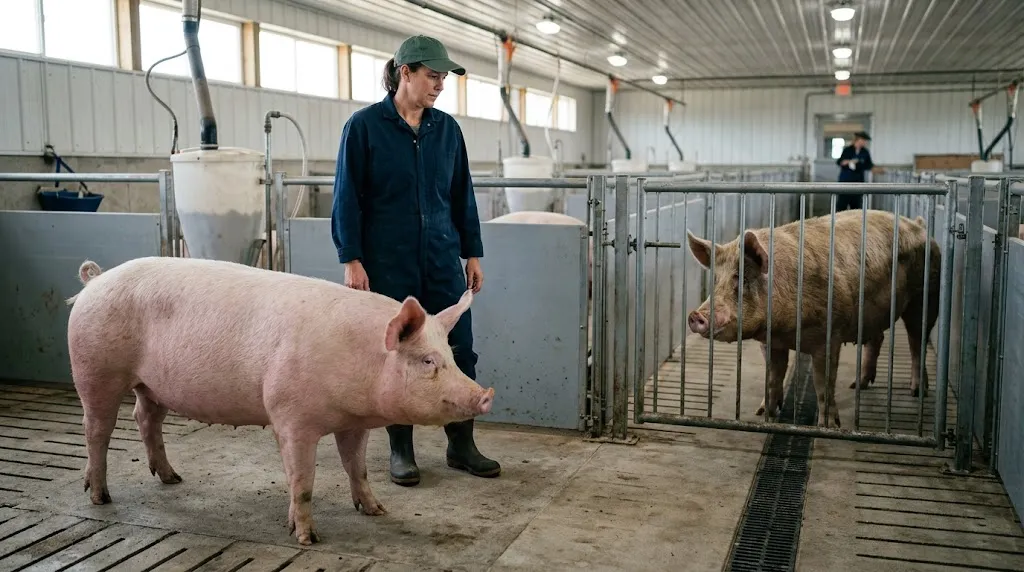
A mated female that comes back into heat around 21 days after service is not pregnant. This is the cheapest and earliest diagnostic signal available, and it is also the one most often squandered by farms that stop checking once a female has been bred.
Run daily boar exposure through the return window, with particular attention to females mated 18 to 24 days earlier. The technique is identical to routine heat detection, and the details of stimulation, back pressure and timing of day are covered in our guide to reading the heat cycle correctly.
The limitation is important. Failing to return is not proof of pregnancy. A female can fail to show heat because she is pregnant, because she was missed, because boar stimulation was inadequate, or because she is genuinely anestrus. Absence of a signal is weaker evidence than presence of one. That asymmetry is the whole reason ultrasound exists: return to estrus is a reliable negative test and an unreliable positive one.
Days 24–35: Real-Time (B-Mode) Ultrasound
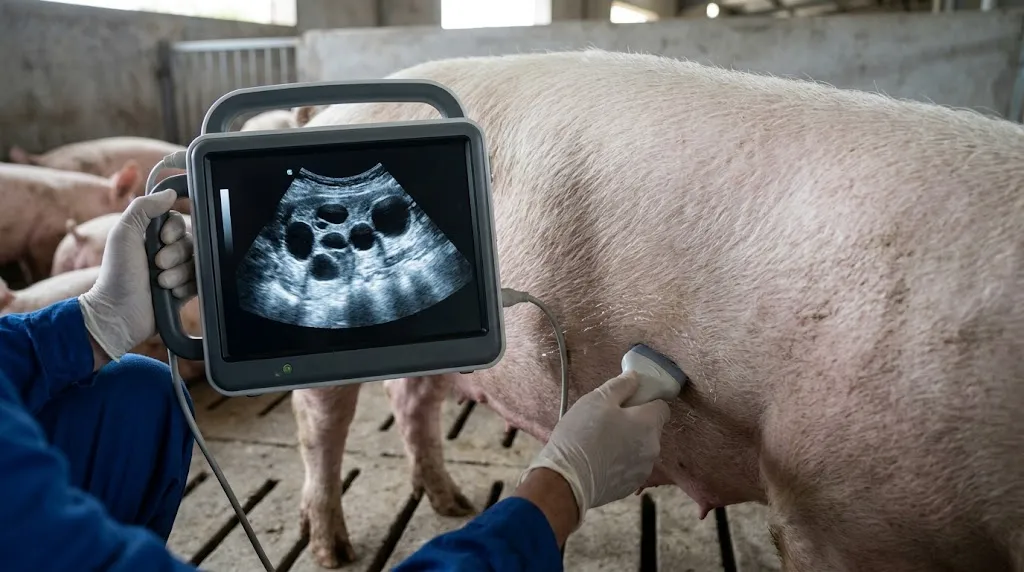
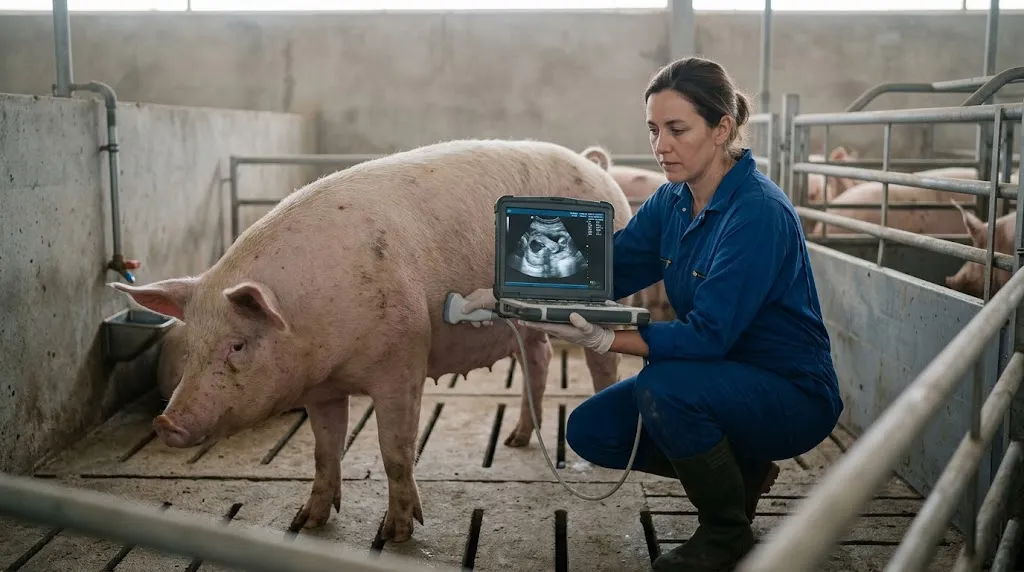
Real-time ultrasound, also called B-mode, produces a live image on a screen. Accuracy for a positive diagnosis rests on visualizing clear, multiple, fluid-filled pockets within the uterus, and those pockets are maximal in size between days 24 and 35 of pregnancy. That is not a manufacturer’s recommendation; it is the biology the technique depends on.
The probe is placed on the flank above a point between the last two nipples on the female’s right underline, angled toward the uterus, with oil or gel applied first so the sound waves penetrate the skin rather than deflecting off it.
Two protocol rules follow directly, and both are firm:
- A female diagnosed pregnant between days 24 and 35 does not need rechecking before farrowing.
- A female diagnosed open at day 24 should be rechecked a few days later before any culling or rebreeding decision is made.
Later in gestation the technique changes character. Between days 65 and 75 the scanner shows fetal skeletons and heartbeats rather than fluid alone, which is what makes it capable of distinguishing true pregnancy from fluid accumulation in the uterus. On one commercial farm with a history of pseudopregnancy, 115 of 138 non-pregnant females were correctly identified this way.
Doppler and A-Mode: Where Older Equipment Still Fits
Doppler
Doppler detects blood flow rather than fluid. Its accuracy exceeds 95% after day 29 of gestation, but before day 29 it falls to somewhere between 70% and 85%. The reason is specific: implantation completes around day 30 and brings with it a regular pattern of blood flow in the uterine and umbilical arteries. Before that pattern establishes, there is less for the instrument to find.
A-mode
A-mode, or amplitude-depth, is generally the least expensive option and gives a simple positive or negative output rather than an image. It is also the least flexible in timing: its accuracy is compromised before day 28 and again after day 80.
A field study in the Netherlands compared the two approaches on 881 females scanned between days 24 and 32 on a commercial farm. Specificity was 90.6% for real-time ultrasound against 55.8% for A-mode, and the negative predictive value was 100% against 70.5%. In that herd, in that window, an A-mode negative result was wrong a substantial share of the time. These are figures from one commercial population at one stage of gestation, not universal constants — but the direction is consistent with the underlying principle that an image carries more information than a beep.
Comparing Methods for Pregnancy Diagnosis in Sows
| Method | Best timing | What it detects | Sensitivity / accuracy* | Specificity | Main limitation |
|---|---|---|---|---|---|
| Return to estrus | Days 18–24 | Absence of pregnancy | Reliable as a negative test | Not applicable | Silence is not proof of pregnancy |
| Real-time (B-mode) | Days 24–35 | Fluid pockets, later fetal structures | High within window | 90.6% in the Utrecht study (days 24–32) | Requires operator skill and interpretation |
| Doppler | After day 29 | Uterine and umbilical blood flow | Over 95% after day 29; 70–85% before | Not reported in the sources used here | Poor before implantation completes |
| A-mode | Days 28–80 | Fluid depth | Compromised outside the window | 55.8% in the Utrecht study (days 24–32) | Highest rate of misdiagnosis; no image |
| External physical signs | Late gestation | Udder and abdominal development | Late and non-specific | Not applicable | Far too late to save non-productive days |
*Sensitivity, specificity and overall accuracy are different measures drawn from different studies with different populations and gestation windows. They are not directly comparable across rows, and this table should be read as a guide to timing and limitation rather than a ranking by a single number.
Days 38–50: Why This Is a Poor Checking Window
Between roughly day 38 and day 50, pregnancy becomes harder to read on a scanner rather than easier. Uterine fluid declines from its day 24–35 peak, and the fetuses grow and begin calcifying — so the clear fluid pockets the technique depends on are fading while the fetal structures that replace them as a diagnostic target are not yet unmistakable.
The Pork Information Gateway’s guidance is to avoid pregnancy checks during this period altogether. If a female is checked in this window and appears open, do not act on that result. Recheck once more after day 50 before culling.
This is the most common avoidable error in farm pregnancy checking: a real pregnancy diagnosed as open at day 42, followed by a cull decision on a productive female.
When a Mated Sow Appears Empty
Work the sequence rather than the instinct.
| Stage | What it means | Action |
|---|---|---|
| Returns to estrus ~day 21 | Not pregnant | Rebreed at this heat |
| Open on scan at day 24 | Provisional only | Recheck a few days later before deciding |
| Confirmed open after recheck | Reliable | Rebreed at next estrus, or cull |
| Appears open between days 38 and 50 | Unreliable window | Do not act; recheck after day 50 |
| Confirmed pregnant days 24–35, later found open | Pregnancy loss, not a testing error | Investigate at herd level |
That last row is the one most often mistaken for a false positive. False positives and false negatives do occur, and they cluster in the first three weeks after breeding when every method is at its weakest. But a female correctly diagnosed pregnant at day 28 who is found open at day 70 falls into the 25% of failures that early detection cannot capture — she lost the pregnancy afterward.
Repeated losses of that kind are a health question rather than a diagnostic one, and they warrant a structured investigation of the kind described in our guide to herd health investigation rather than a new scanner. If the pattern instead points to the breeding itself — repeat services, poor conception across a whole batch — look first at insemination timing, where small timing errors produce exactly this signature.
What Confirmation Changes
A confirmed pregnancy is a scheduling event as much as a biological one. It fixes a farrowing date, allocates a crate, and moves the female onto a different feeding curve — see our guide to gestation feeding for how intake should change once pregnancy is established.
Confirmation also feeds the herd’s forward planning. Knowing which females are carrying, and when, is what makes pig flow predictable across the production cycle rather than reactive.
The Economics of Checking Early
Non-productive days are days a female is neither pregnant nor nursing while still consuming feed and occupying space. With herds averaging around 70 such days per sow, the value of pregnancy diagnosis is measured in how many of those days it removes, not in the accuracy figure on the equipment brochure.
The arithmetic is straightforward. A female identified as open at day 24 can be rebred at her next heat. The same female identified at day 80 has consumed roughly two additional months of feed and crate space for nothing. Whether a scanner pays for itself is a herd-size calculation rather than a universal answer, and it belongs alongside the other fixed-cost decisions covered in our guide to cost per non-productive day.
Conclusion
Three points carry the weight here. First, timing governs accuracy more than equipment does: real-time ultrasound between days 24 and 35, Doppler after day 29, A-mode between days 28 and 80. Second, the largest single share of detectable failure — about 40% of the roughly 20% that do not farrow — is caught by watching for return to estrus with no equipment at all. Third, days 38 to 50 are a blind window, and a female that appears open during it should be rechecked after day 50 rather than culled.
Mike Jennings
Explore more in our Breeding and Reproduction in Pigs category.