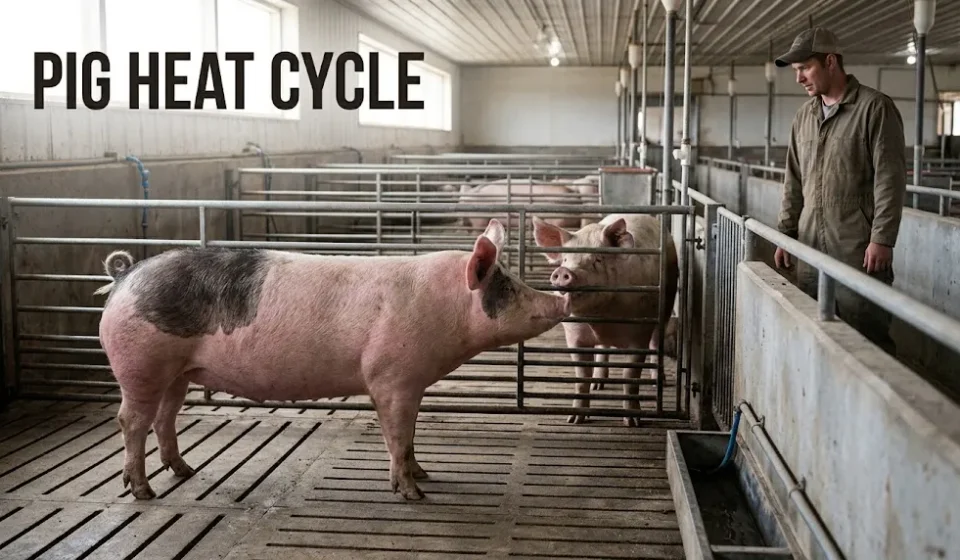
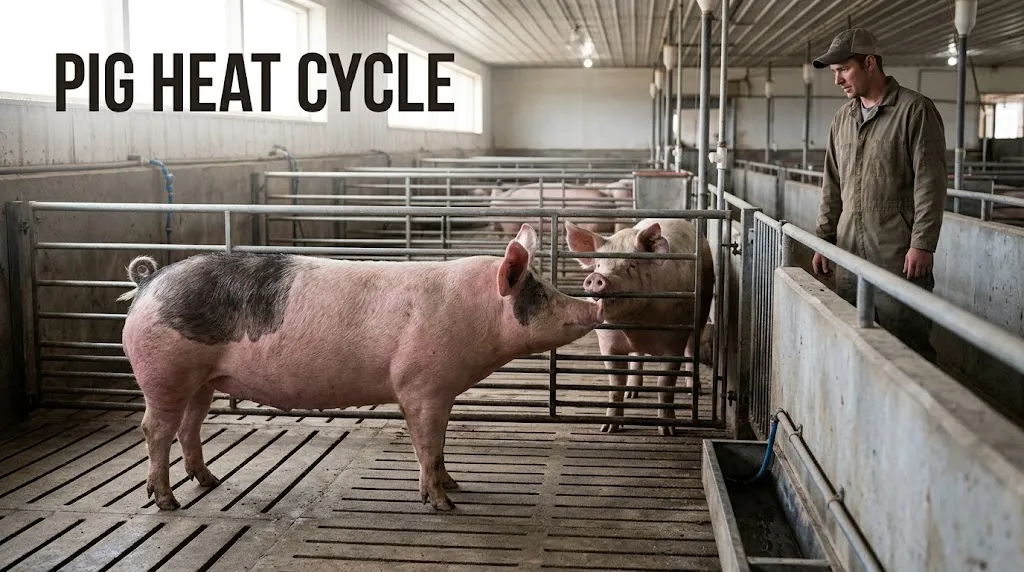
Pig Heat Cycle: Stages, Signs and Breeding Window
The pig heat cycle is the repeating reproductive rhythm that decides when a gilt or sow can conceive, and reading it correctly is the single skill that separates a breeding herd that stays on schedule from one that drifts. Most missed matings on U.S. farms are not caused by pigs that failed to cycle. They are caused by heat that happened and was not seen.
This guide sits within our wider resource on breeding and reproduction in pigs and focuses on what you can actually observe, when to act on it, and what to do when a female shows nothing at all.
Quick Answer
The pig heat cycle averages 21 days from one heat to the next, with a normal range of 18 to 24 days. Standing heat itself lasts about 40 hours in gilts and 55 hours in sows, though individual females range from 12 to 84 hours. Ovulation occurs roughly two-thirds of the way through heat, usually 30 to 40 hours after it begins. The confirming sign is the standing reflex: the female locks up under back pressure while a boar is present.
Key Takeaways
- The estrous cycle averages 21 days, ranging from 18 to 24 days, according to the National Pork Board’s Pork Information Gateway.
- Standing heat averages 40 hours in gilts and 55 hours in sows, with individual variation from 12 to 84 hours.
- Ovulation happens at about two-thirds of the way through heat, typically 30 to 40 hours after onset.
- Weaned sows normally come into heat 3 to 5 days after weaning; gilts reach first heat at 170 to 210 days of age with boar stimulation.
- Estrus detection rate tends to fall when females are more than 3 feet from the heat-check boar.
- Silent heat is relatively rare. Missed heat caused by human error or weak boar stimulation is far more common.
What the Pig Heat Cycle Is — and Why “Heat” Means Two Things
The pig heat cycle, or estrous cycle, is the recurring hormonal sequence in a sexually mature female that produces a short window of sexual receptivity and ovulation, then resets. Estrus is the technical name for the receptive phase itself, and heat is the everyday word for the same thing. Pigs are polyestrous and non-seasonal, meaning they cycle year-round rather than in a fixed breeding season.
Heat versus heat stress
Two unrelated meanings collide in the barn. Reproductive heat is estrus. Heat stress is the physiological strain of high ambient temperature. They are not the same condition, but they do interact, which is why the confusion matters. Research on a 2,500-sow commercial herd conducted by North Carolina State University found that sows weaned in spring showed a shorter duration of estrus than sows weaned in summer, 53.1 hours against 60.8 hours, and that season also shifted the time of ovulation.
The practical reading is that warm weather moves the target rather than removing it. In that herd, a multiple-insemination schedule absorbed the shift and subsequent fertility was not measurably affected.
The Four Stages of the Pig Heat Cycle
The pig heat cycle runs through four stages — proestrus, estrus, metestrus and diestrus — but only one of them is visible enough to breed on. Published stage-by-stage hour counts vary widely between sources and are not reliable enough to plan a breeding day around, so what follows describes what each stage does rather than assigning it a precise duration.
Proestrus
Proestrus is the buildup phase, when ovarian follicles develop and estrogen rises. Two to three days before heat begins, that rising estrogen increases blood flow and fluid retention in the reproductive tract, swelling and reddening the vulva. Behavior shifts too: vocalization changes, activity rises, and feed intake may drop. These are warning signs, not breeding signs. Mark the female and check her again next round.
Estrus (standing heat)
Estrus is the receptive phase in which the female will accept the male and is capable of conceiving. This is the only stage that matters for insemination timing, and everything in the rest of this guide is calibrated to it.
Metestrus
Metestrus follows ovulation, as the ruptured follicles form corpora lutea and estrogen falls away. Receptivity ends. A female that stood yesterday and refuses today has moved into this phase.
Diestrus
Diestrus is the long, quiet luteal phase dominated by progesterone. If the female conceived, it continues into pregnancy. If not, the corpora lutea regress and proestrus begins again, which is what produces the roughly 21-day rhythm.
How to Tell a Sow Is in Heat
The definitive sign is immobilization — standing rigid in response to back pressure from a boar, another female, or a person. Every other sign is supporting evidence, and none of them is guaranteed to appear.
Preliminary signs
| Sign | What it looks like | Gilt or sow |
|---|---|---|
| Swelling and reddening | Vulva swells and reddens 2–3 days before onset | Obvious in gilts; in sows usually visible only if the vulva is parted |
| Mucous discharge | Clear sticky mucus on the vulva, increasingly tacky when pressed between fingertips | Both |
| Riding | Mounting pen mates; most females will not tolerate being mounted and will vocalize and escape | Group-housed females |
| Crate behavior | Biting at neighbors or climbing the crate when a boar passes | Crated females |
| Boar seeking | Moving forward toward a passing boar with visibly more effort than usual | Both |
These signs are not always exhibited, and their intensity varies between individual females, between breeds, and between herds. Do not treat their absence as proof that a female is not cycling.
The standing reflex
Some females in heat lock up with no physical contact at all when a boar passes close by. The ears may spring erect in certain breeds, the back arches slightly, and the legs brace through isometric muscle contraction as if preparing to carry weight. Once a female begins standing she will often hold for 10 to 15 minutes, then refuse to be mounted even though she is still in heat. That refractory state fades within a few hours and she will stand again.
The back-pressure test
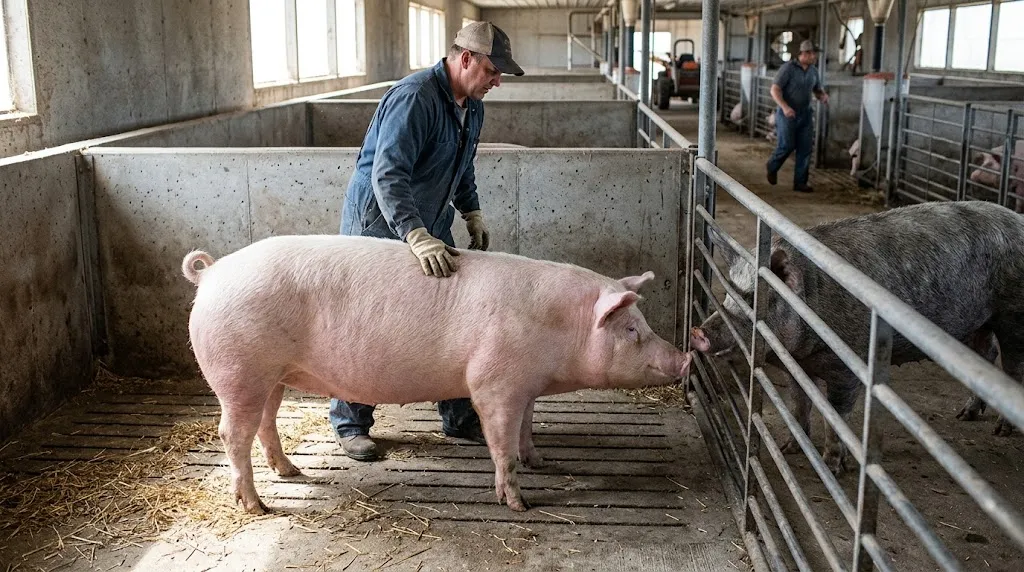
The back-pressure test is applying firm downward pressure to the female’s back to see whether she stands immobile. A few females will stand for it with no boar present, but many will not. The reliable sequence is boar contact first, then firm strokes along the flank and underline, then pressure on the back.
With a boar present, females will generally stand for back pressure about 6 to 10 hours earlier than they would without one — which means the boar is not an accessory to the test, he is part of it.
How Long Pigs Stay in Heat — and Why the Range Is So Wide
Standing heat averages 40 hours in gilts and 55 hours in sows, but the individual range runs from 12 to 84 hours. That spread is not sloppy measurement. It reflects real biological and management variables, and knowing which ones apply to your barn is more useful than memorizing the average.
| Variable | Effect on observed duration |
|---|---|
| Gilt versus sow | Standing heat is often shorter and less intense in gilts, while preliminary signs last longer |
| Individual variation | Dominant factor; 12 to 84 hours across individuals |
| Season | Summer-weaned sows showed longer estrus than spring-weaned sows in the NC State commercial herd study |
| Intensity of boar stimulation | Stronger stimulation tends to lengthen the observed duration, because onset and end are gradual transitions rather than switches |
| Check frequency | A female checked once a day can only be recorded in whole-day increments, which compresses the apparent range |
The last two rows deserve emphasis. Duration of heat is partly an artifact of how you measure it. Two farms with identical pigs and different heat-check protocols will report different numbers.
When to Inseminate — and Why Onset Alone Is a Weak Guide
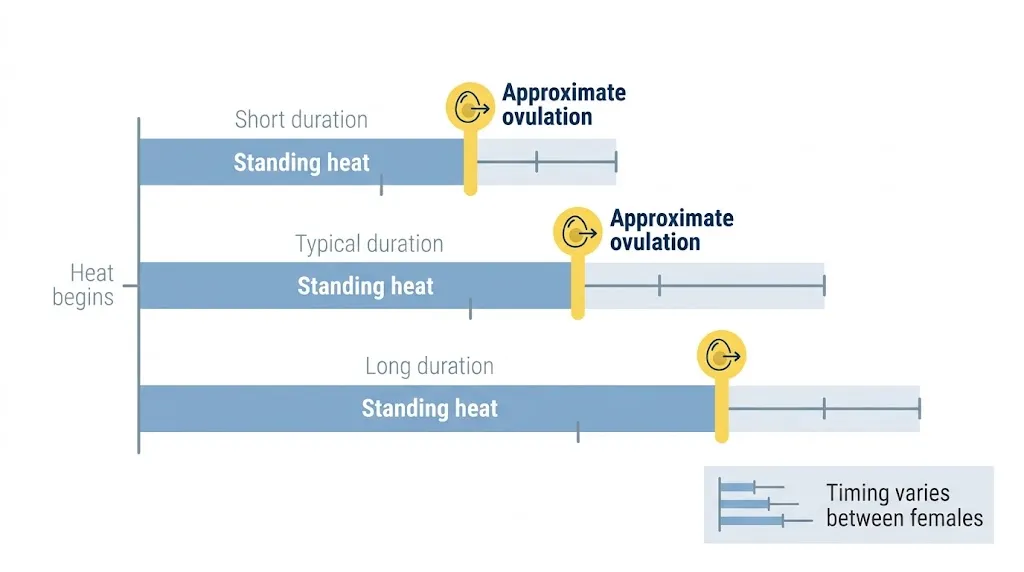
Insemination should be timed to fall within roughly 24 hours before ovulation, and because ovulation cannot be observed directly on farm, most U.S. herds cover the window with more than one service rather than betting on a single hour. Ovulation occurs at about two-thirds of the way through heat, typically 30 to 40 hours after onset.
The complication is that onset of heat is a poor predictor of ovulation on its own. The reproductive physiology literature reports that the moment of ovulation after onset can vary from 10 hours to 85 hours across sows, which is why duration of heat, not onset, is currently the better working predictor: ovulation falls at roughly 70 percent of the way through, whatever the total length turns out to be.
Gilts
Gilts show shorter, less intense standing heat than sows and need more stimulation to express it, so the practical margin for error is narrower. Check twice where labor allows and treat a gilt that stands strongly as a shorter window than a sow that does the same.
Sows
Sows show longer heat with a wider spread, and the weaning-to-estrus interval itself shifts both duration and ovulation timing. Sows that return to heat quickly after weaning behave differently from those that take longer, which is one reason a fixed farm-wide hour rule performs poorly.
Natural service versus artificial insemination
Under natural service the boar does the detecting and the timing partly corrects itself. Under artificial insemination that responsibility transfers entirely to the technician, which is precisely why detection accuracy carries more weight on AI farms. The mechanics of dose handling, catheter placement and service intervals are covered in our guide to timing artificial insemination correctly.
Gilts Versus Sows: Where the Cycle Differs
The cycle length is the same; the entry points and the expression differ.
Puberty in gilts
First heat usually occurs at 170 to 210 days of age in gilts that receive boar stimulation — the stimulation is part of the trigger, not just the detection method. Gilts that never get proper boar contact are frequently recorded as non-cyclers when the real problem is the protocol. Which animals enter the herd in the first place is a separate decision, covered in our guide to selecting breeding stock.
The wean-to-estrus interval
The wean-to-estrus interval is the gap between weaning a litter and the sow returning to heat, and in mature sows it normally runs 3 to 5 days after weaning. Body condition coming out of lactation influences it, which links feeding decisions directly to breeding performance — see our guide to sow feeding through lactation.
Start daily boar exposure the day after weaning even though none of the sows should be in heat for another 2 or 3 days, because the exposure itself promotes onset and reduces anestrus.
When She Does Not Come Into Heat
Start from the assumption that the heat happened and was missed, because that is statistically the most likely explanation. Silent heat — ovulating without showing the standing response — occurs, but it appears to be relatively rare in most situations. Missed detection caused by human error or inadequate boar stimulation is far more common, and it leads directly to the wrong conclusion that a female is not cycling.
Missed detection
Work through the protocol before working through the animal. Was the boar mature and willing? Was he close enough? Detection rate tends to fall once females are separated from the boar by more than 3 feet. Was he present continuously rather than only at check time, allowing habituation to blunt the response? Was the check done at the right hour?
Habituation and the refractory state
Habituation is the loss of response that follows constant boar presence — the novelty wears off. House heat-check boars away from the females between checks. The refractory state is different: a female who has already stood for 10 to 15 minutes will temporarily refuse, then become receptive again within hours. A female recorded as negative immediately after standing for someone else is a bookkeeping error, not an open sow.
True anestrus
Only after the protocol has been cleared does a genuine failure to cycle become the working diagnosis. Anestrus is the absence of cycling activity, and it warrants a veterinary workup covering body condition, nutrition, lameness, disease and age rather than a guess.
Season
Seasonal effects shift duration and ovulation timing, as the NC State work showed, and can reduce or delay observable heat. They are a reason to tighten detection in summer, not a reason to stop checking.
Building a Heat-Detection Routine
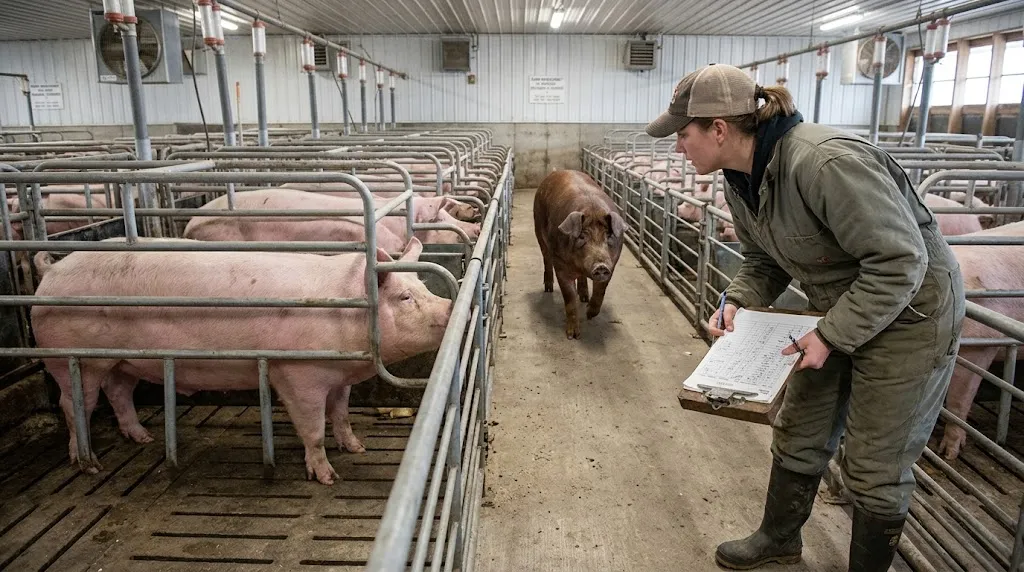
Base the routine on the type of female rather than the size of the herd. The National Pork Board’s detection checklist separates three groups, and the distinctions hold whether you run 5 sows or 500.
| Group | Boar exposure | What to focus on |
|---|---|---|
| Gilts | 10–15 minutes of direct physical contact daily, starting shortly after entry to the breeding herd | Avoid both extremes: constant boar presence and insufficient exposure. Expect longer preliminary signs and shorter standing heat |
| Weaned sows | A few minutes of close nose-to-nose contact daily, starting the day after weaning | Firm flank and underline strokes, then back pressure while the boar is focused on her. Recheck anyone who nearly stood |
| Mated females | Daily checking, without exception | Special attention to females mated 18–24 days earlier — one cycle post-mating, the likeliest return window |
On timing of day: onset most commonly occurs during late night and early morning hours, which is why heat check is usually run shortly after morning feeding. An additional afternoon check is typically unproductive, because few new females come into heat between the morning check and the end of the workday.
Recording matters as much as observing. A date, a sign, and a response per female is enough to predict the next heat, identify repeat offenders, and tell a missed heat apart from a genuine non-cycler. That distinction is the difference between a management fix and a veterinary one — a principle that applies across the whole production calendar, as our overview of the commercial breeding cycle lays out. The same records are equally valuable on small-scale operations, where a single missed heat carries a proportionally larger cost.
Frequently Asked Questions
How long does a pig stay in heat?
Standing heat averages about 40 hours in gilts and 55 hours in sows, but individual females range from 12 to 84 hours. The spread reflects genuine individual variation plus management factors — stronger boar stimulation lengthens the duration you actually observe, and season shifts it as well. Treat the average as a planning figure and the range as the reason to check every female rather than assuming she follows the mean.
How often do pigs come into heat?
A non-pregnant, sexually mature female returns to heat on an average 21-day cycle, with a normal range of 18 to 24 days. Pigs are non-seasonal, so this repeats year-round rather than within a breeding season. After weaning, a sow does not follow the 21-day clock — she typically returns to heat 3 to 5 days after her litter is removed.
How can you induce heat in pigs naturally?
Boar exposure is the main non-pharmaceutical tool. Daily physical contact with a mature, high-libido boar stimulates the onset of puberty in gilts and promotes return to heat in weaned sows, and moving small groups of gilts to the boar’s pen appears more effective than moving the boar to theirs. Relocation or transport can also synchronize heat in gilts approaching puberty. Hormonal protocols exist but are veterinary decisions requiring product-label directions.
What are the first signs of heat in a gilt?
In gilts, vulva swelling and reddening are usually the earliest visible changes, appearing 2 to 3 days before standing heat and showing more obviously than in sows. Clear, sticky mucous discharge and increased effort to reach a passing boar follow. None of these confirms breeding readiness on its own — only the standing reflex under back pressure with a boar present does that.
Can a pig be in heat without showing signs?
Yes, but it is uncommon. Females can ovulate without exhibiting the standing response, and this is known as silent heat. It appears to be relatively rare in most situations. Far more often, heat is missed because of human error or inadequate boar stimulation, and the female is then wrongly assumed not to be cycling. Audit the detection protocol before concluding an animal has a reproductive problem.
Conclusion
Three things carry most of the value here. First, the pig heat cycle averages 21 days and standing heat averages 40 hours in gilts and 55 in sows — but the 12-to-84-hour range is the number that should shape your protocol. Second, ovulation falls at roughly two-thirds of the way through heat, and onset alone is too weak a signal to time a single service on. Third, when a female shows nothing, the detection protocol is the more likely culprit than the animal.
Mike Jennings
Explore more in our Breeding and Reproduction in Pigs category.