
Pig Artificial Insemination: Timing, Technique, and Where It Fails
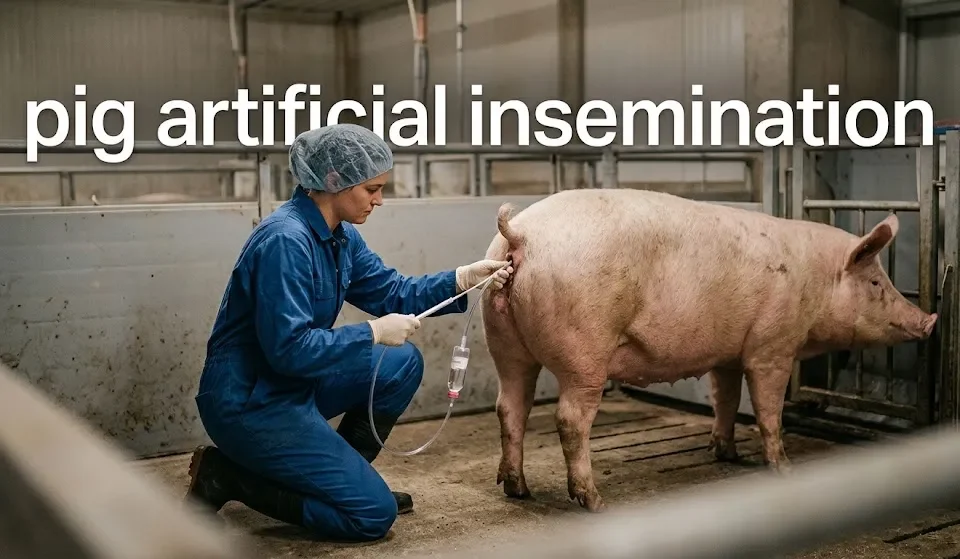
Pig artificial insemination is the practice of depositing boar semen in the female’s reproductive tract by hand rather than through natural mating, and it is the dominant breeding method on U.S. commercial farms. Most failures trace to three things — semen handling, heat detection, and catheter placement — rather than to the animals themselves. This guide sits within our wider resource on breeding and reproduction in pigs.
Quick Answer
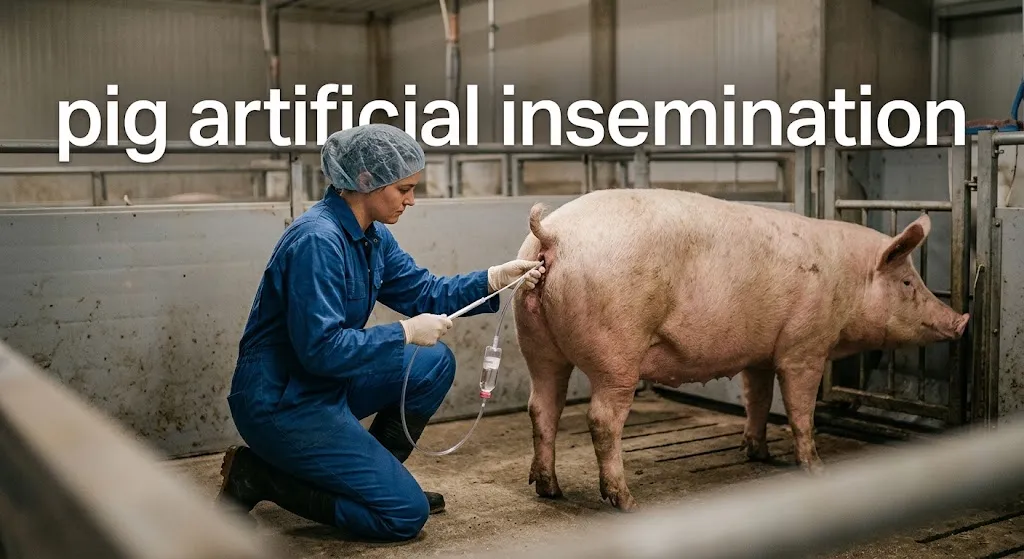
Pig artificial insemination involves inseminating a female at the onset of standing heat and again about 24 hours later, using liquid-stored boar semen held near 63°F. A lubricated spiral or foam-tipped catheter is guided in with the tip pointed up, rotated counterclockwise into the cervix, and the semen is then drawn in by uterine contractions rather than pushed. The procedure itself is straightforward; timing and semen handling are what determine whether it works.
Key Takeaways
- Roughly 99% of swine AI worldwide uses liquid-stored semen, not frozen — the opposite of cattle practice.
- Boar semen is held near 63°F (17°C), far warmer than a household refrigerator.
- The catheter tip is kept pointed up to avoid the bladder, because urine backflow kills sperm.
- The semen bottle is attached only after the catheter is correctly placed.
- The swine reproductive tract is more suited to AI than that of cattle or sheep.
Why Producers Use AI
Artificial insemination lets a farm use genetics from boars it does not own, which is the reason it displaced natural service across U.S. commercial production. Three advantages drive the shift.
Genetic access. Semen from high-merit, health-tested boars can be used on any farm, so herd improvement no longer depends on which boar you can afford to house. Which females receive that semen is a separate decision, covered in choosing which females to breed.
Lower cost. Fewer intact boars to house, feed, and handle. Mature boars are large, difficult, and expensive to maintain, and each one covers a limited number of females.
Biosecurity. Moving semen rather than live animals removes one of the highest-risk pathways for introducing disease onto a farm — the arrival of a new pig.
There is a real trade-off. University of Missouri Extension notes that AI may require a higher level of management than natural service, with a greater chance of human error, because in natural mating the semen is not subjected to severe environmental changes and is deposited more than once across the fertile window. AI moves that responsibility to the operator.
Why AI Means Artificial Insemination in Swine
In swine literature, AI has meant artificial insemination for decades, and the abbreviation predates the current use of the same letters for artificial intelligence by a wide margin.
This matters practically. A search for “AI in pigs” returns both breeding content and precision-livestock-technology content, and product marketing now uses the collision deliberately. Throughout this article, AI refers to insemination. Artificial intelligence is spelled out wherever it appears.
Why Boar Semen Is Usually Stored as Liquid
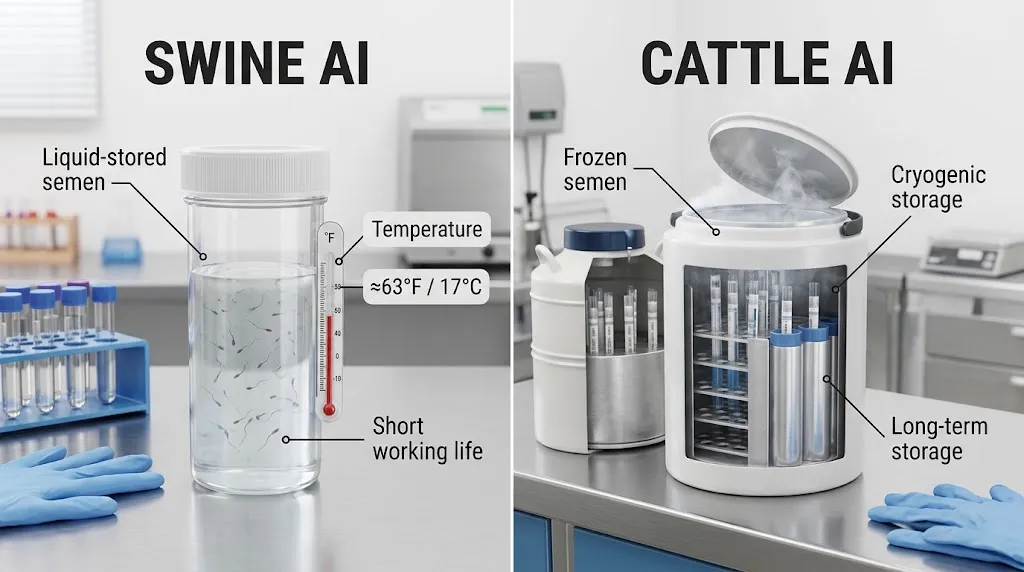
Boar semen is normally stored and shipped in liquid form rather than frozen, and this is the single most consequential difference between swine AI and the cattle AI most people have encountered.
Liquid-stored semen accounts for approximately 99% of AI procedures worldwide, with frozen-thawed semen making up less than 1%. Frozen boar semen exists — it is used in research and in genetic preservation — but it is not the working format on commercial farms.
The reason is biological. Boar sperm tolerate freezing and thawing poorly compared with bull sperm, and the fertility loss has never been small enough to justify the convenience. So the swine industry built its logistics around a product with a shelf life of days rather than years.
Everything downstream follows from that. Semen is ordered against a breeding schedule rather than kept in a tank. A missed delivery is a missed breeding week. And the storage rules below are not optional refinements — they are the entire reason the dose is still viable when it reaches the sow.
If you have done cattle AI, unlearn the liquid nitrogen model before you start. It is the most common source of ruined doses among newcomers.
Storing and Handling Boar Semen
Boar semen is stored at approximately 63°F (17°C), a temperature that is neither room temperature nor refrigeration. Penn State Extension notes that specialized refrigerators designed to hold this temperature are commercially available, but that for small farms the purchase is unlikely to be economically advisable—which makes timely ordering and prompt use more important, not less.
| Factor | Requirement | What happens if it’s wrong |
|---|---|---|
| Temperature | ~63°F (17°C) | Cold shock below range; accelerated decline above |
| Mixing | Gently invert twice daily | Sperm settle unevenly dose |
| Handling | No vigorous shaking | Physical damage to sperm |
| Light | Keep protected | Damage to sperm |
| Time since collection | Use promptly | Motility and viability decline with age |
A household refrigerator runs near 38°F. Storing boar semen there is not a compromise—it is a discarded dose.
Two habits separate operations that get consistent results. Invert the containers twice daily, gently; Penn State specifies that the re-mixing should not be a vigorous shake. And check viability before use where possible: semen can be crudely evaluated on-farm with a microscope, placing less than a drop on a slide, or by viewing a transparent container directly.
Timing: The Window That Decides Everything
Insemination is timed to the onset of standing heat, not to a fixed number of days after weaning, and this is where most AI programs succeed or fail.
Standing heat — the period when a female will hold still under back pressure and accept mating — is detected by applying pressure to her back, ideally with boar contact. West Virginia University Extension describes bringing a boar to the female for nose-to-nose contact in an adjacent pen, using boar spray on her snout when no boar is available, and acting as a boar by pressing on her shoulders, sides, and back.
That contact does more than reveal heat. The locked-up standing position triggers oxytocin release, which produces the uterine contractions that transport semen toward the oviduct. Boar presence is part of the insemination, not just part of the detection.
Common practice is to breed at least twice during standing heat, roughly 24 hours apart. Published research describes conventional practice as breeding sows by AI at least twice using approximately three billion sperm per insemination upon standing heat—a description of commercial convention rather than a universal prescription; follow the dose specifications supplied with your semen.
Because heat length varies widely between gilts and mature sows, detection has to be a daily routine. Where this fits in the wider schedule is covered in our guide to the commercial pig breeding cycle.
How Pig Artificial Insemination Is Performed
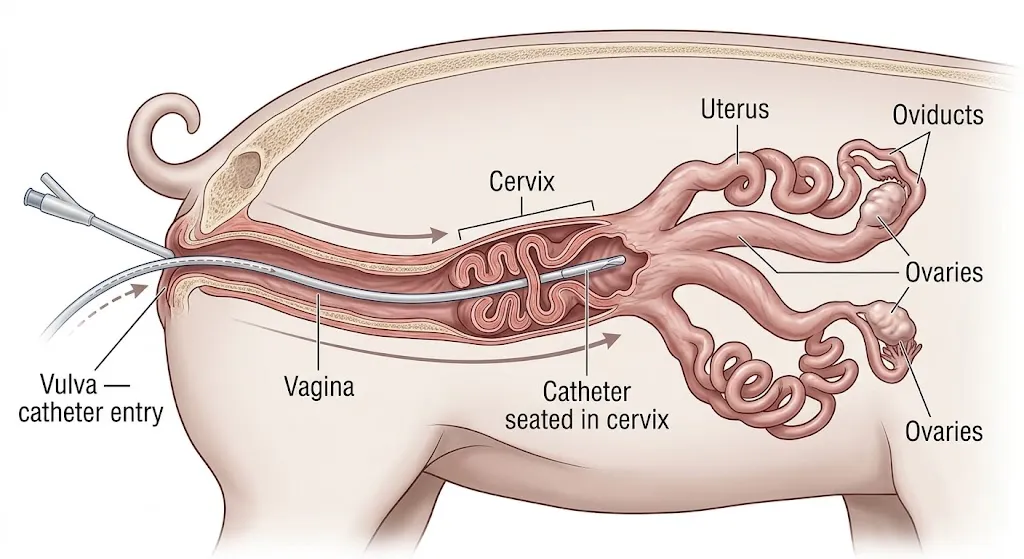
The procedure has six steps, and the details that look fussy are the ones that determine whether sperm survive the trip. The sequence below follows University of Missouri Extension’s published guidance.
- Clean the vulva with a paper towel before beginning. This prevents debris and micro-organisms being drawn into the tract by the catheter.
- Lubricate the catheter tip with a nonspermicidal lubricant or a few drops of extender. Take care not to get lubricant inside the opening of the catheter.
- Insert with the tip pointed up, guiding gently through the vagina toward the cervix. Keeping the tip up minimizes the chance of contacting the bladder, which can cause urine to flow back into the catheter. If that happens, a new catheter is needed, because urine kills sperm.
- Do not attach the semen bottle yet. This is the primary reason for the previous step — a urine backflow into an attached bottle contaminates the whole dose, not just the catheter.
- Rotate counterclockwise into the cervix until resistance is felt, then check placement by pulling back gently. A correctly seated catheter locks into the cervical ridges.
- Attach the bottle and let the female take the semen. Invert the bottle a few times to mix, then allow gravity and uterine contractions to draw it in over several minutes. Do not squeeze it through.
That last point is where impatience costs money. Forcing the dose increases backflow, and the semen ends up on the floor rather than in the uterus.
Show Image
Why the Anatomy Cooperates
The swine cervix consists of multiple ridges that act as a barrier against bacteria and debris, and during estrus it becomes swollen—which is exactly what allows a spiral catheter to lock in place without further equipment.
Missouri Extension states it directly: the reproductive system of the female pig is more conducive to AI than that of cattle or sheep, making AI less time-consuming and easier to accomplish in swine. There is no rectal palpation, no deep anatomical navigation. The cervix does the holding for you.
Equipment You Actually Need
The equipment list is short and inexpensive, which is why AI scales down to small herds better than most reproductive technology.
- Catheters — spiral (spirette), foam-tipped, or deep uterine. Foam-tipped types are often used for gilts. All are single-use.
- Nonspermicidal lubricant or extender for the tip.
- Paper towels for cleaning.
- Temperature-controlled storage near 63°F, or a purchasing schedule tight enough not to need it.
- A microscope, optional but useful for checking viability.
- Boar contact or boar spray for stimulation during detection and insemination.
Catheters are single-use items. Reusing one carries a contamination risk that is not worth the saving on a plastic rod.
Why Inseminations Fail
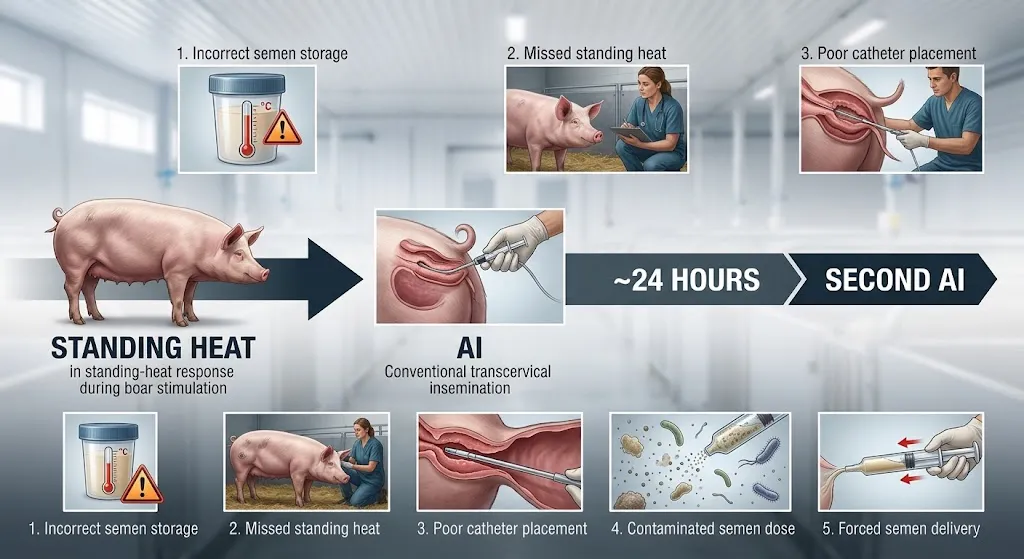
Most AI failures are procedural, not biological, and they cluster into five causes.
Semen was already dead. Temperature excursions in transit or storage, excessive age, vigorous shaking, or light exposure. This failure is invisible without a microscope, which is why the check is worth the minute it takes.
Timing missed the window. Inseminating before standing heat begins or after it ends. Heat detection performed once a day rather than twice, or without boar stimulus, misses females entirely.
Urine contaminated the dose. The bladder contact described above. Preventable by tip orientation and by leaving the bottle unattached during insertion.
The catheter was not seated. Semen deposited in the vagina rather than at the cervix flows straight back out.
The dose was forced. Squeezing rather than letting the female draw it in, producing backflow.
Note that four of the five are operator errors. That is the trade-off Missouri Extension flags—AI transfers the work of successful mating from the boar to the person holding the catheter.
Is Newer Technology Better?
Not automatically, and there is peer-reviewed evidence that reduced-dose approaches can cost more than they save.
A published trial compared conventional twice-bred sows against fixed-time AI variants. Sows bred twice with a conventional catheter and a standard dose of roughly three billion sperm achieved a farrowing rate of 81.6%. The group receiving fixed-time AI with an advanced catheter and a reduced dose of about one billion sperm achieved 62.7%, with smaller litters as well. The researchers concluded that the decrease in reproductive performance outweighed the value of using less semen.
Read those figures as the outcome of one trial under its own conditions, not as general success rates. The transferable lesson is the direction: sperm number provides a margin for error, and removing that margin means every other variable must be executed perfectly.
Post-cervical and deep uterine insemination deposit semen beyond the cervix, allowing smaller doses and faster inseminations. Fixed-time AI breeds on a schedule following hormonal synchronization rather than on detected heat. Both are established techniques with real advantages at scale—and both demand more precise semen evaluation and more training than conventional AI, because there is less reserve to absorb mistakes.
Biosecurity and Bought-In Semen
Purchased semen is an incoming biological product, and it deserves the same scrutiny as an incoming animal — less risk, but not zero.
Buy from studs that health-test their boars and publish their statuses. Ask what the collection-to-delivery interval is, since a dose that spends an extra day in transit arrives older than the label suggests. Confirm the shipping container maintained temperature rather than assuming it did.
Semen delivery is also a vehicle and a person arriving at your site on a schedule. Where those deliveries are received, and by whom, belongs inside your farm biosecurity measures rather than beside them.
Successful service is only the start of the cycle — what happens next depends on how sows are fed after service.
Frequently Asked Questions
Is it hard to artificially inseminate a pig?
The procedure itself is not difficult. University of Missouri Extension notes that the female pig’s reproductive system is more conducive to AI than that of cattle or sheep, making the process less time-consuming and easier to accomplish in swine—the cervix locks the catheter in place without special skill. What is genuinely difficult is everything around it: accurate heat detection, correct semen storage and handling, and consistent technique. Hands-on training raises success rates considerably more than reading about it does.
What are the downsides of artificial insemination?
The main one is that AI demands a higher level of management than natural service and carries a greater chance of human error. In natural mating, semen is not exposed to temperature swings, transport, or storage, and the boar deposits it repeatedly across the fertile window. With AI, all of that becomes the operator’s responsibility—semen handling, timing, and placement each introduce a failure point that natural service does not have.
How long does boar semen last?
Liquid-stored boar semen has a working life measured in days, not months, with motility and viability declining as time since collection increases. Storage temperature near 63°F, gentle twice-daily inversion, and protection from light and temperature swings all extend usable life. This is fundamentally different from cattle AI, where frozen semen is stored for years—boar semen is ordered against a breeding schedule rather than stockpiled.
Where can I buy AI pig sperm?
Boar semen is sold by commercial boar studs, which ship doses on a schedule against your breeding dates. Judge a supplier on the health status of its boars and whether that status is documented; the genetic merit of the lines offered; and—critically—the reliability and speed of delivery to your location. A stud with excellent genetics and a two-day shipping window may deliver a less useful dose than a closer one with adequate genetics.
At what age can a boar be used for AI?
Boars used in commercial studs are put into collection only after they are physically mature enough to produce adequate semen volume and quality consistently, which is later than the age at which they first become fertile. Using a boar too early tends to yield low-volume, low-quality collections and can affect his willingness to work long-term. For farms buying semen rather than collecting it, this is the stud’s responsibility rather than yours.
Do I need a boar on the farm if I use AI?
Not strictly, but boar contact improves results. Standing-heat detection is more reliable with a boar present, and the locked-up standing response triggers oxytocin release, producing the uterine contractions that move semen through the tract. Where no boar is available, boar spray applied to the female’s snout and manual back pressure are used as substitutes. Reduced fertility is commonly expected when inseminating without any boar stimulus.
Conclusion
Pig artificial insemination rewards preparation over technique. Treat semen as a perishable product with a shelf life of days, stored near 63°F rather than refrigerated, because a dead dose cannot be rescued by good placement. Detect heat with boar contact twice daily, since the timing window is narrower than the calendar suggests and the boar’s presence does double duty.
And keep the catheter tip up with the bottle unattached until it is seated—the two habits that prevent the single most avoidable failure in the whole procedure.
Mike Jennings
Explore More
Browse all of our pig breeding guides for more on reproduction, farrowing, and sow herd management in U.S. pig production.