How Much Space Do Pigs Need?
How much space do pigs need is the first question that has to be answered before a single board gets cut, because everything else—feeder placement, shelter size, how often you move them—follows from it. Most of the figures circulating online are not built for U.S. small farms: they come from British welfare codes, animal sanctuaries, or metric equipment catalogs. This guide sorts out what applies to you. If you are still deciding whether to keep pigs at all, start with our small-scale pig farming in the USA guide.
Quick Answer
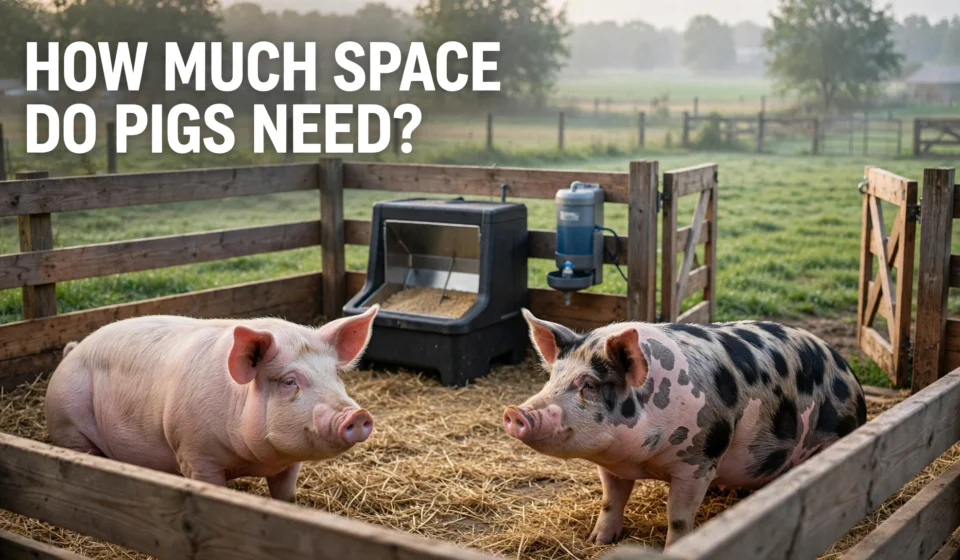
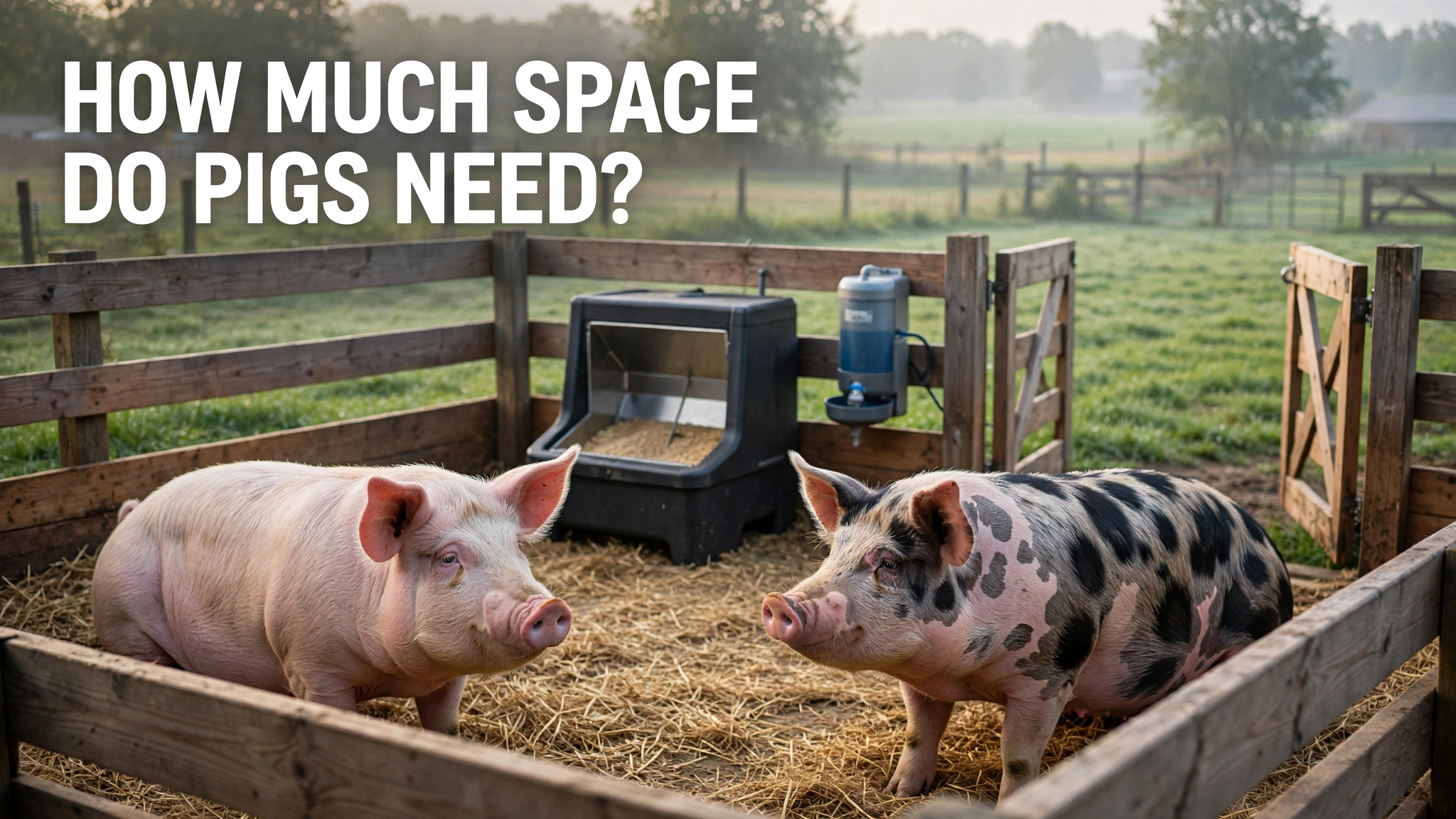
Penn State Extension puts indoor space for growing pigs at around 8 square feet per pig. Outdoors there is no single reliable figure—pasture capacity depends on soil, rotation, and your manure management plan, not on a fixed number of pigs per acre. The practical test is behavioral: every pig must be able to lie fully stretched out without being forced into contact with another.
Note: If you mean a pet or miniature pig, its space needs can differ substantially from the production-pig allowances in this guide. The figures below are intended for pigs raised on small U.S. farms.
Key Takeaways
- Around 8 square feet per growing pig indoors is the working figure from U.S. extension guidance.
- The lying test beats any table—if a pig cannot stretch out without touching a penmate, the pen is too small regardless of what the math says.
- “Half an acre per pig” is a sanctuary figure, not a production one, and most per-acre numbers online are British.
- Space is three separate questions—room to lie down, room to eat, and land that can absorb the manure.
- Pigs under 50 lbs need supplemental heat; pigs over 150 lbs need cooling above 70°F—temperature shapes shelter more than floor area does.
How Much Space Do Pigs Need Indoors?
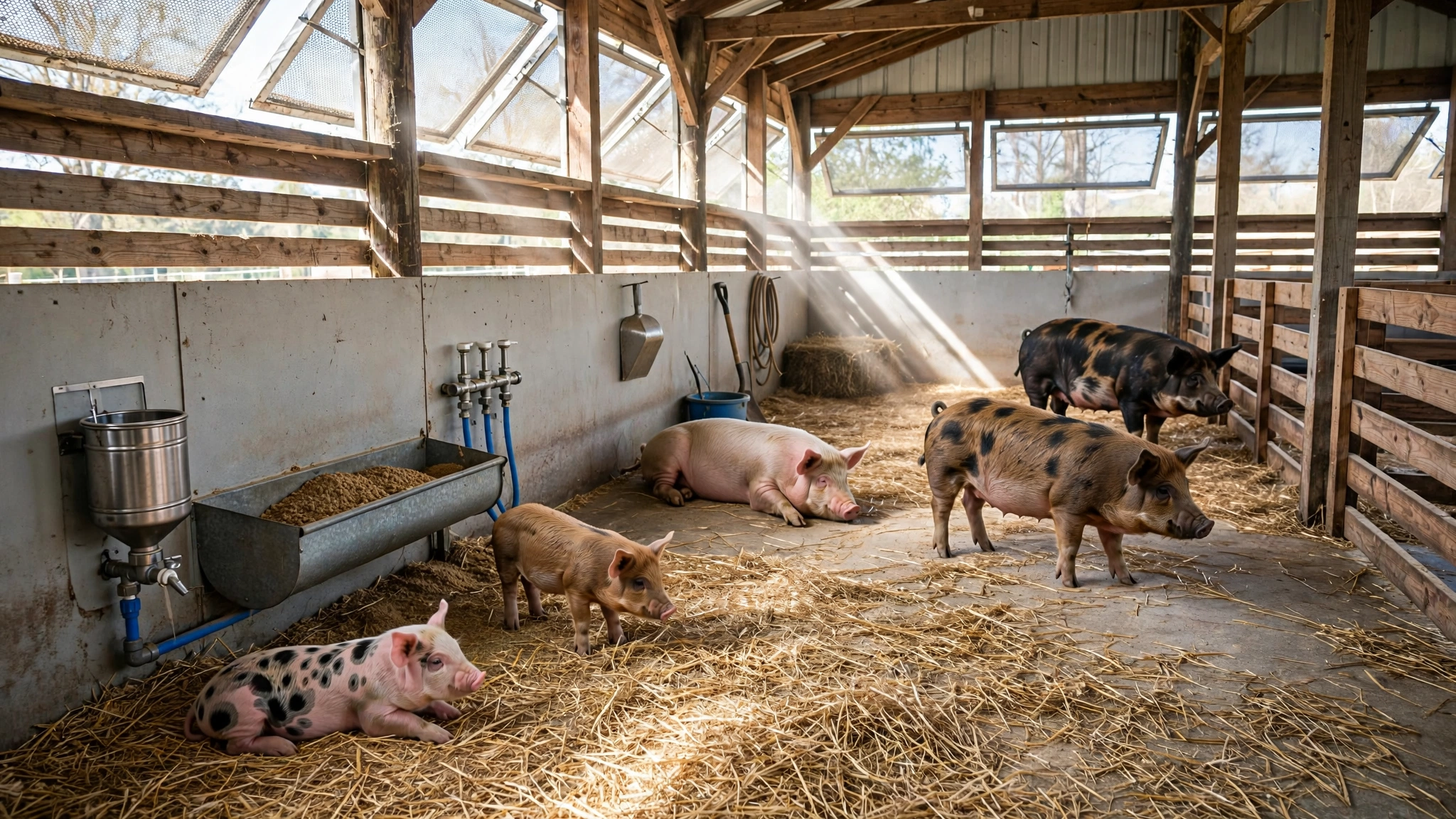
Around 8 square feet per pig is the figure Penn State Extension gives for growing pigs in indoor facilities, and it is the most useful single number for a small U.S. operation. Two feeder pigs raised to market weight need roughly 16 square feet of pen floor as a floor value before you add a feeder, waterer, and dunging area.
That number describes growing pigs. Younger pigs need less, and mature breeding animals need more, but the direction of the adjustment matters more than a precise figure—which is why the next section exists.
The Test That Beats Any Table
South Dakota State University Extension defines adequate space behaviorally rather than numerically: an animal should be able to lie fully down without having to be in contact with other animals, unless by choice. For a sow in an individual stall, the same source applies a second check—she should not have to rest her head on the feeder, and her rump should not touch the back of the stall while she is lying down.
This is more useful than it first appears. A stocking figure describes an average animal in an average pen. Your pigs are specific animals in a specific pen, and you can watch them.
Go out at night, when pigs sleep. If every pig is stretched out on its side with a clear floor between it and the next animal, you have enough room. If they are lying in a forced pile in warm weather, or if some are standing because there is nowhere to lie, the pen is short—whatever the square footage says.
Why Old Tables May Run Short
Published space recommendations are starting points, not specifications, and SDSU Extension warns that the figures in facility planning books may not account for modern genetics producing larger animals. A table written for a 240-pound market hog underestimates a barn full of pigs finishing at 280.
Two practical consequences. First, if you are working from an older reference, treat its number as a minimum and build in margin. Second, watch for crowding as pigs approach market weight—a pen that was comfortable at 120 lbs can be tight at 260 lbs, and the change happens gradually enough to miss.
Crowding is not only a welfare issue. Dense pens raise disease pressure and make sanitation harder, which is why pen sizing belongs in the same conversation as your biosecurity measures.
Space Is Three Questions, Not One
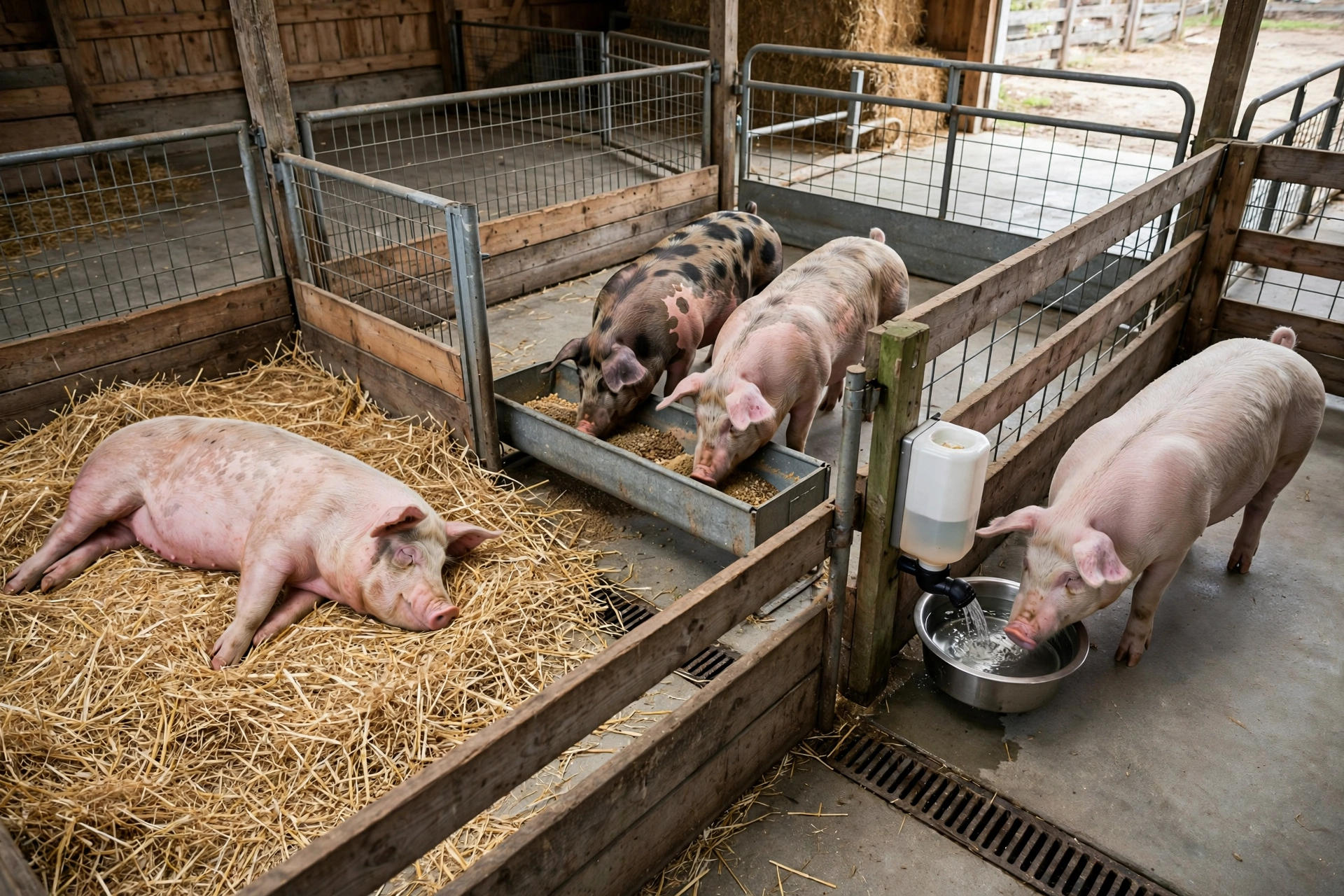
Most guides answer one question—floor area—when a pig pen actually has to satisfy three, and a pen can pass one test while failing another.
Lying Space
This is the number everyone quotes: total floor area per pig. It is necessary and it is not sufficient. A long narrow pen and a square pen of identical area behave differently because pigs lie along walls and need a continuous clear floor rather than scattered gaps.
Feeder and Waterer Space
Floor area says nothing about whether all your pigs can eat. Pigs feed socially and compete at the trough, and a pen with generous floor space but one feeder space produces the same outcome as an undersized pen: the smallest animals get pushed out, growth spreads apart, and you finish an uneven group.
Count feeder positions, not just square feet. The same logic applies to drinkers—restricted water depresses feed intake within hours, which is covered in our guide to pig water quality. How much each pig eats and drinks by weight is set out in our daily feed intake by weight benchmarks.
Land Capacity
Outdoors, the binding constraint is usually not the pigs—it is the ground. Pigs root, meaning they dig with the snout to turn soil, and they deposit manure in concentrated areas. Land that comfortably holds the animals may still be unable to absorb what they leave behind without turning to mud or leaching nutrients.
That is a nutrient question, not a square-footage question, and it is why outdoor stocking cannot be reduced to one number.
Outdoor and Pasture Space
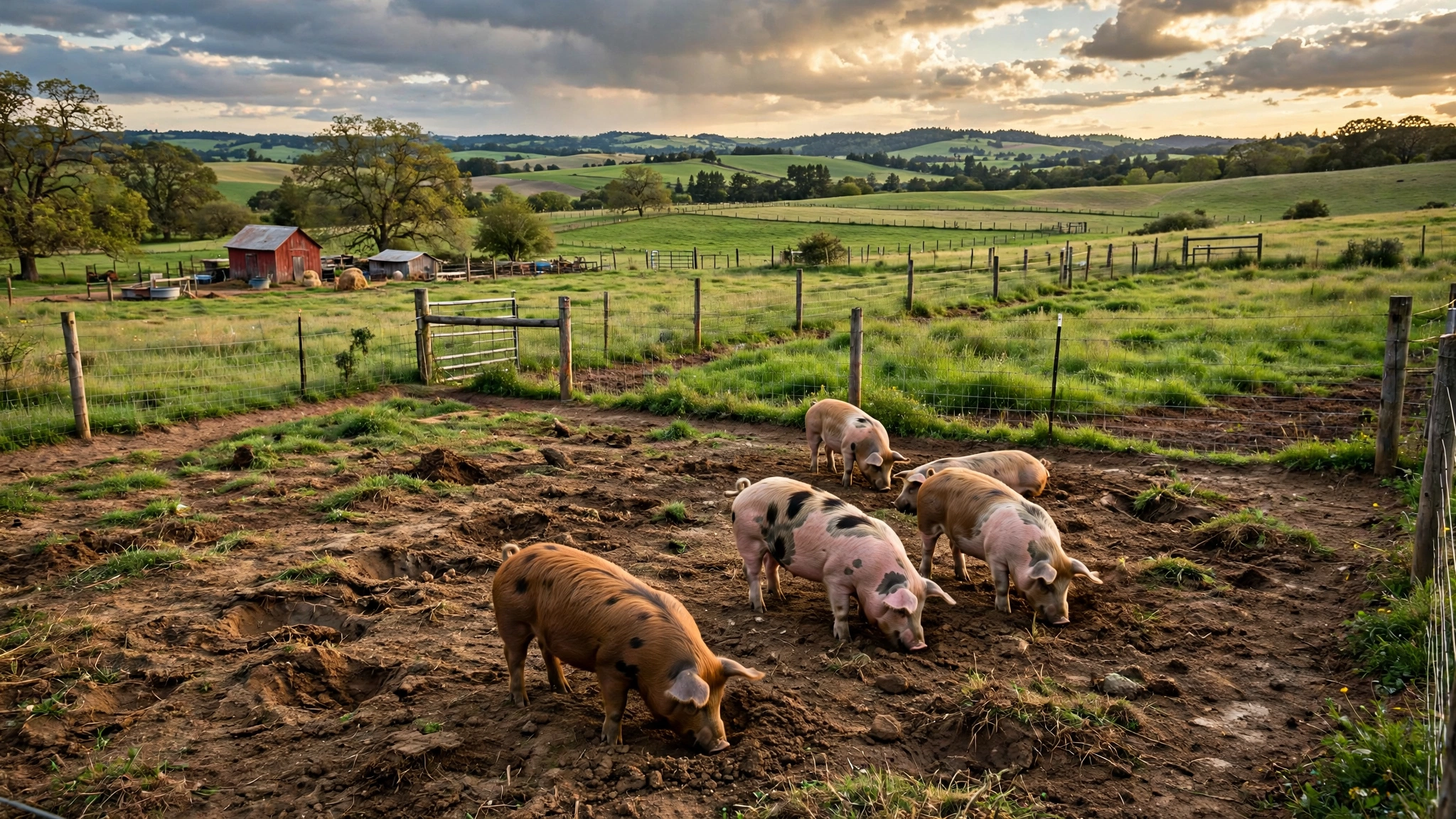
There is no reliable fixed figure for pigs per acre, and any source that gives you one without asking about your soil, rainfall, and rotation plan is guessing. Penn State’s guidance is explicit that outdoor space needs depend on nutrient management planning and pasture condition rather than on a fixed area per animal.
Why “Half an Acre Per Pig” Is Not Your Number
That figure circulates widely, and it comes from British sanctuary and rescue guidance—organizations housing rescued pigs for life, on land they are not trying to keep in forage production. It is a generous, welfare-maximizing allowance for permanent residents.
The other common figures have similar problems. Per-acre stocking rates published by hobby-farming magazines are often single-farm experiences rather than research. Metric allowances from European equipment suppliers reflect EU housing regulations. British welfare-code minimums reflect a different legal framework than the one you farm under.
None of these are wrong in their own context. They are simply answering a different question than the one a U.S. small-farm producer is asking.
Rooting and Rotation
What determines outdoor capacity in practice is how fast the pigs destroy the forage and how long you give it to recover. A small group on a large paddock, moved before the ground is bare, can be sustained indefinitely. The same group left in place will reduce that paddock to bare soil regardless of how many acres it started with.
Plan in paddocks and rest periods rather than in a single stocking number. Fencing that lets you subdivide and move is worth more than extra acreage you never rotate through.
Shelter Size and Temperature
Shelter is sized by what the pigs need to escape from, not by floor area—and for pigs, temperature is the binding constraint. Penn State notes that a three-sided shelter open on the fourth side is sufficient for pigs with access to pasture, with dimensions set by animal numbers, work access, and ventilation.
The temperature thresholds matter more than the dimensions. Pigs under 50 pounds need supplemental heat. Pigs over 150 pounds need help cooling once ambient temperature passes 70°F, because a finishing pig generates substantial body heat and cannot sweat effectively.
This changes what shelter means across the season. In winter, a smaller, well-bedded space that the pigs’ own body heat can warm beats a large drafty one. In summer, the same pigs need shade, airflow, and somewhere to wallow—and a tight shelter becomes a liability. If you are building rather than adapting, the construction side is covered in our pig housing and farm infrastructure guide.
Sizing Your Pen: A Worked Example
Two feeder pigs raised from roughly 40 lbs to market need about 16 square feet of lying area at the 8-square-foot benchmark—but that is where the calculation starts, not where it ends.
Work through it in order:
- Lying area. 2 pigs × 8 sq ft = 16 sq ft minimum.
- Add the dunging area. Pigs separate sleeping and toilet areas when given room to. Denying them that space is why small pens get filthy.
- Add feeder and waterer footprint, plus standing room in front of both so a pig can eat without blocking the other.
- Add margin for finishing size. Size forthe pig at 270 lbs, not the one you bring home at 40.
- Check it at night. Run the lying test once the pigs are in.
A pen in the range of a few hundred square feet gives two pigs room to eat, sleep, and dung in separate places with margin as they grow—which is why homestead setups usually land well above the bare 16 square feet the arithmetic suggests.
Whether you are raising two pigs a year or running a small breeding group changes the calculation entirely, and the systems are compared in farrow-to-finish vs wean-to-finish.
Frequently Asked Questions
How much space do I need per pig?
For growing pigs indoors, around 8 square feet per pig is the working figure from U.S. extension guidance. Add space beyond that for feeding, watering, and a separate dunging area, and size for the pig’s finishing weight rather than its arrival weight. Then verify by watching: every pig should be able to lie fully stretched out at night without being forced against a penmate.
How many acres do 10 pigs need?
There is no single correct answer, and figures given without qualification should be treated skeptically. Outdoor capacity depends on soil type, rainfall, forage species, how often you rotate paddocks, and your manure management plan. Ten pigs on well-rotated ground may need far less land than ten pigs left in one paddock, which will strip it bare whatever its size.
Can pigs survive on just grass?
No. Pigs are monogastric—single-stomached—and cannot ferment forage into usable energy the way cattle do. Pasture supplies enrichment, some nutrients, and rooting opportunity, but it cannot meet a growing pig’s energy and amino acid requirements. Pastured pigs still need a balanced ration; the pasture supplements the feed rather than replacing it.
How much room do piglets need?
Less floor area than growing pigs, but their binding constraint is warmth rather than space. Pigs under 50 pounds need supplemental heat, and a young pig in an oversized unheated pen struggles more than one in a snug, well-bedded space. Size a nursery area so piglets can lie together warm and still reach feed and water without competition.
Is one pig enough, or do I need two?
Pigs are social animals and are generally kept in pairs or groups rather than alone. Two pigs in one pen do not need double the floor area of one in every respect—they share the dunging area and lie together in cold weather—but they do need enough feeder positions that both can eat without one crowding the other out.
Conclusion
Three things settle how much space do pigs need on a small U.S. farm. Start from around 8 square feet per growing pig indoors, then add area for feeding, watering, and dunging rather than treating that number as the whole pen. Ignore per-acre figures that come from British welfare codes or animal sanctuaries—they answer a different question. And verify with your own eyes at night, because a pen that passes the lying test is adequate and one that fails it is not, whatever the arithmetic said.
Size for the pig you will sell, not the one you bring home. That single adjustment prevents most of the crowding problems small farms run into in the last month before market.
Explore More: Browse every article in Small-Scale and Backyard Pig Farming.