Vitamins and Minerals for Pigs: What They Need and Why It Matters
Introduction
Vitamins and minerals for pigs make up less than 2% of the diet, yet they determine how efficiently the other 98% is used. Deficiencies rarely announce themselves—they erode growth rate, feed conversion, and immunity for months before anything visible appears in the barn.
Getting micronutrients right is one of the least expensive corrections available in pig nutrition and feeding and one of the most consistently overlooked. The reason is structural: vitamin and mineral premixes are a small line item, so they are often the first place producers cut costs—without understanding what they are actually buying.
This guide covers what pigs require, how to recognize a shortfall, why source matters more than inclusion rate, and where the safety ceilings sit.
Quick Answer
Pigs require 13 essential minerals and 14 vitamins, supplied through a commercial vitamin-trace mineral premix included at roughly 0.25–0.50% of the complete diet. The nutrients most likely to limit performance in U.S. herds are iron (in nursing piglets), zinc, selenium with vitamin E, biotin, and the calcium-to-phosphorus balance. Requirement tables set minimums, not targets — commercial diets typically supplement above them because bioavailability, stress, and storage losses all reduce what the pig actually absorbs.
Why Vitamins and Minerals for Pigs Matter More Than Their Cost
Pigs require 36 essential nutrients plus water to meet needs for maintenance, growth, reproduction, and lactation. Vitamins and minerals differ from protein and energy in function: rather than supplying building blocks or fuel, they act as regulators, enabling enzyme reactions, hormone synthesis, and immune responses. ScienceDirect
That regulatory role is why a shortfall shows up as poor performance rather than an obvious clinical sign. A pig short on zinc still eats its ration; it just converts less of it into gain.
Understanding how the pig’s digestive system processes feed clarifies why absorption — not inclusion — is the number that matters. A mineral in the feed that is bound to phytate or antagonized by another element may as well not be there.
Actionable tip: Before adjusting inclusion rates, test your water. Sulfate and iron levels in well water directly change copper and zinc requirements, and this variable is the single most commonly missed input in on-farm premix decisions.
The Requirement vs. Recommendation Gap
This distinction causes more confusion than any other topic in swine micronutrition. Published requirement tables are deliberately conservative: the NRC tables intentionally provide best estimates of minimal requirements, specifically to prevent inadvertent oversupplementation. ScienceDirect
Commercial recommendations sit above those minimums because the conditions differ from the research conditions the requirements were derived under—modern genetics, disease pressure, heat stress, and processing losses all raise practical needs. The current reference remains the 2012 edition of Nutrient Requirements of Swine, with an update in progress for 2025. ScienceDirect
Essential Vitamins for Pigs
Fat-Soluble Vitamins (A, D, E, K)
These accumulate in body tissue, which means they can be stored and can also reach toxic levels through chronic oversupplementation.
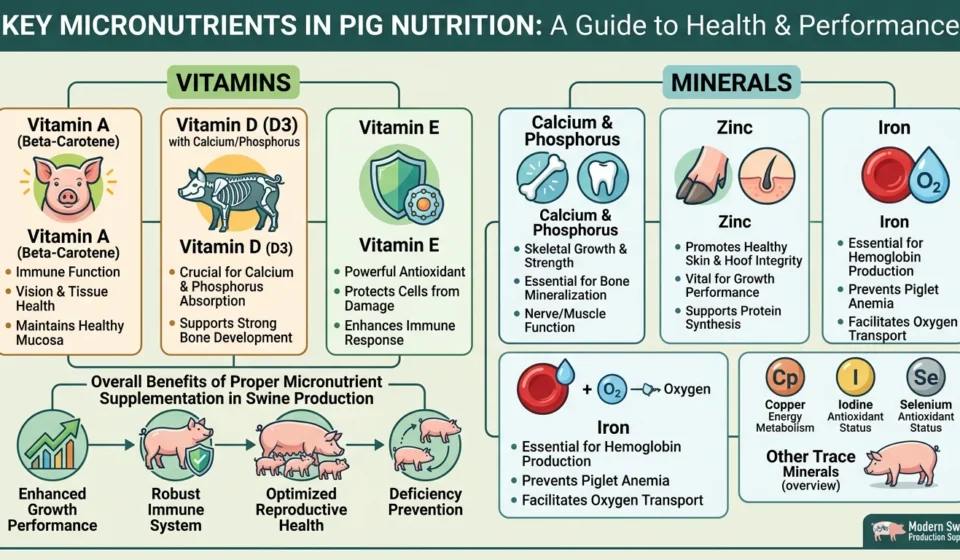
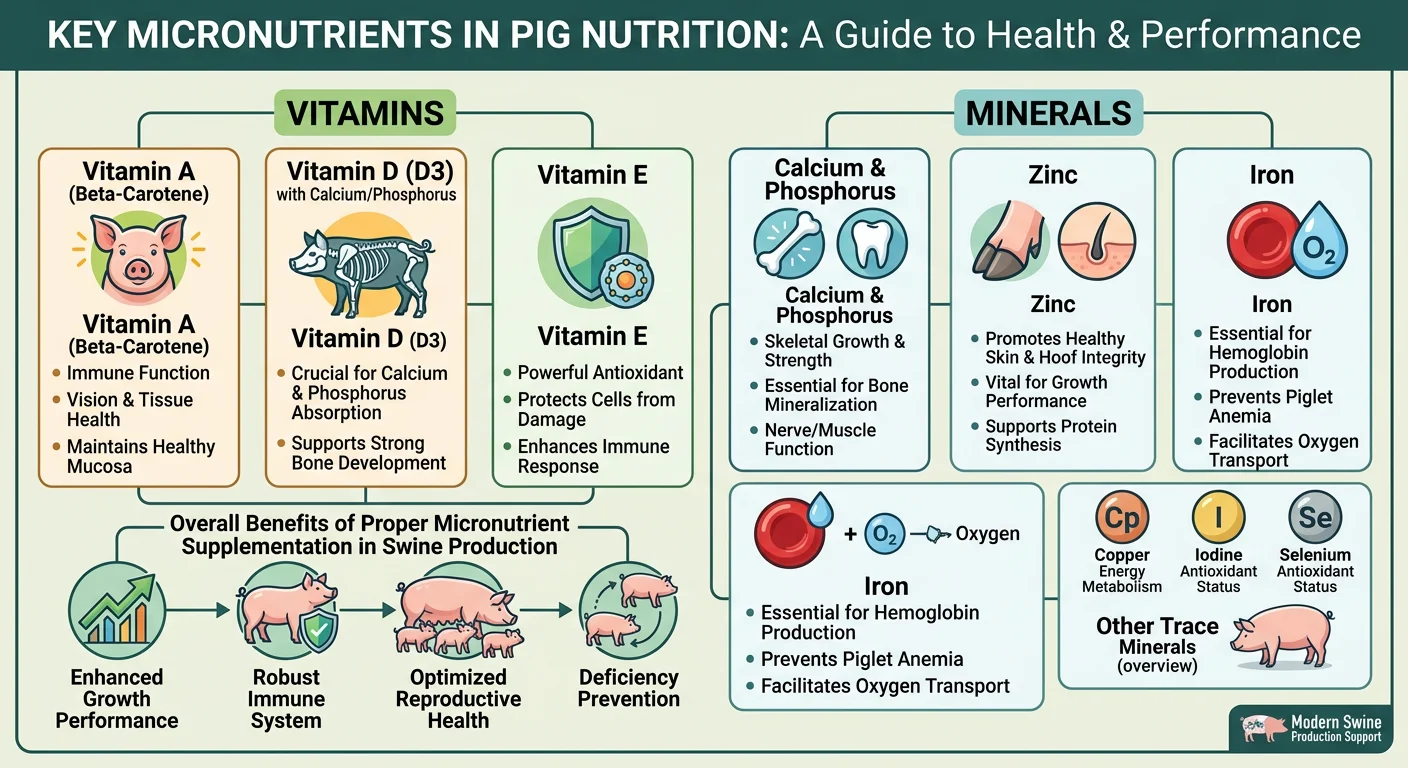
Vitamin A supports vision, reproduction, growth, and epithelial tissue integrity throughout the respiratory and digestive tracts. It occurs as carotenoid precursors in green plant material and yellow corn, with beta-carotene being the most active of the carotenes. Corn-soybean diets cannot meet requirements from precursors alone, so supplementation is universal. ScienceDirect
Vitamin D3 governs calcium and phosphorus absorption and bone mineralization. Pigs synthesize very little from sunlight due to thick skin and sparse hair, so dietary supply is essential even in outdoor systems — a point frequently misunderstood by pasture-based producers.
Vitamin E is the primary membrane antioxidant. It works in tandem with selenium; supplying one cannot compensate for a shortfall in the other. Higher levels are associated with improved immune response and reduced lipid oxidation in pork.
Vitamin K supports blood clotting. Pigs obtain some from gut bacteria, but antibiotics, coccidiostats, and mycotoxins impair that production — which is why most premixes include synthetic menadione as insurance.
Water-Soluble Vitamins (B-Complex and C)
These are not stored and must be supplied continuously. B vitamins are necessary for growth and lean accretion and play a central role in the metabolism of energy, carbohydrates, and fat. uspto
Riboflavin matters disproportionately in breeding stock, where marginal levels are associated with reduced farrowing rates. Biotin supports hoof integrity and is a recognized factor in sow lameness and longevity. Choline—technically not a vitamin—is essential for fat metabolism and liver function, and requirements interact with dietary methionine.
Vitamin C is synthesized by pigs, unlike humans. Supplementation is not routinely required, but heat stress and disease reduce endogenous synthesis, making short-term supplementation a defensible summer practice.
| Vitamin | Primary Function | Deficiency Risk |
|---|---|---|
| A | Immunity, epithelial tissue, reproduction | High corn-soy diets supply almost none |
| D3 | Ca/P absorption, bone | High — minimal skin synthesis |
| E | Antioxidant, immune function | Moderate — degrades in storage |
| K | Blood clotting | Low — unless antimicrobials in use |
| B-complex | Energy metabolism, lean growth | Moderate — higher in breeding stock |
| Biotin | Hoof integrity, sow longevity | Moderate — often under-fortified |
| Choline | Liver and fat metabolism | Low–moderate in corn-heavy diets |
| C | Antioxidant under stress | Low—pigs synthesize it |
Minerals Pigs Require
Pigs require at least 13 minerals, divided by the quantity needed rather than by importance.
Macro-Minerals
Calcium and phosphorus dominate — together they form the majority of the body’s mineral content. The ratio matters as much as the amounts: a Ca:P ratio outside roughly 1:1 to 2:1 reduces absorption of both.
Phosphorus deserves particular attention because phytate phosphorus in cereal grains is poorly available to pigs, which lack sufficient native phytase. Phytase enzyme supplementation liberates a substantial share of it, reducing reliance on inorganic phosphate supplements and cutting phosphorus excretion—a genuine case where nutrition and environmental compliance align.
Sodium and chloride regulate fluid balance and nerve transmission, typically supplied as 0.25–0.50% added salt. Overfeeding salt drives a sharp increase in water intake, which becomes an effluent management problem long before it becomes a health problem.
Corn-soybean diets generally supply adequate potassium, magnesium, and sulfur. Deficiencies appear mainly when alternative ingredients displace a large share of corn.
Trace Minerals
Iron is the highest-risk micronutrient in the entire production cycle. Piglets are born with minimal iron reserves, and sow milk supplies very little iron, so anemia develops within days without intervention. Injectable iron in the first days of life is standard practice and not optional.
Zinc supports immune function, protein synthesis, and skin integrity. Pharmacological zinc oxide has been widely used for post-weaning diarrhea control, but that use is under increasing regulatory pressure due to soil accumulation from manure, which is worth factoring into long-term planning.
Copper functions at low levels nutritionally but has been fed far higher for growth promotion. Maximum inclusion levels are tightening for environmental reasons.
Selenium works with vitamin E as the antioxidant system. It has the narrowest safety margin of any required nutrient in swine diets, with legal maximums close to the requirement itself.
Standard premixes usually provide adequate manganese and iodine.
Chromium and cobalt are the two most misunderstood. Chromium is required by pigs, but no quantitative requirement has been established; supplemental chromium at 200 ppb may improve carcass leanness in finishing pigs and reproductive performance in gestating sows. Cobalt is present in the vitamin B12 molecule and has no benefit when added to swine diets in elemental form. ScienceDirect
Actionable tip: If your premix lists elemental cobalt as a selling point, that is marketing, not nutrition. Check that B12 itself is fortified instead.
Bioavailability: Why the Source Matters
Two premixes listing identical zinc levels can deliver very different amounts of absorbed zinc. Organic (chelated) trace minerals—complexed with amino acids or proteins—are absorbed more efficiently than inorganic sulfates and oxides, which allows lower inclusion at equal or better status and reduces excretion.
Antagonisms compound the problem. High calcium suppresses zinc and iron absorption. Excess iron interferes with copper and zinc. High sulfate in drinking water reduces copper availability, which means a diet formulated correctly on paper can still produce copper-deficient pigs.
This scenario is where reading a feed tag stops being useful and understanding feed formulation becomes necessary. Our comparison of ready-made versus custom pig feed covers the decision between a commercial premix and a custom program in more depth.
Recognizing Deficiency
Subclinical deficiency — reduced performance without visible symptoms — is far more common and more expensive than the textbook clinical presentations.
| Nutrient | Clinical Sign | Where It Shows First |
|---|---|---|
| Iron | Pale skin and mucous membranes, labored breathing | Nursing piglets, days 7–14 |
| Zinc | Parakeratosis — thick, scaly skin lesions | Growing pigs, lower limbs first |
| Selenium / Vit. E | White muscle disease, sudden death, stiffness | Young pigs |
| Biotin | Heel cracks, sole erosion, lameness | Sows |
| Vitamin A | Night blindness, respiratory infections, rough coat | Nursery pigs |
| Ca / P / Vit. D | Bent legs, enlarged joints, fractures | Growing pigs on unbalanced diets |
| Salt | Pica, rough coat, poor feed efficiency | Any stage |
Zinc parakeratosis is worth flagging specifically: it closely resembles severe mange but does not respond to antiparasitic treatment. Producers routinely treat it as a parasite problem for weeks before testing mineral status.
Confirming a suspected deficiency requires tissue analysis rather than visual assessment. Liver samples reflect long-term trace mineral status; blood reflects current status. Both interact with overall herd condition, which is why micronutrient work belongs inside a broader pig health and disease management program rather than being treated as a standalone feed question.
Building a Supplementation Program
Start with a commercial premix. For most operations, formulating individual vitamin and mineral ingredients on-farm is neither economical nor reliable, because minimum purchase quantities, limited shelf life, and precise weighing requirements make it impractical for operations with fewer than about 500 sows.
Match the premix to your conditions. Water mineral content, production system, genetic line, and ingredient base all affect the premix requirements. A generic premix formulated for a corn-soy diet performs differently on a DDGS-heavy diet.
Respect shelf life. Heat-labile vitamins degrade meaningfully during pelleting and continue degrading in storage. Store premixes cool, dark, and dry; mark purchase dates; and rotate oldest-first. Quality premixes include an overage specifically to offset these losses—economy premixes typically do not, which is a large part of why they cost less.
Adjust for stress periods. Weaning, breeding, farrowing, and extreme heat all increase antioxidant demand. This period overlaps directly with nutritional strategies for pig immunity, where vitamin E, selenium, and zinc do most of the work.
Toxicity and Safe Upper Limits
Deficiency reduces performance; toxicity kills pigs. The fat-soluble vitamins and several trace minerals accumulate, and the margin between adequate and excessive is not uniform.
- Selenium has the narrowest margin of any required nutrient. Legal maximums sit close to requirements. Triple-verify premix formulas and mixer sequences.
- Vitamin D — chronic excess causes soft-tissue calcification and kidney failure. Feed mill errors here are catastrophic rather than gradual.
- Vitamin A — chronic excess causes bone fragility, reduced intake, and birth defects in sows.
- Copper — accumulates in the liver; environmental limits are tightening independently of animal health.
- Zinc — sustained high levels induce copper deficiency even when copper is adequately supplied.
- Iodine—excess suppresses thyroid function. Test water in coastal or iodine-rich regions.
- Salt — acute toxicity is a real risk when water access is interrupted after high-salt feed.
Actionable tip: For most nutrients, supplementing 2–5× the published requirement provides insurance without approaching toxicity. Selenium is the exception—a supplement to the legal maximum and no further.
Frequently Asked Questions
sulfur.What vitamins and minerals do pigs need?
Pigs need 14 vitamins (A, D, E, K, the B-complex group, choline, and C) and at least 13 minerals. The macro-minerals are calcium, phosphorus, sodium, chloride, potassium, magnesium, and sulphur. The trace minerals are iron, zinc, copper, manganese, selenium, iodine, and chromium. All are supplied through a vitamin-trace mineral premix included at 0.25–0.50% of the complete diet.
What nutrient do pigs need the most?
By weight, the most important nutrient is water, followed by energy and protein. Among micronutrients, calcium and phosphorus are required in the largest quantities, making up the majority of the body’s total mineral content. However, the nutrient most likely to limit performance in nursing piglets is iron, because sow milk supplies almost none and reserves at birth are minimal.
What are the essential nutrients that pigs require?
Pigs require 36 essential nutrients plus water. These fall into six categories: water, energy, amino acids, fatty acids, minerals, and vitamins. “Essential” means the pig cannot synthesize them in adequate amounts and must obtain them from the diet.
What vitamins are important for hogs?
Vitamins A, D3, and E are the most critical in commercial diets. Vitamin A supports immunity and epithelial tissue, D3 governs bone mineralization, and E provides antioxidant protection alongside selenium. Biotin is relevant specifically for sows through hoof health and longevity. B-complex vitamins support energy metabolism and lean growth in high-performance genetics.
What are some effective mineral supplements for pigs?
For commercial operations, a complete vitamin-trace mineral premix from an established supplier is the practical choice—it delivers balanced ratios with appropriate overages. Organic (chelated) trace minerals offer better absorption than inorganic sulfates and oxides at a higher price per pound, making them most cost-effective in sow and nursery diets where the return is highest.
Do pigs need mineral blocks?
Mineral blocks are not a substitute for a formulated premix in commercial production. Intake is unpredictable and blocks often supply an incomplete trace mineral spectrum. They are useful in extensive outdoor systems only as a supplement to, not a replacement for, a balanced ration.
Conclusion
Micronutrient management is one of the highest-leverage, lowest-cost decisions in pig production. Three points carry most of the value: bioavailability matters more than the number on the tag, subclinical deficiency costs more than clinical deficiency because it goes undetected, and selenium is the one nutrient where “a little more for safety” is genuinely dangerous.
Test your water before formulating; verify premix age before feeding; and confirm status through tissue analysis rather than assumption.
— Rebecca Hayes, Swine Nutrition Specialist
Explore More
Browse all guides in our Pig Nutrition and Feeding category.