Pig Parasite Management: What the Label Covers and What It Doesn’t
Pig parasite management combines recognizing the signs, confirming what you are actually dealing with, and knowing what an approved product label does and does not cover before you treat. Parasite problems can persist with little obvious illness, particularly when you discover lesions or production effects only later. This guide sits within our wider resource on pig health and disease management.
Quick Answer
The dose and withdrawal figures in this article apply only to the specific U.S.-labeled injectable ivermectin product cited here. Other ivermectin products and concentrations are not interchangeable. With that boundary set, effective pig parasite management means identifying the parasite through clinical signs, fecal testing, and slaughter findings; then checking whether an approved product label actually covers it—and involving a veterinarian when it does not.
Key Takeaways
- Clinical signs suggest a parasite problem but do not identify the parasite.
- Ascaris suum larval migration causes liver lesions that lead to condemnation at slaughter, with no clinical signs in the live pig.
- The cited injectable ivermectin label specifies 300 mcg per kg of body weight, given by subcutaneous injection in the neck of swine.
- That label specifies an 18-day slaughter withdrawal. This period is separate from pre-farrowing treatment timing.
- Trichuris suis is not listed on the cited label.
What Pig Parasite Management Involves
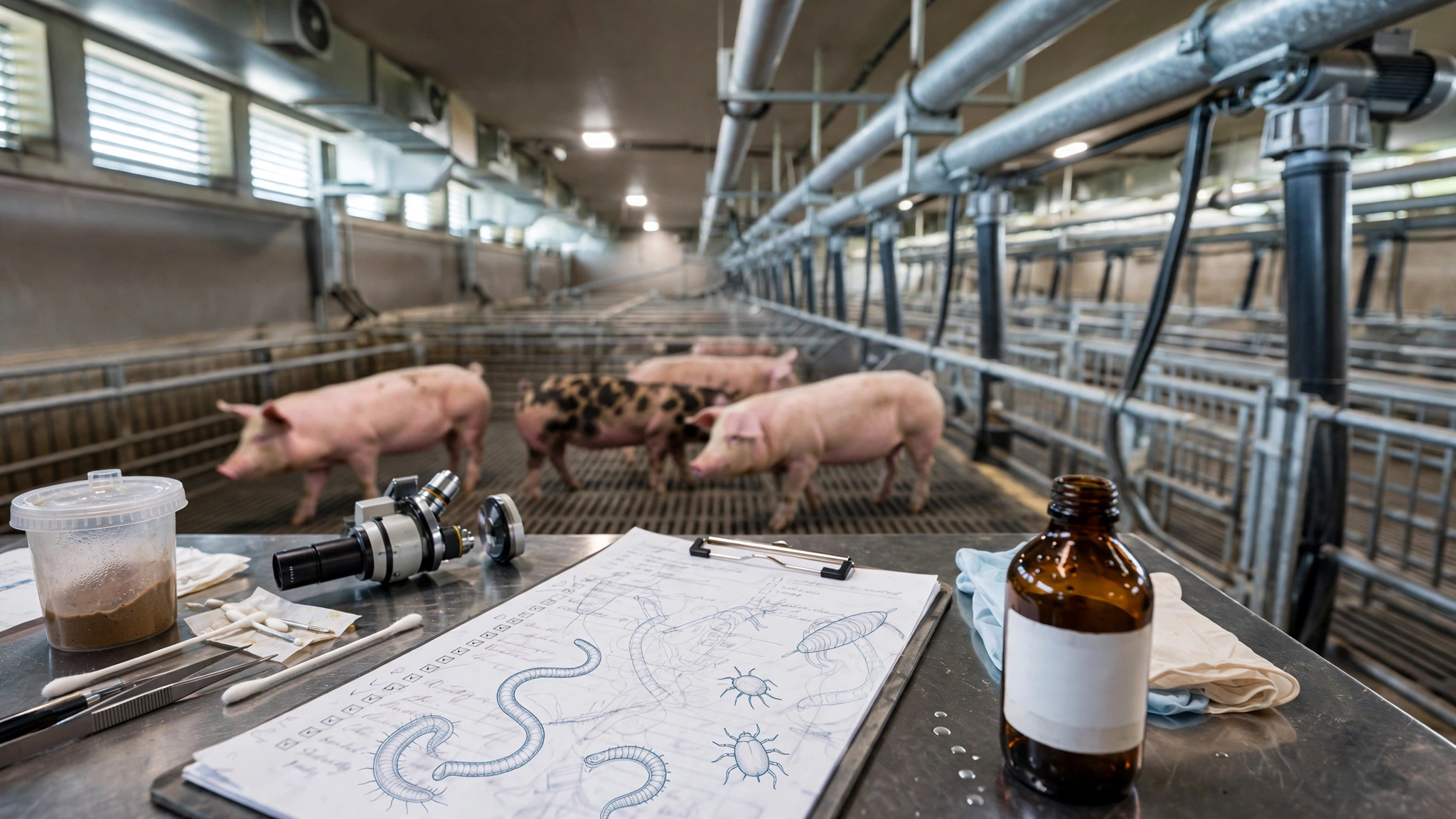
Pig parasite management is a cycle of four steps: observe, diagnose, treat within label limits, and interrupt reinfection. Skipping straight from a sign to a syringe is where most programs go wrong, because the same sign points to several different parasites and to several conditions that are not parasites at all.
The parasites that matter in U.S. production fall into three groups. Gastrointestinal nematodes (roundworm-type worms living in the digestive tract) include Ascaris suum, Oesophagostomum species, and Trichuris suis. Lungworms occupy the airways. External parasites — mange mites and lice — live on the skin. Each group has different signs, different diagnostics, and different label coverage.
Reinfection is the part producers underestimate. Treating pigs without addressing the environment they return to produces a short improvement followed by the same problem, which is why parasite work belongs alongside farm biosecurity measures rather than separate from them.
How to Tell If Your Pigs Have Parasites
Signs can suggest a parasite problem, but they do not identify the parasite by themselves. This is the single most important idea in parasite work, and it is why diagnosis comes before any discussion of products.
What You See in the Barn
Chronic coughing, unthriftiness, and failure to gain weight are recognized clinical signs of ascariasis, the infection of pigs with the swine roundworm. Notice what those three have in common: none is specific. Poor growth and coughing can equally reflect respiratory disease, so parasite control should be considered alongside the herd’s vaccination and health program, not as a substitute for it.
External signs are somewhat more suggestive. Persistent rubbing and scratching, crusted skin — particularly around the ears — and visible insects or eggs cemented to hair shafts all point toward mites or lice. Even here, confirmation matters, because skin conditions have non-parasitic causes.
Fecal Testing and Its Timing

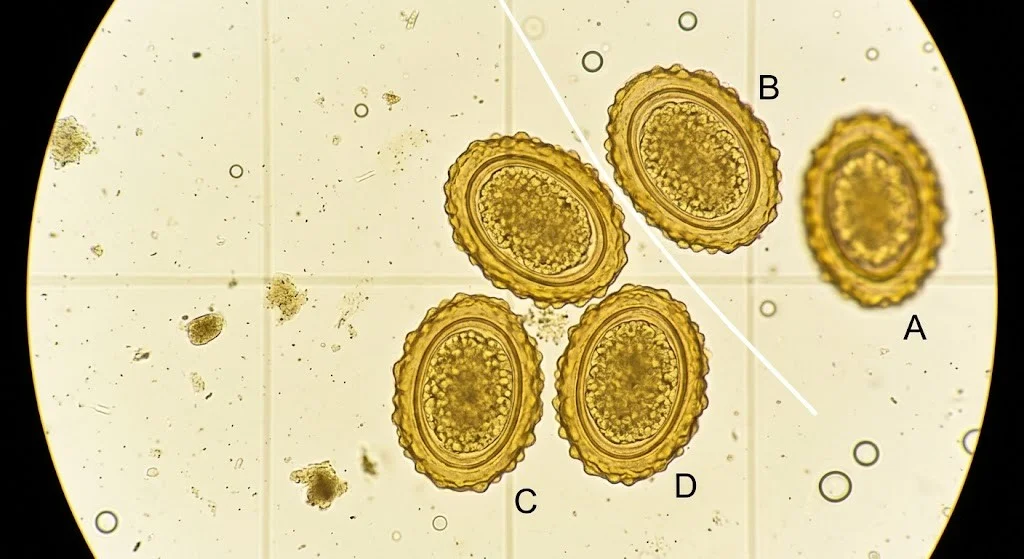
Infections can be detected by fecal flotation during the patent period—the stage when adult parasites are producing eggs that appear in manure. The practical consequence is one every producer should understand:
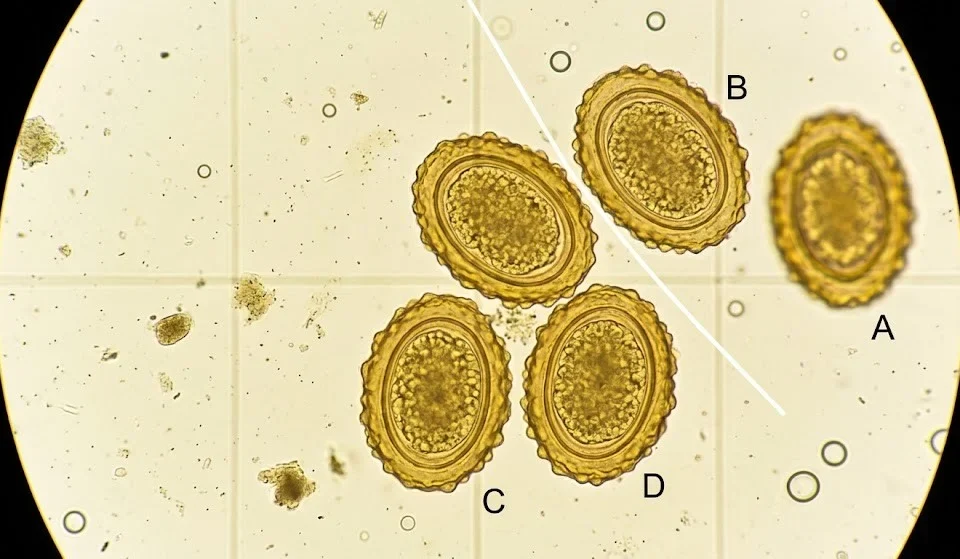
A negative fecal flotation does not necessarily rule out early infection, because egg shedding depends on the parasite’s stage of development and whether it has begun reproducing. Detection of prepatent infections — those that have not yet reached egg production — requires postmortem examination rather than fecal testing.
This is not a reason to distrust fecal flotation. It is a reason to interpret a negative result as “no eggs detected today” rather than “no parasites present.”
What Slaughter Findings Tell You
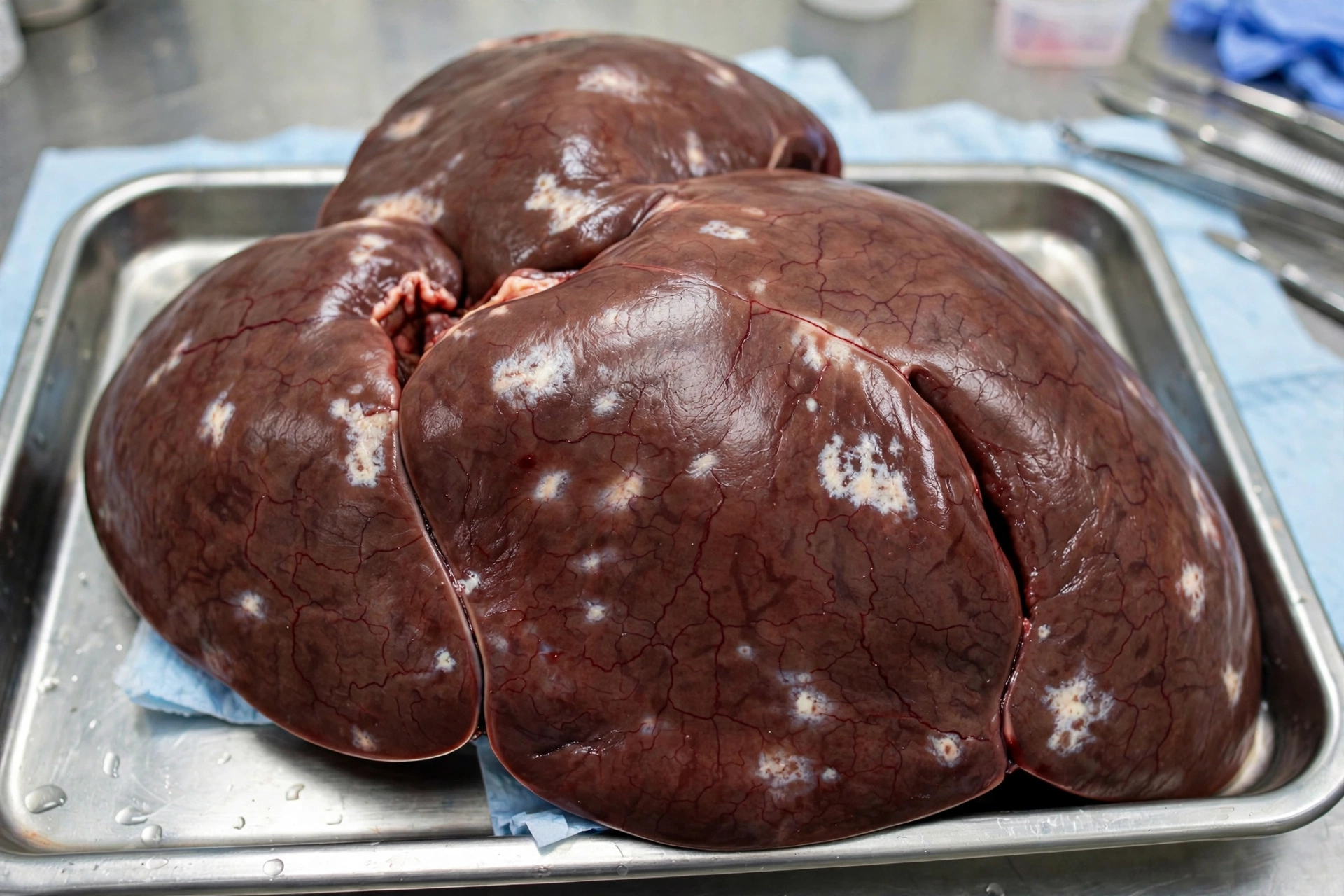
Liver findings at slaughter provide evidence that fecal testing cannot. Larval migration of Ascaris suum through the liver produces focal hepatitis — the lesions known as milk spots — and results in condemnation of the liver at slaughter.
Read those lesions carefully. Milk spots are scarring from larval migration, and their presence at slaughter indicates that migration occurred at some point. They are not a test for a currently active infection. A group showing liver lesions indicates that recent infection or reinfection occurred; it does not establish that the pigs were carrying adult worms on the day they were marketed.
Can You Deworm Pigs With Ivermectin?
Yes, for the parasites listed on an approved product label—and the label, not the active ingredient, is what defines the answer. This distinction is the practical core of parasite treatment, because ivermectin is sold in multiple formulations at different concentrations for different species.
What the U.S. Label Says for the Injectable Product Cited Here
The U.S. label published on DailyMed for the injectable ivermectin product specifies the following for swine:
| Label element | What this label states |
|---|---|
| Concentration | 1% (10 mg ivermectin per mL) |
| Dose level | 300 mcg ivermectin per kilogram of body weight |
| Route | Subcutaneous injection only |
| Injection site | In the neck of swine |
| Slaughter withdrawal | 18 days |
| Sow timing | Treat at least 7 days before farrowing to prevent infection in piglets |
Every figure in that table belongs to that product’s label. A different ivermectin product, a different concentration, or a formulation labeled for another species is a different document with different numbers. Read the label in your hand.
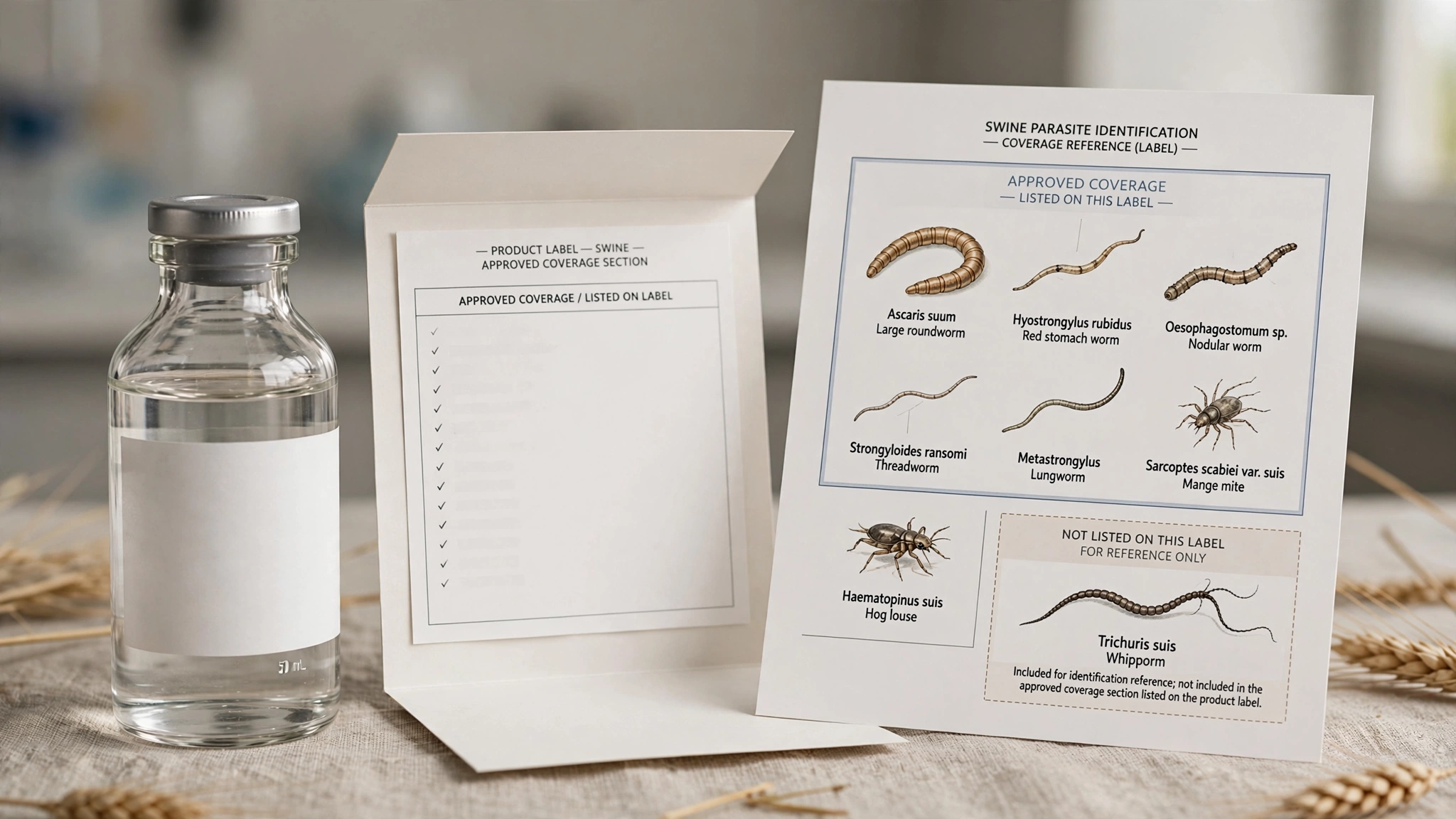
Parasites Listed on This Label
| Parasite | What the cited label states |
|---|---|
| Ascaris suum—large roundworm | Listed (adults and fourth-stage larvae) |
| Hyostrongylus rubidus — red stomach worm | Listed (adults and fourth-stage larvae) |
| Oesophagostomum spp.—nodular worm | Listed (adults and fourth-stage larvae) |
| Strongyloides ransomi—threadworm | Listed (adults and somatic larvae) |
| Metastrongylus spp. — lungworm | Listed (adults) |
| Haematopinus suis—hog louse | Listed |
| Sarcoptes scabiei var. suis—mange mite | Listed |
| Trichuris suis—whipworm | Not listed on this label |
What “Not Listed” Means
Trichuris suis is not among the parasites named on the label cited here. That is a statement about label coverage, not a measured claim about the drug’s biological activity.
The distinction matters in both directions. It would be wrong to tell a producer the product is proven ineffective against whipworm because the label makes no such claim either way. Treating a whipworm problem with a product whose label does not name whipworms, and expecting the outcome promised for named parasites, is equally wrong. If whipworm is the suspected or confirmed problem, that decision belongs with a veterinarian.
Ivermectin Withdrawal Time Before Slaughter
The cited U.S. label specifies an 18-day slaughter withdrawal period for swine. Follow the withdrawal period specified on the label of the specific product you are using.
That number is a property of a specific labeled product, not of ivermectin as a substance. Other products, other concentrations, and other routes of administration have their own withdrawal periods, as stated on their own labels.
Withdrawal Is Not the Same as Pre-Farrowing Timing
People routinely confuse two separate figures on the same label, and this confusion causes real harm.
Slaughter withdrawal — 18 days. A food-safety interval. It governs when a treated pig may enter the food supply.
Pre-farrowing timing — at least 7 days. An efficacy instruction. The label directs that sows be treated at least 7 days before farrowing to prevent infection in piglets. The label’s pre-farrowing instruction specifies the timing of treatment to help prevent infection in piglets, rather than indicating a food-safety withdrawal period.
These figures are not mutually exclusive. A sow treated 7 days before farrowing has satisfied the label’s timing instruction for protecting her litter; she has not satisfied any slaughter withdrawal. If a cull sow is treated and later marketed, the label’s withdrawal period applies to her exactly as it applies to a market hog.
Any statement of the form “18 days, or 7 days for breeding stock” is wrong. The two numbers answer different questions.
One of the Most Common Parasites in Pigs: Ascaris suum
The large roundworm of pigs, Ascaris suum, is the most common and widespread parasite of swine, occurring worldwide wherever pigs are raised. Its economic weight comes from three separate injuries rather than one.
Migration through the liver causes lesions that condemn the livers. Migration through the lungs causes pulmonary damage that can lead to pneumonia, particularly in pigs simultaneously infected with other viral or bacterial pathogens—meaning the roundworm’s real cost is often recorded as a respiratory problem. In the small intestine, heavy infections can interfere with nutrient utilization and contribute to poorer feed conversion and slower growth.
Age matters. Infection usually stimulates immunity, so older animals carry fewer worms and shed fewer eggs than younger ones. That is why the youngest pigs on a site carry the heaviest burdens while the market hogs look fine.
Control requires more than a product. Many anthelmintics — drugs that kill parasitic worms — are available for the intestinal stages, but control programs must also include strict sanitation, according to the Merck Veterinary Manual’s entry on Ascaris suum.
Pig Lungworms: What the Ivermectin Label Covers
Metastrongylus species—lungworms—are named on the cited label for adult stages, which places them within its approved spectrum. Lungworms are absent from most general parasite guides, even though they appear on the label of one of the most commonly used swine parasiticides.
Lungworms live in the airways rather than the digestive tract, and their transmission runs through earthworms as intermediate hosts. That single fact determines who has a lungworm problem: pigs with access to soil and pasture encounter earthworms, and pigs on slatted floors in enclosed barns generally do not.
The clinical picture overlaps heavily with everything else that makes a pig cough, which is why lungworm rarely gets named. If pigs with outdoor or dirt-lot access are coughing and roundworm control appears adequate, lungworm is worth raising with your veterinarian rather than assuming a respiratory infection.
When Ivermectin Is Not the Answer
A labeled product stops being the answer at the edge of its label—when the parasite is not named on it, when treatment fails, or when the situation calls for something the label does not describe.
Three situations recur:
- A parasite outside the label. Trichuris suis is the clearest example of the product cited here.
- Coccidiosis in nursing piglets. Isospora suis is a protozoan — a single-celled organism, biologically unlike worms — and anthelmintics do not address it. Persistent yellow, pasty scours in piglets under three weeks warrant veterinary diagnosis, not a dewormer.
- Treatment that did not work. Persistent signs after treatment can reflect misdiagnosis, dosing or administration error, reinfection from the environment, or reduced drug efficacy. Each has a different fix, and telling them apart requires diagnostics.
Extra-Label Use Is a Veterinary Decision
Using an approved drug in any way its label does not describe—a different dose, a different species, a different parasite, or a different route—is extra-label use, and in the United States it is lawful only under the direction of a veterinarian within a valid veterinarian-client-patient relationship (VCPR), the professional relationship in which a veterinarian has examined your animals and taken responsibility for treatment decisions.
Practically speaking, adjusting a dose based on a forum post recommendation is not a valid treatment strategy. It is an unapproved use with an unknown withdrawal period, and residue violations attach to the person who sold the pig.
Natural Dewormers: What the Evidence Supports
Published evidence does not support diatomaceous earth, garlic, or herbal preparations as substitutes for approved anthelmintics in swine. This article does not provide doses or protocols for them, because recommending an unproven alternative for a confirmed parasite problem delays effective treatment while the burden builds.
Breaking the Parasite Cycle With Management and Timing
Sanitation and timing determine whether treatment holds, because pigs that return to a contaminated environment become reinfected. Control programs must incorporate strict sanitation alongside any anthelmintic use.
Four practices are most important:
- All-in/all-out flow with cleaning between groups. Complete depopulation allows the physical removal of organic matter that harbors parasite eggs. Roundworm eggs are notoriously resistant to disinfectants, so the mechanism here is removal, not chemistry.
- Treating the source before it contaminates. The label’s instruction to treat sows at least 7 days before farrowing exists because the farrowing environment is where the youngest, least immune pigs meet their first parasite exposure.
- Manure and slurry handling. Eggs accumulate wherever manure accumulates. Applying slurry to ground pigs does not access or break the route back.
- Outdoor and pasture management. Soil-based systems face reinfection pressure that confinement does not, and lungworm’s earthworm intermediate host exists only there. Rotation and lower stocking density reduce exposure; they do not eliminate it.
Small herds are not exempt from any of these pressures. Where flow is continuous and pigs of different ages mix, the reinfection cycle runs faster than in commercial all-in/all-out flow—a structural disadvantage worth understanding if you are running small-scale pig farming.
Frequently Asked Questions
How can I treat pig parasites?
Treatment starts with identifying the parasite through clinical signs, fecal testing, and slaughter findings, then selecting a product whose label names that parasite and the class of pig being treated. Follow the label’s dose, route, injection site, and withdrawal period exactly as written for that product. Pair treatment with sanitation and all-in/all-out flow since pigs returned to a contaminated environment become reinfected. When the parasite is not named on any available label, consult a veterinarian.
Can you deworm pigs with ivermectin?
Yes, it is effective against the parasites listed on an approved product label. The injectable product mentioned in this article lists Ascaris suum, Hyostrongylus rubidus, Oesophagostomum species, Strongyloides ransomi, Metastrongylus species, hog lice, and mange mites. Trichuris suis is not listed on that label. Because ivermectin is sold in several formulations and concentrations for different species, the label on the specific product you hold governs—not general statements about ivermectin.
How much ivermectin can I give a pig?
The injectable ivermectin product covered by the U.S. label cited in this article specifies 300 mcg of ivermectin per kilogram of body weight, given only by subcutaneous injection in the neck of swine, at a concentration of 1%—10 mg per mL. That figure belongs to that product’s label and is not transferable to other ivermectin products or concentrations. Do not convert that labeled dose into a volume for another ivermectin product unless its label provides the corresponding directions. Weigh pigs rather than estimating, and read the label on the bottle in your hand.
What is the most effective dewormer for pigs?
There is no single best dewormer for every pig parasite. The appropriate product depends on which parasite is identified or suspected, whether that parasite is named on the product’s label, whether the label covers the class of pig being treated, and whether the intended use is on-label or requires veterinary direction. A product that is excellent for roundworms may not name whipworms at all. Diagnosis determines the product; the product does not determine the diagnosis.
What is the most common parasite in pigs?
Ascaris suum, the large roundworm of pigs, is the most common and widespread parasite of swine, occurring worldwide wherever pigs are raised. Its larvae migrate through the liver and lungs before the adults settle in the small intestine, which is why one parasite produces liver condemnation, lung damage, and poorer feed conversion simultaneously. Infection generally stimulates immunity, so younger pigs carry heavier burdens and shed more eggs than older animals.
How long does ivermectin take to clear parasites?
The withdrawal period is not a measure of how quickly parasites or clinical signs disappear. Withdrawal is a food-safety interval governing when a treated pig may be slaughtered—18 days on the label cited here. Biological response is a separate question that depends on the parasite, its life stage at treatment, and whether pigs are being reinfected from the environment. Signs caused by tissue damage, such as lung lesions, resolve on the timeline of healing rather than of drug action.
Conclusion
Sound pig parasite management rests on three habits. Diagnose before you treat, because coughing and poor growth point to several parasites and to conditions that are not parasites at all. Read the label on the specific product in your hand, since dose, route, injection site, and withdrawal belong to that product rather than to the active ingredient. And treat the environment as seriously as the pig, because sanitation and all-in/all-out flow determine whether any treatment holds.
Mike Jennings
Explore More
Browse all of our pig health guides for more on disease prevention, biosecurity, and herd health.